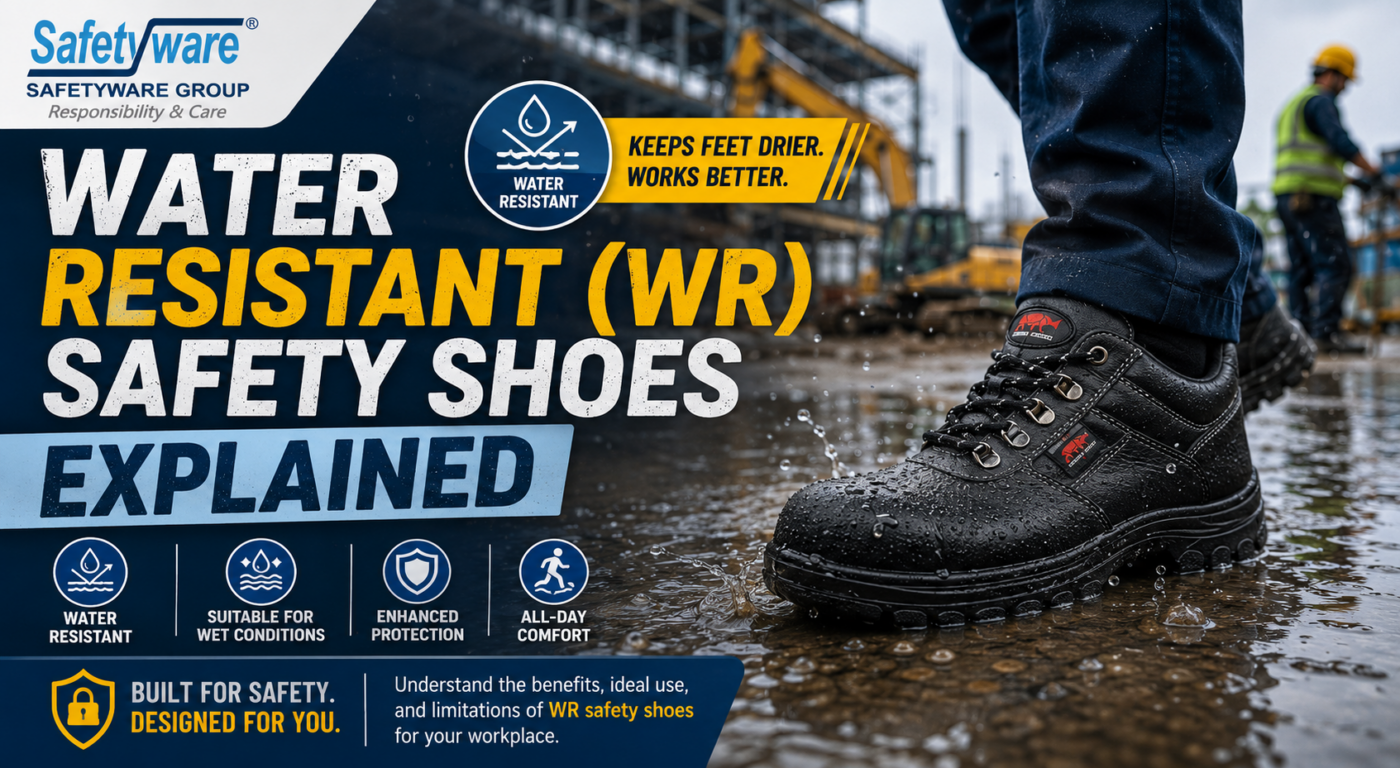
Many workers need safety shoes for wet working conditions, but they often confuse the terms Water Resistant (WR), waterproof, and water-repellent. Although these terms sound similar, they provide different levels of protection against water.
One of the most common questions is:
“If a safety shoe has WR protection, is it completely waterproof like a rubber boot?”
The answer is no.
Water resistance safety shoes resist water penetration in wet working conditions, while waterproof boots keep water out during prolonged exposure or continuous contact with water. Therefore, understanding this difference helps you choose the right footwear for your work environment, ensuring better comfort, protection, and performance.
1. What Are Water Resistant (WR) Safety Shoes?
Water Resistant safety shoes are protective footwear designed to reduce water penetration and water absorption when exposed to wet conditions. Unlike standard safety shoes, they use specially selected materials and construction techniques to provide better protection against moisture. As a result, they help keep your feet drier and more comfortable when working in damp environments such as construction sites, warehouses, manufacturing facilities, and outdoor workplaces.
They are commonly made using:
- Water-resistant leather
- Treated synthetic materials
- Hydrophobic microfiber
- Special shoe construction techniques
WR footwear helps keep feet dry when workers encounter:
- Light rain
- Wet floors
- Water splashes
- Damp surfaces
- Short periods of outdoor exposure
However, WR does not mean the shoe can withstand prolonged immersion in water. Instead, it provides protection against temporary exposure to wet conditions such as rain, water splashes, and damp surfaces. Therefore, workers who frequently stand in water or work in flooded environments should choose waterproof safety boots instead of WR safety shoes.
How Are Water Resistance Safety Shoes Tested?
The WR test evaluates whether the footwear can resist water entering the inside of the shoe and how much water the materials absorb. Therefore, the testing generally involves exposing the footwear to water while simulating walking conditions.
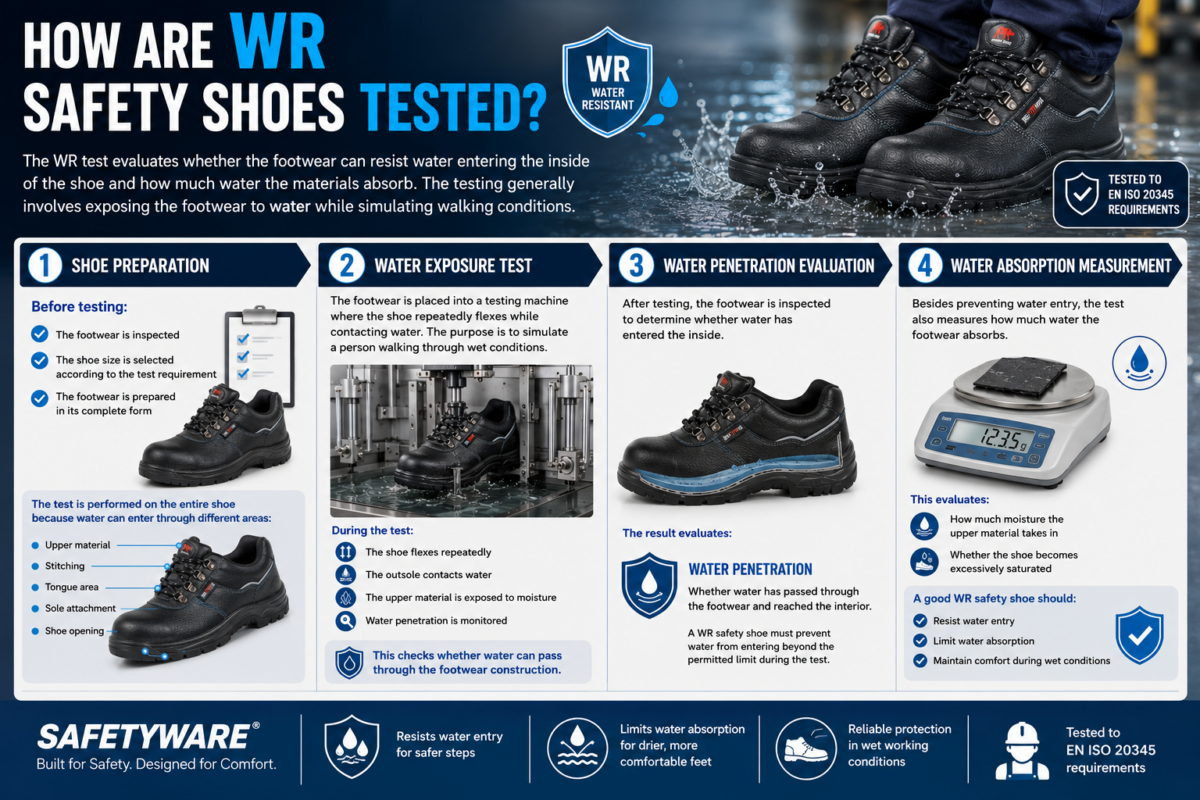
Step 1: Safety Shoe Preparation
Before testing:
- The footwear is inspected
- The shoe size is selected according to the test requirement
- The footwear is prepared in its complete form
The test is performed on the entire shoe because water can enter through different areas:
- Upper material
- Stitching
- Tongue area
- Sole attachment
- Shoe opening
Step 2: Water Exposure Test
Then, the footwear is placed into a testing machine where the shoe repeatedly flexes while contacting water. The purpose is to simulate a person walking through wet conditions.
Evaluate for:
- The shoe flexes repeatedly
- The outsole contacts water
- The upper material is exposed to moisture
- Water penetration is monitored
This ensures whether water can pass through the footwear construction.
Step 3: Water Penetration Evaluation
After testing, the footwear is inspected to determine whether water has entered the inside.
The result evaluates:
- Water Penetration
Whether water has passed through the footwear and reached the interior.
A WR safety shoe must prevent water from entering beyond the permitted limit during the test.
Step 4: Water Absorption Measurement
Besides preventing water entry, the test also measures how much water the footwear absorbs.
This evaluates:
- How much moisture the upper material takes in
- Whether the shoe becomes excessively saturated
A good WR safety shoe should:
- Resist water entry
- Limit water absorption
- Maintain comfort during wet conditions
Why Does WR Testing Matter?
A shoe may look water-resistant because water forms droplets on the surface, but appearance alone does not prove performance.
For example:
Normal Leather Safety Shoe
- May repel small splashes initially
- Can absorb water after longer exposure
- May become heavy when wet
WR Safety Shoes
- Uses tested materials and construction
- Provides verified water resistance performance
- Offers better protection in damp workplaces
What Materials Make a Safety Shoe Water Resistant?
WR performance depends on the complete footwear design.
1. Water-Resistant Leather
Leather can be treated to reduce water absorption while maintaining durability and breathability.
Benefits:
- Durable
- Comfortable
- Suitable for industrial use
2. Hydrophobic Microfiber
Synthetic microfiber materials can be engineered to repel moisture.
Benefits:
- Lightweight
- Faster drying
- Easier maintenance
3. Water-Resistant Membranes
Some footwear uses internal membranes that act as a barrier against moisture.
Benefits:
- Additional water protection
- Helps keep feet dry
4. Tongue and Stitching Design
Water often enters through:
- Tongue gaps
- Stitching points
- Shoe opening
Better construction reduces these entry points.
WR Safety Shoes vs Waterproof Boots
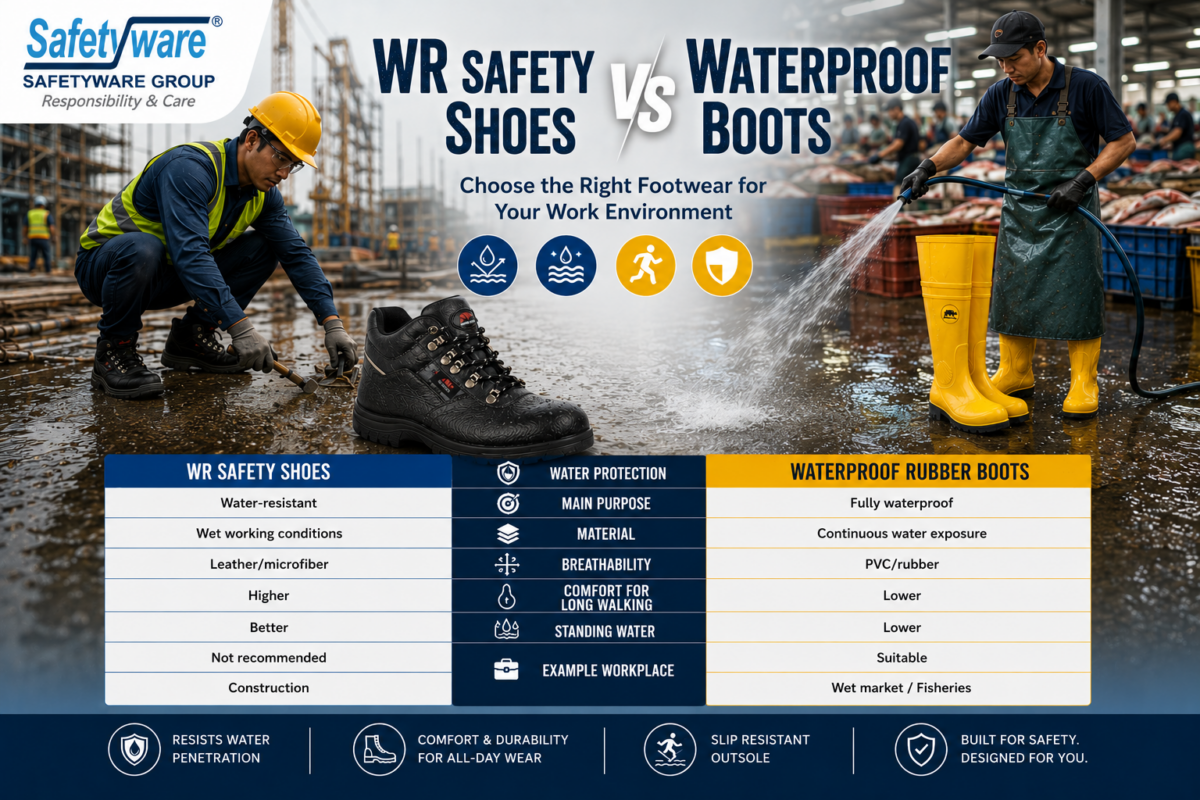
| WR Safety Shoes | Waterproof Rubber Boots | |
| Water protection | Water-resistant | Fully waterproof |
| Main purpose | Wet working conditions | Continuous water exposure |
| Material | Leather/microfiber | PVC/rubber |
| Breathability | Higher | Lower |
| Comfort for long walking | Better | Lower |
| Standing water | Not recommended | Suitable |
| Example workplace | Construction | Wet market/fisheries |
Real Workplace Examples
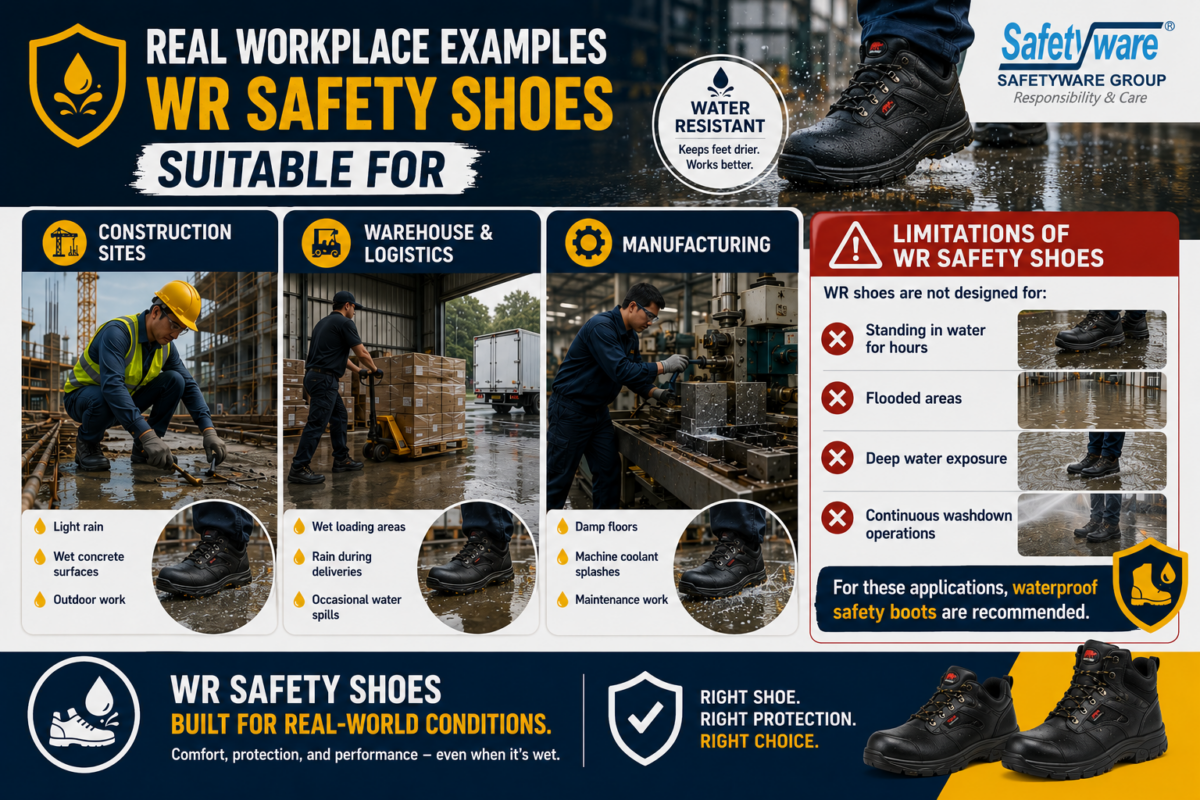
WR Safety Shoes Suitable For:
Construction Sites:
- Light rain
- Wet concrete surfaces
- Outdoor work
Warehouse & Logistics:
- Wet loading areas
- Raining
- Occasional water spills
Manufacturing:
- Damp floors
- Machine coolant splashes
- Maintenance work
Limitations of WR Safety Shoes
WR shoes are not designed for:
❌ Standing in water for hours
❌ Flooded areas
❌ Deep water exposure
❌ Continuous washdown operations
For these applications, waterproof safety boots are recommended.
Recommended Water Resistance Safety Shoes from Safetyware
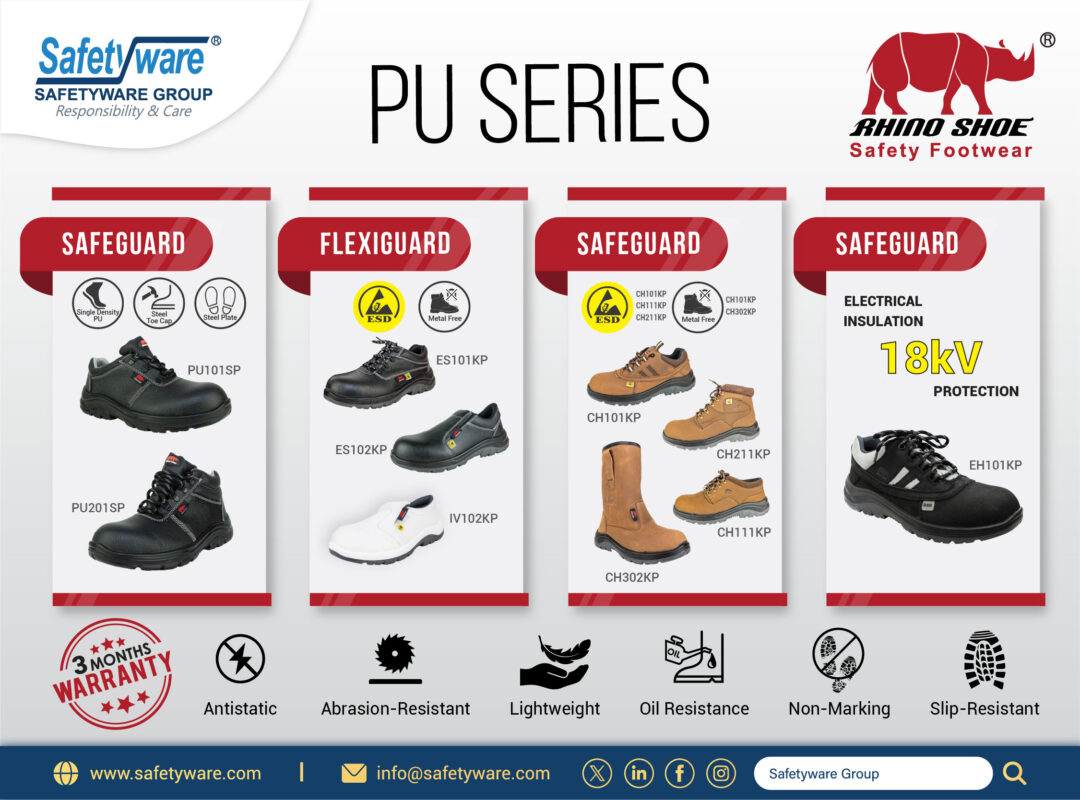
At Safetyware, we offer a range of Water Resistant (WR) safety shoes designed to help workers stay comfortable and protected in damp working environments. Besides that, whether you work in construction, warehousing, logistics, manufacturing, or outdoor maintenance, hence our WR footwear combines reliable safety performance with water-resistant protection for everyday industrial use.
👉 Explore more on Safetyware safety shoes
👉 Read more on PU sole and Rubber sole on safety shoes
Frequently Asked Questions (FAQs)
1. Is WR the same as waterproof?
No. WR provides tested resistance against water penetration, while waterproof footwear is designed for continuous water exposure.
2. Are all EN ISO 20345 safety shoes WR?
No. WR is an additional requirement and must be specifically tested.
3. Can WR shoes be used in wet markets?
Generally no. Wet market environments usually require waterproof rubber/PVC boots because of prolonged water exposure.
4. Can WR safety shoes get wet?
Yes. They can handle wet conditions, but prolonged exposure may eventually allow moisture penetration.
📞 Need More Information?
Looking for reliable head protection solutions for your workplace?
Explore SAFETYWARE’s safety shoes and workplace PPE range at
👉Safetyware Catalogs
Our safety specialists can help evaluate workplace hazards, recommend suitable safety helmets, and support compliance with Malaysia workplace safety requirements.
If you need a quotation, feel free to contact us at:
📩 Email: [email protected]
📞 Tel: WhatsApp Us