If your team climbs ladders, ascends transmission towers, or accesses rooftops via fixed vertical access points, a vertical lifeline system is one of the most important pieces of fall protection equipment you can install. Yet it’s also one of the most misunderstood — often confused with horizontal lifelines or treated as optional because “the harness alone should be enough.” It isn’t.
This guide explains what a vertical lifeline system is, how it works, where it’s typically used, and what to check before you specify or install one on a Malaysian worksite.
What Is a Vertical Lifeline System?
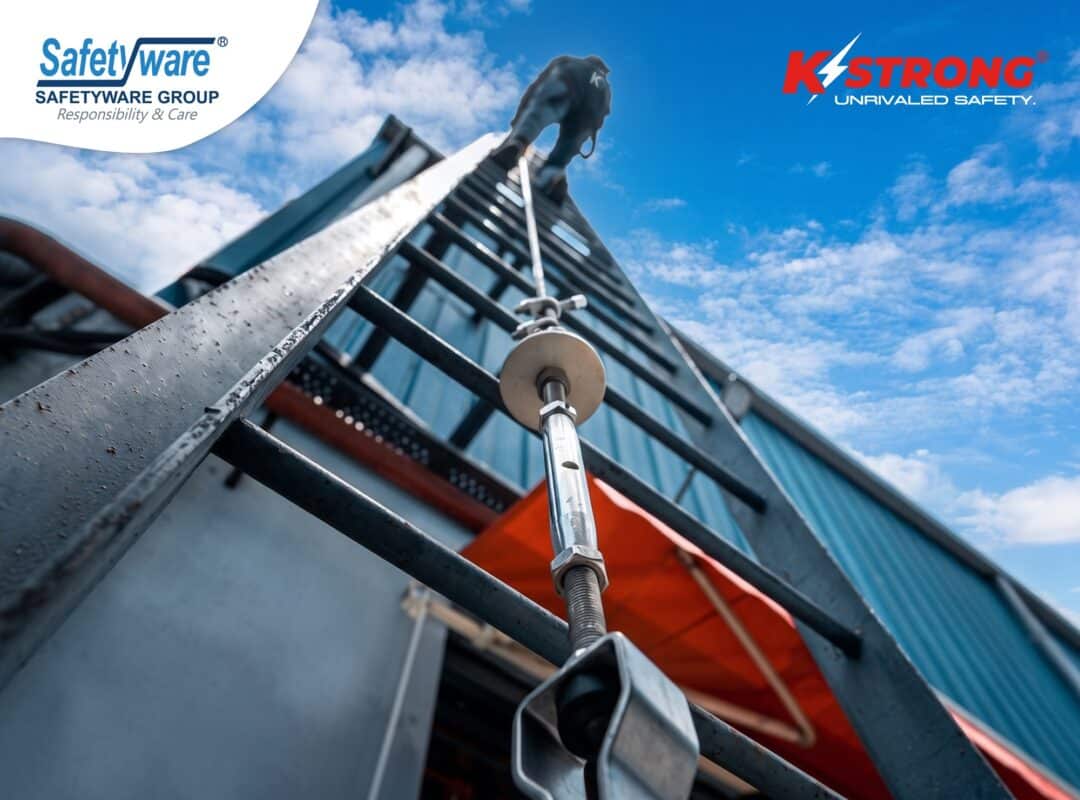
A vertical lifeline system is a fall-arrest system built around a flexible line — usually a steel cable or synthetic rope — anchored at the top of a vertical access route (a ladder, tower, or mast) and running down to or past the base. A mobile fall arrester (sometimes called a rope grab or shuttle) travels along the line and connects to the worker’s full-body harness.
As the worker climbs or descends, the fall arrester moves freely with them. If a fall occurs, the device locks onto the line almost instantly, arresting the fall within a short distance — far less than what a fixed-length lanyard alone would allow.
This makes vertical lifelines a fall-arrest system, not a restraint system: they are designed to catch a fall that has already started, rather than to prevent the worker from reaching a fall hazard in the first place.

How a Vertical Lifeline System Works
- An anchor point is fixed securely at the top of the climbing route (and often at intervals along it, for longer runs).
- A cable or rope line runs the length of the access route, kept in tension or guided by intermediate brackets.
- A mobile fall arrester travels along the lifeline as the worker climbs. It eliminates the need to unclip and reclip manually.
- The worker’s harness connects to the fall arrester via a short energy-absorbing lanyard.
- If the worker falls, the arrester locks onto the lifeline. The energy absorber reduces the forces on the worker’s body.
Where Vertical Lifeline Systems Are Typically Used
- Fixed ladder access — communication towers, silos, chimneys, tank access ladders
- Electrical and telecommunication towers — technicians climbing to antennas or equipment platforms
- Building facade and rooftop access ladders — maintenance and cleaning crews
- Industrial plant structures — vertical access on process towers, cranes, and structural steel
- Construction sites — temporary vertical access during structural works
Vertical vs Horizontal Lifelines: The Short Answer
Vertical lifelines protect movement up and down a fixed route and function as a fall-arrest system. Horizontal lifelines protect movement across a surface (such as a rooftop) and can function as either fall-arrest or fall-restraint, depending on configuration. If your workers are climbing, you need a vertical system; if they’re walking across an elevated surface, you need a horizontal system — many larger sites use both, connected through a transfer point. We cover the topic about horizontal lifeline system in more depth in a dedicated post — see “What is a Horizontal Lifeline System? A Complete Guide for Malaysia”.
What to Check Before You Install One
- Anchor strength and structural verification — the anchor and the structure behind it must be assessed by a competent person for the loads a fall-arrest event can generate.
- Fall clearance — is there enough vertical clearance below the lowest working point for the system to fully arrest a fall before the worker contacts a lower level or obstruction?
- Compatibility — the cable, fall arrester, energy absorber, harness, and connectors must be compatible components from a matched system, not assembled ad hoc.
- Certification — look for components certified to recognised standards (e.g. EN 353-1/353-2 for guided-type fall arresters on rigid/flexible anchor lines, and CE marking) as part of your procurement specification.
- Local compliance is essential for work-at-height activities. Malaysia’s Occupational Safety and Health Act 1994 requires documented risk assessments under Section 18B. This requirement took effect on 1 June 2024. A vertical lifeline is one control identified through the risk assessment. It does not replace the risk assessment process.
- Vertical lifeline systems require scheduled inspections by a competent person. Include inspection and recertification requirements in your maintenance contract from day one.
Permanent or Temporary?
Vertical lifelines can serve as permanent or temporary systems. Permanent systems use welded or bolted brackets engineered for the building’s lifespan. Temporary systems suit short-term construction, maintenance, or project work. Choose the right system based on access frequency, structure type, and long-term maintenance requirements.
Why Work With a Manufacturer, Not Just a Distributor
Vertical lifeline systems are only as reliable as the weakest certified component in the chain. Safetyware designs, manufactures, and supplies CE-certified fall arrest and lifeline systems. Our PPE manufacturing expertise ensures strong component engineering and quality control beyond catalogue specifications.
Frequently Asked Questions
Is a vertical lifeline the same as a fall arrester?
Not quite — the fall arrester (or rope grab) is the mobile device that rides along the lifeline. “Vertical lifeline system” refers to the complete assembly: the line, anchors, fall arrester, energy absorber, and harness connection working together.
How often should a vertical lifeline system be inspected?
Perform a visual inspection before every use. A competent person should conduct formal inspections at intervals recommended by the manufacturer, risk assessment, and usage conditions. There is no single interval that fits every site.
Can one vertical lifeline serve multiple workers?
Some systems are rated for simultaneous multi-user access; others are single-user only. Always confirm rated capacity with the manufacturer’s documentation before allowing more than one worker on the line.
Need a vertical lifeline system assessed, specified, or installed on your site? Talk to Safetyware’s fall protection specialist:
📩[email protected]
☎️WhatsApp Us
Disclaimer: This article provides general product and safety information. It does not replace a site-specific risk assessment or competent professional advice. Confirm regulatory references with your HSE/compliance team before publishing.