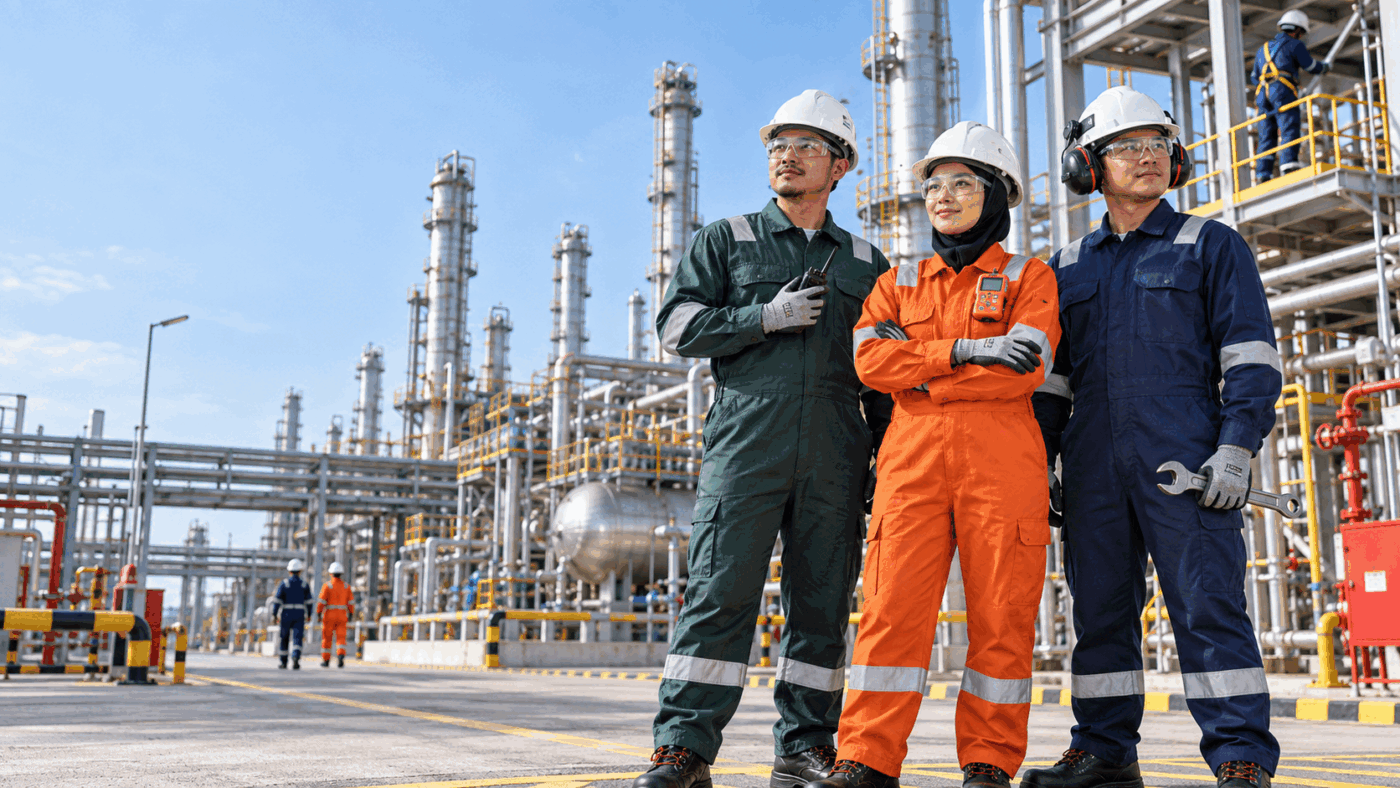
Malaysia’s oil, gas and petrochemical workplaces can expose people to fire, toxic gas, chemicals, noise, moving equipment, falling objects and work at height. However, no single PPE kit can cover every task. A process operator, laboratory worker, tanker-loading crew and shutdown contractor may all need different protection.
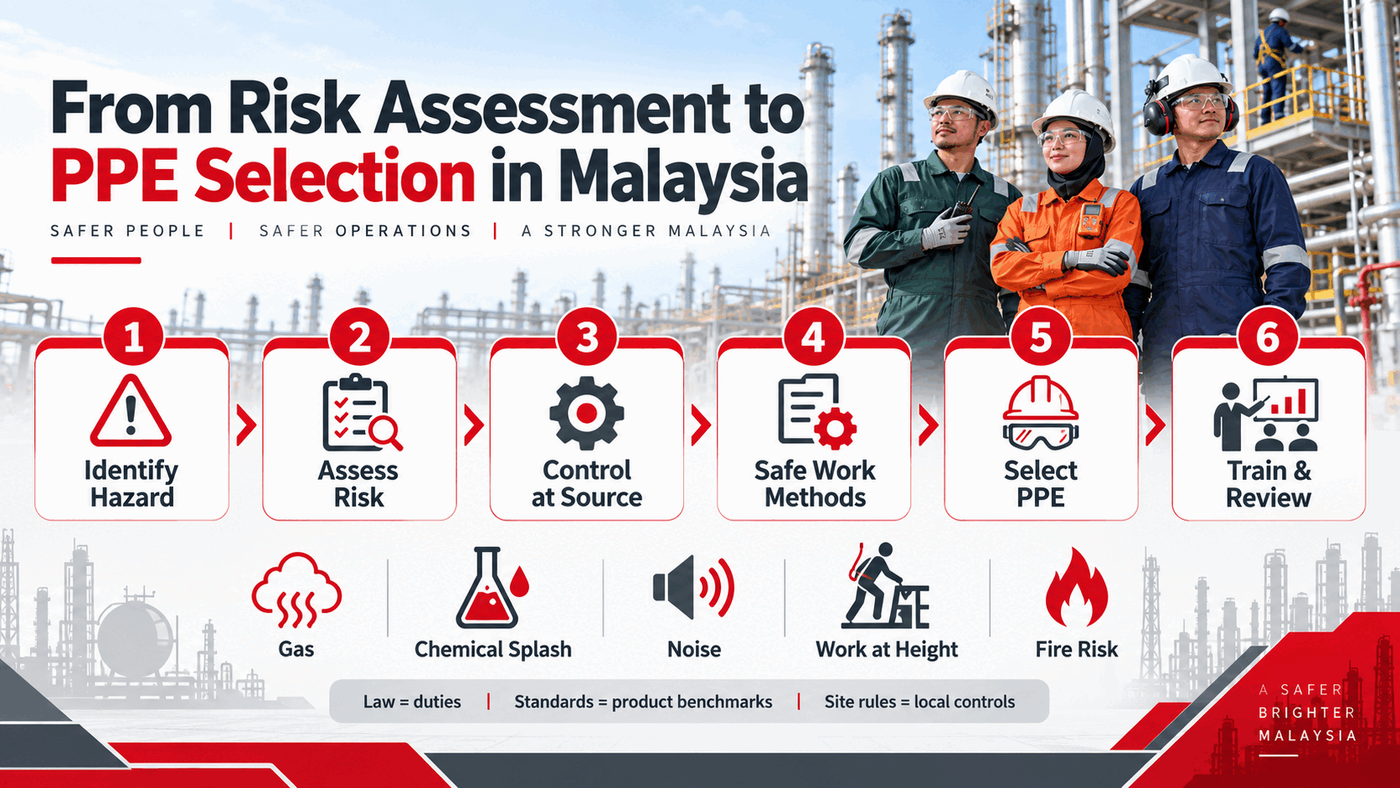
Therefore, employers should start with a site and task risk assessment. They should then remove or reduce each risk through design, isolation, ventilation, safe work systems and other controls. PPE forms the final personal barrier when risk remains.
This guide explains how Malaysian employers and PPE buyers can build a practical, risk-based programme. It also separates legal duties from product standards and common industry practice.
Why PPE Selection in Oil, Gas and Petrochemicals Needs Extra Care
Oil and gas work often combines several hazards in one area. For example, a maintenance technician may face hot surfaces, hydrocarbon vapour, sharp edges and noise at the same time. In addition, a confined space can contain low oxygen, flammable gas or hydrogen sulphide (H2S).
PPE must work as an ensemble. For example, a face shield must fit with the helmet. Likewise, a respirator must seal despite other head-worn items. Meanwhile, gloves must resist the actual chemical without creating poor grip. Finally, flame-resistant clothing should not leave gaps when the user bends or reaches.
Compatibility matters because one item can weaken another. Therefore, buyers should test the complete set during realistic movements before they approve it for site use.
Malaysia’s Legal Framework: What Employers Must Know
The following summary supports planning, but it does not replace advice from a competent safety and health professional.
Occupational Safety and Health Act 1994
The current reprint of Malaysia’s Occupational Safety and Health Act 1994 (Act 514) includes the amendments that took effect on 1 June 2024. Section 15 sets broad employer duties for safe plant, safe work systems, information, training, supervision and a safe workplace. In addition, section 18A sets duties for principals in relation to contractors and subcontractors under their direction.
Most importantly for PPE selection, section 18B requires every employer, self-employed person and principal to conduct a risk assessment. If that assessment calls for controls, the duty holder must put them in place. Therefore, a generic PPE list cannot replace a task risk assessment. See the official DOSH reprint of Act 514.
Chemical exposure: USECHH and CLASS
The USECHH Regulations 2000 address workplace exposure to chemicals hazardous to health. DOSH explains that workplaces must maintain a chemical register and carry out a Chemical Health Risk Assessment (CHRA) where the rules apply. Employers must then act on the assessment and reduce exposure to the lowest practicable level, below any applicable permissible exposure limit. See the DOSH USECHH overview.
Meanwhile, the CLASS Regulations 2013 cover the classification, labelling and safety data sheets of hazardous chemicals supplied for workplace use. Thus, buyers should use the current safety data sheet, CHRA findings and task conditions when they choose chemical gloves, clothing, eye protection or respirators. See the DOSH CLASS Regulations page.
Noise exposure
The Occupational Safety and Health (Noise Exposure) Regulations 2019 govern workplace noise exposure. The legal programme covers more than earplugs. Depending on the assessment, it may include noise identification, a noise risk assessment, engineering or administrative controls, hearing protection, training, audiometric testing and records. Therefore, employers should not use hearing protection as the only control when they can reduce noise at its source. See the official DOSH Noise Exposure Regulations page.
Confined spaces
DOSH’s Industry Code of Practice for Safe Working in a Confined Space 2010 gives detailed guidance for confined-space work. A complete entry system can include hazard assessment, isolation, atmospheric testing, ventilation, an entry permit, trained roles, communication and rescue arrangements. As a result, a respirator or gas detector alone never makes a confined space safe. See the official DOSH confined-space code page.
Major-hazard installations
The Control of Industrial Major Accident Hazards Regulations 1996, often called CIMAH, apply according to the type and quantity of hazardous substances and any determination by the Director General. They do not automatically apply to every company with an oil or chemical process. However, a qualifying major-hazard installation has wider duties for safe operation, reporting and emergency planning. See the official CIMAH Regulations.
Law, standards and site rules are not the same
| Type | What it does | Practical example |
|---|---|---|
| Malaysian law and regulations | Create legal duties for employers, principals, suppliers and other duty holders | Act 514, USECHH 2000, CLASS 2013 and Noise Exposure Regulations 2019 |
| DOSH code or guidance | Explains recognised methods for managing a specific risk | Confined-space entry and rescue guidance |
| Product standard | Defines test methods, markings or performance for a product | ISO 20345 for safety footwear or ISO 16321-1 for occupational eye and face protection |
| Company or client rule | Adds site-specific controls based on the risk and contract | Mandatory FR clothing in a process zone or a four-gas monitor for a defined task |
| Common industry practice | May reflect experience, but does not become a universal legal rule on its own | Helmet colour schemes or standard PPE issue packs |
Product certification helps buyers compare performance. Still, the standard number alone does not prove that an item suits every chemical, temperature or work method. Therefore, buyers should check the full marking, test level, user instructions and current certificate.
Oil, Gas and Petrochemical Hazard-to-PPE Matrix
This table gives a starting point. However, the risk assessment, CHRA, noise assessment, permit and emergency plan must drive the final choice.
| Hazard or task | Controls before PPE | PPE to assess | Key selection question |
|---|---|---|---|
| Flash fire or short flame exposure | Prevent releases, control ignition, isolate and detect leaks | Flame-resistant clothing, helmet, eye protection, gloves and footwear | Does the garment system match the assessed heat or flame hazard? |
| Chemical transfer or sampling | Closed transfer, splash guards, ventilation and clear procedure | Chemical goggles, face shield, chemical gloves, apron or suit and boots | Has the exact chemical and contact time been checked against permeation data? |
| H2S or toxic gas | Closed system, ventilation, fixed detection, portable monitoring and alarms | Task-approved respiratory or escape protection | Is the atmosphere known, within device limits and safe for the chosen respirator? |
| Dust, mist or fume | Capture at source, wet method, enclosure and ventilation | Suitable particulate respirator or other assessed RPE | What contaminant, concentration and protection factor apply? |
| High noise | Quieter equipment, enclosure, isolation and reduced exposure time | Earplugs, earmuffs or a tested combination | Does the protector reduce noise enough without harmful overprotection? |
| Grinding, cutting or chipping | Guarding, screens, dust or spark control | Safety glasses or goggles plus a face shield, gloves and hearing protection | Do the eye and face items suit impact, dust and spark risks? |
| Dropped objects or low structures | Exclusion zones, secure tools and good access design | Industrial safety helmet; chinstrap if the assessment calls for one | Will the helmet stay secure and work with other PPE? |
| Manual handling and sharp parts | Handling aids, guards and safe tools | Cut-, impact- or grip-focused gloves | Does the glove preserve control and dexterity? |
| Wet or oily walking surface | Drainage, housekeeping, leak repair and safe access | Safety footwear with task-suitable slip performance | Has the outsole been tested for the expected surface and contaminant? |
| Work at height | Avoid the height, use a platform or guardrail, plan anchors and rescue | Full-body harness and compatible connecting system | Is the whole system suitable for the anchor, clearance and rescue plan? |
| Confined-space entry | Isolate, test, ventilate, permit, attendant and rescue system | PPE defined by entry assessment; respiratory and retrieval gear where required | Can the team prevent entry hazards and rescue without improvisation? |
| Electrical or arc hazard | De-energise, isolate, verify and control approach | Arc-rated or electrical PPE selected by the electrical risk study | Is every item rated for the specific electrical exposure? |
Essential PPE Categories and Selection Points
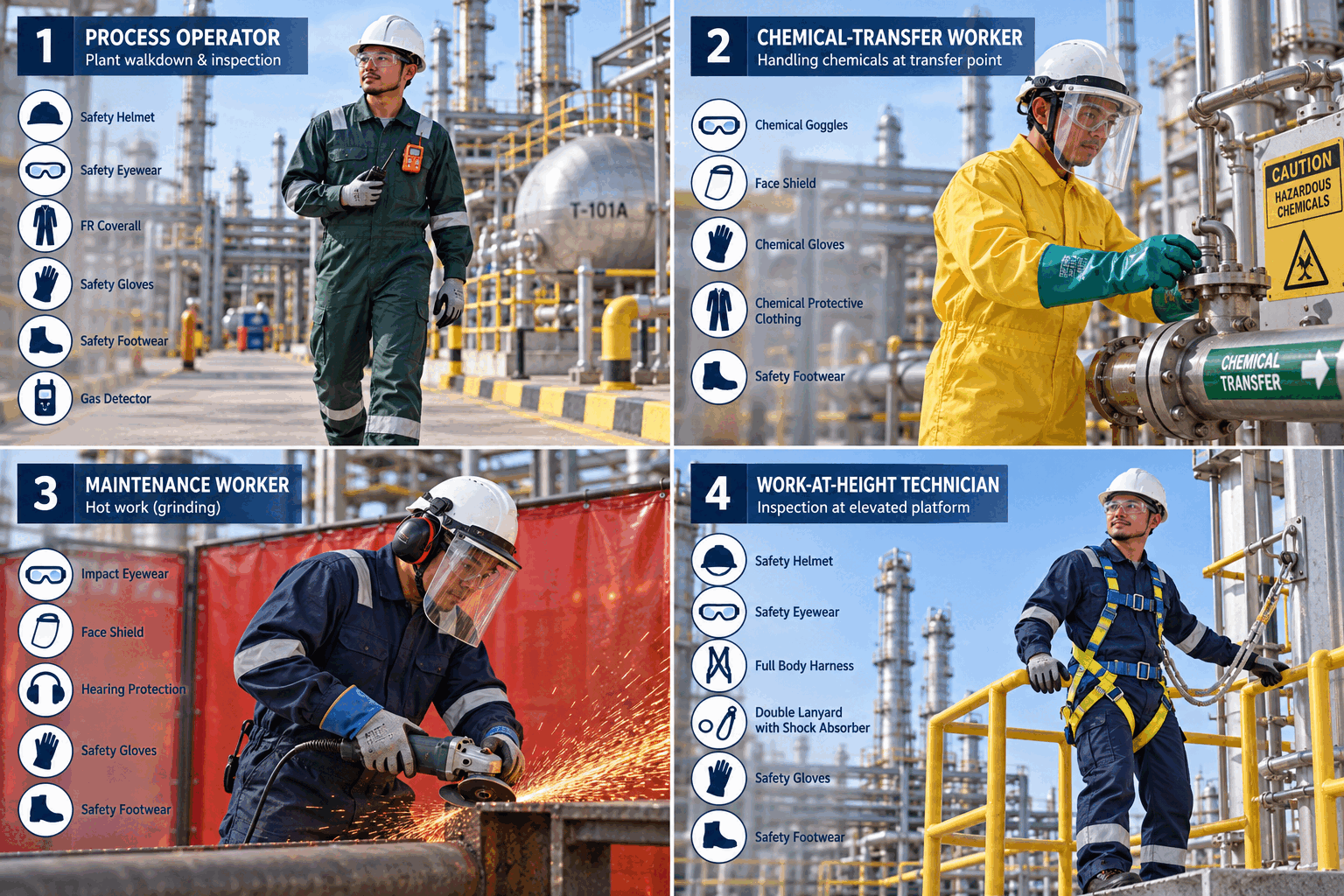
1. Head protection
Industrial safety helmets protect against defined impact and penetration risks. In addition, some models address electrical properties or lateral deformation. First, match the helmet standard and performance options to the risk assessment. Then check fit, suspension condition, shell age, chemical exposure and compatibility with earmuffs, face shields and lamps.
In addition, consider a suitable chinstrap when wind, climbing or awkward positions could dislodge the helmet. Helmet colour may support a site role system, but colour does not show protection level.
2. Eye and face protection
Safety glasses can cover routine impact risks, while sealed or indirect-vent goggles can give better protection against dust or chemical splash. In addition, a face shield adds wider face coverage. However, a face shield normally supplements suitable eye protection rather than replacing it.
Buyers should identify the hazard first: impact, liquid splash, dust, molten splash, ultraviolet or infrared radiation, or a mix. For reference, ISO 16321-1:2021 sets general requirements for occupational eye and face protection and remains current with its 2024 amendment. Still, the exact marking and product instructions determine the item’s tested use.
3. Flame-resistant and task-specific protective clothing
FR clothing may reduce injury during a brief flame or heat exposure, but it is not fireproof. Moreover, fabric type, garment design, closure, condition and underlayers all affect the system.
For general heat and flame clothing, ISO 11612:2015 remains the current published edition as of this article’s verification date, although ISO lists a replacement draft in development. Arc flash, chemical splash, welding and high-visibility risks need other or added performance criteria. Therefore, do not approve a coverall only because its label says “FR.” Verify the certificate, test levels and use limits against the task.
4. Hand and arm protection
Different gloves protect against different hazards. For instance, a cut glove may offer poor chemical protection, while a thick chemical glove may reduce tool control. Moreover, oil resistance does not prove resistance to every solvent or process chemical.
For chemical work, use the SDS and manufacturer’s permeation data for the named substance, concentration, temperature and expected contact time. The current ISO 374-1:2024 covers terminology and performance requirements for gloves against dangerous chemicals. However, a standard marking never replaces a chemical-specific compatibility check.
For mechanical work, consider cut, abrasion, puncture, impact and grip needs. Then trial the glove with the actual valve, tool or component.
5. Safety footwear
Oil and gas footwear may need toe protection, slip performance, resistance to fuel oil, penetration protection, heat resistance or electrical properties. Yet these features are separate. For example, “oil-resistant outsole” describes material resistance; therefore, it does not automatically prove good slip control on an oily floor.
ISO 20345:2021, with Amendment 1:2024, specifies basic and added requirements for safety footwear. Therefore, buyers should read the full marking and verify the claimed features. They should also assess sole pattern, fit, ankle support and the real walking surface.
6. Hearing protection
Earplugs can work well in hot areas and under other head-worn PPE. By contrast, earmuffs can be easier to check and manage. In some high-noise settings, the assessment may call for dual protection.
However, more attenuation is not always better. Too much reduction can block alarms and speech. Therefore, use the noise risk assessment to set the required protection, train each wearer and check the fit. Helmet-mounted earmuffs must also match the approved helmet connection.
7. Respiratory protective equipment
Respirator selection demands a clear answer to five questions:
- What contaminant is present?
- What is its measured or expected concentration?
- Is oxygen at a safe level?
- Does the atmosphere present an immediate danger to life or health?
- What protection factor, filter or air supply does the task require?
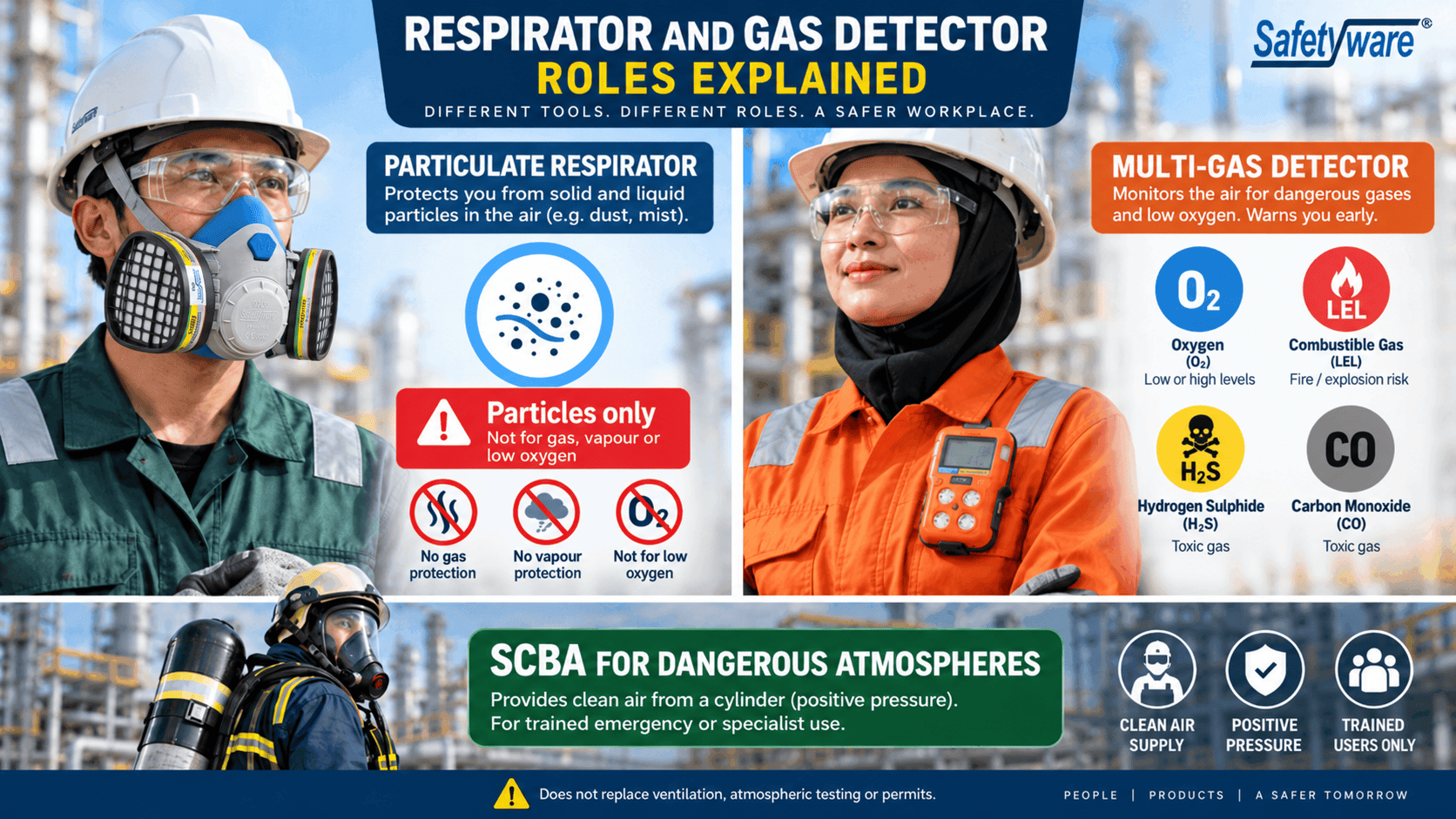
A disposable particulate respirator can filter suitable particles. However, it does not protect against gases, vapours or low oxygen. Likewise, an organic-vapour cartridge does not cover every gas and has a limited service life.
For known, controlled atmospheres, the assessment may support an air-purifying respirator with the correct filter or cartridge. By contrast, an unknown, oxygen-deficient or immediately dangerous atmosphere requires a specialist approach, often positive-pressure supplied breathing air or self-contained breathing apparatus (SCBA), plus trained users and a rescue plan. Never choose respiratory protection from odour alone.
A respiratory programme should also cover medical suitability where needed, fit testing for tight-fitting models, clean-shaven sealing areas, training, inspection, cleaning, storage and cartridge change rules.
8. Portable gas detection
A portable gas detector is an instrument, not PPE. Nevertheless, it can provide a vital warning of oxygen, flammable gas, H2S, carbon monoxide or other site-specific hazards.
First, choose the sensor set from the process and entry hazards. In addition, define alarm actions, bump checks, calibration, charging, maintenance and recordkeeping. Most importantly, workers must know what to do when an alarm sounds. Therefore, they should never treat silence from an unsuitable or untested detector as proof of clean air.
9. Fall protection and confined-space rescue equipment
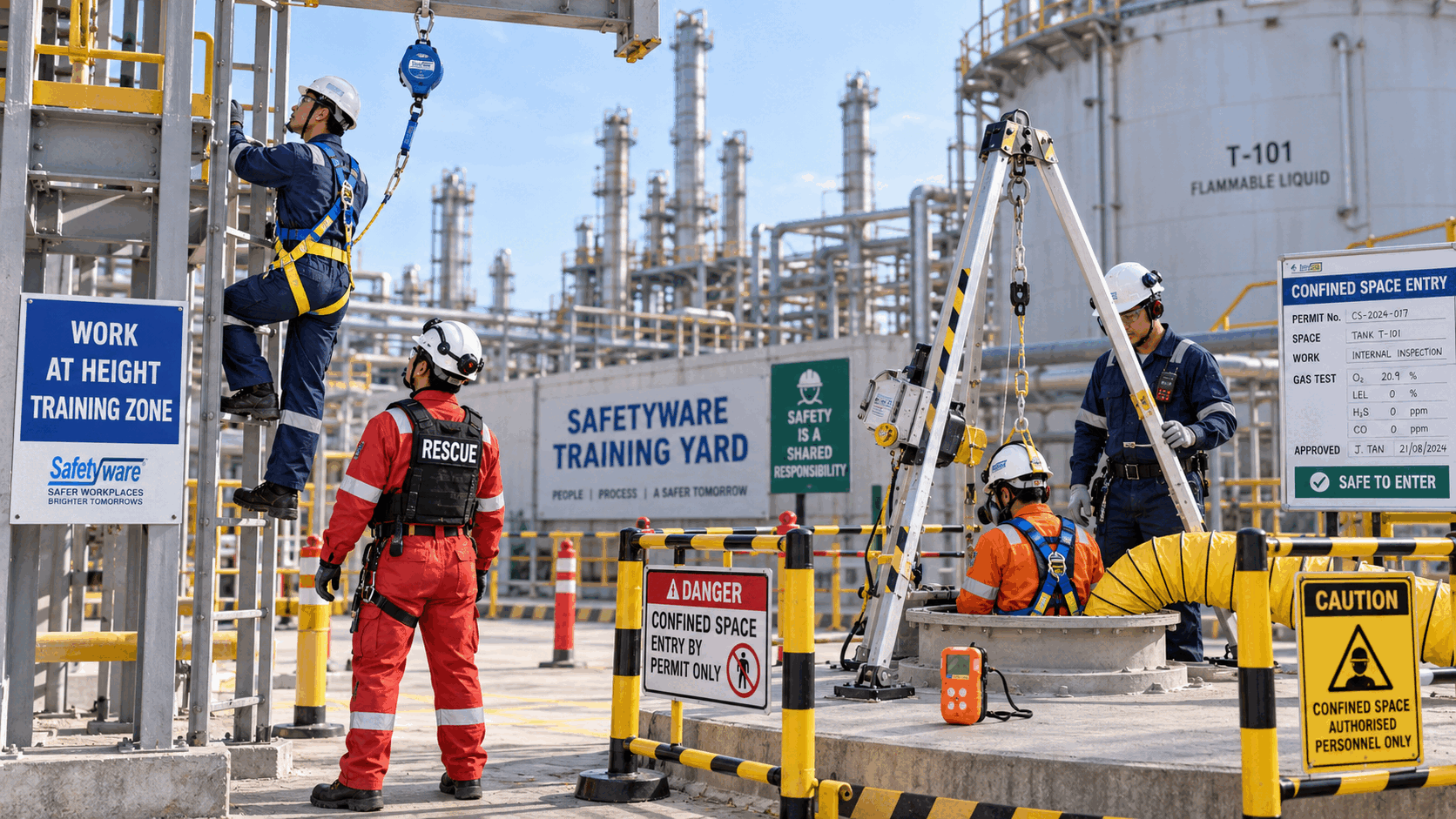
A harness alone cannot arrest a fall safely. The system may need a suitable anchor, connector, lanyard or self-retracting lifeline, energy control, enough fall clearance and a prompt rescue plan. Therefore, a competent person should design or approve the system for the work.
For confined spaces, retrieval equipment may support rescue, but it must suit the opening, entry path and casualty movement. In addition, the team must consider whether respiratory protection, supplied air, communication and non-entry rescue are required. Finally, training and drills should confirm that the plan works before entry starts.
A Practical PPE Procurement Checklist
Before ordering PPE for a refinery, terminal, offshore support base or petrochemical plant, confirm the following:
- The current task risk assessment defines the hazard and remaining risk.
- The CHRA and current SDS support every chemical-protection choice.
- Noise data supports the hearing-protector selection.
- The product’s standard, test level and marking match the task.
- The certificate and any required DOSH approval remain current for the exact brand and model.
- The complete PPE set works together without loss of fit or seal.
- Sizes cover the workforce, including smaller and larger users.
- A wearer trial checks comfort, grip, vision, movement and communication.
- Tight-fitting respirators have a fit-testing plan.
- Inspection, cleaning, storage and replacement rules are clear.
- Spare parts, filters and cartridges will remain available.
- Users receive task-based training and supervised practice.
- Emergency PPE links to the alarm, escape and rescue plan.
- Purchase records capture model, certificate, lot or batch where useful, and issue date.
For regulated PPE categories, consult the current DOSH Approval and Authorization lists and verify the exact model rather than relying on a supplier name alone.
Common PPE Selection Mistakes
Buying one “oil and gas kit” for every job
This approach looks simple, but it ignores task differences. Instead, build role packs only after mapping each role to its real tasks and exceptions.
Treating every FR garment as equal
FR claims can cover different tests and exposure types. Therefore, check the standard, protection level, garment design and certificate.
Choosing gloves by material name alone
Nitrile, neoprene and other material names do not give a complete answer. Chemical concentration, heat, contact time and glove thickness can change performance.
Using particulate masks for vapour or H2S
Particulate filters do not remove gas or vapour. Consequently, the wrong respirator can create false confidence in a dangerous atmosphere.
Issuing a harness without a rescue plan
Fall arrest can stop a person from hitting a lower level, yet suspension can still cause serious harm. Plan prompt rescue, suitable access and trained response.
Ignoring PPE interaction
Safety glasses can disturb a respirator seal. Earmuffs can lose their seal over thick headwear. Likewise, glove cuffs and sleeves can leave a gap. Test the ensemble, not only the items.
SAFETYWARE Products and Solutions
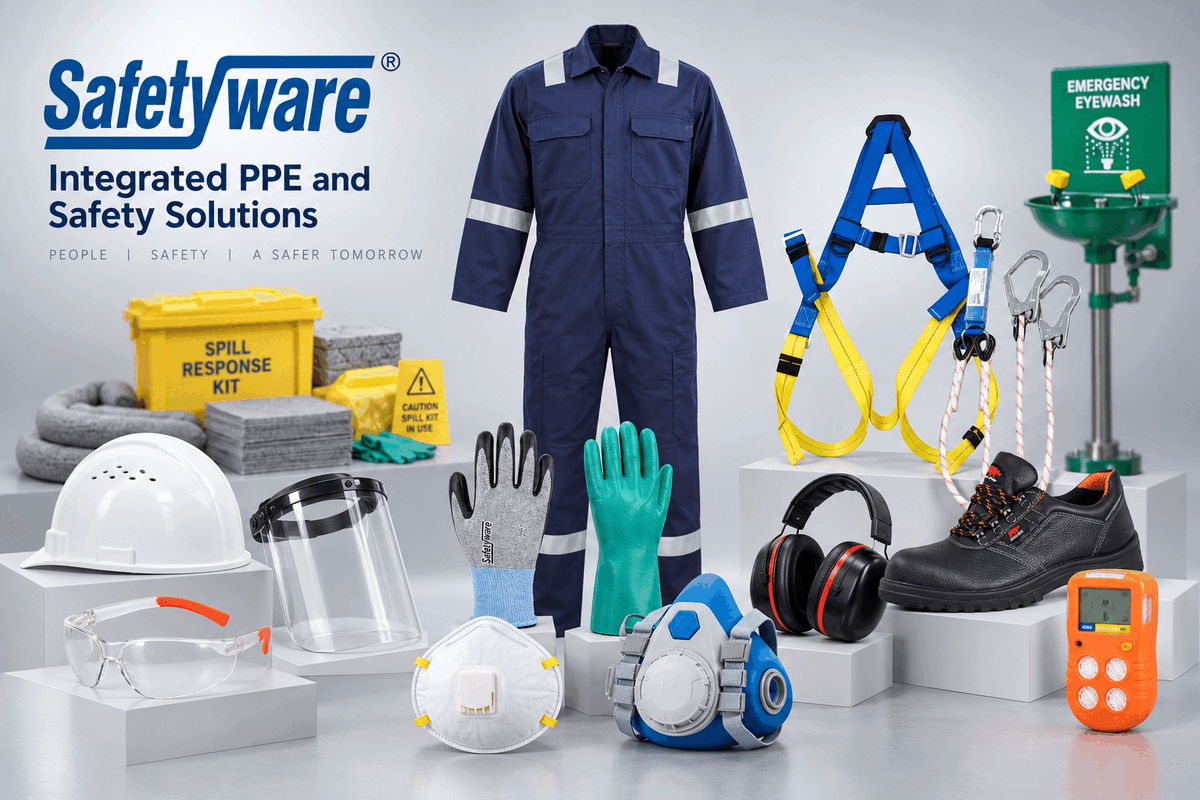
SAFETYWARE supplies certified PPE, gas detection equipment, fall protection systems and workplace safety solutions for Malaysia’s oil, gas and petrochemical sectors. Our specialists can help review task hazards and recommend suitable equipment based on applicable standards and site requirements. The right starting point is the hazard and task, not a product name. Therefore, buyers should share the risk assessment, chemical details, work method, required standards and site rules when requesting a recommendation.
Relevant SAFETYWARE ranges include:
| Need | SAFETYWARE range | Selection focus |
|---|---|---|
| Head protection | Safety helmets | Impact class, electrical option, chinstrap and accessory compatibility |
| Eye and face protection | Eye and face protection | Impact, splash, dust, optical quality and face coverage |
| FR and heat protection | Flame and heat-resistant clothing | Flame, radiant heat, welding, arc or other assessed exposure |
| Hand protection | Hand and arm protection | Chemical, cut, impact, heat, grip and dexterity needs |
| Safety footwear | Foot protection | Toe, slip, penetration, fuel-oil, heat and electrical features |
| Hearing protection | Hearing protection | Required attenuation, fit, comfort and alarm audibility |
| Respiratory protection | Respiratory protection | Contaminant, concentration, oxygen, protection factor and fit |
| Work at height | Fall protection | Anchor, connector, clearance, compatibility and rescue |
| Atmospheric monitoring | Gas detection | Gas set, range, alarms, sampling, calibration and support |
| Spill response | Spill control solutions | Liquid type, spill size, location and disposal plan |
| Emergency decontamination | Emergency eyewash and showers | Chemical risk, location, flow, access and maintenance |
SAFETYWARE also offers portable gas detectors for personal monitoring and field work. Because gas detection supports a wider safety system, users should pair the selected instrument with a written procedure, response actions, maintenance and training.
For project support, browse the SAFETYWARE product range or contact the team with the task details. Always confirm stock, specifications, certification and suitability for the exact application before purchase.
Conclusion
Effective PPE for Malaysia’s oil, gas and petrochemical sector starts with the risk, not a standard issue pack. First, assess the task and apply controls at source. Next, use the CHRA, SDS, noise data, entry permit and site rules where they apply. Finally, select certified, compatible PPE for the risk that remains.
The best programme also manages fit, training, inspection, storage, replacement and rescue. As a result, PPE becomes part of a working safety system instead of a box-ticking purchase.
Sources and References
Verified on 7 September 2026.
- Malaysia Department of Occupational Safety and Health (DOSH), Occupational Safety and Health Act 1994 (Act 514), reprint version as at 1 June 2024
- DOSH, USECHH Regulations overview and resources
- DOSH, CLASS Regulations 2013
- DOSH, Occupational Safety and Health (Noise Exposure) Regulations 2019
- DOSH, Industry Code of Practice for Safe Working in a Confined Space 2010
- DOSH, Control of Industrial Major Accident Hazards Regulations 1996
- DOSH, Approval and Authorization lists
- ISO, ISO 16321-1:2021 — Eye and face protection for occupational use
- ISO, ISO 11612:2015 — Clothing to protect against heat and flame
- ISO, ISO 374-1:2024 — Gloves against dangerous chemicals
- ISO, ISO 20345:2021 — Safety footwear
- SAFETYWARE, Products and safety solutions
📞 Need More Information?
Looking for PPE for Oil and Gas industry?
Explore SAFETYWARE’s safety shoes and workplace PPE range at
👉Safetyware Catalogs
Our safety specialists can help evaluate workplace hazards, recommend suitable safety helmets, and support compliance with Malaysia workplace safety requirements.
If you need a quotation, feel free to contact us at:
📩 Email: [email protected]
📞 Tel: WhatsApp Us