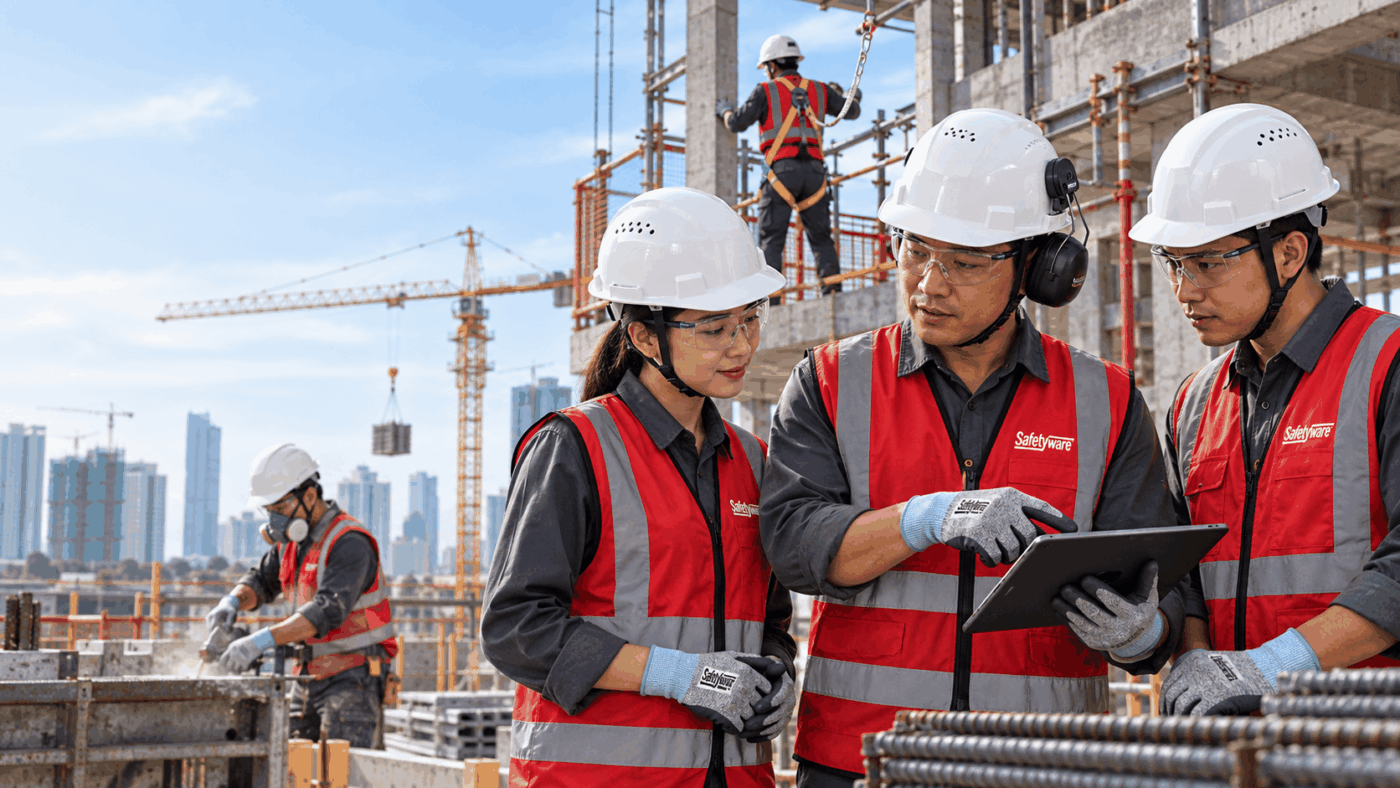
Vietnamese construction sites can change quickly. One crew may pour concrete at ground level while another installs steel at height, cuts tiles, welds pipework or guides vehicles through a tight access road. As a result, one basic PPE kit cannot cover every worker and every task.
Instead, employers should start with the hazard, apply collective and engineering controls, and then select personal protective equipment for the risks that remain. This approach protects workers more effectively and supports compliance with Vietnam’s occupational safety and construction rules.
This guide explains the main types of construction PPE in Vietnam, how employers can match them to common site hazards, and what buyers should check before placing a project order. It also separates legal requirements from product standards and normal industry practice.
Image placement marker: Place Image 1, the featured image, above this introduction. The complete copy-ready image brief appears at the end of the article.
Why Construction PPE Needs a Task-Based Approach
Construction combines several hazards in one workplace. For example, workers may face falling tools, sharp reinforcement bars, moving plant, silica-containing dust, high noise, hot work, live electrical parts and unprotected edges. Weather, heat and heavy rain can also affect comfort, grip and visibility.
However, PPE only protects the person wearing it. Guardrails, safe access, lifting plans, machine guards, dust suppression and traffic separation control hazards closer to their source. Therefore, a site should use PPE as one part of a wider safety system, not as a replacement for better controls.
In practice, the required PPE can change by trade, work area and stage of the project. A visitor walking through a controlled route may need different protection from a welder, scaffolder, electrician or confined-space worker.
Construction PPE Law and Regulation in Vietnam
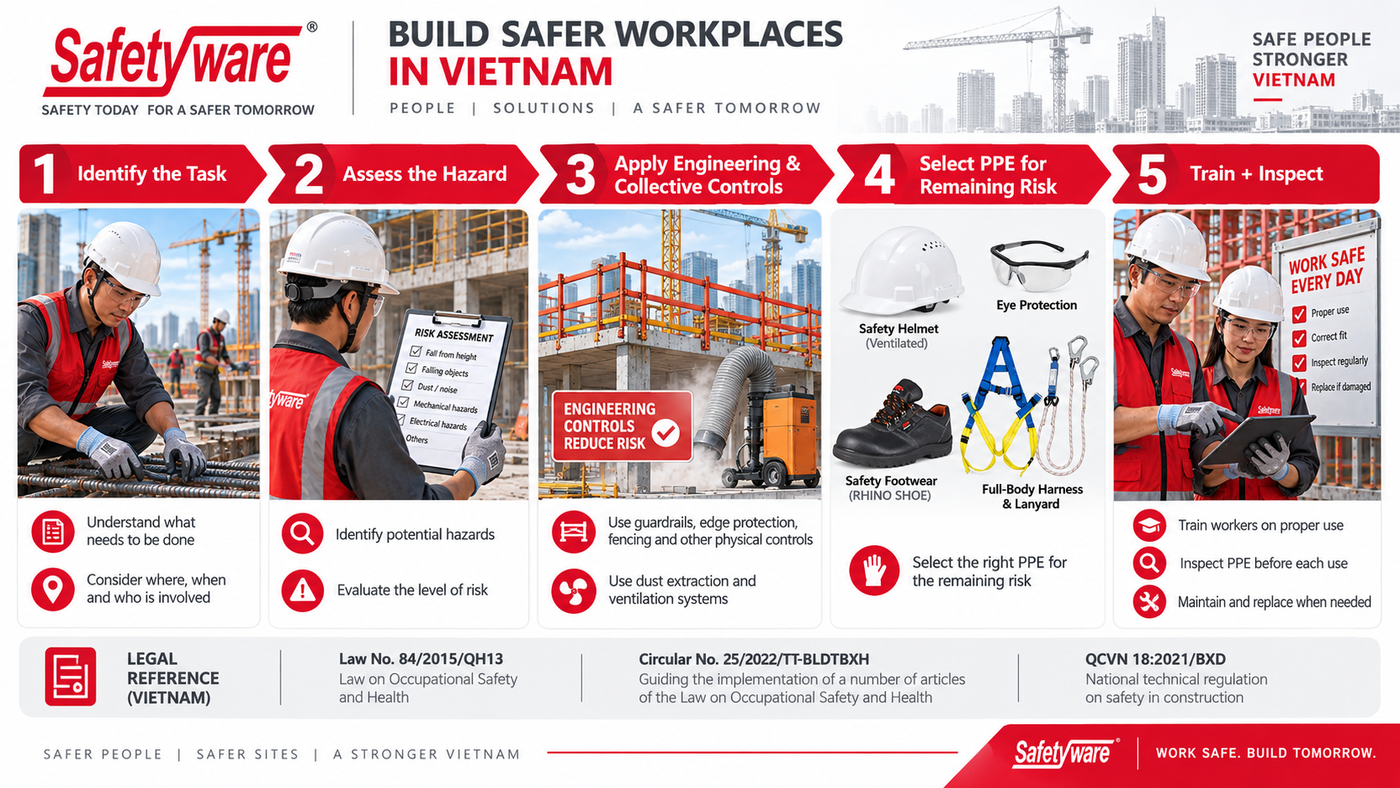
Three sources form the main framework for this guide.
Law on Occupational Safety and Health No. 84/2015/QH13
First, Vietnam’s Law on Occupational Safety and Health No. 84/2015/QH13 took effect on 1 July 2016. Article 23 addresses personal protective equipment for workers who face dangerous or harmful factors.
Under Article 23, the employer must provide suitable PPE in the correct type, quantity and quality. In addition, the employer may not replace PPE with cash, force workers to buy it or collect money from them for it. The employer must also guide and supervise its use.
However, the same article places hazard control before PPE. Employers must apply technology, equipment and occupational safety measures to remove or minimise hazards and improve working conditions.
Circular No. 25/2022/TT-BLDTBXH
Next, Circular No. 25/2022/TT-BLDTBXH governs the provision of PPE at work and took effect on 1 April 2023. It covers head, eye and face, hearing, respiratory, hand, foot, body, fall, electrical and other forms of protection.
The Circular also focuses on use and care. For example, employers must instruct workers in correct use, check specialised PPE where the rules require it, monitor issued equipment and replace items that become damaged, lost or expired under the applicable conditions. Workers, meanwhile, must use the PPE correctly and care for issued equipment.
QCVN 18:2021/BXD for construction safety
Finally, QCVN 18:2021/BXD, issued with Circular No. 16/2021/TT-BXD, is Vietnam’s National Technical Regulation on Safety in Construction. It took effect on 20 June 2022 and replaced QCVN 18:2014/BXD.
The regulation covers site safety, access, scaffolds, ladders, lifting equipment, machinery, hand tools, work at height, excavation, underground work, demolition, work over water and many other construction activities. Therefore, project teams should read its task-specific rules together with the general occupational safety law.
Legal requirement, standard and site rule: know the difference
| Type | Purpose | Example |
|---|---|---|
| Law or regulation | Creates duties within its legal scope | Law No. 84/2015/QH13 and QCVN 18:2021/BXD |
| Product standard | Defines a test method, performance level or marking system | EN 397 for industrial helmets or EN ISO 20345 for safety footwear when the project accepts them |
| Project or company rule | Sets a site-specific requirement | A contractor’s rule for chinstraps, high-visibility clothing or eye protection in designated zones |
Consequently, a recognised EN, ISO, ANSI or TCVN marking does not automatically prove that a product suits every Vietnamese project. Buyers should confirm the current legal requirement, project specification, product certificate and exact model marking before purchase.
Image placement marker: Place Image 2 after this section to show how the law, risk assessment, site controls and PPE selection connect.
Main Construction Hazards and Suitable PPE
The following table supports an initial review. However, it does not replace a task risk assessment or the technical rules for specialist work.
| Construction hazard | Primary controls to consider first | PPE to assess for remaining risk |
|---|---|---|
| Falling or swinging objects | Exclusion zones, toe boards, tool tethering, lifting controls | Industrial safety helmet with suitable retention and accessories |
| Work at height | Avoid height, use platforms, guardrails and safe access | Full-body harness and a compatible restraint or fall-arrest system where needed |
| Sharp materials and rough handling | Safe storage, mechanical handling, deburring | Task-matched gloves, sleeves and safety footwear |
| Flying particles | Guards, screens, wet cutting, tool control | Safety glasses or goggles; face shield where wider coverage is needed |
| Dust, fumes, gases or vapours | Substitution, enclosure, extraction, wet methods, ventilation | Respirator selected for the measured contaminant and exposure |
| High noise | Quieter equipment, isolation, barriers, maintenance, time control | Ear plugs or earmuffs with suitable attenuation |
| Hot work and welding | Permit system, screens, ventilation, fire watch | Welding eye and face protection, heat-resistant gloves and suitable protective clothing |
| Vehicle and plant movement | Segregated routes, barriers, spotters, traffic plan | High-visibility clothing and protective footwear |
| Electrical work | Isolation, lockout, test-before-touch, safe distance | Task-rated electrical PPE where the electrical risk assessment requires it |
| Wet, muddy or uneven ground | Drainage, housekeeping, access routes | Slip-resistant safety footwear or boots suited to the surface and exposure |
| Work over or near water | Guardrails, safe access, rescue arrangements | Suitable buoyancy aid or life jacket where the assessment requires it |
Essential PPE for Construction Workers in Vietnam
1. Safety helmets
Safety helmets help protect workers from falling objects, overhead impact and some site-specific hazards. However, a helmet’s colour does not determine its protection level.
First, check the hazard and the accepted product standard. Then review shell type, suspension, fit, size range, chinstrap, ventilation and accessory compatibility. For example, a secure retention system may matter for active work or work at height. In contrast, electrical work may restrict vented shells or metal components.
Moreover, inspect helmets before use. Remove any helmet with cracks, deep cuts, heat damage, chemical attack, a damaged suspension or an expired service life under the manufacturer’s instructions.
2. Safety glasses, goggles and face shields
Flying chips, dust, concrete fragments, chemical splash and welding radiation need different eye and face protection. Therefore, buyers should not issue one clear spectacle for every task.
Safety glasses can suit many impact and flying-particle hazards. Meanwhile, sealed goggles may give better protection against fine dust or liquid splash. A face shield adds wider face coverage for grinding or splash work, but workers often still need suitable glasses or goggles underneath.
For welding and cutting, select the correct filter shade and product type for the process. Likewise, check compatibility with helmets, respirators and hearing protection so one item does not disturb another item’s fit.
3. Safety footwear
Construction footwear may need to address impact, compression, sharp objects, slips, water, mud, heat or electrical hazards. Consequently, the required features depend on the worker’s task and ground conditions.
For general building work, buyers often assess toe protection, penetration resistance, outsole grip and ankle coverage. In addition, wet or muddy work may need waterproof boots with a suitable outsole. Electrical workers may need specially rated footwear, but electrical safety shoes and dielectric boots do not serve the same purpose.
Fit also matters. A technically suitable shoe that causes pain or poor balance can create new problems during long shifts, ladder access or uneven-ground work.
4. Hand and arm protection
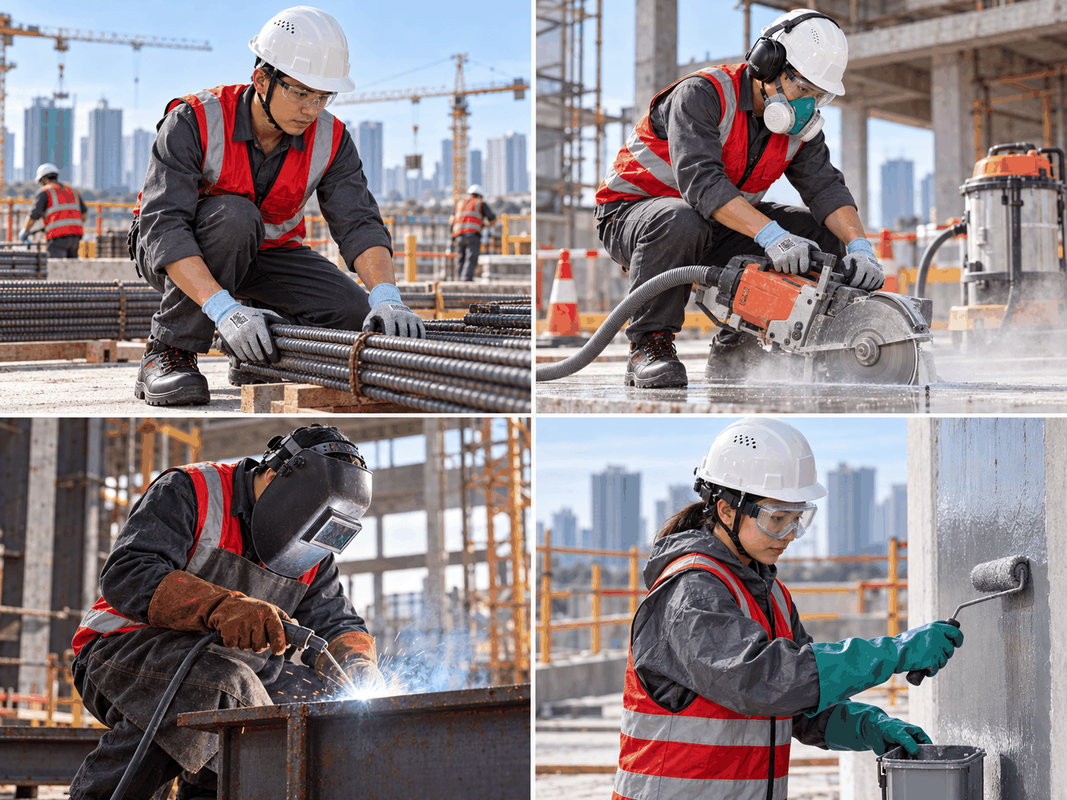
Construction workers handle steel, timber, cable, concrete, glass, chemicals and powered tools. As a result, glove selection should consider cuts, abrasion, puncture, impact, grip, heat, chemicals and dexterity.
For example, a coated general-purpose glove may support dry handling, while a cut-resistant glove may suit sharp sheet or reinforcement work. Chemical tasks need a glove material with suitable permeation, degradation and breakthrough data for the exact product. Welding and hot work, meanwhile, need suitable heat and flame protection.
Most importantly, gloves cannot make a rotating tool or pinch point safe. Machine guarding and safe work methods remain essential.
Image placement marker: Place Image 3 after this section to compare task-matched PPE for concrete, steel, cutting and chemical work.
5. High-visibility clothing
High-visibility clothing helps workers stand out near trucks, cranes, excavators and other mobile plant. However, garment colour alone does not guarantee adequate visibility.
Instead, review the site traffic plan, light level, background, reflective material, garment coverage and project requirement. In addition, keep vests clean and replace items when fading, dirt or damage reduces visibility.
6. Hearing protection
Concrete breakers, piling, cutting tools and heavy equipment can create harmful noise. First, measure or assess the exposure. Then reduce noise through equipment choice, maintenance, barriers, distance and work planning.
Where risk remains, select ear plugs or earmuffs by the required attenuation, task duration, fit and compatibility with other PPE. Too little protection leaves workers exposed. Nevertheless, excessive attenuation can also make communication and warning signals harder to hear.
7. Respiratory protection
Construction can generate cement dust, silica-containing dust, wood dust, welding fume, paint mist, gases and solvent vapours. Yet no single disposable mask protects against all these hazards.
Therefore, identify the contaminant, concentration, oxygen level and work duration before selecting a respirator. A particulate respirator does not protect against gases or vapours unless the approved product specifically combines those functions. Likewise, tight-fitting respirators need the correct size, a good face seal and a suitable fit-testing programme.
Respiratory protection should support dust suppression, extraction and ventilation. It should not replace those controls.
8. Fall protection
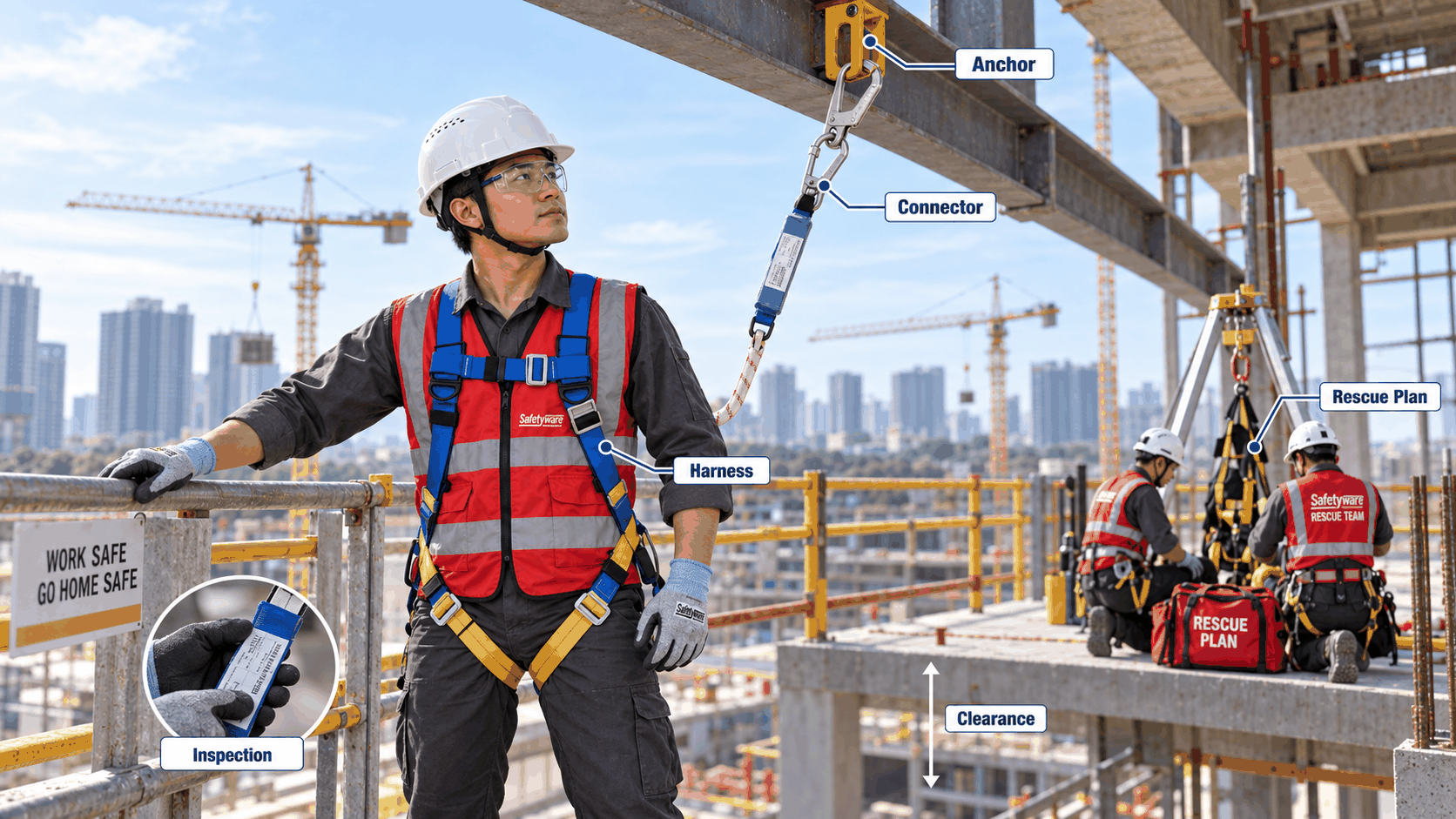
Falls remain a major construction risk, but a harness alone cannot stop a fall safely. A personal fall-protection system also needs a suitable anchor, connector, lanyard or self-retracting lifeline, enough fall clearance, compatible components, inspection and a rescue plan.
First, avoid work at height where practical. Next, prevent falls with guardrails, covers, safe scaffolds or work platforms. Finally, use restraint or fall arrest when the risk assessment and work method require personal equipment.
For continuous movement, a double-leg energy-absorbing lanyard may support transitions between suitable anchors. However, the user must understand tie-off, clearance and connector use. A competent person should plan the complete system and the rescue method.
Image placement marker: Place Image 4 after this section to illustrate a complete fall-protection system rather than a harness by itself.
9. Task-specific protection
Some activities need additional controls and PPE:
- Welding and hot work: welding shield or helmet, correct lens shade, heat-resistant gloves, suitable clothing and respiratory protection where the assessment requires it.
- Electrical work: voltage-rated gloves, face and body protection, electrical head protection and suitable footwear according to the electrical study and safe work method.
- Chemical handling: chemical-resistant gloves and clothing, splash goggles, face protection and respiratory equipment selected from the SDS and exposure assessment.
- Confined spaces: gas testing, ventilation, communication, entry control, rescue equipment and respiratory protection as the entry assessment requires.
- Work near water: suitable flotation equipment, edge control and a tested rescue plan.
Because these tasks can have fatal risks, project teams should never select specialist PPE from a general checklist alone.
How to Build a Construction PPE Matrix
A PPE matrix helps contractors standardise issue without assuming that every role has the same exposure.
Step 1: Break the project into tasks
First, list actual activities such as rebar work, formwork, scaffolding, concrete cutting, welding, electrical installation, painting, lifting and traffic control.
Step 2: Identify hazards and existing controls
Next, record the hazards, exposure routes, work area, duration and people at risk. Also note collective and engineering controls that already reduce the risk.
Step 3: Define the remaining protection need
Then describe the required protection, not a preferred brand. For example, state the needed impact, cut, slip, fall-arrest or respiratory performance.
Step 4: Match complete PPE systems
After that, check compatibility. Helmet-mounted earmuffs need the correct adaptor. A face shield should not break the respirator seal. A lanyard, harness and anchor must work as one system.
Step 5: Validate products and documentation
Finally, confirm the exact model, marking, certificate, instructions, size range, expiry or service-life information and traceability. Where Vietnamese law, a national technical regulation or the contract calls for specific conformity documents, obtain them before approval.
Example PPE matrix
| Task | Main hazards | PPE selection direction |
|---|---|---|
| Rebar installation | Cuts, punctures, falling objects, foot injury | Helmet, eye protection, cut-resistant gloves and safety footwear selected to the task |
| Concrete cutting | Flying particles, dust, noise | Eye and face protection, hearing protection and task-selected respiratory protection |
| Scaffolding | Falls, dropped objects, hand and foot hazards | Helmet with suitable retention, gloves, footwear and a planned fall-protection system |
| Welding | Arc radiation, sparks, heat, fumes | Welding eye/face protection, heat-resistant gloves and clothing, plus assessed respiratory protection |
| Painting or coating | Splash, vapour, skin contact | Goggles, chemical gloves, suitable clothing and a respirator selected from the SDS and exposure |
| Traffic marshal | Vehicle strike, poor visibility, weather | High-visibility clothing, helmet, footwear and weather protection according to the traffic plan |
Construction PPE Procurement Checklist
Before ordering, confirm the following:
- Each product links to a task and documented hazard.
- The project accepts the stated standard and certificate.
- The exact model marking matches the quotation and sample.
- The PPE gives the required protection level without creating another hazard.
- Sizes cover the workforce and allow a proper fit.
- Different PPE items work together correctly.
- Workers can use the item in Vietnam’s heat, rain and humidity.
- The supplier provides instructions in a form workers can understand.
- The site has inspection, cleaning, storage and replacement rules.
- Specialist equipment includes user training and a rescue or emergency plan where needed.
- The issue record identifies the worker, product, quantity and date.
- Trial users have checked comfort, grip, movement and task suitability before bulk purchase.
Moreover, procurement teams should control substitutions. A product with a similar appearance may have a different test level, material or intended use.
Image placement marker: Place Image 5 after this checklist as a visual receiving-and-inspection workflow.
Common Construction PPE Mistakes
Issuing the same gloves to every trade
One glove cannot optimise cut protection, chemical resistance, heat protection, grip and fine dexterity at the same time. Instead, create task groups and limit the approved models for each group.
Buying a harness without planning the system
A harness needs a compatible connector and anchor, enough clearance, inspection and rescue. Therefore, buy and manage fall protection as a complete system.
Selecting respirators by dust appearance
Visible dust does not reveal particle size, concentration or the presence of gases and vapours. Consequently, use exposure information and the work method to choose respiratory protection.
Ignoring fit in hot conditions
Heat and humidity can reduce worker acceptance. However, removing PPE during exposure removes its protection. Worker trials, suitable sizing, rest planning and compatible product choices can improve correct use.
Treating a certificate as the whole decision
A certificate shows evidence against a stated requirement for a specific product. Nevertheless, the site must still confirm fit, condition, compatibility, intended use and the actual hazard.
SAFETYWARE Products and Solutions
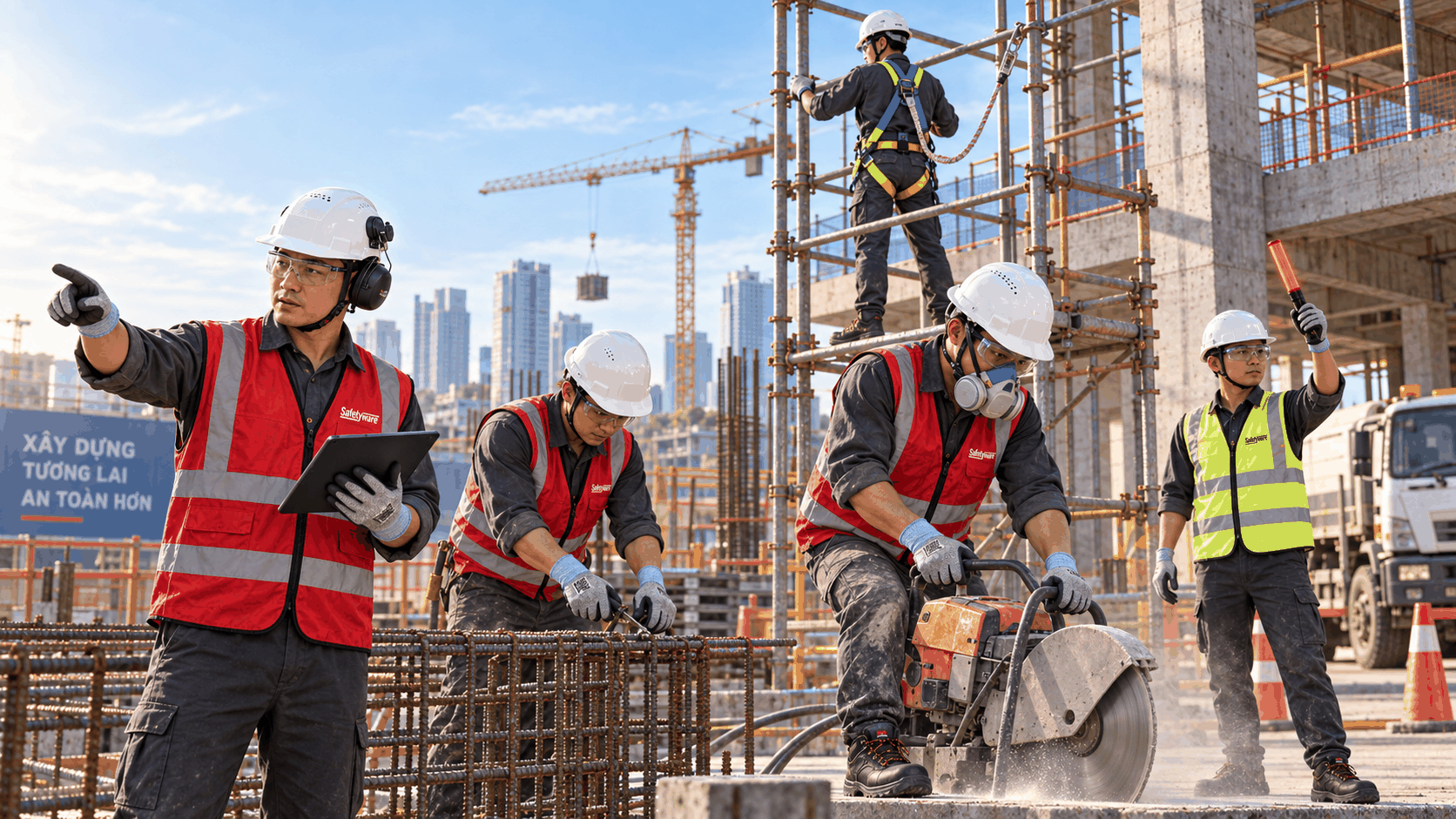
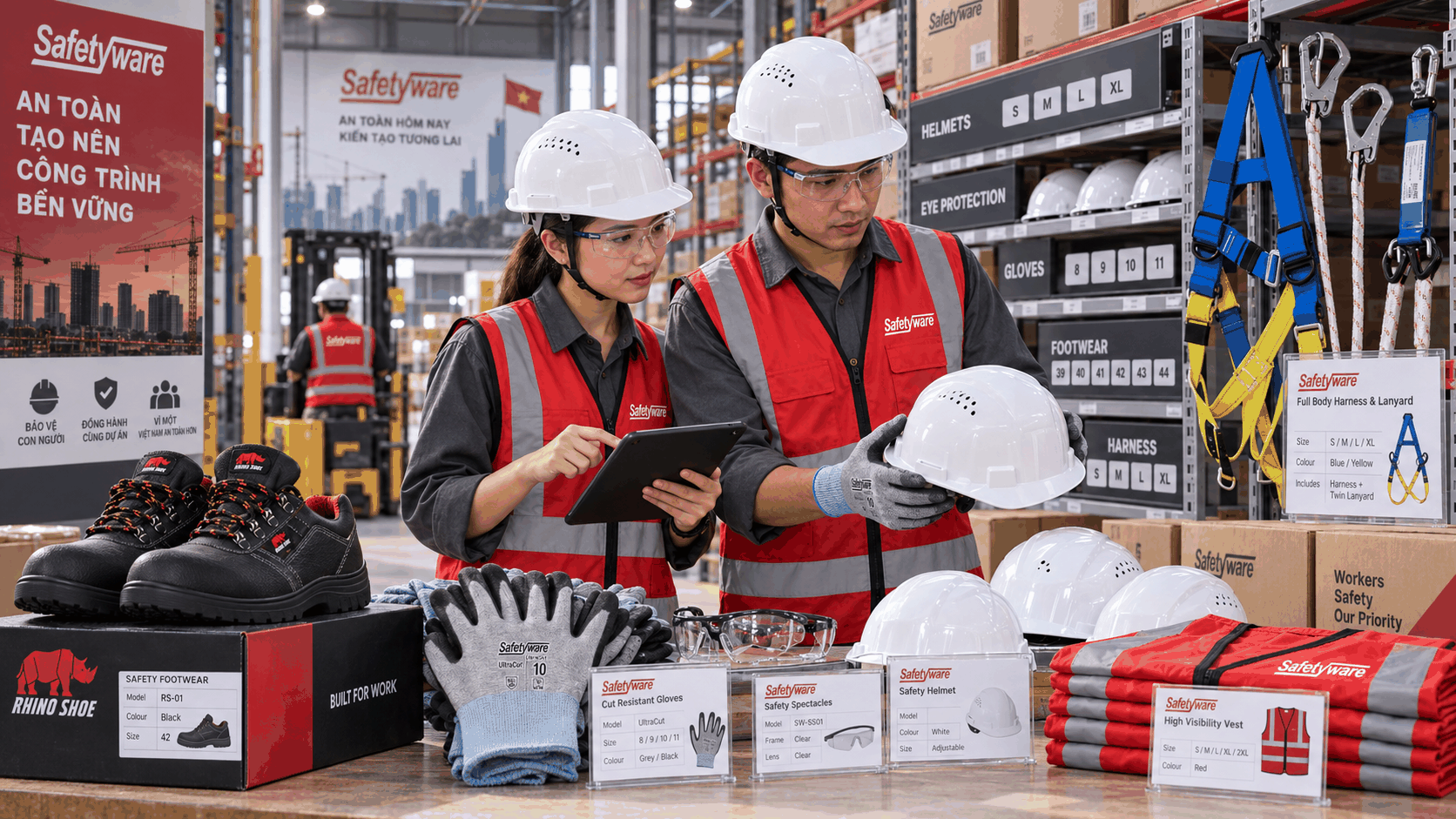
SAFETYWARE supports construction and industrial buyers with head-to-toe PPE categories, including SAFETYWARE-branded equipment, RHINO SHOE safety footwear and selected international brands. Buyers should begin with their hazard matrix and project requirement, then shortlist suitable models and documents.
Head, eye, face and visibility protection
The SAFETYWARE safety-helmet range includes industrial helmet options with different shell, suspension and accessory configurations. In addition, buyers can explore eye and face protection for impact, dust, splash, grinding and welding tasks.
For vehicle routes, lifting zones and low-light work, the high-visibility apparel range provides several vest and garment formats. However, the project traffic plan should define the required visibility performance and garment layout.
Hand, hearing and respiratory protection
Construction teams can compare hand and arm protection by cut, impact, chemical, heat, grip and dexterity needs. Likewise, the hearing-protection range includes ear plugs and earmuffs for assessed noise exposure.
For dust, fume, gas or vapour hazards, review SAFETYWARE’s respiratory-protection range. Most importantly, choose the respirator and filter from the exposure assessment; particulate products do not automatically protect against gas or vapour hazards.
RHINO SHOE safety footwear
SAFETYWARE manufactures RHINO SHOE safety footwear for construction and industrial use. Project buyers can compare toe protection, penetration resistance, outsole grip, upper height, wet-area needs and wearer comfort. Still, they should verify the technical data and accepted certification for the exact model.
Fall-protection systems
The fall-protection range covers harnesses, lanyards, self-retracting lifelines, anchors, connectors, lifelines and rescue-related equipment. For standardised issue packs, buyers can also review full-body harness kits.
However, a kit still requires task review. Confirm anchorage, connector compatibility, fall clearance, edge conditions, inspection, user training and rescue before use.
SAFETYWARE can support regional distributors and project buyers with product comparison, documentation, size planning and quotations. For the best shortlist, provide the job tasks, hazard matrix, accepted standards, quantities, size range and delivery location.
Image placement marker: Place Image 6 after this section to show a coordinated SAFETYWARE construction PPE system on a Vietnamese site.
Conclusion
Effective construction PPE in Vietnam starts with the job, not a generic shopping list. Employers should first remove or reduce hazards through design, collective protection, engineering controls and safe work methods. Then they should provide suitable PPE for the risks that remain.
Vietnam’s occupational safety law, Circular No. 25/2022/TT-BLDTBXH and QCVN 18:2021/BXD provide the core legal framework. However, the exact equipment still depends on the activity, exposure, project rules and accepted product standards.
Therefore, the best procurement process links every item to a hazard, verifies the exact model and documents, checks compatibility and fit, and supports workers with training, inspection, care and timely replacement.
Sources and References
- Government of Vietnam, Law No. 84/2015/QH13 on Occupational Safety and Health
- Government of Vietnam, Circular No. 25/2022/TT-BLDTBXH on provision of personal protective equipment at work
- Vietnam Government Gazette, Circular No. 25/2022/TT-BLDTBXH
- Government of Vietnam, Circular No. 16/2021/TT-BXD issuing QCVN 18:2021/BXD
- Vietnam National Database of Legal Documents, QCVN 18:2021/BXD status and issuing circular
- SAFETYWARE Group, Personal Protective Equipment categories
Legal, standards and product information checked on 4 September 2026. Employers and project teams should confirm the latest Vietnamese legal text, contract requirements and exact product documentation for their worksite.
📞 Need More Information?
Looking for international grade PPE supplier?
Explore SAFETYWARE’s safety shoes and workplace PPE range at
👉Safetyware Catalogs
Our safety specialists can help evaluate workplace hazards, recommend suitable safety helmets, and support compliance with Malaysia workplace safety requirements.
If you need a quotation, feel free to contact us at:
📩 Email: [email protected]
📞 Tel: WhatsApp Us