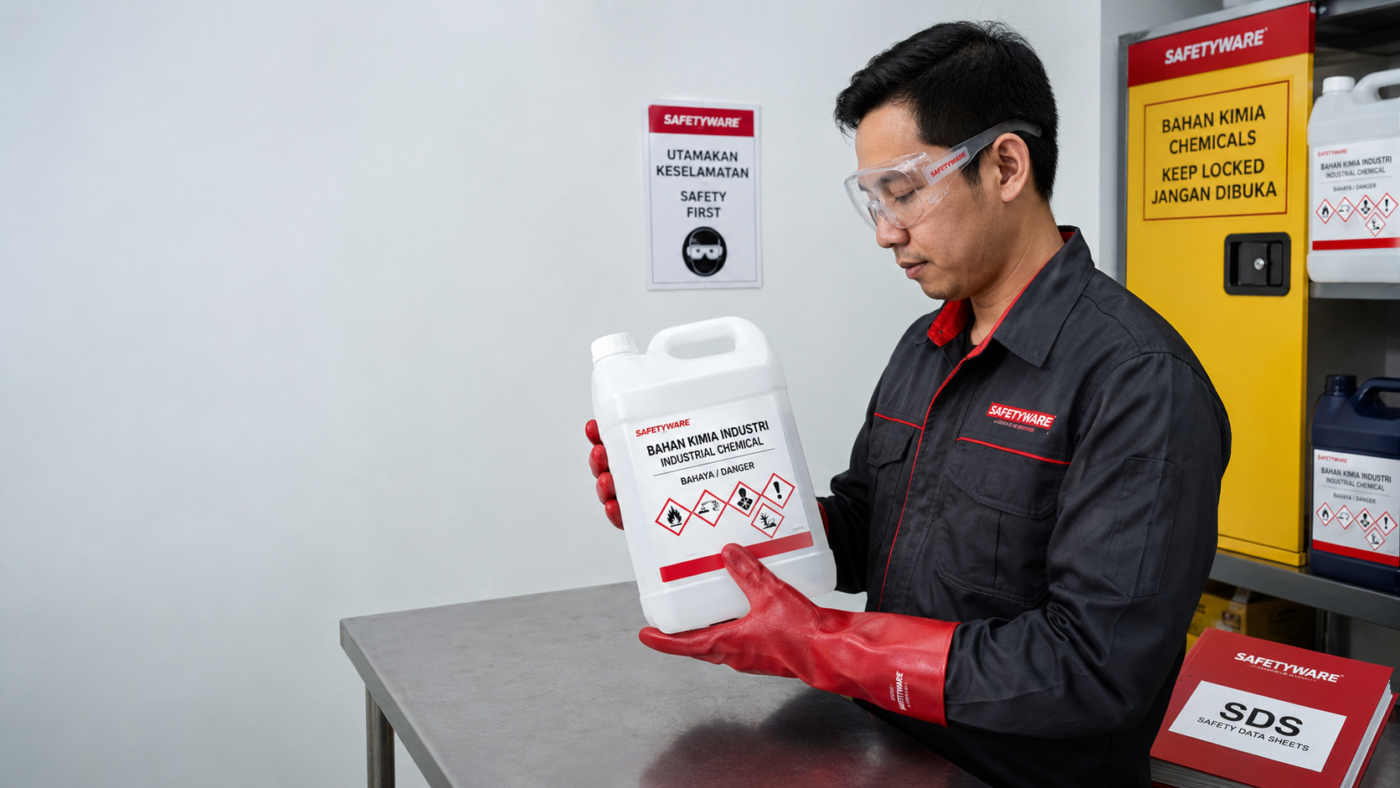
A red diamond with a flame, skull or corroding hand can warn workers about a serious chemical hazard before they open a container. However, the symbol tells only part of the story. Workers must also read the product name, signal word, hazard statements, precautionary statements and Safety Data Sheet (SDS).
More specifically, Malaysia regulates chemical supply labels through the Occupational Safety and Health (Classification, Labelling and Safety Data Sheet of Hazardous Chemicals) Regulations 2013, commonly called the CLASS Regulations. These rules bring the Globally Harmonized System of Classification and Labelling of Chemicals (GHS) into Malaysia’s workplace chemical supply chain.
In addition, this guide explains the nine GHS hazard symbols that Malaysia recognises, the information that a compliant chemical label must show, and the difference between a chemical label and a workplace safety sign. It also gives buyers and safety teams a practical checklist for signs, labels and related protective equipment.
Image placement marker: Place Image 1, the featured image, above this introduction. The complete image-generation brief appears at the end of the article.
Quick Answer: What Do Hazard Symbols Mean?
Hazard symbols show the main types of danger linked to a chemical. For example, a flame can identify a fire hazard, while a skull and crossbones can identify severe acute toxicity. A single product may carry several pictograms because it can create more than one hazard.
In Malaysia, a CLASS pictogram uses a black symbol on a white background inside a red diamond. Nevertheless, the pictogram does not show the full risk for every task. Therefore, always read the whole label and the current SDS before choosing controls or PPE.
The Legal Framework for Chemical Labels in Malaysia
First, the CLASS Regulations apply to chemicals supplied for use at work, subject to exclusions and special provisions in the Regulations. DOSH states that suppliers must handle classification, packaging, labelling, SDS preparation and chemical inventory submissions under this framework.
Specifically, the rules divide suppliers into two broad groups:
- A principal supplier may formulate, manufacture, import, recycle or reformulate a hazardous chemical.
- A subsidiary supplier may repack, distribute or retail a hazardous chemical.
In contrast, employers who use chemicals at work also need to consider the Occupational Safety and Health (Use and Standards of Exposure of Chemicals Hazardous to Health) Regulations 2000, or USECHH Regulations. DOSH explains that USECHH provides the framework for controlling employee exposure to chemicals hazardous to health. For example, employers may need a chemical register, a chemical health risk assessment and suitable exposure controls.
Law, standards and good practice are not the same
For clarity, it helps to separate three ideas:
| Type | What it does | Example |
|---|---|---|
| Malaysian legal requirement | Creates a duty that applies within its legal scope | CLASS requirements for suppliers of workplace hazardous chemicals |
| Approved industry code or guidance | Gives recognised methods and detail for applying the rules | DOSH Industry Code of Practice on Chemicals Classification and Hazard Communication |
| International standard or system | Provides a shared technical language but does not automatically become Malaysian law | UN GHS or ISO safety-sign standards |
Therefore, a company should not assume that every international symbol, foreign label or online template meets Malaysian requirements. Instead, it should check the product, intended use and current Malaysian rules.
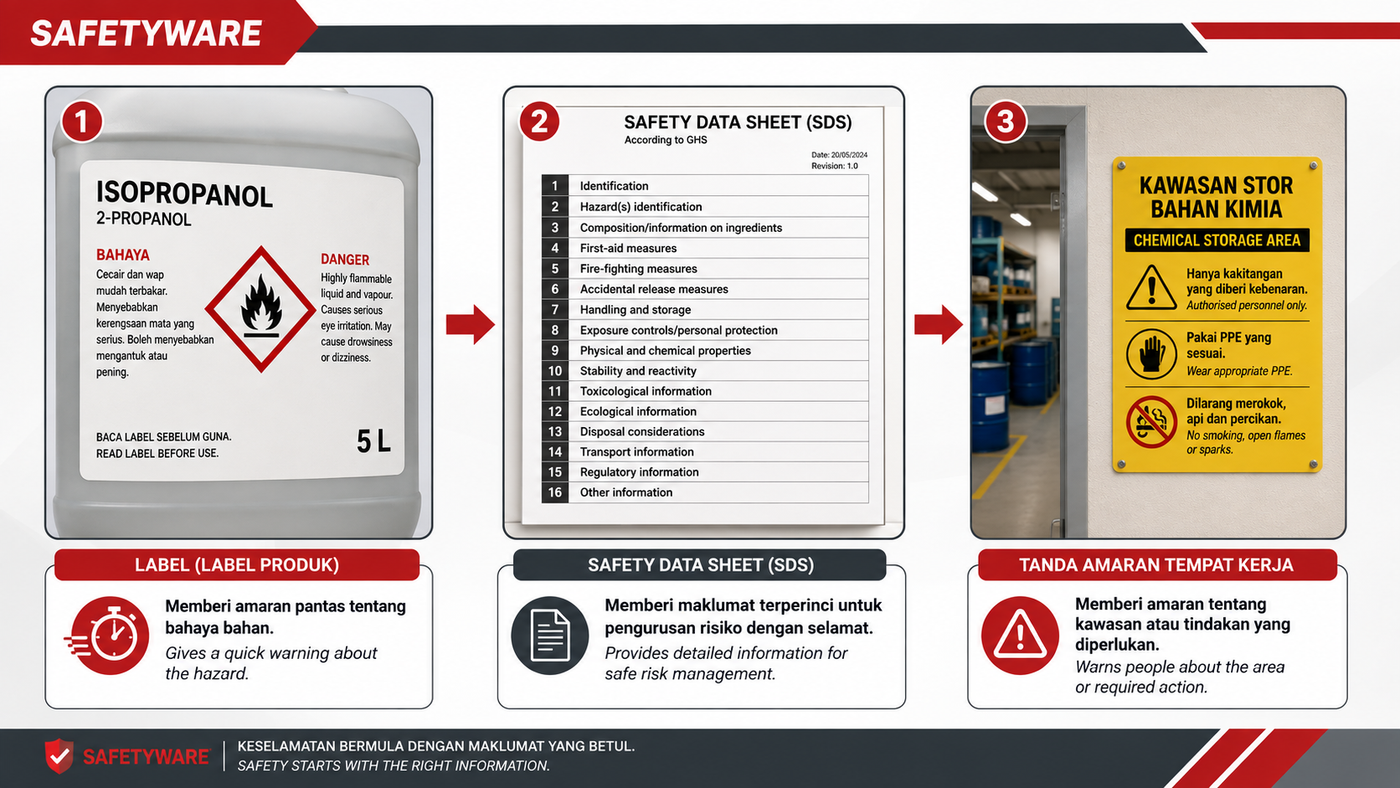
Image placement marker: Place Image 2 after this section to show the legal and practical relationship between a chemical label, an SDS and a workplace sign.
The Nine GHS Hazard Pictograms Used in Malaysia
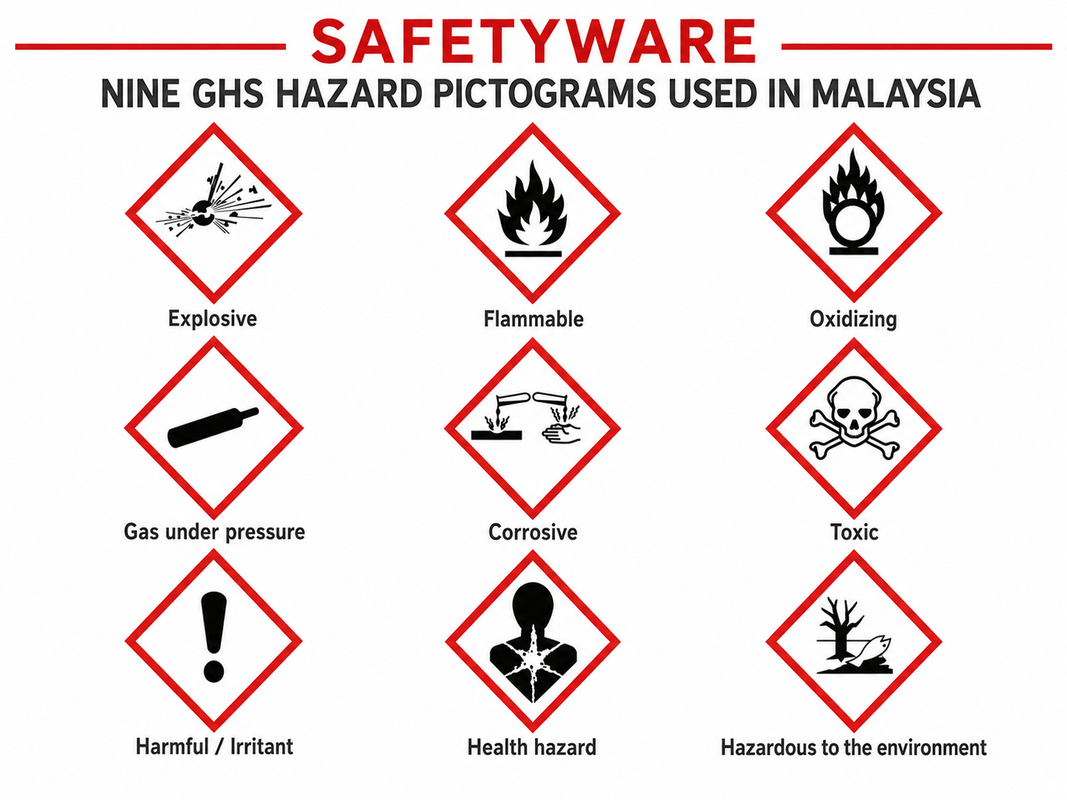
Next, DOSH publishes the following nine hazard pictograms. The table gives a plain-language guide, but the official chemical classification decides which pictogram appears on a label.
| Pictogram | Common meaning | Typical hazard examples | Key point for workers |
|---|---|---|---|
| Exploding bomb | Explosion or severe reactivity hazard | Explosives, some self-reactive chemicals and some organic peroxides | Keep away from heat, shock and friction as the SDS directs. |
| Flame | Fire hazard | Flammable gases, aerosols, liquids or solids; pyrophoric or self-heating chemicals; chemicals that release flammable gas; some self-reactives and organic peroxides | Control ignition sources and follow storage and grounding instructions. |
| Flame over circle | Oxidising hazard | Oxidising gases, liquids and solids | The chemical may intensify a fire even if it does not burn like a fuel. Keep it away from incompatible and combustible materials. |
| Gas cylinder | Gas under pressure | Compressed, liquefied, dissolved or refrigerated liquefied gas | Secure cylinders, protect valves and follow heat and ventilation precautions. The symbol does not, by itself, describe toxicity. |
| Corrosion | Corrosive effects | Severe skin burns, serious eye damage or corrosion of metals, depending on classification | Prevent splashes and contact. Check glove, clothing, eye and face protection against the exact chemical. |
| Skull and crossbones | Severe acute toxicity | Chemicals that can cause fatal or toxic effects after short exposure by relevant routes | Avoid all exposure and follow strict handling, emergency and access controls. |
| Exclamation mark | Harmful or irritating effects | Harmful acute toxicity, skin or eye irritation, skin sensitisation, respiratory irritation or drowsiness, depending on classification | Do not treat this symbol as “minor.” Read the hazard statement to learn the exact effect. |
| Health hazard | Serious or long-term health effects | Cancer, genetic damage, reproductive harm, respiratory sensitisation, organ damage or aspiration hazard, depending on classification | The danger may not cause an immediate warning sign. Control repeated and long-term exposure. |
| Environment | Hazard to the aquatic environment | Acute or long-lasting harm to aquatic life | Prevent release to drains, soil and waterways. Follow spill and disposal instructions. |
Several pictograms cover more than one hazard class. Likewise, some hazard categories do not use a pictogram. As a result, workers should never guess a chemical’s full hazard profile from the symbol alone.
Image placement marker: Place Image 3 after the pictogram table as a clean reference chart of all nine symbols.
How to Read a Malaysian CLASS Chemical Label
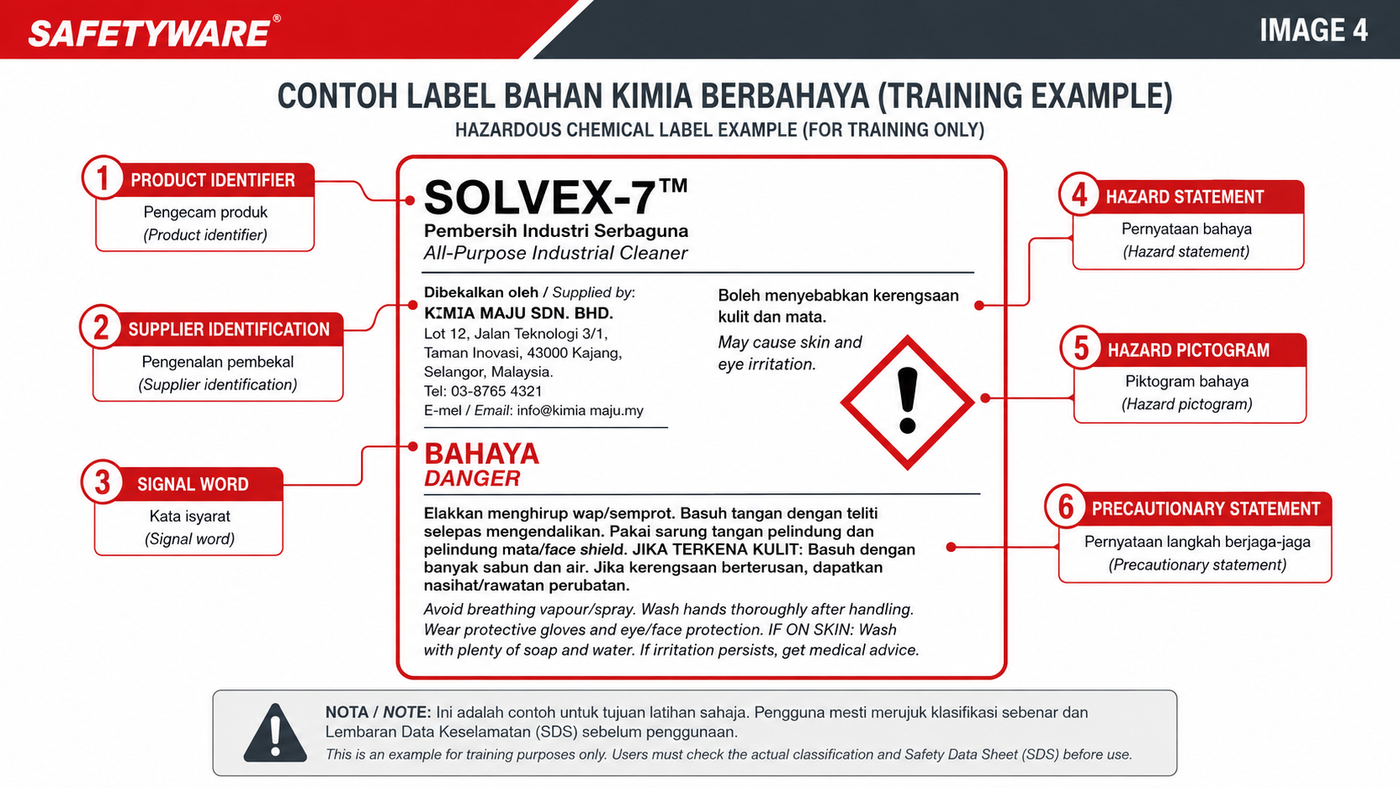
For a normal hazardous-chemical package, Regulation 8 requires the supplier to provide six main items clearly and indelibly. Specifically, the label must include:
- Product identifier – the name or number that identifies the chemical.
- Supplier identification – details that identify the supplier.
- Signal word – either “Danger” for more severe categories or “Warning” for less severe categories, when the classification calls for one.
- Hazard statement – a set phrase that describes the nature and, where relevant, severity of the hazard.
- Hazard pictogram – the red-diamond visual symbol linked to the classification.
- Precautionary statement – recommended steps for prevention, response, storage or disposal.
The label information must appear in Bahasa Malaysia and English. In addition, if the label uses “Danger,” it must not also use “Warning.”
Pictogram format and size
In addition, Regulation 9 sets a specific format. The pictogram must have a black symbol, a white background and a clearly visible red border. It must also form a diamond tilted 45 degrees. Moreover, its area must equal one-fifteenth of the label’s surface area and must not fall below 100 mm².
Small containers
Meanwhile, containers of 125 ml or less follow a reduced label-information rule under Regulation 8(2). The label still needs the product identifier, supplier identification, signal word and applicable pictogram. It must also tell the user to read the SDS before use.
Label updates
If a classification change creates a new and more severe hazard, the supplier must update the label within three months from the date of that change. Consequently, procurement teams should control obsolete stock labels and obtain the latest SDS from the supplier.
Image placement marker: Place Image 4 here to show the anatomy of a bilingual Malaysian CLASS label.
Signal Words, Hazard Statements and Precautionary Statements
At first, many workers look at the pictogram. However, the words beside it often give the most useful detail.
“Danger” and “Warning”
The signal word shows relative hazard severity within the GHS system:
- Danger points to more severe hazard categories.
- Warning points to less severe hazard categories.
Still, the absence of a signal word does not prove that a product is harmless. Some classifications may use a hazard statement without a signal word or pictogram.
Hazard statements
Hazard statements explain the classified danger. For instance, the same broad pictogram can cover different effects. Therefore, “causes serious eye damage” and “may cause respiratory irritation” lead to different control decisions even though both labels use familiar GHS elements.
Precautionary statements
Precautionary statements describe actions such as:
- preventing exposure;
- responding to a spill, fire or contact;
- storing the product safely; and
- disposing of the chemical or container correctly.
Treat these statements as essential instructions, not optional label text. Then check the SDS for fuller details, including incompatibilities, first aid, firefighting measures, exposure controls and PPE guidance.
Hazard Pictograms vs Workplace Safety Signs
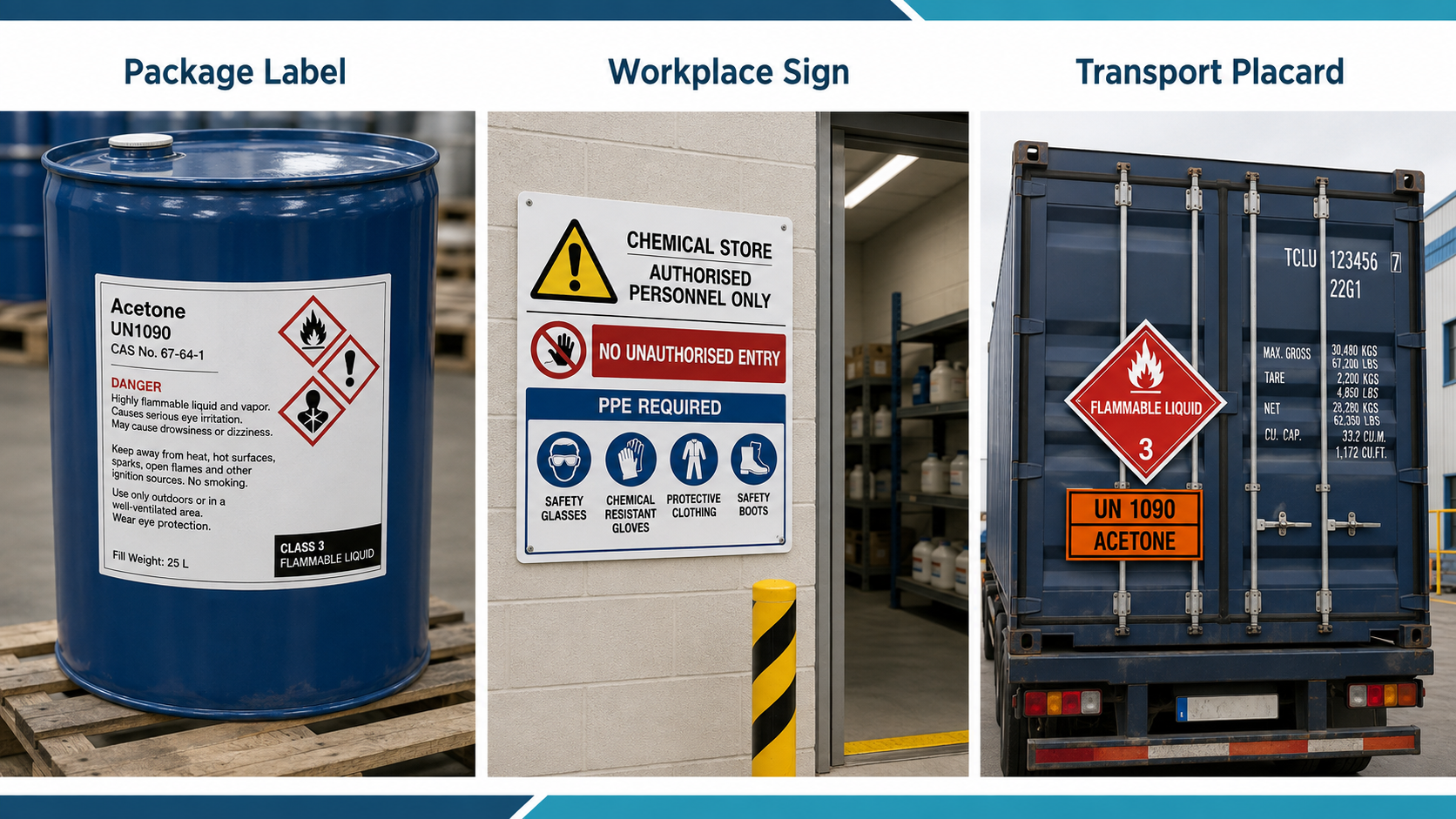
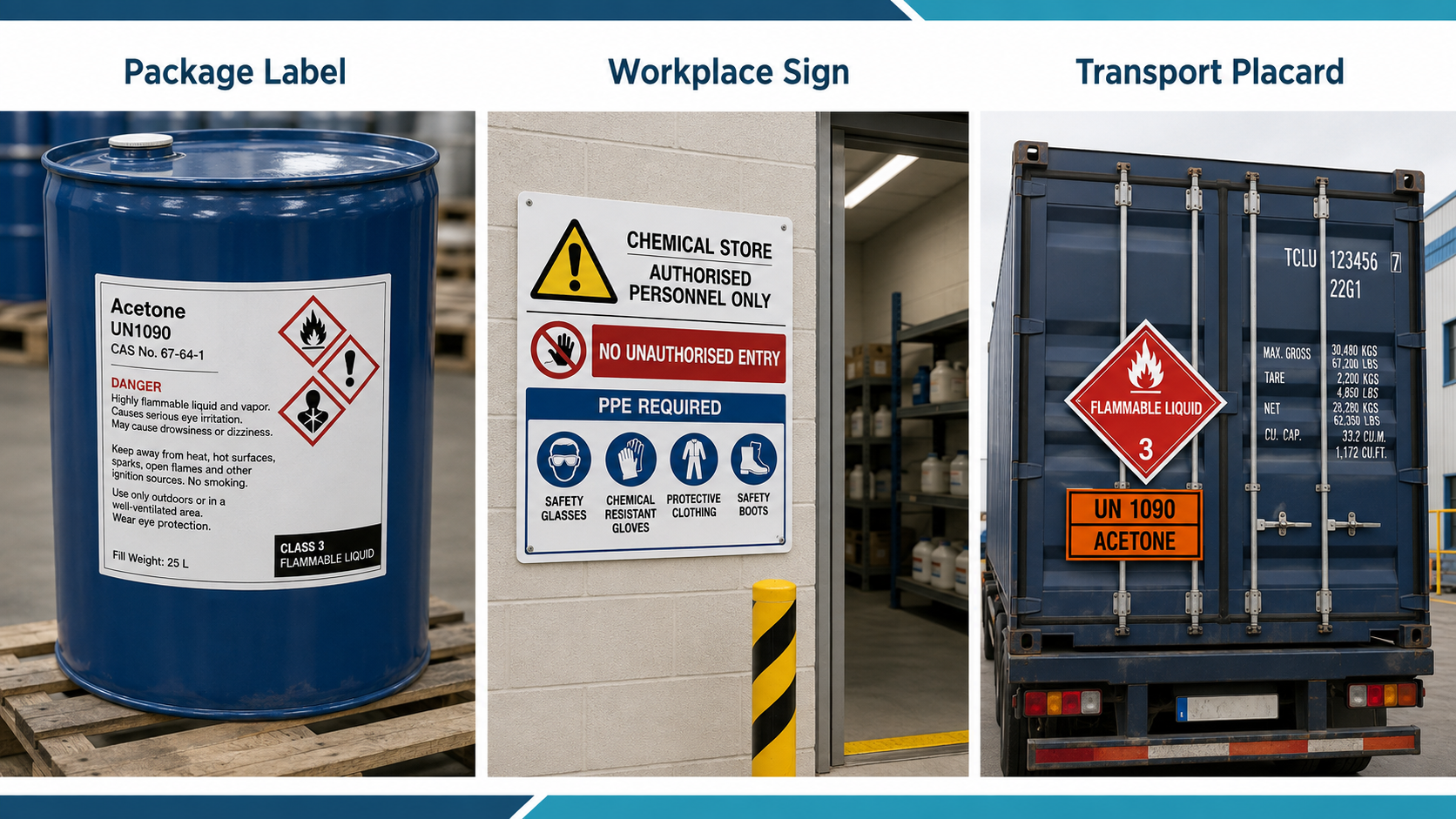
In practice, people often use “hazard symbol,” “warning label” and “safety sign” as if they mean the same thing. Yet each item has a different purpose.
| Communication tool | Main purpose | Where you usually find it |
|---|---|---|
| GHS/CLASS hazard pictogram | Communicates a chemical’s classified hazard | Chemical package or label |
| Hazard and precaution statements | Explain the hazard and recommended actions | Chemical label and SDS |
| Workplace warning sign | Warns people about a hazard in an area or at a task | Doors, walls, tanks, process areas or storage zones |
| Mandatory PPE sign | Tells people which action or PPE the site requires | Entry points or workstations |
| Transport dangerous-goods label or placard | Communicates transport hazards under transport rules | Packages, vehicles, freight containers or tanks |
A workplace may need more than one system. For example, a flammable-liquid store can have CLASS-labelled containers, a workplace “No Smoking” sign and the correct transport marks on outgoing goods. One sign does not replace the others.
Moreover, do not copy a GHS pictogram onto a site sign without checking its purpose. A supplier label communicates the chemical classification, whereas a workplace sign communicates a location or behaviour rule.
Image placement marker: Place Image 5 after this comparison to show the difference between a package label, an area warning sign and a transport placard.
Common Mistakes When Using Chemical Warning Labels
1. Choosing PPE from the pictogram alone
For example, the corrosion symbol does not identify a suitable glove material. Similarly, the health-hazard symbol does not identify the correct respirator or cartridge. Instead, check the exact chemical, concentration, exposure route, task, duration and SDS. Then use a documented risk assessment.
2. Covering or damaging the original label
Likewise, tape, dirt, condensation and poor storage can hide key information. Therefore, keep labels readable throughout storage and handling, and address damaged labels through the site’s approved procedure.
3. Using an English-only label for Malaysian workplace supply
CLASS requires the specified information in the national language and English. Thus, an imported label may need review before the chemical enters the Malaysian workplace supply chain.
4. Treating “Warning” as safe
“Warning” describes relative severity within a classified hazard. It does not mean workers can ignore controls.
5. Confusing oxidisers with flammables
The flame-over-circle symbol marks an oxidising hazard. An oxidiser can make another material burn more fiercely. Therefore, storage compatibility matters even when the oxidiser itself is not a fuel.
6. Keeping an SDS that does not match the product
The product identifier on the label should match the SDS. In addition, teams should control the SDS version and make it available to the people who need it.
Practical Chemical Label and Signage Checklist
Finally, use this checklist during receiving, storage and workplace inspections:
- Match the product identifier on the container to the SDS.
- Confirm that the label stays clear, fixed and readable.
- Check for Bahasa Malaysia and English label information.
- Read every pictogram, signal word and hazard statement.
- Review the precautionary statements for prevention, response, storage and disposal.
- Check whether the classification or SDS has changed.
- Keep incompatible chemicals apart according to the SDS and risk assessment.
- Mark storage and process areas with suitable workplace safety signs.
- Train workers to understand both chemical labels and site signs.
- Select PPE for the chemical, concentration, task and exposure route—not the symbol alone.
- Check emergency equipment, spill response materials and access routes.
- Verify any transport label or placard separately under the applicable transport rules.
This checklist supports daily control, but it does not replace a competent chemical risk assessment or the current legal text.
SAFETYWARE Products and Solutions
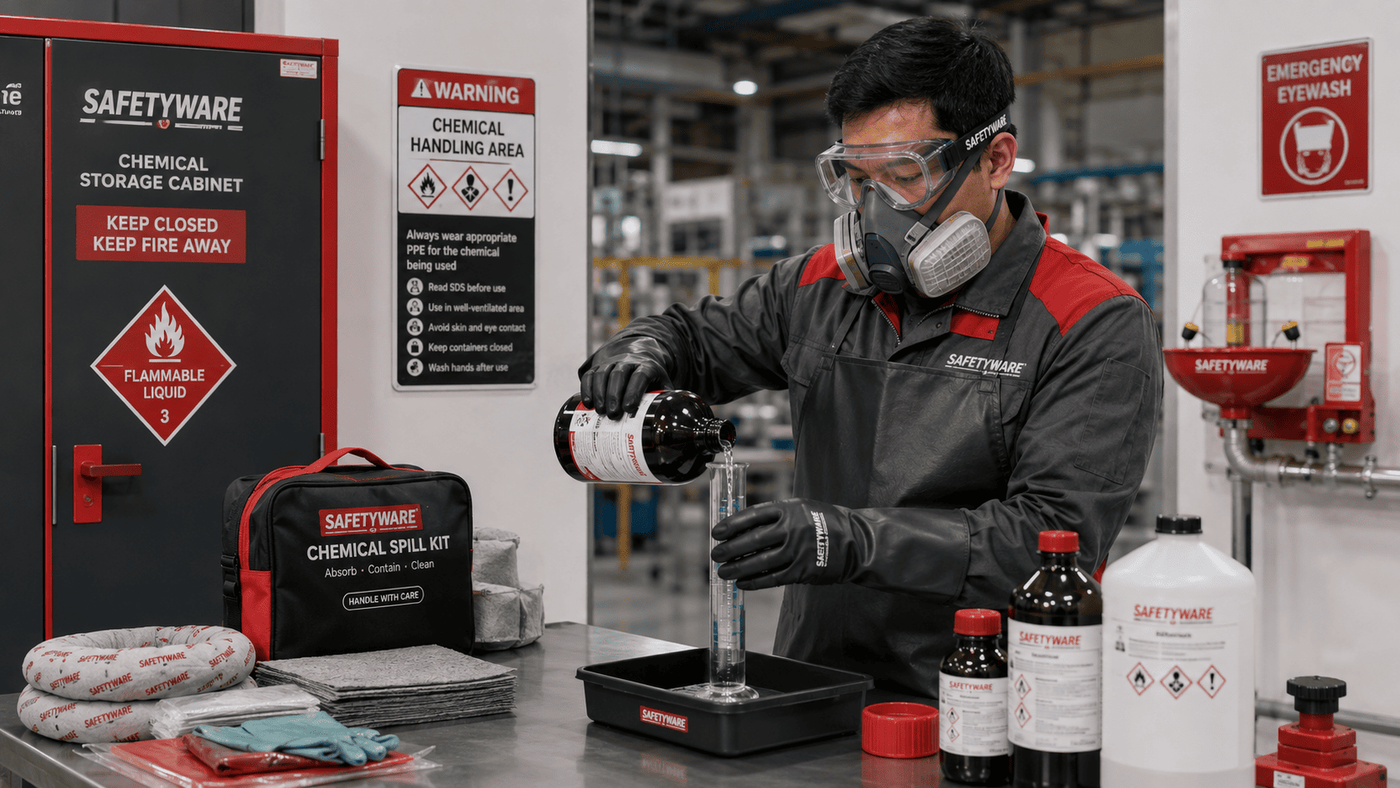
Most importantly, clear hazard communication works best when companies link labels and signs to suitable controls. SAFETYWARE Group offers several relevant product and solution categories for Malaysian workplaces.
Chemical safety signs and labels
QuickSign, a SAFETYWARE Group division, provides signage, labels and digital printing, including chemical safety signs and hazardous-substance label signs.
Before production, confirm the message, language, symbol, dimensions, viewing distance, substrate, chemical resistance and installation method. Next, approve the final artwork against the applicable CLASS, site or transport requirement. A general warning sign should not replace a supplier’s compliant chemical label.
Chemical PPE
SAFETYWARE supplies chemical-resistant gloves, chemical splash goggles, chemical-resistant body protection and a broad range of respiratory protection.
However, buyers should not select a product from a pictogram alone. For example, compare the exact chemical against glove permeation, breakthrough and degradation data. In addition, consider splash direction and impact risk for eye and face protection. For respirators, identify the contaminant, concentration, oxygen level, required protection factor, filter or cartridge limits, fit-testing needs and change schedule.
Spill and emergency response
The spill-control range includes chemical spill-control categories, while the emergency eyewash and shower range supports emergency decontamination planning.
Again, match the solution to the chemical and the risk assessment. For example, check sorbent compatibility, spill volume, response training, disposal route and the location of emergency equipment before purchase.
SAFETYWARE can help buyers compare these categories, but the employer or duty holder should make the final selection through its risk assessment and applicable legal process.
Image placement marker: Place Image 6 after this section to show an integrated SAFETYWARE chemical-safety setup with signs, PPE, spill control and emergency equipment.
Conclusion
Hazard symbols give workers a fast visual warning, but they never tell the whole story. In Malaysia, the CLASS framework links each pictogram to a product identifier, supplier details, a signal word, hazard statements and precautionary statements in Bahasa Malaysia and English.
Therefore, safety teams should teach workers to read the complete label, confirm the SDS and assess the real exposure before selecting controls. They should also keep chemical labels separate from workplace signs and transport placards, because each system serves a different purpose.
When organisations combine correct labels, clear signs, sound procedures and properly selected PPE, workers can identify chemical hazards sooner and respond more safely.
Sources and References
- Department of Occupational Safety and Health (DOSH), CLASS Regulations overview and official resources
- Attorney General’s Chambers of Malaysia, Occupational Safety and Health (Classification, Labelling and Safety Data Sheet of Hazardous Chemicals) Regulations 2013, P.U. (A) 310
- DOSH, official hazard pictograms
- DOSH, USECHH Regulations overview and guidance
- United Nations Economic Commission for Europe, Globally Harmonized System of Classification and Labelling of Chemicals, Revision 11 (2025)
- SAFETYWARE Group, PPE, safety equipment and workplace solutions
Legal and product information checked on 2 September 2026. Organisations should confirm the latest legal text, DOSH guidance, SDS and product documentation for their specific chemicals and workplace.
📞 Need More Information?
Looking for Hazard Symbols and Warning Labels for your workplace?
Explore SAFETYWARE’s safety shoes and workplace PPE range at
👉Safetyware Catalogs
Our safety specialists can help evaluate workplace hazards, recommend suitable safety helmets, and support compliance with Malaysia workplace safety requirements.
If you need a quotation, feel free to contact us at:
📩 Email: [email protected]
📞 Tel: WhatsApp Us