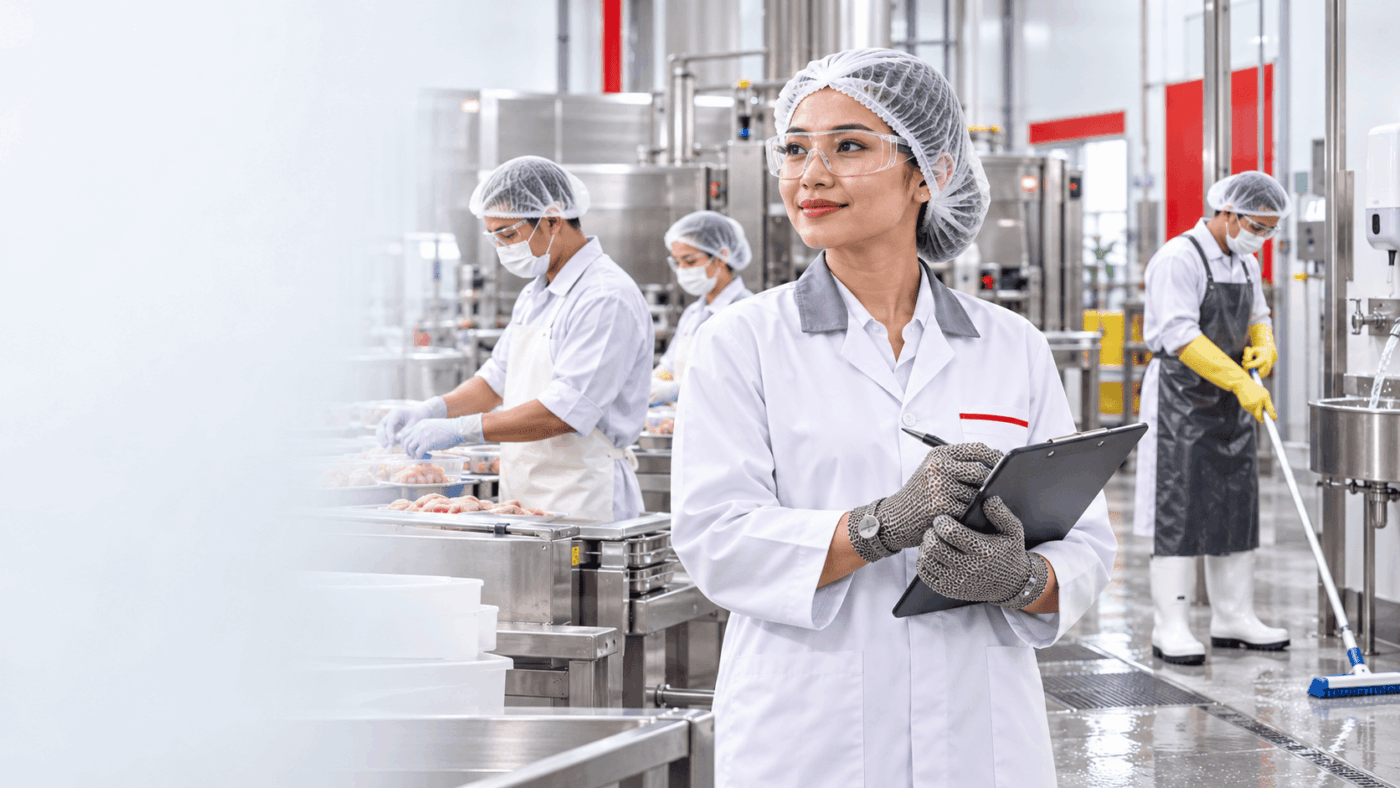
Food manufacturers must manage two connected goals: protect workers from harm and protect food from contamination. Although the same clothing may support both goals, not every hygiene item qualifies as worker-protection PPE.
For example, a hair cover mainly keeps hair away from food. By contrast, a cut-resistant glove protects a worker from a blade. Meanwhile, a chemical glove may protect the worker during sanitation, but the site must still confirm that its material suits the cleaning chemical and the task.
Therefore, Malaysian food factories need a risk-based system rather than one standard kit for every employee. This guide explains the legal framework, common hazards and practical selection steps for PPE in food manufacturing in Malaysia.
PPE and Food-Hygiene Clothing Are Not the Same
Food-hygiene clothing prevents a person from contaminating food, food-contact surfaces or a controlled processing zone. Common examples include hairnets, beard covers, clean overalls, aprons and shoe covers.
Worker-protection PPE reduces exposure to a safety or health hazard. Examples include safety goggles, chemical-resistant gloves, cut-resistant gloves, hearing protectors and protective footwear.
Some items perform both roles. A liquid-resistant apron, for instance, may keep a uniform clean and reduce splash contact. However, buyers should confirm its protective limits instead of assuming that every disposable apron resists hazardous chemicals, heat or sharp objects.
| Item | Main purpose | Important limitation |
|---|---|---|
| Hairnet or mob cap | Food contamination control | Does not protect against impact |
| Beard cover | Food contamination control | Does not provide respiratory protection |
| Disposable food-handling glove | Hygiene and short-duration handling | Does not automatically protect against chemicals, cuts or heat |
| Chemical-resistant glove | Worker protection from selected chemicals | Must match the chemical, concentration, contact time and task |
| Cut-resistant glove | Worker protection from cut hazards | Does not automatically resist puncture, chemicals or powered blades |
| Slip-resistant footwear | Worker protection from slipping | “Slip-resistant” does not mean slip-proof in every contaminant |
| Safety goggle or face shield | Eye or face protection | A face shield may need safety goggles underneath for splash protection |
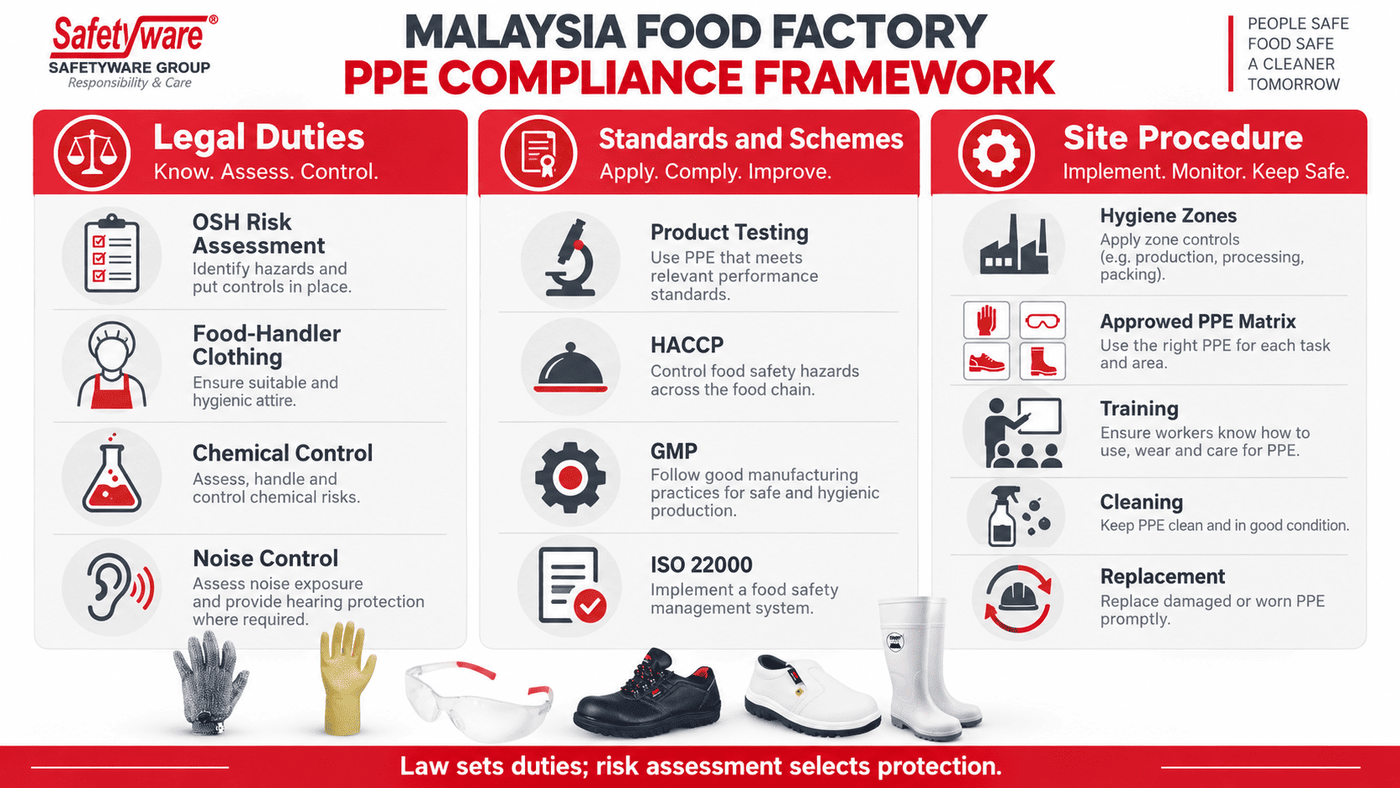
Malaysian Legal Requirements for Food-Factory PPE
Several laws and regulations can apply at the same time. As a result, managers should avoid treating a food-safety audit checklist as a complete occupational safety programme.
Occupational Safety and Health Act 1994
Malaysia’s Occupational Safety and Health Act 1994 applies broadly to places of work. The updated text, which includes amendments effective from 1 June 2024, requires employers to ensure the safety, health and welfare of employees so far as practicable.
Section 18B also requires every employer, self-employed person or principal to conduct a safety and health risk assessment. When that assessment shows a need for controls, the responsible party must implement them.
Therefore, the law does not create one universal “food factory PPE list.” Instead, each factory must assess its actual hazards and control them. The employer should first consider elimination, safer materials, guarding, enclosure, ventilation and safe work methods. Then, the employer should use suitable PPE for the remaining risk.
Moreover, section 26 prevents employers from charging employees for measures provided under the Act. Employers should include issue, replacement, cleaning, storage and training costs in the PPE programme.
Food Hygiene Regulations 2009
The Food Hygiene Regulations 2009 protect food and consumers. Regulation 32 requires a food handler to wear clean, suitable and proper clothing that does not contaminate food. It also requires a clean, suitable, light-coloured outer overall or apron, head cover and footwear, unless the authorised officer accepts other suitable clothing.
In addition, the specified outer clothing must remain within the food premises and go into a suitable cupboard or locker when not in use. Regulation 33 requires high personal cleanliness and handwashing at key times. It also requires food handlers to remove their overall, head cover or apron before visiting the toilet.
Gloves do not replace these duties. A worker can contaminate food while wearing dirty gloves just as easily as with dirty hands. Therefore, glove procedures should state when workers must wash hands, change gloves and dispose of single-use items.
Cleaning and sanitation chemicals
Food plants often use detergents, disinfectants, sanitisers, acids, alkalis and other chemicals. Where a chemical hazardous to health is present, the Occupational Safety and Health (Use and Standards of Exposure of Chemicals Hazardous to Health) Regulations 2000 may apply.
The employer should assess the chemical risk and follow the required control hierarchy. When approved PPE remains necessary, the site should select it from the chemical health risk assessment, safety data sheet and actual exposure conditions. A disposable food glove should not replace a chemical-resistant glove unless its documented performance suits that exposure.
Occupational noise
Mixers, compressors, conveyors, filling lines, canning systems and packaging equipment can create harmful noise. The Occupational Safety and Health (Noise Exposure) Regulations 2019 require employers to identify excessive noise exposure, carry out the required assessment and implement controls.
Hearing protectors may form part of that programme. However, the employer should control noise at source where practicable and select protectors according to the measured exposure, fit, communication needs and hygiene conditions.
DOSH approval and product documents
DOSH identifies several PPE groups that require approval for workplace use, including head protection, foot protection, hearing protection, chemical eye, hand and body protection, and chemical respiratory protection. The exact approval scope depends on the product and its intended hazard.
Consequently, buyers should confirm whether a selected model falls within a DOSH approval category. They should also verify the model, approval number, validity and supporting SIRIM documents through current official records. Ordinary hygiene apparel does not automatically fall into the same approval route as hazard-protection PPE.
Law, Standards and Common Industry Practice
The following sources serve different purposes:
| Source | Role | Status |
|---|---|---|
| OSH Act 1994 and applicable regulations | Protect workers and create enforceable duties | Legal requirement within scope |
| Food Act 1983 and Food Hygiene Regulations 2009 | Protect food and consumers; set food-premises and food-handler duties | Legal requirement within scope |
| Product standards such as EN ISO 20345, EN 388, EN ISO 374, EN 407 and EN 511 | Describe test methods, markings and performance categories | Standards; not a complete risk assessment and not automatically mandatory unless adopted |
| HACCP, GMP and ISO 22000 systems | Help a business manage food-safety risks and records | Scheme, standard or customer requirement depending on the business |
| Company hygiene and PPE procedure | Defines local zones, colours, change rules and approved products | Site requirement; it must remain consistent with the law |
A certification mark does not prove suitability for every task. For example, two chemical gloves may meet the same broad standard but resist different chemicals for different lengths of time. Therefore, buyers must check the test detail and intended use.
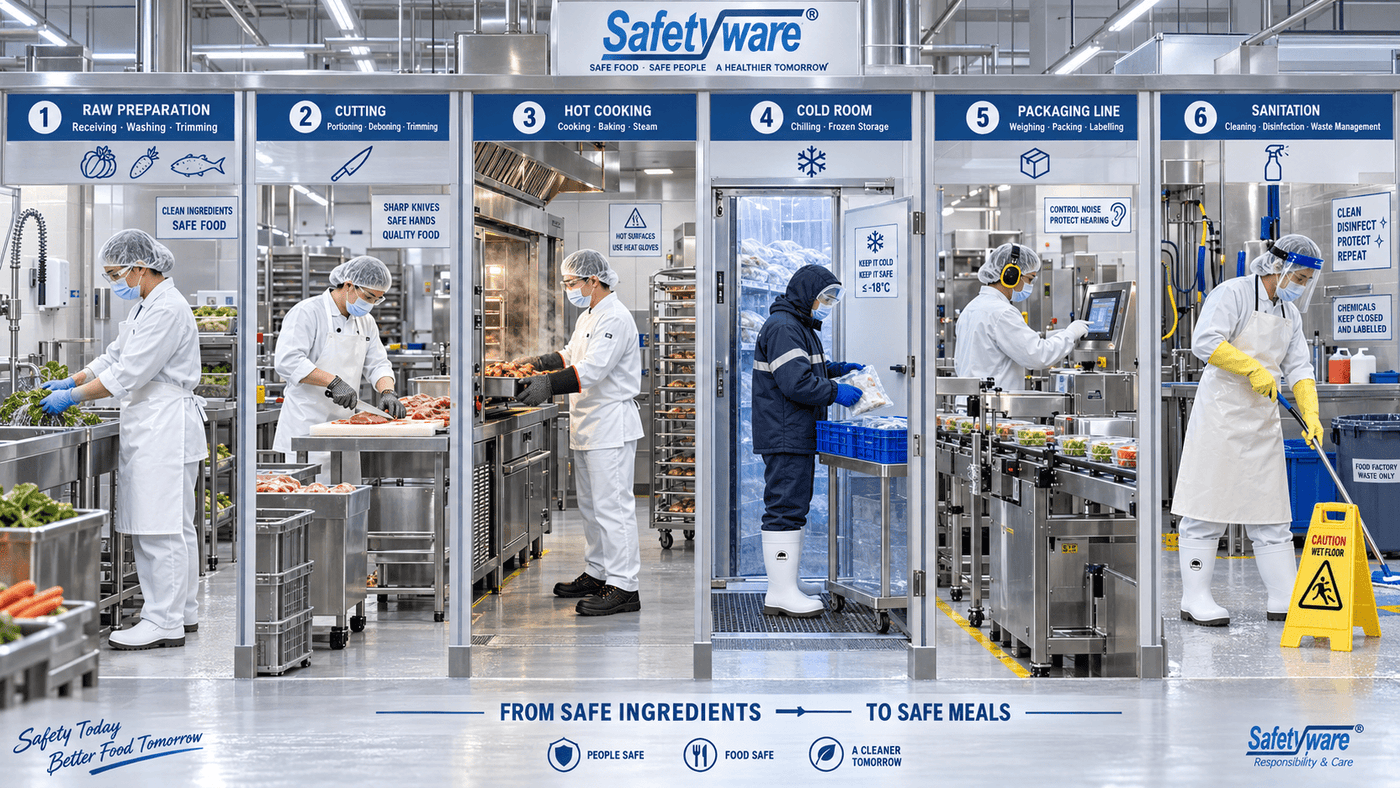
Common Hazards and PPE Selection Matrix
Food manufacturing covers many processes, from raw-material handling to cooking, freezing and packing. This matrix provides a starting point, not a substitute for a site assessment.
| Area or task | Main hazards | Typical hygiene or PPE controls | Selection notes |
|---|---|---|---|
| Raw-food receiving and preparation | Contamination, wet floors, cold surfaces, manual handling | Clean workwear, head cover, suitable gloves, slip-resistant footwear | Separate raw and ready-to-eat zones; match gloves to both hygiene and hazard needs |
| Cutting, trimming and deboning | Knives, sharp edges, puncture and cut risk | Cut-resistant or task-specific hand and arm protection, apron where assessed, slip-resistant footwear | Do not use loose gloves near rotating machinery; powered blades need guarding and safe systems |
| Cooking, baking and frying | Hot surfaces, steam, hot liquid and oil splash | Heat-resistant gloves, suitable apron, eye or face protection where splash risk exists | Check contact-heat limits, cuff length, dexterity and wet performance |
| Cold room or frozen-food handling | Cold contact, reduced dexterity, condensation and slips | Cold-resistant gloves, thermal clothing, insulated or suitable footwear | Balance warmth with grip and fine handling needs |
| Mixing dry ingredients | Airborne dust, eye irritation and manual handling | Enclosure or extraction first; suitable eye and respiratory protection if assessment requires it | Select respirators from measured or assessed exposure, not from dust visibility alone |
| Filling and packaging | Repetitive work, pinch points, noise and product contamination | Hygiene apparel, suitable gloves, hearing protection where required | Machine guarding and ergonomic controls come before PPE |
| Cleaning and sanitation | Chemical splash, wet floors, pressure spray and biological residue | Chemical gloves, goggles and/or face protection, apron or suit, boots, respiratory protection where assessed | Follow the SDS and chemical assessment; never mix incompatible chemicals |
| Maintenance and engineering | Stored energy, sharp parts, electrical hazards and tools | Task-specific gloves, safety glasses, safety footwear, hearing protection and lockout devices | Isolate hazardous energy and control tools, parts and clothing before re-entering food zones |
| Warehouse and loading bay | Vehicles, falling loads, impact and foot injury | High-visibility clothing, safety footwear, head protection where risk exists | Separate pedestrian and vehicle routes; PPE does not replace traffic controls |
Essential PPE and Hygiene Apparel by Body Area
Head and facial-hair control
Food handlers should fully contain hair in the required zone. In addition, workers with facial hair may need beard covers under the site’s hygiene procedure. Buyers should choose sizes and elastic designs that stay secure throughout the shift without causing discomfort.
However, a mob cap or hairnet does not protect against falling objects. Maintenance workshops, warehouses or construction work inside a factory may need approved industrial head protection based on the impact risk.
Hand protection
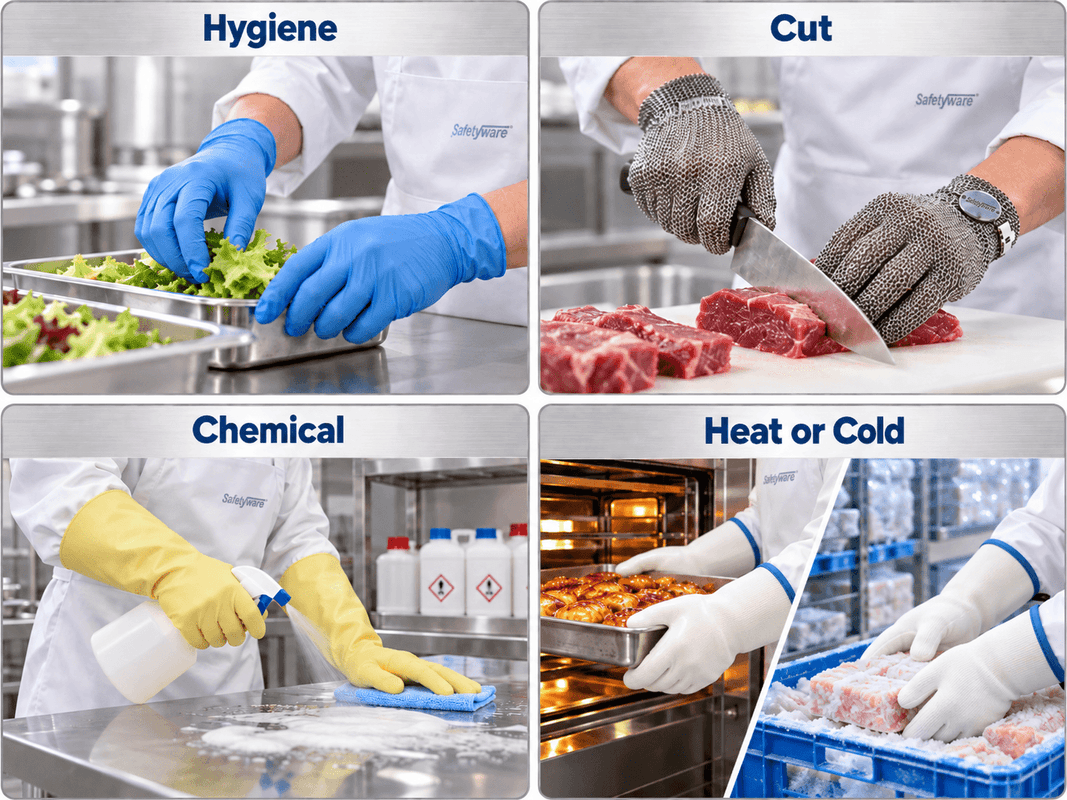
No single glove covers every food task. Therefore, divide hand protection into clear groups.
Disposable food-handling gloves
Disposable nitrile, latex, vinyl or polyethylene gloves can support hygiene and short-duration work. First, check whether the material suits direct food contact under the company’s food-safety controls. Next, assess allergies, powder, thickness, grip, tear risk and change frequency.
Workers should replace gloves after contamination, damage, task changes and any event defined by the hygiene plan. In addition, they should wash their hands at the times required by the Food Hygiene Regulations and the site procedure.
Cut-resistant gloves
Workers who use knives or handle sharp packaging may need cut-resistant gloves. Select the protection level from the task and injury risk. Also check grip, dexterity, cuff coverage, cleaning method and fibre-shedding risk.
A cut rating does not cover every hazard. For example, cut-resistant textile gloves may not resist a knife point, powered blade, chemical or high heat. Consequently, the site should specify the exact glove for each workstation.
Chemical-resistant gloves
Sanitation teams need gloves that match the cleaning chemical. Review the safety data sheet, chemical concentration, temperature, expected contact time and glove breakthrough data. Then, choose the required length and decide whether the glove can be reused safely.
Heat- and cold-resistant gloves
Heat-resistant gloves may suit ovens, hot trays and selected cooking tasks. Meanwhile, cold-resistant gloves help in freezers and chilled handling. Still, moisture changes performance. A wet glove can transfer heat or cold faster and may reduce grip, so the site should test it under real working conditions.
Protective clothing and aprons
The Food Hygiene Regulations set clothing duties for food handlers. In practice, factories may use washable coats, overalls, disposable gowns, aprons and sleeve covers according to zone and task.
Choose clothing that limits loose parts and keeps fasteners away from exposed food. Furthermore, define where workers put it on, remove it, store it and dispose of it. Reusable garments need a controlled laundry process, while single-use items need a clear change and waste route.
For chemical cleaning, verify the apron or suit material against the chemical. For hot-liquid work, assess thermal and splash performance separately.
Eye and face protection
Safety glasses can protect against flying particles during maintenance or packaging tasks. However, chemical splash work often needs sealed or suitable splash goggles. A face shield can add facial coverage, but it may not replace goggles where liquid can pass around the shield.
Food plants should also consider fogging, cleaning, optical clarity and compatibility with hearing or respiratory protection. If workers constantly remove fogged eyewear, the selection has failed in practice.
Foot protection
Wet and greasy floors create a major slip risk. Start with drainage, cleaning, spill response and suitable flooring. Then, select footwear with tested slip performance for the expected floor and contaminant.
“Oil-resistant” usually describes how a sole material resists oil-related damage. It does not automatically prove strong slip resistance on an oily tile. Likewise, a slip test under one condition cannot guarantee grip in every food process.
Toe protection may suit warehouses, engineering areas and heavy raw-material handling. Waterproof PVC Wellington boots can support wet processing and washdown tasks. Nevertheless, buyers should also check fit, sole pattern, cleaning design, toe and midsole needs, cold conditions and any current DOSH approval requirement.
Hearing protection
Earplugs and earmuffs can reduce noise exposure when correctly selected and worn. Yet overprotection can make alarms and communication harder to hear. Therefore, use noise-assessment data and provide fit training.
For hygiene zones, consider clean storage, disposable versus reusable options and how workers will handle protectors without contaminating gloves or food-contact tasks.
Respiratory protection
Factories should control flour, spice, additive or other airborne dust through closed transfer, local exhaust or other engineering measures. If residual exposure requires a respirator, the respiratory programme should cover selection, approval, fit, training, inspection and replacement.
A surgical or hygiene mask does not automatically provide occupational respiratory protection. Moreover, chemical vapours require a different selection process from food dust. Always use the risk assessment, exposure information and manufacturer instructions.
Hygiene Zoning and Colour Coding
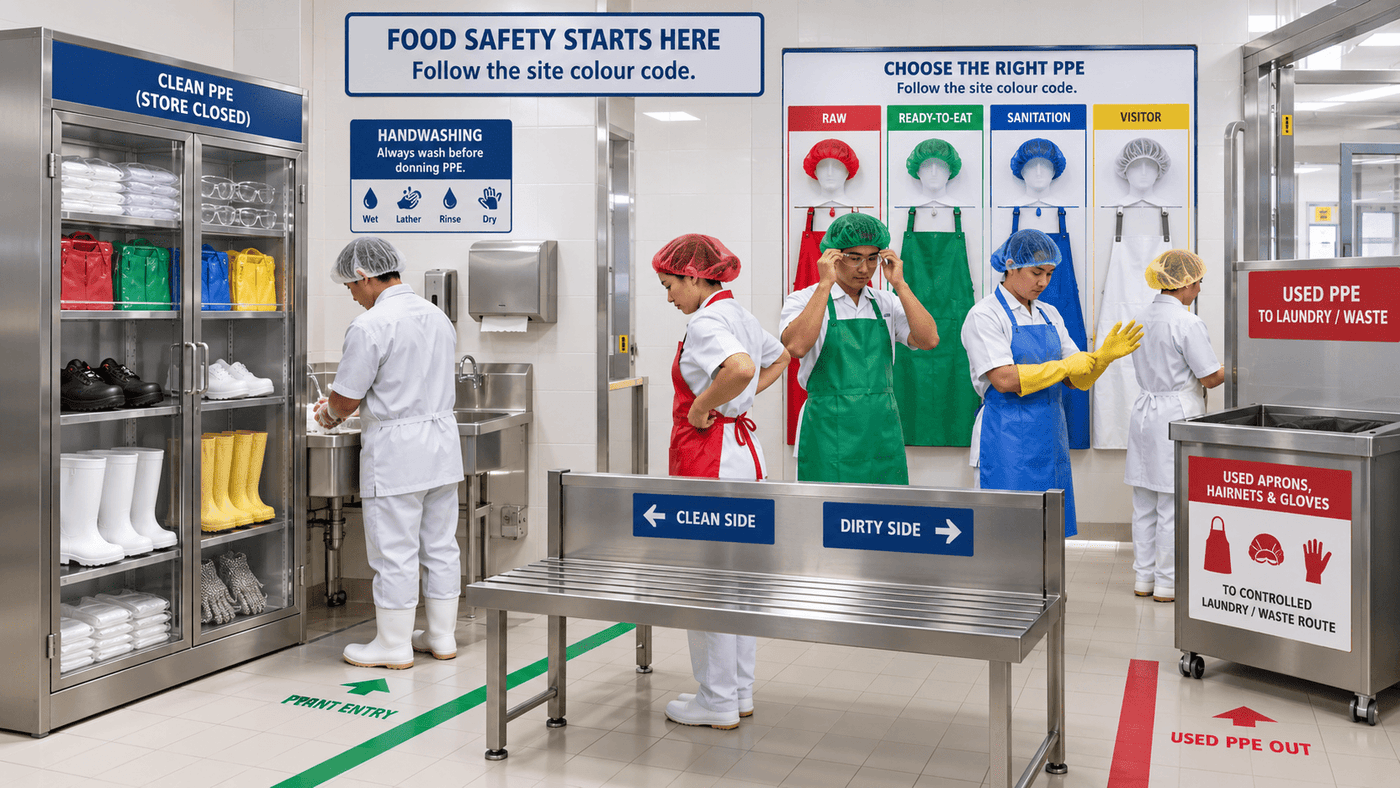
Colour coding can help separate raw, cooked, allergen, sanitation and visitor areas. For example, a site may assign different apron, glove or mob-cap colours to different zones.
However, Malaysian law does not prescribe one universal colour chart for food-factory PPE. Each business should document its own legend and use it consistently. Text labels and zone signs should support colour so that people do not rely on colour alone.
A practical zoning plan should define:
- Which garments and PPE belong in each zone
- Where users put them on and remove them
- Whether items are single-use, personal or shared
- How reusable items move to controlled cleaning
- How the site separates clean stock from used items
- What visitors, contractors and maintenance teams must wear
- How workers change PPE when moving between raw and ready-to-eat areas
- How the site manages allergen and high-care restrictions
PPE Does Not Replace Food-Safety Behaviour
Good equipment can still fail when people use it incorrectly. Therefore, training should cover both worker safety and food hygiene.
Key rules include:
- Wash hands at required times even when the task uses gloves
- Change disposable gloves after contamination, damage or task changes
- Never take food-zone clothing into toilets or outside areas
- Keep jewellery, loose items and unsecured personal objects out of production zones
- Inspect reusable PPE before use
- Store clean PPE away from used or contaminated items
- Remove damaged equipment from service
- Follow the correct order for putting on and removing contaminated PPE
- Report skin reactions, poor fit, fogging or reduced grip
Supervisors should observe real use, not only check issue records. In addition, worker trials often reveal sizing, comfort and compatibility problems before a large order.
Food-Factory PPE Procurement Checklist
Risk and legal review
- Has the factory completed a current workplace risk assessment under section 18B?
- Does each food-handling role meet the clothing duties in regulation 32?
- Has the site assessed hazardous cleaning chemicals under the applicable rules?
- Has the site assessed areas with excessive occupational noise?
- Has the buyer checked whether each hazard-protection model needs current DOSH approval?
Product selection
- Does each glove match the actual cut, chemical, heat, cold or hygiene task?
- Does footwear match the floor, contaminant, cleaning method and impact risk?
- Can workers wear eye, hearing and respiratory products together comfortably?
- Do garments contain hair, fibres and loose parts as required by the zone?
- Can the site clean, inspect or dispose of every item correctly?
- Are sizes available for the full workforce?
Programme control
- Does the PPE matrix state who wears what, where and why?
- Does the hygiene-zone legend stay consistent across signs, stock and training?
- Does the issue system prevent stockouts during peak production?
- Do workers receive fitting, use, limitation and removal training?
- Does the site record inspections, replacement and approval validity where required?
- Does the review process capture incidents, product complaints and process changes?
SAFETYWARE Products and Solutions
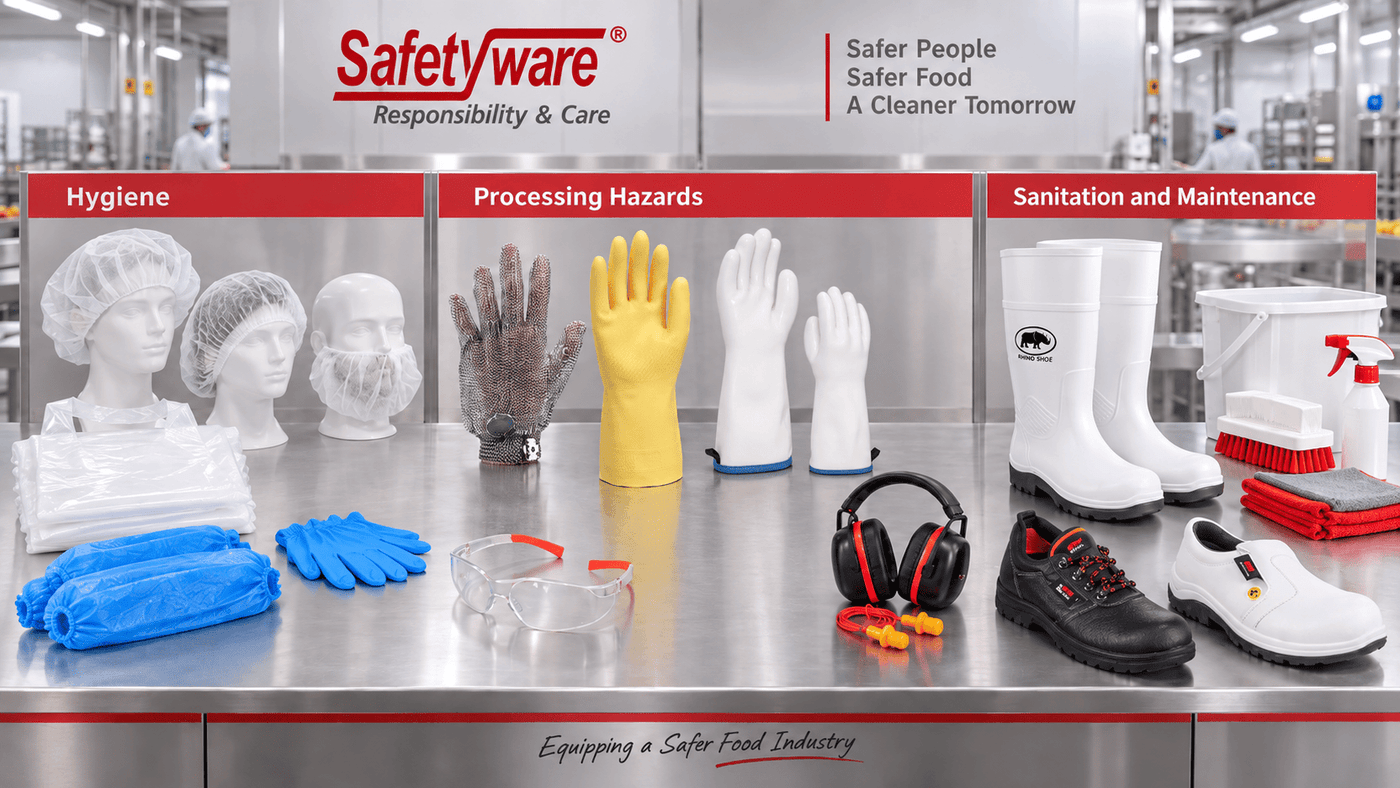
SAFETYWARE supplies several product groups that can support food manufacturing, hygiene control, sanitation and maintenance. Nevertheless, factories should select each item from the task risk, zone rules and required documentation.
Hygiene apparel and disposable gloves
The SAFETYWARE disposable hygiene apparel range includes mob caps, hairnets, beard covers, aprons, sleeve covers, gloves and shoe covers for hygiene-sensitive work. Sites can use these options to build controlled entry and clothing systems for processing, packing and visitor areas.
For short-duration handling and hygiene tasks, buyers can review SAFETYWARE disposable gloves. However, the product page also makes an important distinction: disposable gloves are not automatically chemical-protective gloves.
Hazard-specific hand protection
For knives and sharp materials, compare cut-resistant gloves. Meanwhile, sanitation work may require chemical-resistant gloves selected from the chemical and exposure data.
SAFETYWARE also provides heat-resistant gloves and cold-resistant gloves for assessed thermal tasks. Buyers should compare the stated test performance, materials, size range and care instructions with the actual process.
Foot, eye, hearing and body protection
The RHINO SHOE PVC Wellington boot range provides options for wet industrial work. Before selection, confirm the required toe protection, sole properties, sizing and approval status.
For cleaning splash and maintenance work, review SAFETYWARE eye and face protection and industrial aprons. In noisy areas, the hearing-protection range includes earplug and earmuff options.
SAFETYWARE can support product comparison and quotations through its official enquiry form. For a useful review, share the process area, hazards, chemicals and concentrations, temperature, floor conditions, hygiene zone and required approval documents.
Conclusion
Effective PPE for food manufacturing in Malaysia must protect people without creating a food-contamination risk. Therefore, factories should separate legal food-handler clothing duties from hazard-specific worker protection, while managing both through one clear site programme.
Start with the risk assessment and stronger controls. Then, choose gloves, garments, footwear, eye protection, hearing protection and respirators for the actual task. Finally, train workers, control clean and used stock, verify required approvals and review performance on the production floor.
This approach helps a food business meet its duties, protect employees and maintain the hygiene discipline that customers expect.
Sources and References
Information checked on 18 September 2026.
- DOSH Malaysia — Occupational Safety and Health Act 1994, updated text as at 1 June 2024
- Ministry of Health Malaysia, Food Safety and Quality Programme — Food Hygiene Regulations 2009
- DOSH Malaysia — Occupational Safety and Health (Use and Standards of Exposure of Chemicals Hazardous to Health) Regulations 2000
- DOSH Malaysia — Occupational Safety and Health (Noise Exposure) Regulations 2019
- DOSH Malaysia — PPE approval requirements
- DOSH Malaysia — Guidelines on PPE against chemical hazards
- SAFETYWARE — Products and solutions
📞 Need More Information?
Looking for Full Range PPE for Food Industry in Malaysia?
Explore SAFETYWARE’s safety shoes and workplace PPE range at
👉Safetyware Catalogs
Our safety specialists can help evaluate workplace hazards, recommend suitable safety helmets, and support compliance with Malaysia workplace safety requirements.
If you need a quotation, feel free to contact us at:
📩 Email: [email protected]
📞 Tel: WhatsApp Us