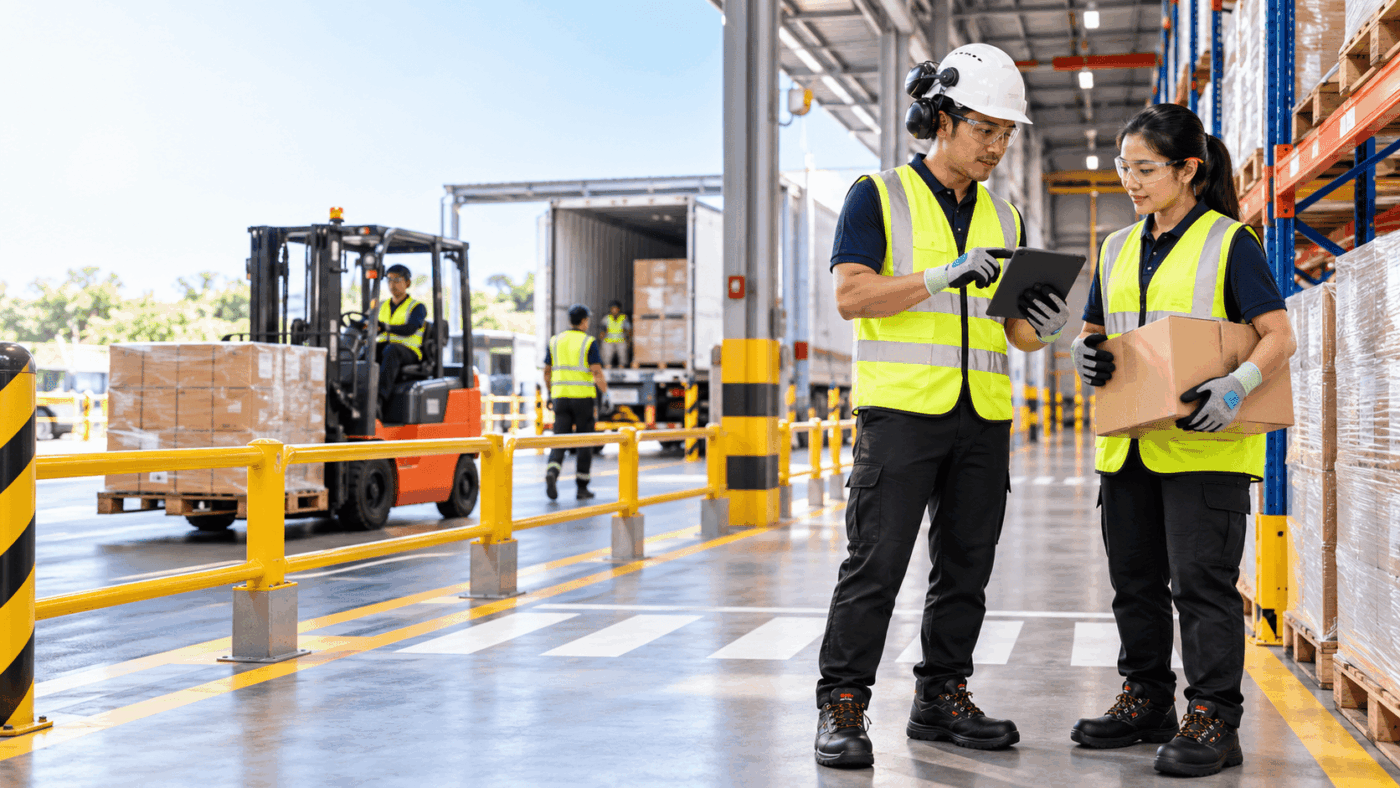
Warehouses and distribution centres bring people, vehicles, storage systems and fast-moving goods into the same space. As a result, workers may face moving forklifts, falling stock, sharp packaging, slippery floors, noise, dust, cold rooms and work at height during one shift.
A logistics PPE checklist helps safety teams control the remaining risk after they improve the workplace and work method. However, no single PPE set suits every logistics role. A picker, battery technician, yard marshal and cold-room worker need different protection.
Therefore, start with a risk assessment. Next, separate people from vehicles, secure storage, maintain equipment and set safe work rules. Finally, select PPE for the hazards that remain. This guide gives PPE buyers, employers and safety managers a practical framework for that process.
Important: This article provides general guidance. Employers must check the law, site rules, safety data sheets, product documents and approved-product records that apply to their country, task and workplace.
Quick logistics PPE checklist
Use this list as a starting point, then adapt it to the site risk assessment.
- High-visibility clothing for people who work near forklifts, lorries or mobile equipment
- Safety footwear with protection and sole performance that match the task
- General handling, cut-resistant, cold-resistant or chemical-resistant gloves, as required
- Safety glasses, goggles or face protection for identified eye and face hazards
- Safety helmets only in zones with a falling-object, overhead-impact or similar head hazard
- Hearing protection where a noise assessment shows a need
- Respiratory protection only for a known airborne hazard and within a managed programme
- Cold, rain or chemical-protective clothing for the relevant exposure
- A complete fall-restraint or fall-arrest system where safer collective controls cannot control the risk
- Correct sizes and compatible PPE for every worker, contractor and visitor
- Training, inspection, cleaning, storage and replacement arrangements
- Current certificates, markings and approval records for the exact product model where required
This checklist does not make every item compulsory in every warehouse. Instead, the risk assessment should decide which items each person needs.
PPE is the last line of defence
PPE can reduce harm, but it cannot stop a forklift from entering a pedestrian lane. Likewise, safety shoes cannot prevent an unstable pallet from falling. A good logistics safety plan follows the hierarchy of controls.
First, remove the hazard where possible. For example, redesign a process so employees do not climb racking. Next, use engineering controls such as fixed barriers, dock-edge protection, machine guards and local exhaust ventilation. Then add traffic rules, training, inspections and safe work procedures. After that, use PPE for the risk that remains.
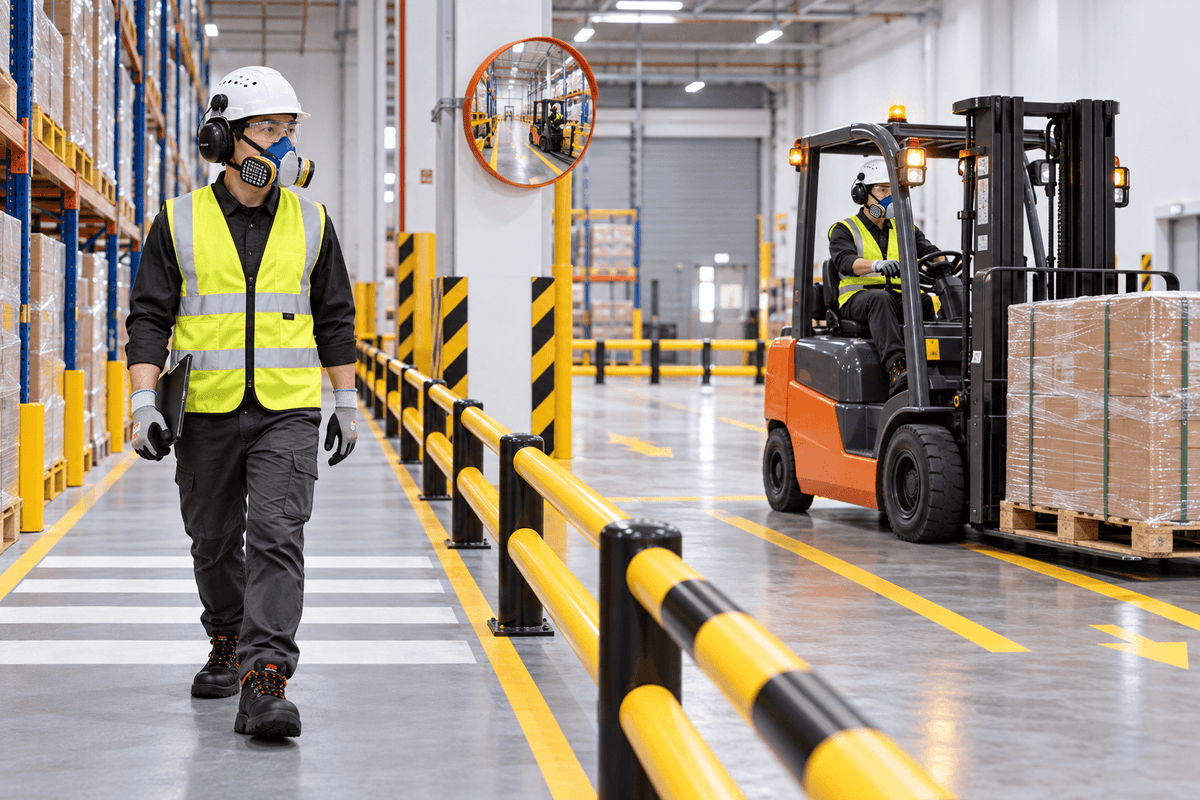
For forklift areas, useful controls may include:
- separate pedestrian routes;
- barriers at crossing points;
- marked aisles and exclusion zones;
- mirrors at blind corners;
- suitable lighting;
- speed controls;
- safe loading and parking rules; and
- trained, authorised operators.
High-visibility clothing supports these controls because it helps vehicle operators see people. However, it does not replace physical separation or a sound traffic plan.
Legal requirements, standards and common practice
Buyers often mix these three ideas. Therefore, procurement teams should label each requirement clearly.
| Type of requirement | What it means | Logistics example |
|---|---|---|
| Law or regulation | A duty that applies in the relevant jurisdiction | An employer must assess workplace risk and implement suitable controls under applicable OSH law |
| Product standard | A test and marking framework for a product | ISO 20345 sets basic and optional requirements for general-purpose safety footwear |
| Site or industry practice | A rule that a company adopts for its own risk profile | A distribution centre requires high-visibility vests in every vehicle movement zone |
Malaysia: employer duties and risk assessment
Malaysia’s Occupational Safety and Health Act 1994, in its updated text as at 1 June 2024, applies to places of work across Malaysia, subject to stated exceptions. Section 15 requires employers to ensure, so far as practicable, employees’ safety, health and welfare. The duty includes safe plant and work systems, safe handling and storage, information, training, supervision, safe access and emergency procedures.
In addition, section 18B requires every employer, self-employed person or principal to conduct a risk assessment for people who may face risk from the undertaking. When that assessment shows a need for control, the responsible party must implement the control. Consequently, Malaysian logistics employers should build the PPE matrix from actual tasks and hazards instead of copying a generic list.
Section 26 also prevents an employer from charging employees for anything provided under the Act or its regulations. Therefore, employers should review who pays for required workplace PPE under the applicable legal duty rather than treating it as a personal purchase.
Malaysia also controls approval for specific PPE groups used at work. DOSH lists seven groups: head protection, foot protection, hearing protection, eye protection for chemical hazards, hand protection for chemical hazards, certain body protection, and respiratory protection for chemical hazards. The body-protection group includes safety belts, lifelines and equipment used to secure lifelines, as well as protection against chemical hazards.
Approval applies to the exact product, not simply to a brand or category. Therefore, buyers should check the current DOSH list, the model number, approval period, marking and technical file before ordering.
International standards
Product standards help buyers compare declared performance. However, a standard does not automatically become law everywhere. A contract, regulator or site specification may adopt it, so buyers should confirm local acceptance.
- ISO 20345:2021 with Amendment 1:2024 covers basic and optional requirements for general-purpose safety footwear. It includes mechanical and slip risks, among other properties. Nevertheless, a marking does not prove that every optional feature suits every logistics task.
- ISO 20471:2013 with Amendment 1:2016 sets test methods and requirements for high-visibility clothing. ISO still listed this edition as current when this guide was checked, while a replacement draft remained under development.
- ISO 45001:2018 gives organisations a framework for an occupational health and safety management system. It supports risk management but does not serve as a PPE product standard.
United States example
For US workplaces, OSHA 29 CFR 1910.132 requires employers to assess hazards, select suitable PPE, communicate the selection and train affected employees. In addition, 29 CFR 1910.176 addresses safe materials handling and storage, including clear aisles and secure stacking. These US rules provide useful reference points, but they do not replace Malaysian or other local law.
Logistics hazard-to-PPE selection matrix
This matrix shows typical directions, not automatic requirements. Always confirm the task, exposure level and local rules.
| Work area or task | Main hazards | Higher-order controls to consider first | PPE direction after assessment |
|---|---|---|---|
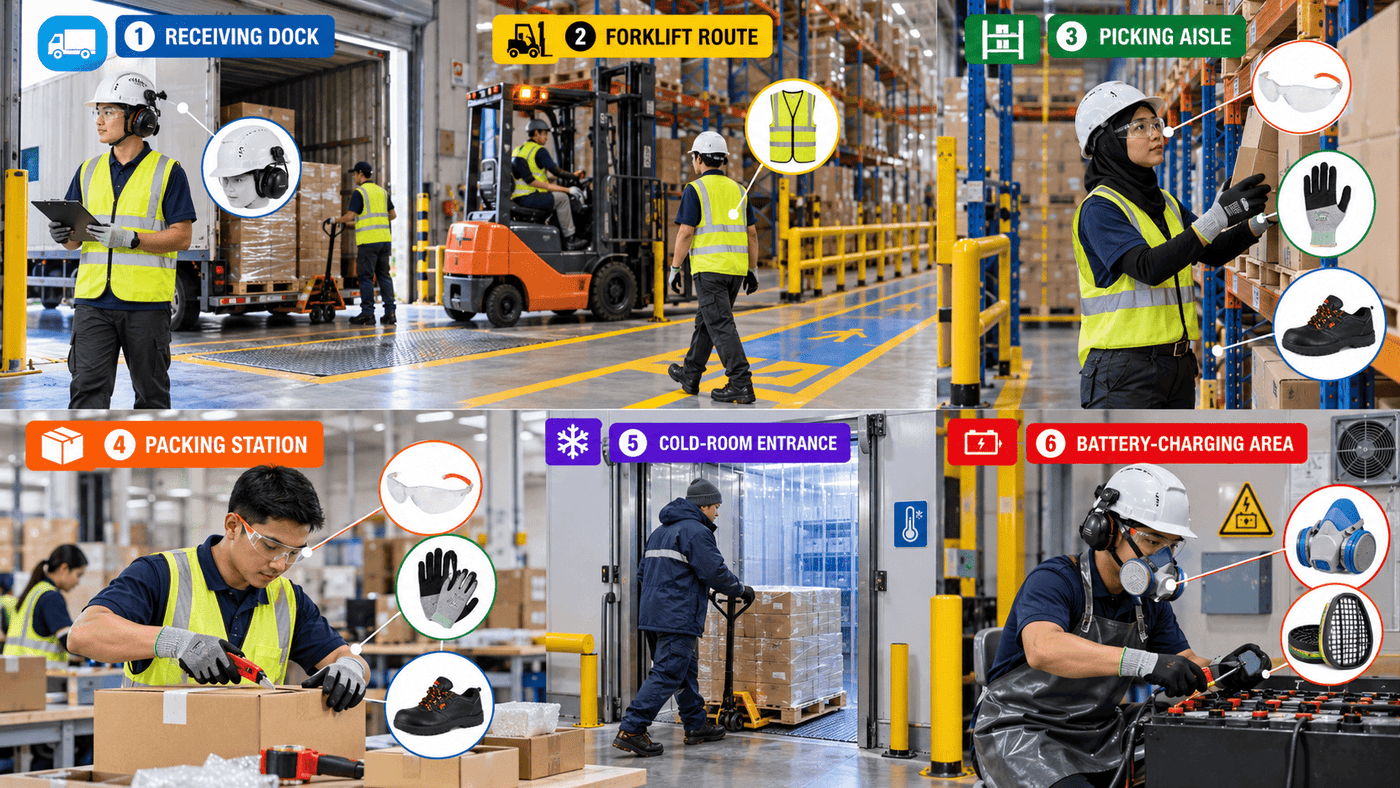
| Receiving and loading docks | Reversing vehicles, dock edges, falling goods, rain, poor light | Vehicle restraints, barriers, dock levellers, traffic control, lighting | High-visibility clothing, safety footwear, gloves; helmet where falling-object risk remains |
| Forklift and pallet-truck routes | Vehicle strike, crushed feet, falling loads | Segregated routes, crossings, barriers, speed control, trained operators | High-visibility clothing and suitable safety footwear; head protection in defined overhead-risk zones |
| Picking and replenishment | Dropped cartons, sharp edges, overreaching, repetitive handling | Stable storage, safe access equipment, weight limits, mechanical aids | Grip or cut-resistant gloves, safety footwear, eye or head protection where the assessment requires it |
| Packing and dispatch | Knives, strapping, staples, powered conveyors | Guarded cutters, safe blades, conveyor guards, good layout | Task-matched gloves and safety glasses where fragments or strap recoil can reach the eyes |
| Racking inspection and maintenance | Work at height, falling tools, sharp metal | Ground-level inspection, mobile platform, guardrails, exclusion zone | Complete fall-protection system if needed, helmet, gloves and footwear |
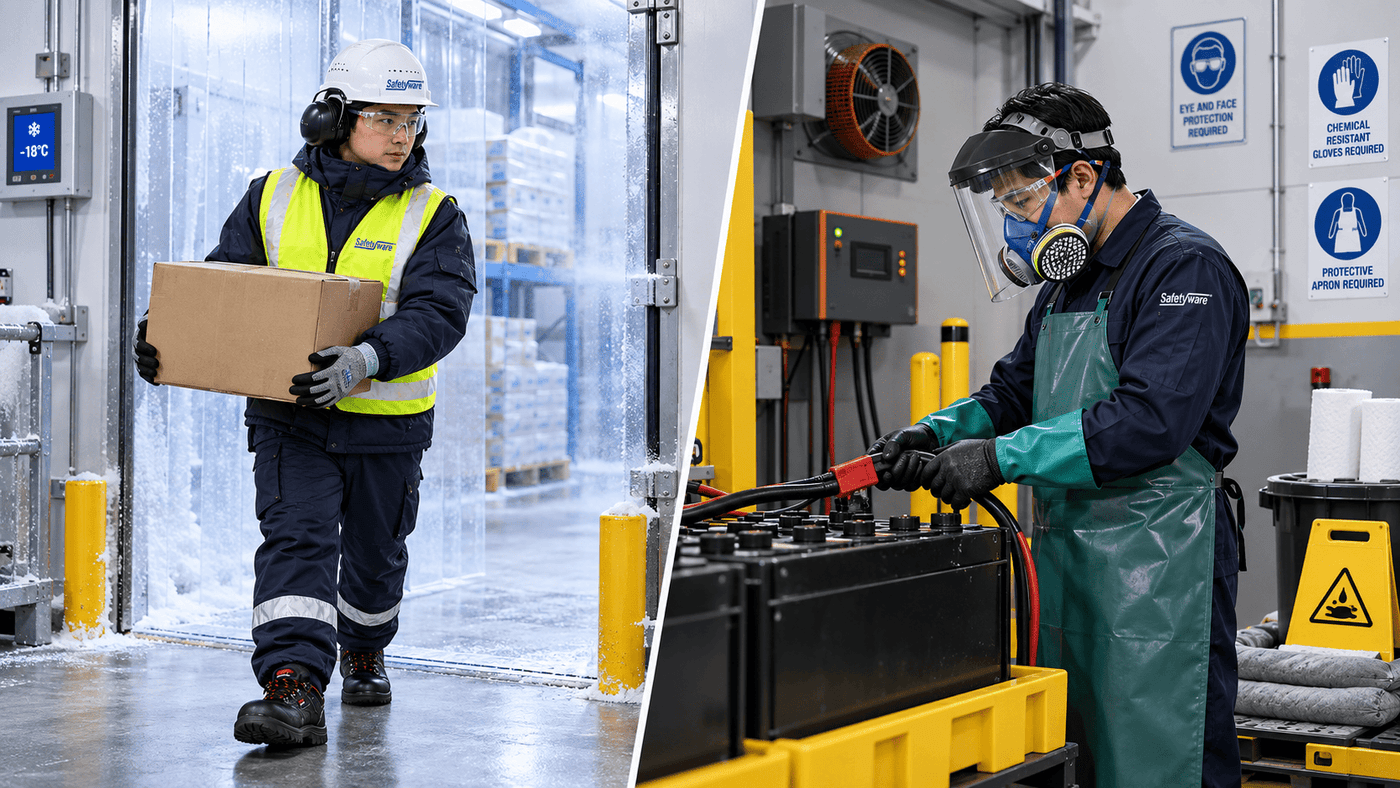
| Cold rooms and freezers | Cold stress, reduced grip, condensation, slippery floors | Exposure limits, warm-up breaks, door alarms, dry floors | Insulated clothing, cold-resistant gloves and suitable footwear |
| Battery charging | Electrolyte splash, fumes, electrical energy, fire | Designated area, ventilation, spill control, protected charger, ignition control | Chemical splash goggles, face shield where needed, compatible gloves and apron based on the battery type and SDS |
| Maintenance and cleaning | Chemicals, stored energy, sharp parts, dust | Isolation, lockout/tagout, guards, ventilation, chemical substitution | PPE selected from the maintenance task and SDS; may include eye, hand, body, hearing or respiratory protection |
| Yard and night loading | Vehicle movement, low visibility, weather | Lighting, one-way plan, barriers, banksman procedure | Suitable high-visibility and weather clothing, safety footwear and task-specific hand protection |
Head-to-toe warehouse PPE checklist
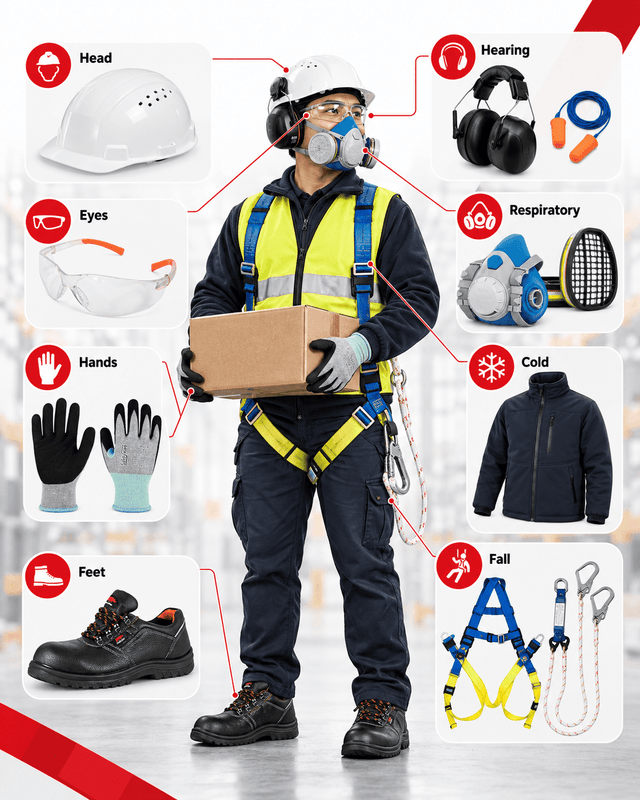
1. High-visibility clothing
Workers near moving vehicles need to remain easy to see. Therefore, choose high-visibility clothing for the work setting, light level, viewing background and site traffic plan.
Check the following:
- the garment provides the class or performance that the site requires;
- reflective material remains visible from the needed directions;
- the size fits without loose parts that may catch on equipment;
- jackets or other clothing do not cover the reflective areas;
- the garment remains clean enough to perform; and
- workers replace faded, torn or heavily soiled items.
For occasional visitors, a vest may suit short, supervised access. In contrast, yard marshals or night workers may need a higher-performance garment and weather protection. Always check the product marking and task requirements.
2. Safety footwear
Logistics workers may face dropped loads, pallet damage, sharp debris, wet floors and long walking distances. As a result, footwear often forms part of the basic PPE set in operational zones.
Choose footwear by hazard rather than appearance. Consider:
- toe protection for impact or compression;
- penetration resistance where sharp objects may enter through the sole;
- verified slip performance for the floor and likely contamination;
- outsole resistance where oils or chemicals may contact the shoe;
- water resistance for wet areas;
- electrostatic properties where the process needs them;
- correct width and size; and
- comfort for long periods of standing and walking.
Slip resistance and oil resistance describe different properties. Therefore, buyers should not assume that one claim proves the other. Likewise, an ESD shoe manages electrostatic discharge; it does not automatically protect against electric shock.
Before each shift, workers should inspect the outsole, upper, fastening and visible damage. They should remove unsuitable footwear from service according to the manufacturer’s instructions and site rule.
3. Hand protection
One generic glove rarely covers every logistics task. For example, a thin coated glove may provide grip during picking, while a cut-resistant glove may better suit metal strapping or sharp packaging. Meanwhile, a cold room needs thermal protection, and battery electrolyte handling needs chemical compatibility.
Match the glove to:
- cut, abrasion, puncture or impact risk;
- dry, wet or oily grip;
- chemical identity and contact time;
- cold or heat exposure;
- dexterity and touch needs;
- cuff length and wrist coverage; and
- interaction with rotating or moving machinery.
Do not use gloves near a moving part when they could create an entanglement risk. In addition, never call a glove “cut-proof.” A cut rating reflects a test result, not protection from every blade or work method.
4. Eye and face protection
Packing straps, broken pallets, dust, maintenance work and chemicals can harm the eyes. Safety glasses can support protection from general impact and flying particles. However, chemical splash work normally needs sealed goggles, and the risk assessment may also call for a face shield over the goggles.
Select the lens, frame and coverage as one system. Also check:
- impact or splash marking;
- side coverage;
- optical quality;
- anti-fog needs in humid or cold-to-warm transitions;
- fit over prescription eyewear; and
- compatibility with helmets, earmuffs and respirators.
Ordinary prescription glasses do not replace rated protective eyewear. Likewise, a face shield usually adds face coverage rather than replacing suitable eye protection underneath.
5. Head protection
Not every logistics worker needs a safety helmet. Instead, require one where the assessment identifies falling objects, overhead impact or another relevant head hazard. Examples may include active racking maintenance, lifting operations or areas where stored items can fall despite other controls.
Choose the helmet by the hazard and declared standard. Then check the shell, suspension, fit, chinstrap needs and compatibility with other PPE. A bump cap only protects against minor bumps against fixed objects; it does not replace an industrial safety helmet for falling-object hazards.
6. Hearing protection
Conveyors, compressors, vehicle movement and packing equipment may create harmful noise. However, employers should measure or assess exposure before selecting earplugs or earmuffs.
First, reduce noise at the source where practicable. Then select hearing protection that provides suitable attenuation without blocking safety-critical signals or communication. Train workers on fit, hygiene and replacement. Excessive attenuation can also create problems, so “the highest rating” is not always the best choice.
7. Respiratory protection
Dust from damaged goods, cleaning chemicals, exhaust, fumigation or a spill may create an airborne hazard. Nevertheless, employers should not issue a disposable mask as a universal answer.
First, identify the contaminant and exposure. Next, improve ventilation, isolation or process control. If a respirator remains necessary, select it by contaminant type, concentration, work rate and protection factor. A complete respiratory programme may also need medical evaluation, fit testing, user checks, training, filter change rules, cleaning and storage, depending on local requirements and respirator type.
Escape or emergency conditions require specific planning. An air-purifying respirator does not supply oxygen and must not enter an oxygen-deficient or immediately dangerous atmosphere unless the equipment and programme specifically suit that use.
8. Cold, wet and weather protection
Cold rooms can reduce hand movement and create condensation on floors and eyewear. Therefore, combine insulated clothing with exposure management, warm-up breaks, dry storage and suitable footwear. Gloves must protect against cold while allowing a safe grip.
For outdoor yards, select rainwear and footwear that preserve visibility and movement. Also confirm that the outer garment does not hide high-visibility elements.
9. Fall protection
Avoid climbing racking, pallets or forklift forks. Instead, use suitable access equipment and collective protection such as platforms and guardrails. If the assessment still requires personal fall protection, treat it as a complete system.
That system may include a full-body harness, connector, lanyard or self-retracting lifeline, suitable anchorage and rescue plan. In addition, calculate fall clearance, train users and inspect every part. A harness by itself cannot stop a fall.
US OSHA 29 CFR 1910.28 illustrates the principle: it requires protection from specified fall and falling-object hazards and recognises guardrails, safety nets or personal systems in defined cases. Local thresholds and duties may differ, so apply the law for the actual worksite.
Special logistics areas that need a separate PPE review
Battery charging stations
Battery technology affects the hazard. For lead-acid battery work, electrolyte can cause chemical burns, while charging can release gas. Lithium-ion systems introduce different electrical, thermal and fire risks. Therefore, review the equipment manual, safety data sheet and emergency plan for the exact battery.
As a useful US reference, OSHA 29 CFR 1910.178(g) calls for designated charging areas and facilities for electrolyte control, fire protection, charger protection and adequate ventilation for battery gases. It also addresses ignition control and safe handling. These facility controls come before PPE.
Where splash exposure remains, the assessment may call for chemical goggles, a compatible face shield, chemical-resistant gloves, an apron and suitable footwear. In addition, workers need the right spill response and emergency-washing arrangements. Do not choose glove or clothing material without checking chemical compatibility.
Cold storage
Cold exposure varies with temperature, air movement, contact surfaces and work duration. Consequently, a short visit to a chilled room differs from a full shift in a freezer.
Use layered clothing, cold-rated gloves and insulated footwear where the assessment requires them. Also manage time in the cold, wet clothing, condensation, door security, lone work and signs of cold stress. Because bulky clothing can affect movement, trial the full PPE combination before purchase.
Racking and work at height
Racking inspection does not give workers permission to climb the structure. Use ground-level tools or a suitable platform where possible. Moreover, isolate the area below any overhead work and secure tools against falling when needed.
If personal fall protection remains necessary, involve a competent person in system design and rescue planning. Never connect a lanyard to a point merely because it looks strong.
Daily logistics PPE inspection checklist
Supervisors can use this short check during the pre-shift briefing.
| Item | What the wearer should check | Action if the check fails |
|---|---|---|
| High-visibility garment | Clean, bright, reflective areas intact, correct fit | Clean or replace |
| Safety footwear | Tread, sole bond, upper, fastening, damage or contamination | Clean, quarantine or replace |
| Gloves | Holes, cuts, wear, contamination, correct type and size | Replace or change to task-correct glove |
| Eye protection | Clean lens, no crack, secure fit, correct rating | Clean or replace |
| Helmet | Shell, suspension, chinstrap, damage, date and fit | Remove from service if required by instructions |
| Hearing protection | Clean, intact, correct fit and type | Replace disposable or damaged parts |
| Respirator | Correct model and filter, seal area, valves, straps and service life | Do not enter hazard; correct the issue |
| Cold or rain clothing | Dry, intact, correct layers, visibility maintained | Dry, repair or replace |
| Fall-protection system | Webbing, stitching, connectors, labels, inspection status | Quarantine immediately and report |
Workers should also confirm that the day’s PPE matches their task. For example, a picker who moves to battery maintenance needs a fresh assessment and different protection.
Logistics PPE procurement checklist
A strong purchase decision covers more than unit price. Use the following questions before approval.
Hazard and performance
- What exact hazard and task does the item address?
- Which control measures already reduce the risk?
- Which product standard, performance level or site rule applies?
- Does the product document support every required claim?
- Does the item suit the expected temperature, moisture, chemical and work duration?
Legal and document check
- Does local law require regulator approval or a specific standard?
- For Malaysia, does the exact model appear in the current DOSH approval record where required?
- Do the model, brand, standard, certificate and product marking match?
- Is the certificate current for the delivery and use period?
- Can the supplier provide technical data, instructions and traceable records?
Fit and compatibility
- Does the size range cover all workers?
- Can wearers adjust the item correctly?
- Does eyewear work with the helmet, earmuffs or respirator?
- Does high-visibility clothing remain visible over rainwear?
- Does the glove preserve the grip and movement that the task needs?
Use and lifecycle
- Can the team clean, dry and store the item correctly?
- What inspection and replacement rules apply?
- Are replacement filters, lenses, straps or other parts available?
- How will the employer train workers and record issue?
- How will the site control visitor and contractor PPE?
Run a wearer trial before a large purchase whenever possible. A product may meet a standard yet fail the task because it fogs, slips, restricts movement or clashes with another item.
Common logistics PPE mistakes
Requiring the same PPE everywhere
A blanket rule looks simple, but it can add needless burden or miss a special hazard. Instead, define PPE by zone, task and exposure.
Using PPE to solve a traffic-design problem
A reflective vest cannot stop a vehicle. Therefore, give priority to route separation, barriers, crossings, visibility and operating rules.
Choosing footwear only by toe cap
Toe protection matters, but grip, penetration resistance, fit and walking comfort may matter just as much. Review the whole footwear specification.
Selecting gloves by colour or material name
Two nitrile gloves can serve very different purposes. One may support general grip, while another may provide documented chemical resistance. Always check the declared performance and task.
Treating a face shield as complete eye protection
A face shield adds broad coverage but may allow particles or liquid around the sides. Use suitable glasses or goggles underneath where the assessment requires them.
Buying a harness without a system
A harness needs a compatible connector, suitable anchor, enough clearance and a rescue plan. Without them, the purchase does not create a safe fall-protection system.
Ignoring replacement and storage
Heat, sunlight, dirt, chemicals and poor storage can damage PPE. As a result, buyers must plan the full lifecycle, not only the first issue.
SAFETYWARE Products and Solutions
SAFETYWARE provides PPE and workplace-safety categories that can support a risk-based logistics programme. Buyers should begin with the hazard matrix, then compare exact models, sizes, markings, certificates and compatibility.
Visibility and traffic safety
The SAFETYWARE high-visibility apparel range includes vests and reflective garments for warehouse, traffic and site-visibility needs. In addition, logistics teams can use the broader SAFETYWARE range to support route marking and traffic control. Select garment performance through the site traffic and visibility assessment.
Safety footwear
SAFETYWARE manufactures RHINO SHOE general-purpose safety footwear for logistics, warehouses and other industrial uses. Buyers can compare cut height, toe protection, sole features, fit and comfort. However, confirm the exact model’s marking and current DOSH/SIRIM documentation for Malaysian workplace use.
Hand protection
For packing, picking and material handling, explore SAFETYWARE general-purpose gloves. Where sharp edges or strapping create a cut hazard, review the cut-resistant glove range. Select the glove by the required protection, grip and dexterity instead of choosing the highest rating by default.
Eye, head and fall protection
SAFETYWARE’s safety glasses range supports general impact and particle-protection needs, while the wider eye and face category covers other hazards. For defined overhead or falling-object zones, compare safety helmets. While for work at height, the fall-protection range includes harnesses, lanyards, self-retracting lifelines, anchors and rescue equipment.
For a broader review, use the SAFETYWARE PPE catalogue. Share the work area, hazard, required standard, quantity, size range and destination with the SAFETYWARE team. This information helps narrow the options without relying on unverified claims.
Conclusion
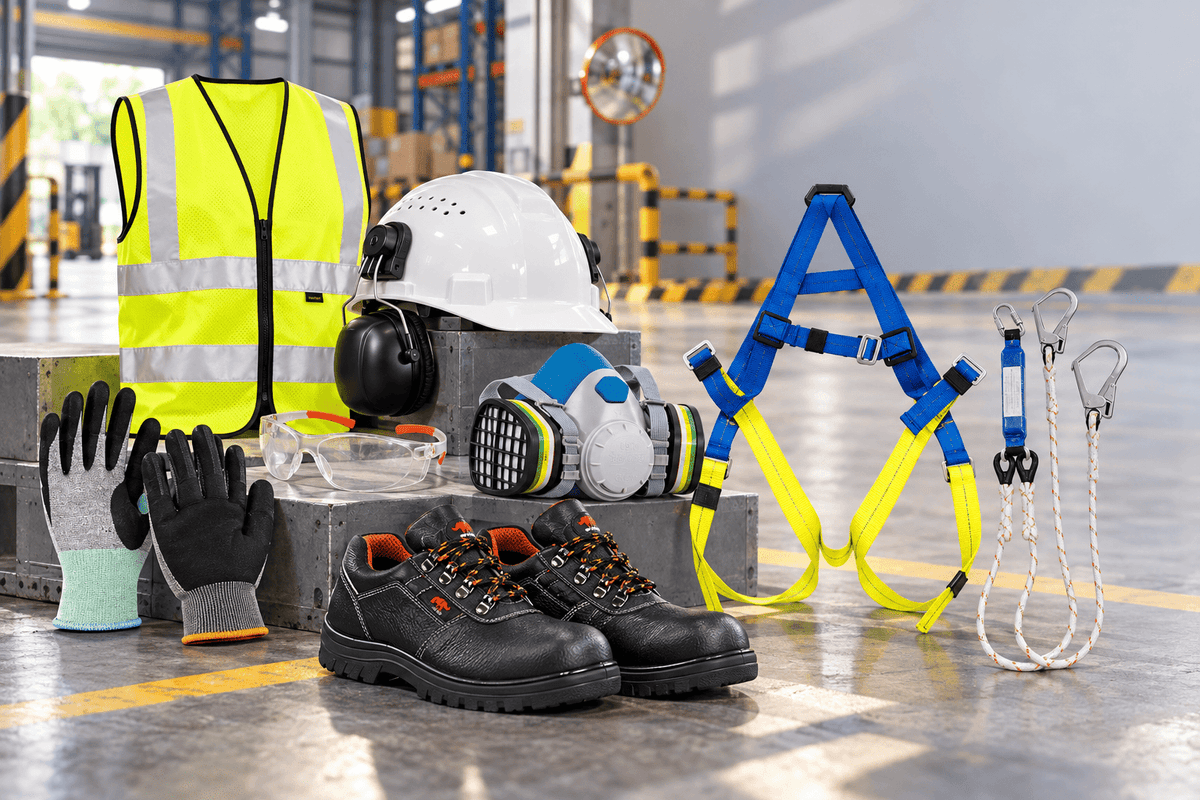
A useful logistics PPE checklist starts with the work, not the product. First, map forklift routes, docks, storage, packing, maintenance, cold rooms and charging areas. Next, remove or control the hazards through layout, equipment and safe procedures. Then select PPE for the risk that remains.
For Malaysia, connect every choice to the employer’s duties and risk assessment under the Occupational Safety and Health Act 1994. In addition, confirm current DOSH approval for the exact model where the PPE category requires it. Finally, test fit and compatibility, train the wearer, inspect the equipment and replace it at the right time.
When buyers follow that process, PPE becomes part of a complete logistics safety system instead of a stand-alone shopping list.
Sources and references
Information and links checked on 21 September 2026.
- Malaysia Department of Occupational Safety and Health, Occupational Safety and Health Act 1994 (Act 514), updated text as at 1 June 2024
- Malaysia DOSH, Personal Protective Equipment approval requirements
- US OSHA, 29 CFR 1910.132 — General PPE requirements
- US OSHA, 29 CFR 1910.176 — Handling materials, general
- US OSHA, 29 CFR 1910.178 — Powered industrial trucks
- US OSHA, 29 CFR 1910.28 — Fall and falling-object protection
- ISO, ISO 20345:2021 — Safety footwear and Amendment 1:2024
- ISO, ISO 20471:2013 — High-visibility clothing and Amendment 1:2016
- ISO, ISO 45001:2018 — Occupational health and safety management systems
- SAFETYWARE, Personal Protective Equipment categories
📞 Need More Information?
Looking for Full Range PPE for Logistic?
Explore SAFETYWARE’s safety shoes and workplace PPE range at
👉Safetyware Catalogs
Our safety specialists can help evaluate workplace hazards, recommend suitable safety helmets, and support compliance with Malaysia workplace safety requirements.
If you need a quotation, feel free to contact us at:
📩 Email: [email protected]
📞 Tel: WhatsApp Us