
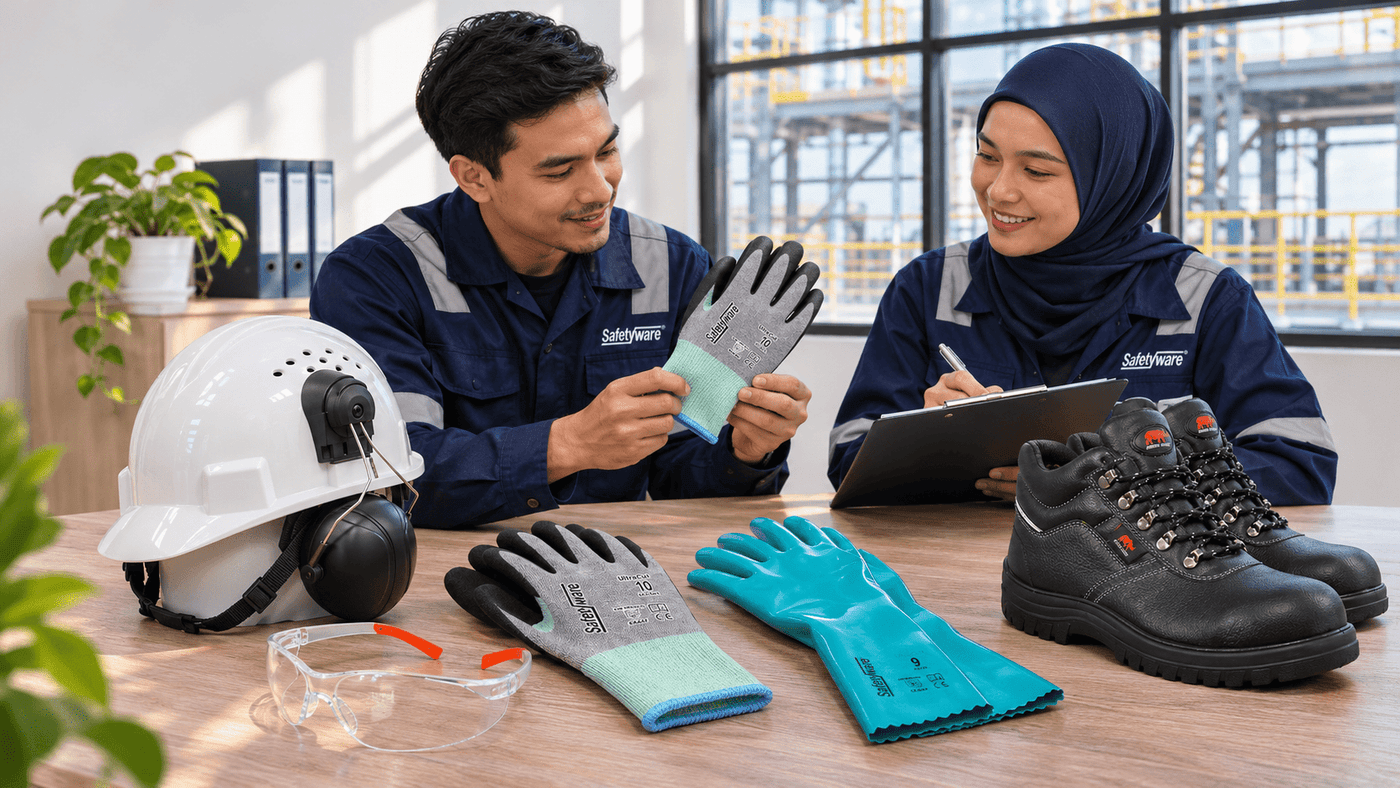
A helmet, gloves and safety shoes may look like a complete workplace safety kit. However, the right combination depends on what a person actually does, the hazards they face and the controls already in place.
For buyers searching for mandatory PPE required by DOSH Malaysia, the starting point is the workplace risk assessment. Employers must identify the protection needed for each task, then check the suitability and applicable approval requirements of the exact equipment they purchase.
This guide separates legal duties, product approvals and practical purchasing decisions, helping employers and distributors build a clearer PPE specification.
Is There One Mandatory PPE List for Every Malaysian Workplace?
The legal framework does not create one identical head-to-toe outfit for every worker. A chemical-transfer operator, warehouse picker and office visitor may require different protection. A site’s entry rules may also set a baseline PPE requirement, with additional equipment for particular tasks.
Under the Occupational Safety and Health Act 1994, as amended:
| Provision | Core duty |
|---|---|
| Section 15 | Employers must ensure employees’ safety, health and welfare at work so far as practicable, including appropriate information, instruction, training and supervision. |
| Section 18B | Employers, self-employed persons and principals must assess relevant workplace risks and implement controls where needed. |
| Section 24 | Employees must use protective equipment or clothing supplied to prevent risks and follow applicable safety instructions. |
| Section 26 | Employers cannot charge employees for things provided or done pursuant to the Act or its regulations. |
These duties support task-based PPE selection rather than buying a standard kit without assessing its purpose. [1]
Keep Three Different Requirements Separate
| Requirement | What it answers | Practical example |
|---|---|---|
| Legislation | What duties apply to the work? | Chemical exposure controls and approved PPE under USECHH, where applicable. |
| Product standard and approval | What evidence supports this equipment? | A model’s test standard, performance rating and applicable DOSH approval. |
| Workplace procedure | Where and how must people use it? | A written PPE matrix for a production line or designated work zone. |
A site rule can be mandatory for entry without being a nationwide rule for every workplace. Equally, an international standard marking does not, by itself, establish Malaysian regulatory approval.
Start with Hazards, Then Select PPE
Use this table as a planning aid, not a universal statutory list. The final selection needs the workplace assessment, applicable regulations and equipment instructions.
| Task or exposure | Protection to evaluate | Purchasing questions |
|---|---|---|
| Overhead impact or falling-object risk | Suitable industrial safety helmet | Which impact risks, accessories and fit requirements apply? |
| Moving loads, dropped objects or sharp underfoot material | Suitable protective footwear | Which toe, penetration, traction or other properties does the task need? |
| Flying particles | Task-rated eye and, where necessary, face protection | Does the selected protector cover the direction and severity of exposure? |
| Hazardous chemical splashes | Chemical-suitable eye, face, hand, body and foot protection | Is there compatibility evidence for the actual chemical and concentration? |
| Harmful airborne contaminants | An appropriate respiratory protection system | What contaminant, concentration and atmospheric conditions must it address? |
| Hazardous noise | Suitable approved hearing protectors | Does selection reflect measured exposure and actual fit? |
| Residual risk of a fall from height | A properly designed personal fall-protection system where needed | Are the harness, connection, anchorage, clearance and rescue arrangements compatible? |
| Vehicle interaction or poor visibility | Suitable high-visibility clothing | Does visibility suit the lighting, traffic and working posture? |
First consider removing or reducing the hazard. For example, a safer transfer arrangement may reduce splashing, while physical segregation can reduce vehicle–pedestrian interaction. PPE then forms part of the remaining protection strategy.

Specific Legal Requirements: Chemicals and Noise
Chemical Exposure: USECHH Regulations 2000
Regulation 16 requires approved PPE when the preferred controls specified in Regulation 15 are impracticable, while those controls are being developed, or when they do not adequately control exposure.
The employer must implement procedures covering issue, maintenance, inspection and training. Equipment must suit the work, fit employees, avoid adversely affecting their health or medical condition, and be available in sufficient quantities. [2]
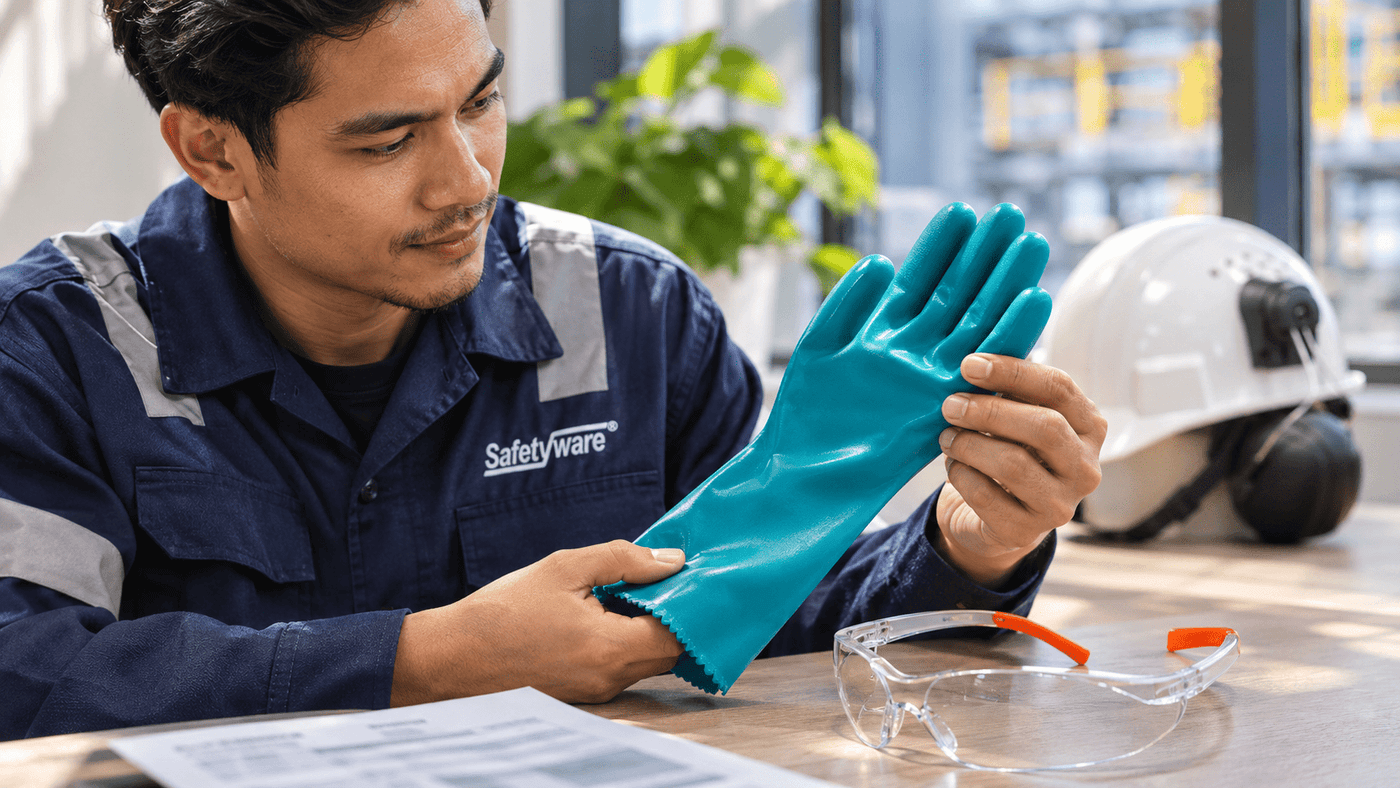
For purchasing, ask for more than a description such as “chemical glove”. Give the supplier the chemical name, concentration, temperature, contact pattern and task duration. Request the relevant model-specific compatibility data and agree inspection and replacement arrangements before use. Treat this as a practical selection process; no single material should be assumed suitable for every chemical.
Noise: Noise Exposure Regulations 2019
The regulations distinguish the daily excessive-noise trigger above 82 dB(A) from the daily exposure limit of 85 dB(A); dose, maximum and peak limits also apply. These figures are not interchangeable and should be interpreted through a noise assessment.
Regulation 7 requires hearing protectors supplied to reduce excessive noise to be suitable, maintained, available, sufficiently effective when worn correctly, and approved by the Director General. Regulation 8 requires identified hearing protection zones where the specified limits are exceeded, provision of protectors and their use by people entering those zones. [3]
For buyers, a useful next step is to send the noise assessment information to the supplier and arrange a fit and compatibility review. Avoid choosing solely by the largest attenuation number on the packaging.
Which PPE Needs DOSH Approval?
DOSH publishes approval information across head, foot, hearing, eye, hand, body and respiratory protection. Its guidance includes chemical-specific categories and fall-protection equipment. However, the presence of a category in an approval list does not mean that every product with a similar name has the same approval scope. [4,5]
There is a documentation caveat: some official PPE pages still refer to the former Factories and Machinery Act. Its repeal took effect on 1 June 2024. Therefore, use current legislation and current model approval records, and obtain DOSH clarification where an older guidance document leaves the application unclear. [6]
Check the Exact Model Before Ordering
Use the DOSH approval directory as a starting point. For equipment subject to approval, ask the supplier for evidence that matches the exact brand, model and intended application. Check the approval’s validity and the required DOSH-SIRIM identification. DOSH’s FAQ does not treat an overseas CE label as a substitute for its specified approval process. [4,5]
SIRIM QAS describes product certification as a process involving assessment, testing and ongoing oversight. A generic laboratory report should not be treated as the whole certification and approval package. [7]
Recommended purchase-order wording:
Supply the specified PPE model for the stated workplace application, with current technical information, user instructions and applicable Malaysian approval evidence. Obtain written acceptance before substituting another model.
This wording is a suggested purchasing control, not prescribed legal text.

Build a PPE Programme That Works in Daily Use
A sound purchase is only the beginning. Turn the selection into a repeatable process that supervisors and workers can follow.
1. Write a Task-Based PPE Matrix
For each task, record the hazard, existing controls, required PPE, approved model or specification, sizes and responsible person. Include less frequent work such as cleaning, maintenance and contractor access.
2. Trial Fit and Compatibility
Let representative users try the complete combination. Check whether eyewear, helmet attachments and hearing protectors interfere with each other. Confirm that gloves allow the required grip and that footwear fits the wearer and work pattern.
A comfortable trial does not prove protective performance. Review the documentation as well as the practical fit.
3. Explain Use and Limitations
Show workers how to put equipment on, adjust it, inspect it and recognise when replacement is necessary. Use demonstrations and languages the workforce understands. A signed issue record alone does not show that someone can use the equipment correctly.
4. Plan Inspection, Storage and Replacement
Set checks according to the manufacturer’s instructions and actual use conditions. Provide clean storage, a route for reporting defects and replacement stock in the required sizes. Isolate doubtful equipment until a competent review decides what to do with it.
5. Review Changes Before Reordering
Revisit the selection when the process, chemical, exposure, worker needs or product model changes. Procurement should notify the safety team before approving substitutions, even where the replacement appears visually similar.

Practical PPE Purchasing Checklist
The following is a recommended working checklist, rather than a list of separately mandated documents for every workplace.
- The task and hazards are clear, including abnormal and maintenance work.
- The safety team has considered controls before relying on PPE.
- The specification identifies required protective properties and limitations.
- The exact model’s technical documents match the product offered.
- Applicable DOSH approval and identification have been checked.
- Sizes and combined-equipment fit have been reviewed with users.
- Instructions, training and supervision arrangements are ready.
- Inspection, cleaning, storage and replacement arrangements are defined.
- Suppliers know that substitutions require review.
- Repeat orders include a check for changed models or approval status.
For distributors, capture these details at enquiry stage. A more complete specification makes it easier to propose suitable alternatives and reduces the risk of an order failing the customer’s document review.
SAFETYWARE Products and Solutions
SAFETYWARE’s official product directory provides a starting point for comparing protection categories. Share the workplace assessment and purchasing requirements so the discussion can focus on suitability, fit and supporting evidence.
| Verified official category | What to discuss with SAFETYWARE |
|---|---|
| Safety helmets | Task hazards, fit, compatible accessories and applicable approval evidence. |
| Foot protection | Appropriate RHINO SHOE or other listed footwear options, sizes and the required protective properties. |
| Chemical-resistant gloves | Actual chemicals, contact conditions, dexterity and model-specific compatibility information. |
| Hearing protection | Noise assessment findings, earplug or earmuff fit and applicable approval. |
| Respiratory protection | Exposure information, suitable system selection, fit requirements and maintenance. |
| Fall protection | The complete system, compatibility, inspection and rescue arrangements. |
Category links confirm the available product areas; they do not establish that every listed item is approved or suitable for every task. Request current specifications and approval evidence for the selected model before purchase.
Ready to review your PPE requirements? Send SAFETYWARE your task list, assessment findings, required quantities and sizes. Ask for a proposal that connects each recommended model to the application and supporting documents.
Conclusion
Choosing mandatory PPE in Malaysia starts with understanding the work. Identify the hazards, establish the applicable duties, then select equipment with the right performance, fit and approval evidence.
A practical next step is to review one high-risk task: compare the PPE currently issued with the task specification, check its documentation and ask workers to demonstrate correct use. Resolve any gaps before extending the review across the workplace.
Sources and References
Official sources checked on 16 November 2026. Section numbers above refer to the cited legislation. The purchasing matrix and implementation checklist are practical guidance, not a substitute for a site-specific assessment.
- DOSH: Occupational Safety and Health Act 1994, updated text as at 1 June 2024.
- DOSH: USECHH Regulations 2000, especially Regulations 15–16.
- DOSH: Occupational Safety and Health (Noise Exposure) Regulations 2019.
- DOSH: PPE approval FAQ.
- DOSH: PPE approval information and approval directory.
- DOSH: Commencement of the Factories and Machinery (Repeal) Act 2022 — 1 June 2024.
- SIRIM QAS: Personal Protective Equipment Certification and certification process guideline.
- SAFETYWARE: Products and solutions; relevant category links appear in the product table above.
📞 Need More Information?
Get your Dosh Certified PPE?
Explore SAFETYWARE’s safety shoes and workplace PPE range at
👉Safetyware Catalogs
Our safety specialists can help evaluate workplace hazards, recommend suitable safety helmets, and support compliance with Malaysia workplace safety requirements.
If you need a quotation, feel free to contact us at:
📩 Email: [email protected]
📞 Tel: WhatsApp Us