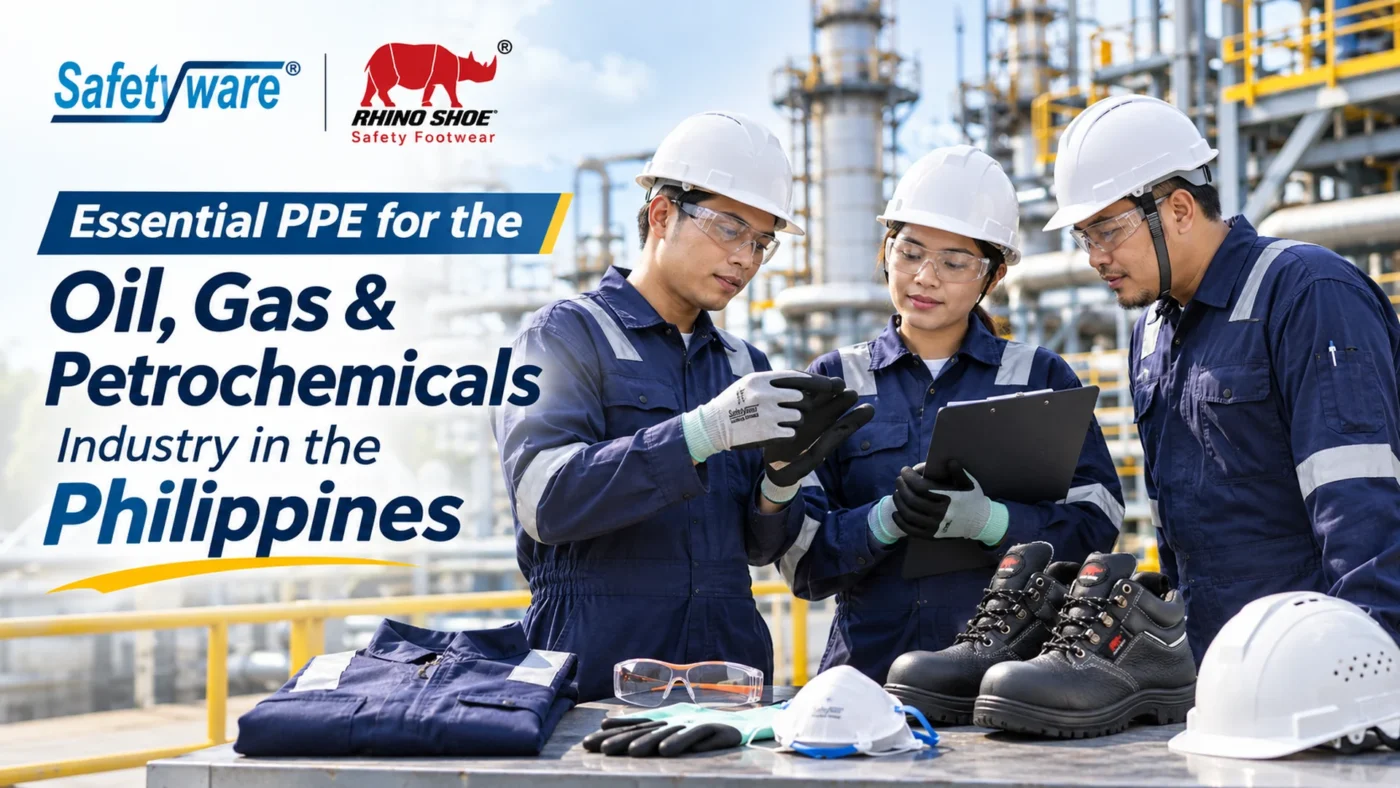
A safety helmet and boots may satisfy a site’s basic access rules, but they do not answer the most important question: what could harm this worker during this particular job?
At a Philippine refinery, fuel terminal or petrochemical facility, routine inspection, chemical sampling and maintenance can demand different protection. Shutdowns add further complexity as several contractors perform unfamiliar tasks in the same area. Effective oil and gas PPE in the Philippines therefore starts with a clear assessment of the work, followed by documented product selection.
This guide helps employers, safety managers, distributors and PPE buyers turn those assessments into practical specifications. It covers Philippine workplace duties, essential protection categories and the purchasing checks that connect equipment to its intended use.
Philippine PPE requirements: what buyers need to know
Start with RA 11058 and the revised implementing rules
Section 8 of Republic Act No. 11058 requires employers, contractors and subcontractors to provide necessary PPE free of charge. It also addresses appropriate PPE types, DOLE testing and approval, and selection and use based on the safety officer’s evaluation and recommendation. PPE provision belongs within the workplace safety and health programme. [1]
DOLE Department Order No. 252, Series of 2025 is the revised implementing framework for RA 11058. The Bureau of Working Conditions confirms that it took effect on 16 May 2025 and emphasises hazard identification, risk assessment and control, or HIRAC. Its official guidance also reiterates free PPE provision with training on use and maintenance. [2]
For procurement, confirm the applicable DOLE testing, approval or verification route for the exact PPE type and model. An overseas certificate should not be treated as automatic evidence that every Philippine acceptance requirement has been met.
Keep three types of requirement separate
| Requirement | What it means | Procurement action |
|---|---|---|
| Philippine legal duties | Obligations established by legislation and applicable DOLE rules | Confirm the current requirements with the responsible safety team and relevant authority where needed. |
| Product performance standards | Tests and performance criteria for defined hazards | Check the standard edition, ratings, model and supporting documents. |
| Operator or project specifications | Site acceptance rules and contractual requirements | Obtain the owner’s approved specification before ordering. |
The international standards below are selection references, not a claim that each is compulsory at every Philippine facility. Similarly, US and UK technical guidance cited here does not replace Philippine law. Offshore, marine, construction or other specialised operations may need additional requirements beyond this general procurement guide.
Assess the work before choosing the equipment
The hierarchy of controls gives priority to eliminating hazards, substituting safer alternatives and using engineering controls before relying on procedures and PPE. Equipment should address the risk that remains after those measures. [3]
For example, a chemical glove does not replace a closed sampling arrangement, and protective clothing does not make it acceptable to open a pressurised line without proper isolation.
Build the PPE specification around five questions:
- What is the task? Separate normal operation, cleaning, maintenance and emergency response.
- What can reach the worker? Consider chemicals, heat, particles, noise, electricity and mechanical energy.
- How much exposure is possible? Record concentration, duration, temperature and credible release conditions.
- Which controls already reduce the risk? Include isolation, ventilation, barriers and work procedures.
- What protection remains necessary? Specify performance, fit, compatibility and replacement arrangements.
Essential PPE by task and hazard
Use this table as a discussion framework. The safety officer and relevant specialists should determine the final selection through the site assessment.
| Task or location | Protection to assess | Key selection check |
|---|---|---|
| Routine process-area rounds | Helmet, eye protection, safety footwear and area-specified clothing | Confirm the area’s actual hazards and access requirements. |
| Chemical sampling or controlled transfer | Chemical gloves, splash eye/face protection, protective clothing and footwear | Check the substance, mixture, concentration and likely contact conditions. |
| Mechanical maintenance | Eye protection, task-specific gloves and protective footwear | Match impact, abrasion, cut and grip needs; review entanglement hazards. |
| Noisy plant areas | Hearing protection | Use the noise assessment and preserve necessary warning and communication functions. |
| Potential fire exposure | Suitable thermal protective clothing and compatible layers | Verify evidence for the assessed exposure rather than relying on an “FR” description. |
| Electrical work | Arc and shock protection appropriate to the authorised task | Assess arc thermal energy and electrical contact hazards separately. |
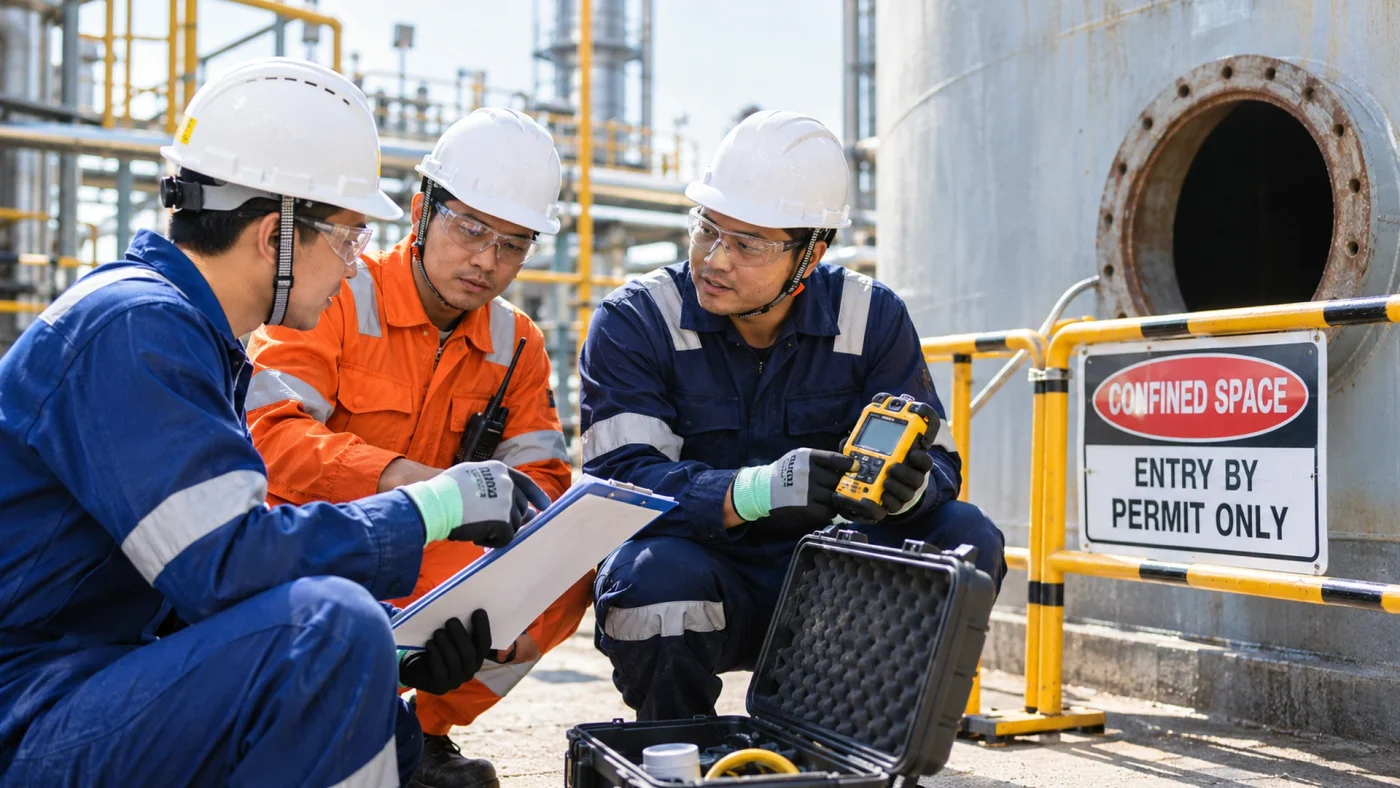
| Tank or vessel entry | Task- and atmosphere-specific PPE, with planned rescue equipment | Equipment must support a controlled entry system. |
| Work at height or near water | Suitable fall protection or flotation where the assessment requires it | Check the complete system, compatibility and rescue arrangements. |
Oil and gas hazards can include flammable releases, high-pressure equipment, falls and hazardous energy. PPE cannot prevent a major release or neutralise stored energy. [4]
Select protection that matches the hazard
Head, eye, face and hearing protection
Check the helmet’s intended protection, fit, retention and approved accessories. Helmet colour may identify a role under a site scheme, but colour alone does not establish performance.
Choose eye and face protection for the exposure: flying particles, splash or optical radiation require different specifications. For splash tasks, review primary eye protection and supplementary face coverage together. Include prescription-eyewear needs in the assessment.
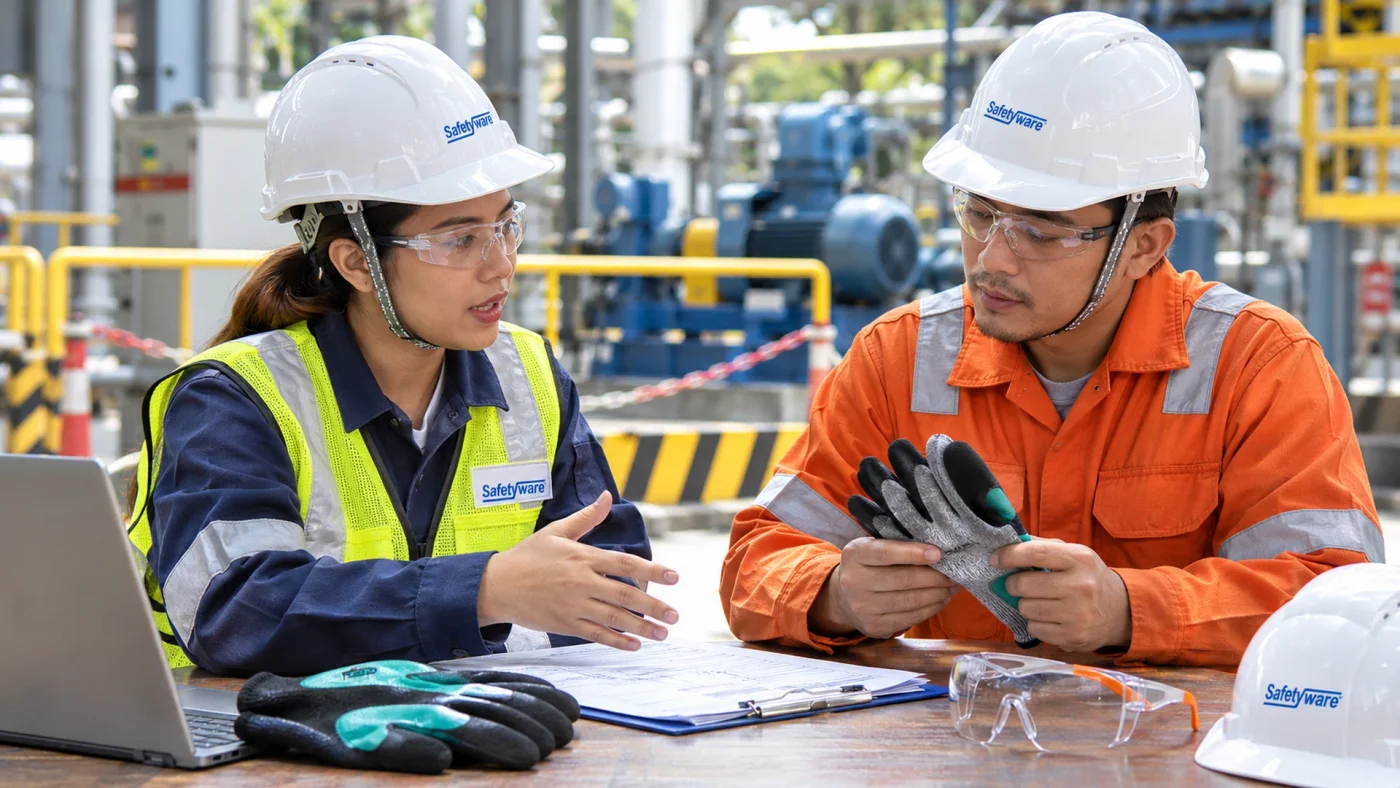
When several items must be worn together, trial the complete combination. Eyewear can disturb a respirator seal, and helmet accessories can affect the fit of hearing protection. HSE guidance highlights compatibility, worker size and equipment weight as important selection factors. [5]
Flame-resistant clothing and arc protection
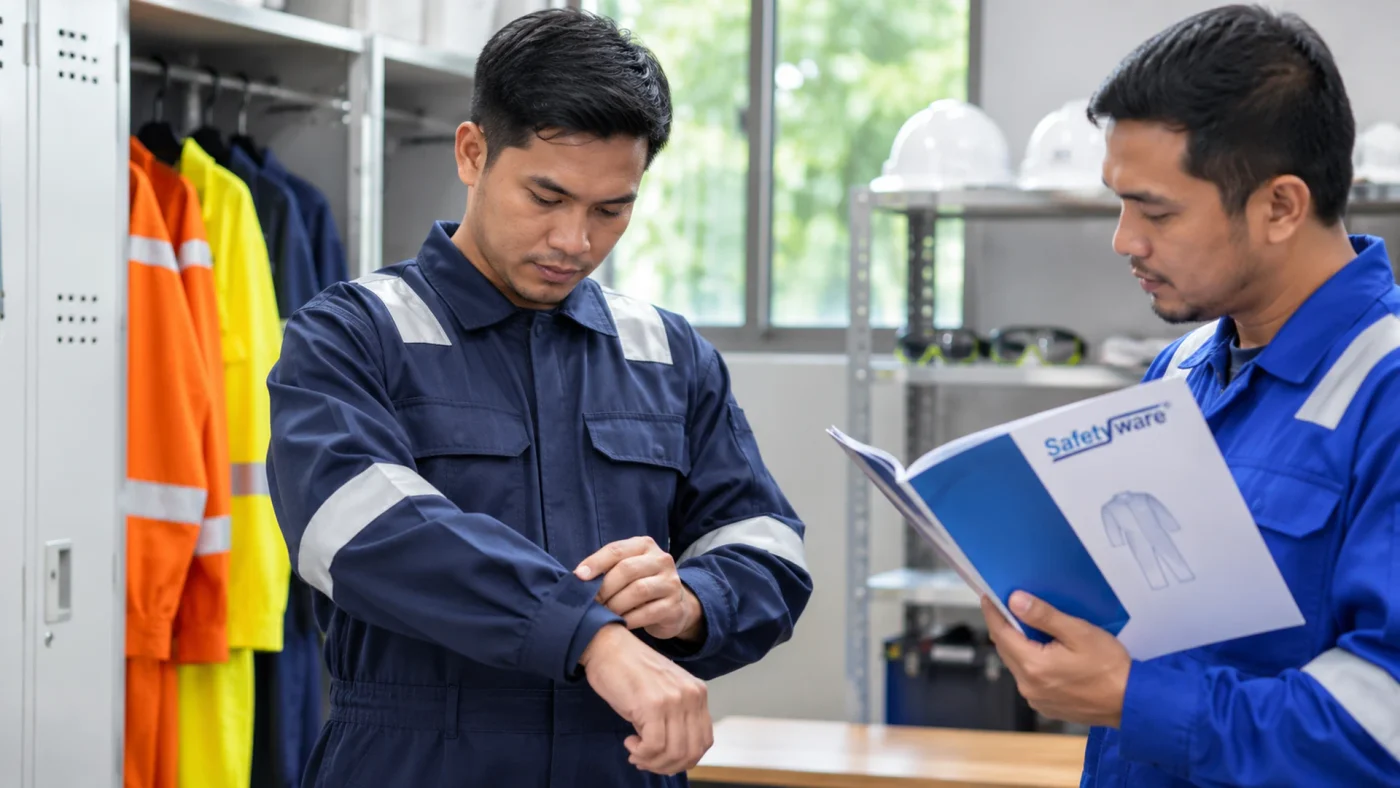
“Flame-resistant” is not a complete specification. The required protection depends on the thermal exposure, garment design, performance levels and clothing system.
ISO 11612:2015 addresses clothing protection against heat and flame. ISO currently lists it as published, with a replacement final draft under development. A draft should not be represented as an already published replacement. IEC 61482-2:2018 addresses protective clothing against the thermal hazards of an electric arc; it does not cover electric shock protection. [6]
Consequently, a coverall suitable for one thermal hazard should not automatically be accepted for chemical splash, electric shock or every arc exposure. Specify any electrostatic requirements separately as well.
Ask the supplier to explain how underlayers, outerwear, laundering, repairs and contamination affect the documented performance. Rainwear or an ordinary visibility vest can change the clothing system, so include them in the review rather than adding them after purchase.
Chemical and mechanical hand protection
No glove material protects against every chemical. Select using the exact glove manufacturer’s data, including permeation, breakthrough and degradation information. Consider the mixture, concentration, temperature, contact duration and required dexterity. Laboratory data for a pure substance may not represent a process mixture. [7]
ISO 374-1:2024 specifies requirements for chemical-protective gloves. Additional hazards, such as cuts or heat, require relevant additional performance evidence. [8]
For instance, a glove selected for handling dry metal components may be unsuitable for solvent contact. Conversely, a chemical glove may not provide the mechanical protection needed during maintenance. Request evidence for both needs when the task combines them, and establish replacement arrangements rather than treating a laboratory breakthrough time as a universal safe wearing period.
Safety footwear
ISO 20345:2021, with Amendment 1:2024, is a relevant international reference for safety footwear. It includes basic and additional requirements, so the standard designation alone does not prove every property needed for a refinery task. [9]
Specify the hazards separately: toe impact, underfoot penetration, wet or contaminated surfaces, chemicals, heat and electrical conditions. Check the actual model’s markings and documentation. In particular, do not infer grip on oily surfaces from a fuel-oil-resistance claim, or chemical protection from a boot’s waterproof appearance.
Include a wearer trial with the intended socks and work movements. The right specification is only useful if the footwear fits and workers can use it consistently.
Respiratory protection: identify the atmosphere first
A respirator specification must identify the contaminant, its physical form and concentration, oxygen availability and required protection. A particle filter does not become suitable for vapours simply because it fits the same facepiece.
NIOSH explains that air-purifying respirators remove contaminants from ambient air but do not supply oxygen. They are unsuitable for oxygen-deficient or immediately dangerous to life or health atmospheres. [10]
For unknown or potentially dangerous atmospheres, competent specialists must determine the appropriate approach, including whether entry can proceed at all. Where atmosphere-supplying respiratory protection is necessary, its configuration must match the work and emergency arrangements. Escape-only equipment must not be repurposed for entry or rescue.
Plan fit testing for tight-fitting facepieces, wearer suitability, seal checks, training, cleaning and replacement schedules as part of the respiratory programme. Keep the manufacturer’s instructions for the exact approved configuration available to users.
Gas detection supports the decision; it does not provide protection
A detector measures specified hazards through its installed sensors. It does not remove a gas or supply breathable air. Select the sensor configuration for the actual hazards and follow the manufacturer’s bump-test, calibration and maintenance instructions.
For tank entry, organise isolation, atmospheric assessment, authorisation, communication, standby arrangements and a viable rescue plan before work begins. An available harness or breathing apparatus does not by itself establish a safe entry system. [4]
Make PPE usable throughout the shift
Protective clothing and equipment can increase heat burden by limiting heat loss and adding physical effort. In hot conditions, consider the clothing system, workload, acclimatisation, humidity and recovery arrangements when planning work and rest. Provide appropriate hydration and safe recovery areas. [11]
During trials, ask workers to demonstrate normal movements and communication. Look for fogging, restricted reach, poor grip and uncomfortable pressure points. Resolve these problems before approving a bulk order.
For shutdowns, include contractors in the same product-acceptance process. Record approved models, sizes, issue quantities and replacement routes. A last-minute substitute should receive technical review even if its description looks similar.
A practical procurement checklist
Before accepting a quotation or product substitution, confirm:
- The task and residual hazards are documented.
- The safety officer has reviewed the proposed selection.
- Philippine acceptance requirements and operator specifications are identified.
- Certificates and test information match the exact model.
- Chemical or other specialist performance evidence addresses the actual exposure.
- Representative workers have checked fit and compatibility.
- Training, cleaning, inspection and replacement arrangements are ready.
- Respiratory, fall-protection and emergency equipment support competent procedures.
- Consumables, spare parts and required sizes are available within the project timeline.
- The supplier has disclosed any documentation or application limitations.
A strong request for quotation includes the task list, relevant safety data sheets, required performance, quantities by size, delivery location and project acceptance criteria. This gives buyers a defensible basis for comparing offers beyond unit price.
SAFETYWARE Products and Solutions
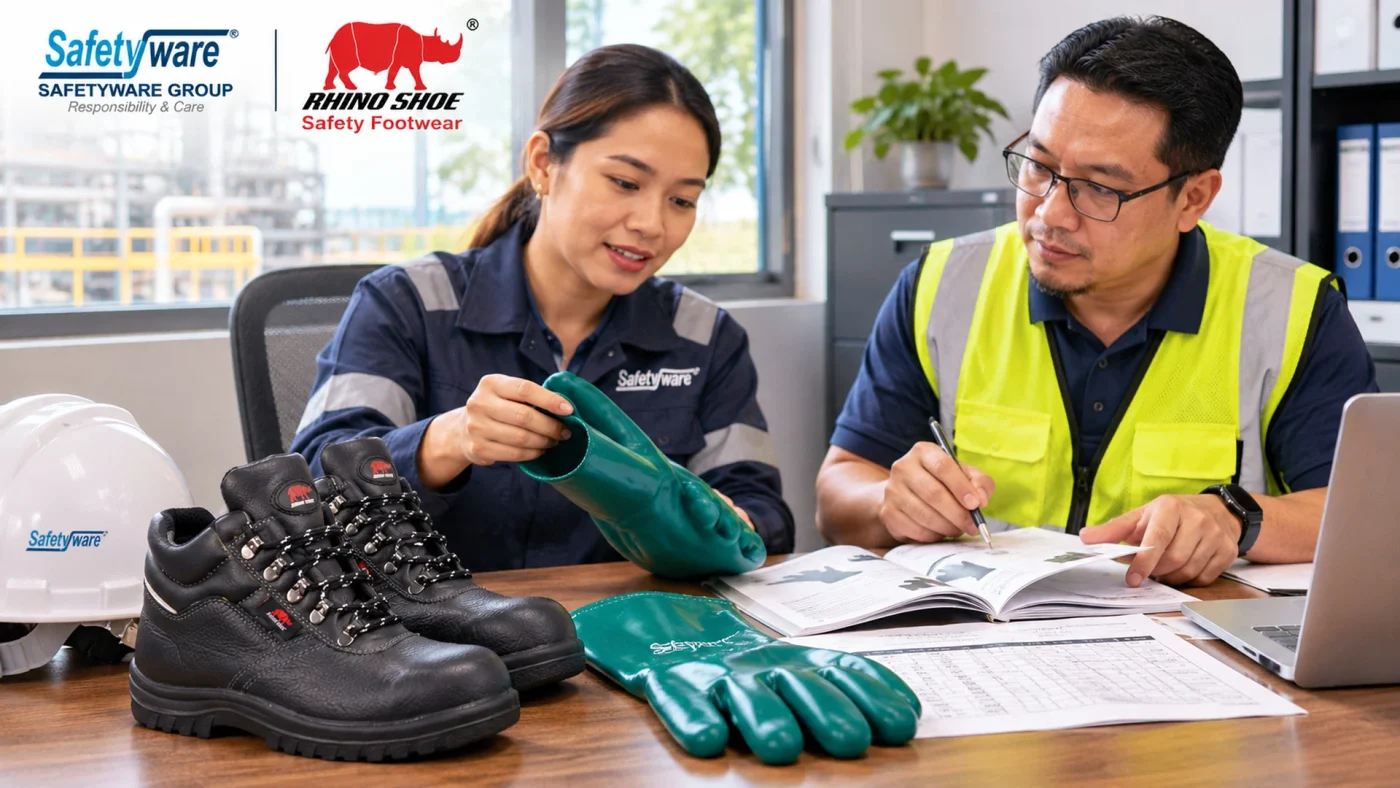
The SAFETYWARE product directory provides a useful starting point for discussing task-specific protection. Verified ranges relevant to this sector include:
| Range or solution | Official category | Selection discussion |
|---|---|---|
| SAFETYWARE FRPro and BlazeArmor clothing | Flame and heat resistant clothing | Request the exact garment’s certification, ratings, intended use and care instructions. |
| SAFETYWARE Chem-Pro GNF1513 nitrile gloves and NeoPlus NEO2813 neoprene gloves | Chemical-resistant gloves | Compare model-specific chemical data against the actual substance and task. |
| RHINO SHOE safety footwear | Foot protection | Confirm protection features, sizing and model documentation. |
| Respiratory equipment | Respiratory protection | Define the atmosphere and programme before choosing a configuration. |
| Monitoring equipment | Portable gas detectors | Check target gases, sensors, hazardous-area suitability and servicing needs. |
These category listings establish available product families; they do not establish that every model suits every application or holds a particular Philippine approval. Confirm local availability and acceptance documents before purchase.
SAFETYWARE’s oil, gas and petrochemical safety solutions page also brings together relevant product and support pathways. Share the site’s hazard assessment, required documents and workforce needs to begin a focused selection discussion.
Conclusion
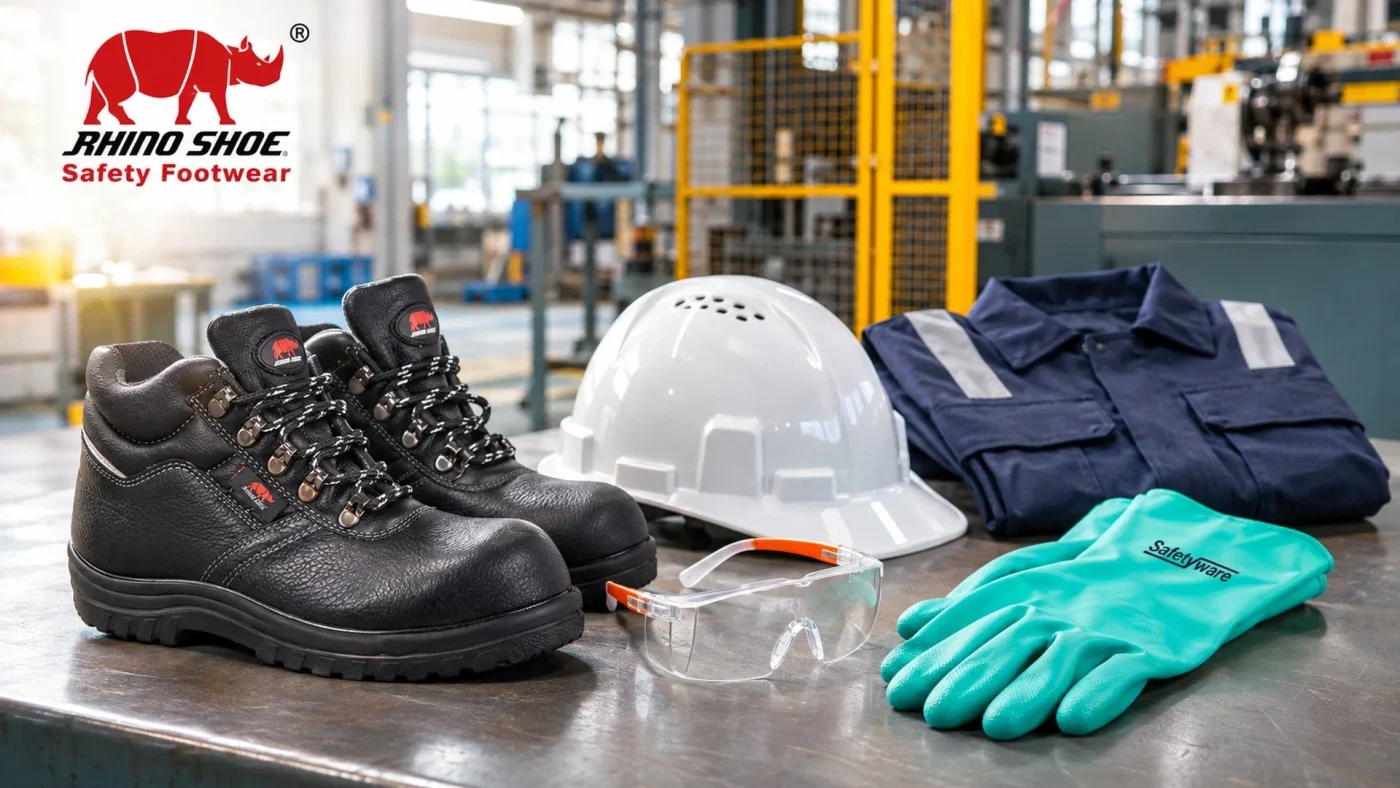
Essential PPE for the Philippines’ oil, gas and petrochemical industry depends on the task, the worker and the remaining exposure. Start with Philippine workplace duties and the site’s risk assessment, then turn those findings into clear product specifications.
Verify the exact models, trial the complete equipment combination and plan training, care and replacement before issue. With those details ready, buyers can work with SAFETYWARE to evaluate suitable products and support a practical, consistent PPE programme.
Sources and references
Reviewed on 11 November 2026. International regulator guidance supports technical discussion; it is not presented as Philippine legislation.
- Philippine Supreme Court E-Library — Republic Act No. 11058; Section 8 text, Lawphil.
- DOLE Bureau of Working Conditions — Revised IRR and effective date and PPE provision and training guidance; official DOLE publication notice.
- NIOSH — Hierarchy of Controls.
- US OSHA — Oil and gas extraction hazards.
- UK HSE — PPE selection and use.
- ISO — ISO 11612:2015; IEC — IEC 61482-2:2018.
- UK HSE — Glove selection principles, used for chemical-selection principles rather than its older standard references.
- ISO — ISO 374-1:2024.
- ISO — ISO 20345:2021 and Amendment 1:2024.
- NIOSH — A Guide to Air-Purifying Respirators.
- NIOSH — PPE Heat Burden.
- SAFETYWARE — Products, plus the verified category and sector links in the products section.
📞 Need More Information?
Looking for PPE for a factory in Philippines?
Explore SAFETYWARE’s safety shoes and workplace PPE range at
👉Safetyware Catalogs
Our safety specialists can help evaluate workplace hazards, recommend suitable safety helmets, and support compliance with Malaysia workplace safety requirements.
If you need a quotation, feel free to contact us at:
📩 Email: [email protected]
📞 Tel: WhatsApp Us