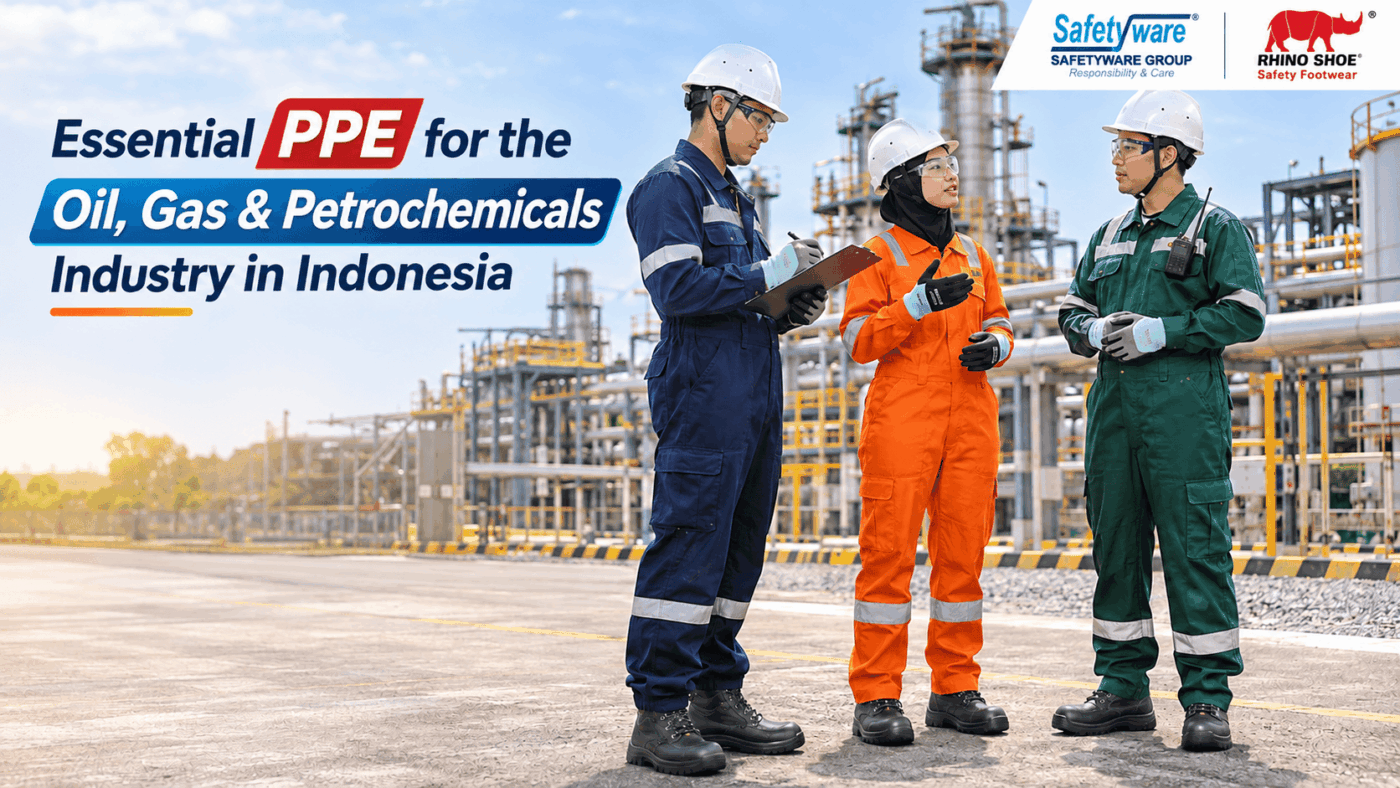
A refinery operator taking a sample, a maintenance team opening a process line and a technician inspecting an offshore platform can face very different hazards. Giving all three the same PPE kit leaves important selection questions unanswered.
Choosing oil and gas PPE in Indonesia starts with the task, the substances involved and the conditions under which exposure could occur. The aim is a compatible protective system that workers can wear correctly, supported by isolation, exposure controls, training and emergency arrangements.
This guide explains Indonesia’s core PPE duties, the protection categories buyers should assess and the documents to request before approving equipment for oil, gas and petrochemical operations.
What does Indonesian law require for PPE?
Indonesia’s Ministry of Manpower lists PER.08/MEN/VII/2010 on personal protective equipment, known locally as Alat Pelindung Diri or APD, as in force. Its key duties include:
- Article 2: Employers provide PPE free of charge; it must conform to SNI or applicable standards.
- Article 5: Employers or management communicate PPE obligations in writing and display signs.
- Article 6: Workers and other people entering the workplace use PPE according to hazards and risks.
- Article 7: Employers or management operate a PPE management programme covering selection, training, use, care, storage, inspection and evaluation, among other duties.
Article 4 expressly addresses workplaces involving flammable or hazardous materials and oil and gas activities. The regulation does not turn a generic catalogue list into a suitable kit for every task. [1]
Separate legal duties, standards and site rules
| Requirement type | What it means for procurement |
|---|---|
| Indonesian law | Establishes duties that apply to the workplace. Identify relevant regulations and any product-specific obligations. |
| Product performance standard | Defines tests or performance requirements within a stated scope. Check the exact edition, model and claimed protection. |
| Operator or contractor specification | Sets project acceptance criteria, which may be more demanding than the legal baseline. |
| Practical selection guidance | Helps translate hazards into a workable purchasing specification; it is not automatically a legal requirement. |
The international standards discussed below are technical references, not a claim that each is universally mandated in Indonesia. Likewise, UK HSE and US NIOSH/OSHA guidance cited here supports technical selection; their domestic legal requirements are not presented as Indonesian law.
Start with the job and exposure scenario
PPE sits below elimination, substitution and engineering controls in the hierarchy of controls. A more protective garment does not remove the need to prevent a release, isolate equipment or reduce exposure at source. [2]
Before requesting quotations, divide work into distinct scenarios: normal rounds, sampling, breaking containment, maintenance, shutdowns, electrical intervention and emergency response. For each, record:
- The substance or energy that could cause harm.
- How exposure could occur and how severe it could be.
- Controls already in place and the residual risk.
- Required PPE performance and compatibility.
- The conditions that require stopping work or escalating protection.
For example, “gloves for refinery maintenance” is an incomplete specification. A useful request identifies the chemicals, concentrations, contact temperature, expected contact duration and mechanical demands of the task.
Essential PPE categories for oil, gas and petrochemical work
The following is a selection framework, not a universal mandatory kit. A competent site assessment should determine the final combination.
| Work or exposure | PPE to assess | Important buying question |
|---|---|---|
| Process-area rounds | Helmet, eye protection, safety footwear and protective clothing specified for the area | Does the complete ensemble meet the area’s hazard assessment and access rules? |
| Chemical sampling or controlled line opening | Chemical gloves, splash eye/face protection and suitable protective clothing and footwear | Is there evidence for the actual chemical mixture and exposure conditions? |
| Handling tools, pipework or sharp components | Gloves with appropriate mechanical protection | Are grip, dexterity and the required protection demonstrated for the task? |
| Compressor, turbine or other noisy areas | Hearing protection selected using the noise assessment | Can workers still receive necessary warnings and communications? |
| Work with assessed fire exposure | Clothing and compatible layers selected for the identified thermal hazard | What does the garment certificate cover, and what are its limitations? |
| Electrical intervention | Task-specific arc and electrical shock protection | Have thermal arc exposure and electric shock been assessed separately? |
| Confined-space work | PPE determined by the space, atmosphere, work and rescue plan | Is entry authorised, and is respiratory protection suitable for the atmosphere? |
| Elevated work or work near water | Suitable fall protection or flotation equipment where required by the assessment | Can the systems be worn together and support the planned rescue? |
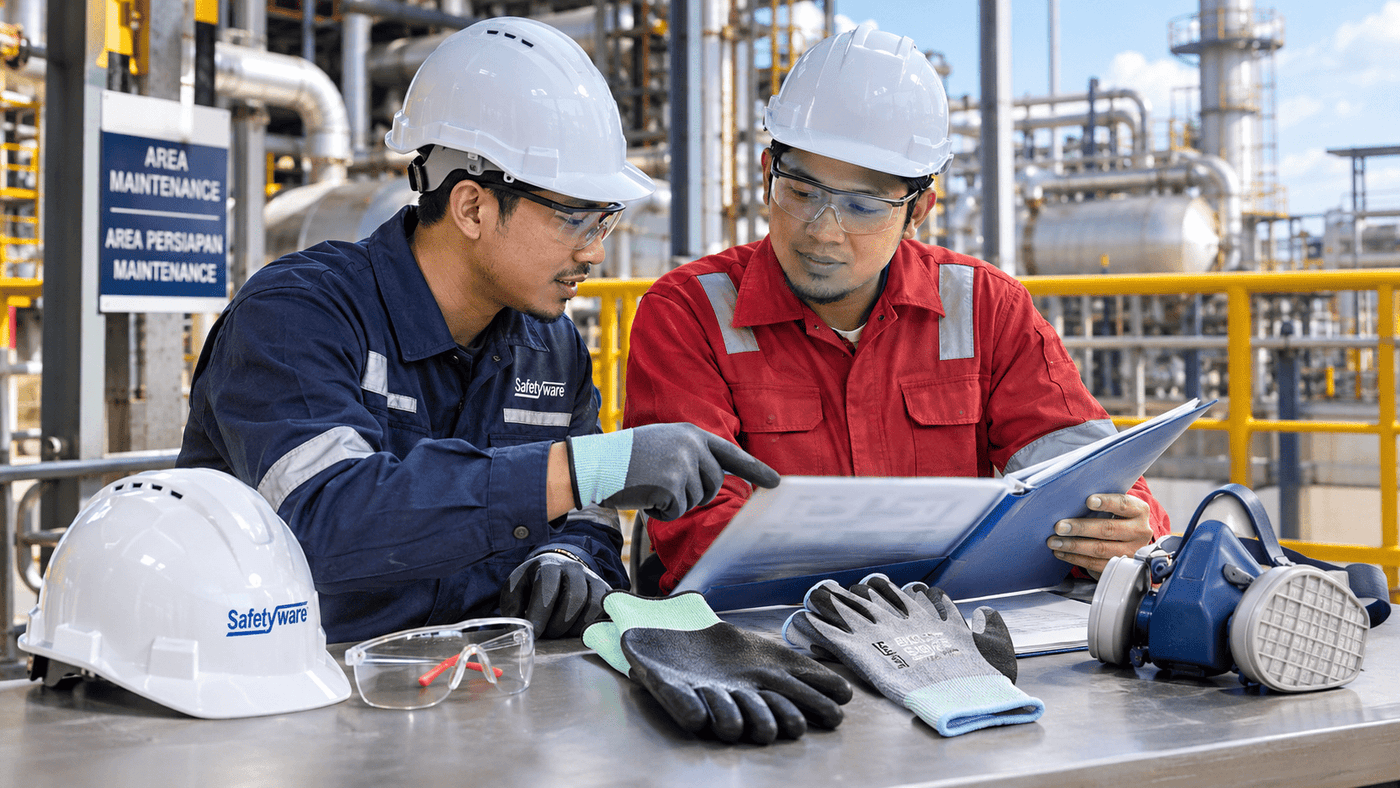
General selection should consider fit, weight, compatibility and the worker’s physical characteristics. For example, eyewear can interfere with a respirator seal, while poorly matched helmet and earmuff components can compromise protection. [3]
Choose protective clothing for the specific hazard
Flame resistance, chemical resistance and arc protection are different
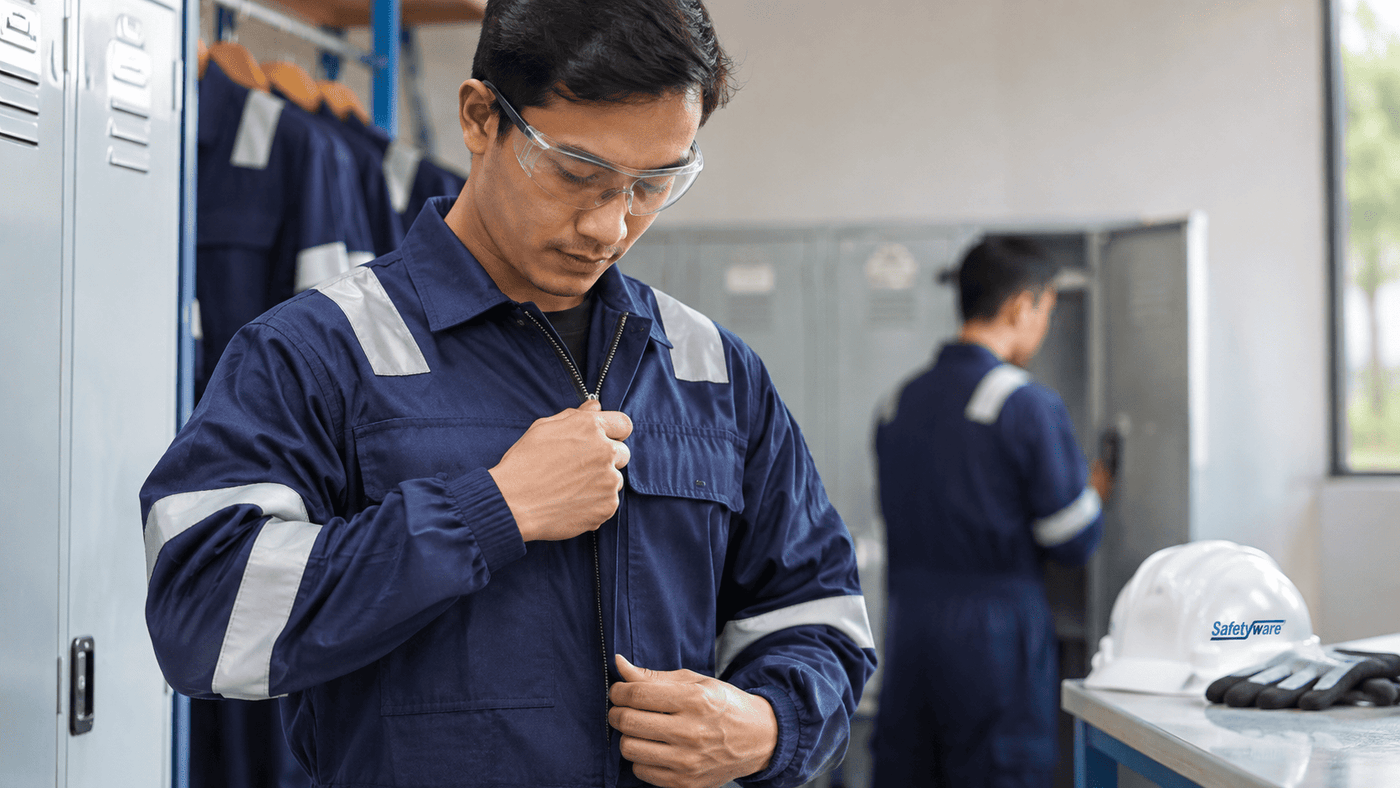
A garment described as flame-resistant does not automatically provide chemical splash protection or a suitable electric arc rating. Procurement should specify the required protection for each exposure and then check that the proposed garment system meets those needs.
Three useful standard references illustrate the distinction:
| Reference checked | Scope relevant to buyers | What still needs checking |
|---|---|---|
| ISO 11612:2015 | Clothing performance against heat and flame | The performance codes, levels and complete garment configuration needed for the assessed exposure |
| IEC 61482-2:2018 | Clothing against the thermal hazards of an electric arc | Suitability for the assessed arc exposure; separate protection against electric shock and other arc effects |
| ISO 374-1:2024 | Chemical protection requirements for gloves | Chemical-specific test data; separate mechanical, thermal or electrostatic performance where needed |
ISO’s catalogue currently lists ISO 11612:2015 as published and its replacement as a final draft under development. Check publication status again when specifying a future tender. IEC 61482-2 does not cover electric shock protection. [4–6]
For potential flash-fire exposure, ask the responsible safety specialist to define the required evidence and acceptance criteria. A generic “FR” label alone is insufficient. OSHA identifies flash fire as a serious oil and gas hazard; that technical hazard information should not be confused with an Indonesian mandate to adopt US rules. [7]
Assess the complete clothing system
Review underlayers, coveralls, rainwear, high-visibility garments and accessories together. Ask the supplier how layering, laundering, repairs and contamination affect the claimed performance. Include sleeve and trouser coverage, fastening methods and freedom of movement in the wearer trial.
Where ignition from static electricity is a concern, specify the required electrostatic performance separately. Do not infer it from garment colour, fabric weight or flame resistance.
Select chemical gloves and footwear with evidence
Chemical gloves: the material name is only a starting point
Nitrile, neoprene and PVC are not interchangeable, and no glove material protects against every substance. Ask for the manufacturer’s data on permeation, breakthrough and degradation for the exact product. Confirm whether the evidence applies to the concentration, mixture and temperature involved. [8]
Use that information to establish replacement arrangements with competent technical input. Do not turn a laboratory breakthrough result into a guaranteed safe wearing time for all field conditions.
Mechanical protection may also be necessary, but a cut-resistant or impact-protective glove should not be treated as chemically protective without supporting evidence. Check cuff coverage and the glove-to-sleeve interface, and train workers to remove contaminated gloves without spreading contamination.
Footwear: specify each required property
ISO 20345:2021, together with Amendment 1:2024, is a relevant international safety-footwear reference. Its scope includes basic and optional protection requirements; the standard number alone does not establish every feature a site needs. [9]
A purchasing specification should identify toe protection, underfoot hazards, slip conditions, chemical exposure and any thermal or electrical requirements. Ask for evidence for each selected feature. In particular, do not assume that resistance to fuel-oil damage proves grip on an oily floor, or that ordinary safety boots provide protection against process chemicals.
Where static dissipation and electrical shock hazards both exist, obtain a coordinated selection from the responsible specialists. Those objectives cannot be resolved by choosing footwear from a broad marketing description.
Respiratory protection and gas detection need a planned system
Respirator selection depends on the contaminant, its concentration, oxygen availability, work demands and the required protection. Particle filters do not remove gases merely because they capture dust. Air-purifying respirators do not supply oxygen and are unsuitable for oxygen-deficient or immediately dangerous to life or health atmospheres. [10]
For such conditions, competent specialists must specify appropriate atmosphere-supplying equipment, operating procedures and rescue arrangements. An escape-only device must not be repurposed for entry or rescue.
A respiratory programme should address suitability for the wearer, fit testing for tight-fitting facepieces, seal checks, training, maintenance and filter or cartridge replacement arrangements. Obtain instructions for the exact equipment configuration.
Gas detectors support hazard recognition; they do not protect the lungs. For hydrogen sulfide risks, select instruments capable of detecting that gas and establish monitoring and response procedures. OSHA’s technical guidance emphasises exposure evaluation, suitable testing equipment and planned rescue resources. [11]
Confined spaces have specific Indonesian requirements
Permenaker No. 11 of 2023, listed by the Ministry as in force, governs occupational safety and health in confined spaces. It addresses classification, access control, entry permits, safe procedures, equipment and competent personnel. Article 17 requires a written emergency plan, including personnel, equipment and evacuation arrangements. [12]
Treat PPE as one part of that system. A respirator and harness do not make an unassessed tank safe to enter, and a rescue plan must exist before a foreseeable emergency occurs.

Make the PPE programme workable in hot conditions
Protective clothing, respirators and other equipment can increase heat burden. Plan work and recovery periods around the environment, workload, acclimatisation and the clothing system. Provide hydration and suitable recovery areas, with PPE removal only where it is safe and contamination is controlled. [13]
During wearer trials, observe normal actions: climbing permitted access steps, bending, handling tools and communicating. Check whether goggles fog, gloves reduce control or clothing restricts movement. Address those problems before purchasing a large quantity.
Use practical instruction and demonstrations in a language workers understand. Maintain a clear route for reporting damaged equipment and obtaining replacements.
PPE procurement checklist for Indonesian operations
Before approving a model or issuing a purchase order, confirm:
- The task and residual hazards are documented.
- Applicable Indonesian duties and operator specifications are identified separately.
- The proposed model matches the certificate, datasheet and product markings.
- Chemical compatibility or other specialist performance evidence is available where needed.
- Workers have trialled the required sizes and complete PPE combinations.
- Respiratory, fall protection and emergency equipment are linked to competent procedures.
- Cleaning, storage, inspection and replacement arrangements are practical.
- Delivery quantities include the sizes and replacement stock the workforce needs.
- Training and instructions are available before issue.
- Substitutions require technical review before acceptance.
A useful supplier enquiry includes the work location, task list, chemical safety data sheets, exposure information, required standards, workforce sizes and expected delivery dates. This makes product comparisons more meaningful than comparing unit prices alone.
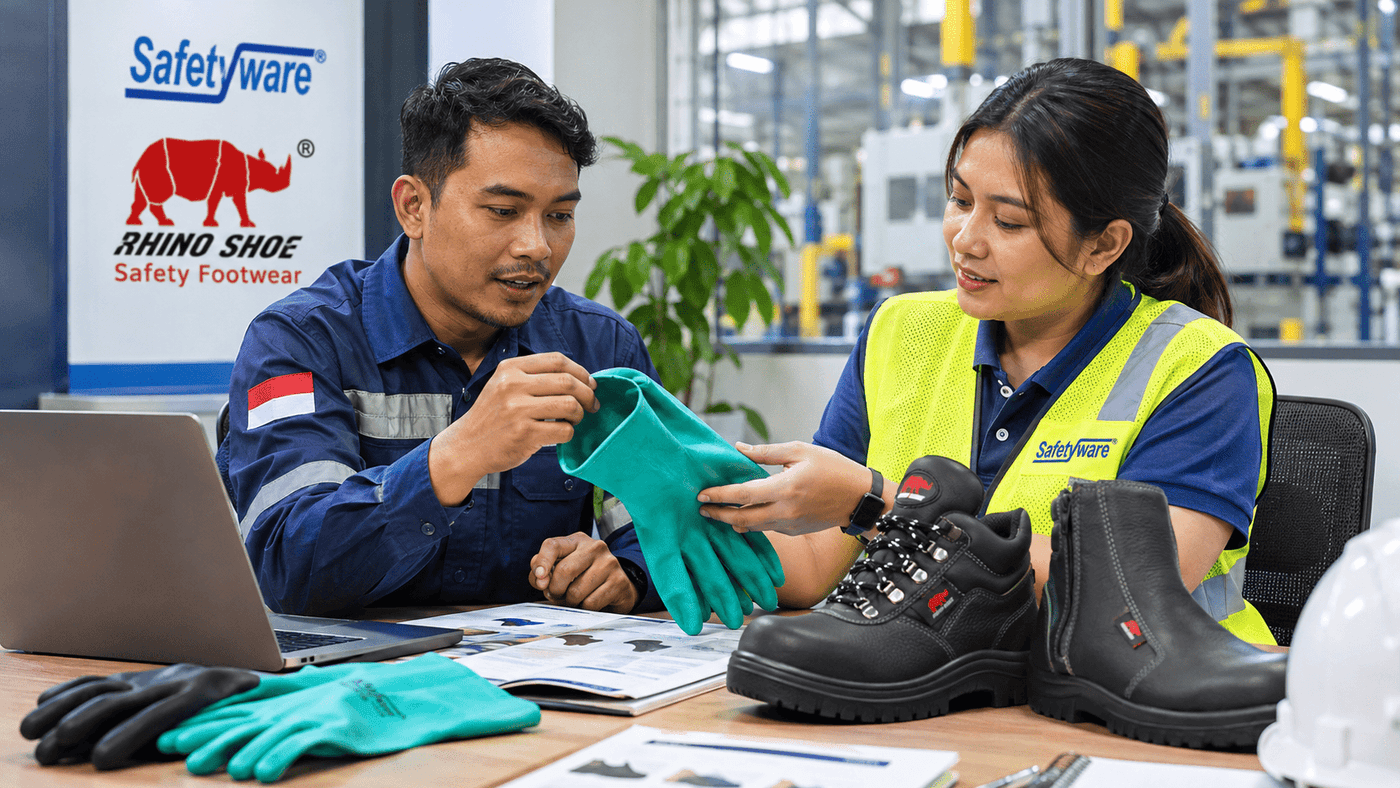
SAFETYWARE Products and Solutions
The SAFETYWARE product directory provides a starting point for assembling a task-specific specification. Relevant verified ranges include:
| Product or solution | Relevant official link | How to approach selection |
|---|---|---|
| SAFETYWARE FRPro and BlazeArmor clothing ranges | Flame and heat resistant clothing | Request the exact garment’s certification, performance levels, care instructions and approved use. |
| SAFETYWARE Chem-Pro nitrile and NeoPlus neoprene gloves | Chemical-resistant gloves | Compare model-specific chemical data with the actual substances and contact conditions. |
| RHINO SHOE safety footwear | Foot protection | Match documented protection features, fit and sole performance to the work environment. |
| Respiratory equipment | Respiratory protection | Define the atmosphere and respiratory programme before selecting the equipment configuration. |
| Gas-monitoring equipment | Portable gas detectors | Check target gases, sensor configuration, hazardous-area suitability and service requirements. |
These listings verify the ranges offered, not suitability of every model for every oil and gas task. Confirm Indonesian availability and applicable product documentation for the proposed purchase.
For coordinated planning, SAFETYWARE also provides an oil, gas and petrochemical safety solutions pathway. Share the site’s tasks and hazards to discuss appropriate product and support options.
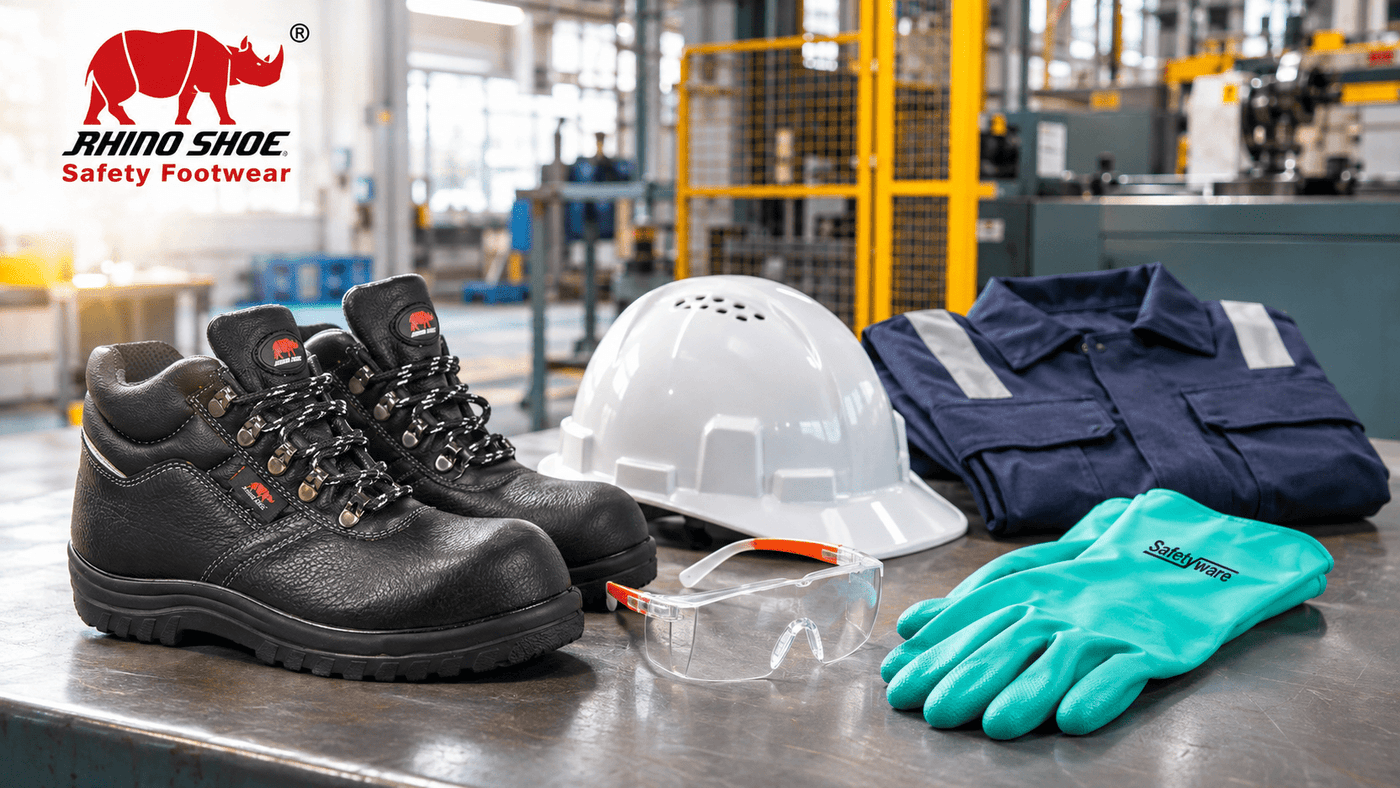
Conclusion
Effective PPE selection for Indonesia’s oil, gas and petrochemical industry begins with a clear description of the work. Establish the legal duties, assess the residual hazards and specify the protection required for each task.
Then verify the exact products, trial the complete combination and plan training, care and replacement. Bring that documented specification to SAFETYWARE to discuss suitable options and build a PPE programme that supports safe daily work.
Sources and references
Primary sources and official product pages reviewed on 9 November 2026:
- Indonesian Ministry of Manpower — PER.08/MEN/VII/2010: status and official text.
- NIOSH — Hierarchy of Controls.
- UK HSE — PPE selection and use.
- ISO — ISO 11612:2015 and replacement draft status.
- IEC — IEC 61482-2:2018.
- ISO — ISO 374-1:2024.
- US OSHA — Oil and gas extraction hazards.
- UK HSE — Choosing gloves to protect skin. Used for selection principles, not its older standard designation.
- ISO — ISO 20345:2021 and Amendment 1:2024.
- NIOSH — A Guide to Air-Purifying Respirators.
- US OSHA — Hydrogen sulfide: evaluating and controlling exposure.
- Indonesian Ministry of Manpower — Permenaker No. 11 of 2023: status and official text.
- NIOSH — PPE Heat Burden.
- SAFETYWARE — Product directory and the official category and solutions links in the SAFETYWARE section above.
📞 Need More Information?
Looking for PPE in indonesia?
Explore SAFETYWARE’s safety shoes and workplace PPE range at
👉Safetyware Catalogs
Our safety specialists can help evaluate workplace hazards, recommend suitable safety helmets, and support compliance with Malaysia workplace safety requirements.
If you need a quotation, feel free to contact us at:
📩 Email: [email protected]
📞 Tel: WhatsApp Us