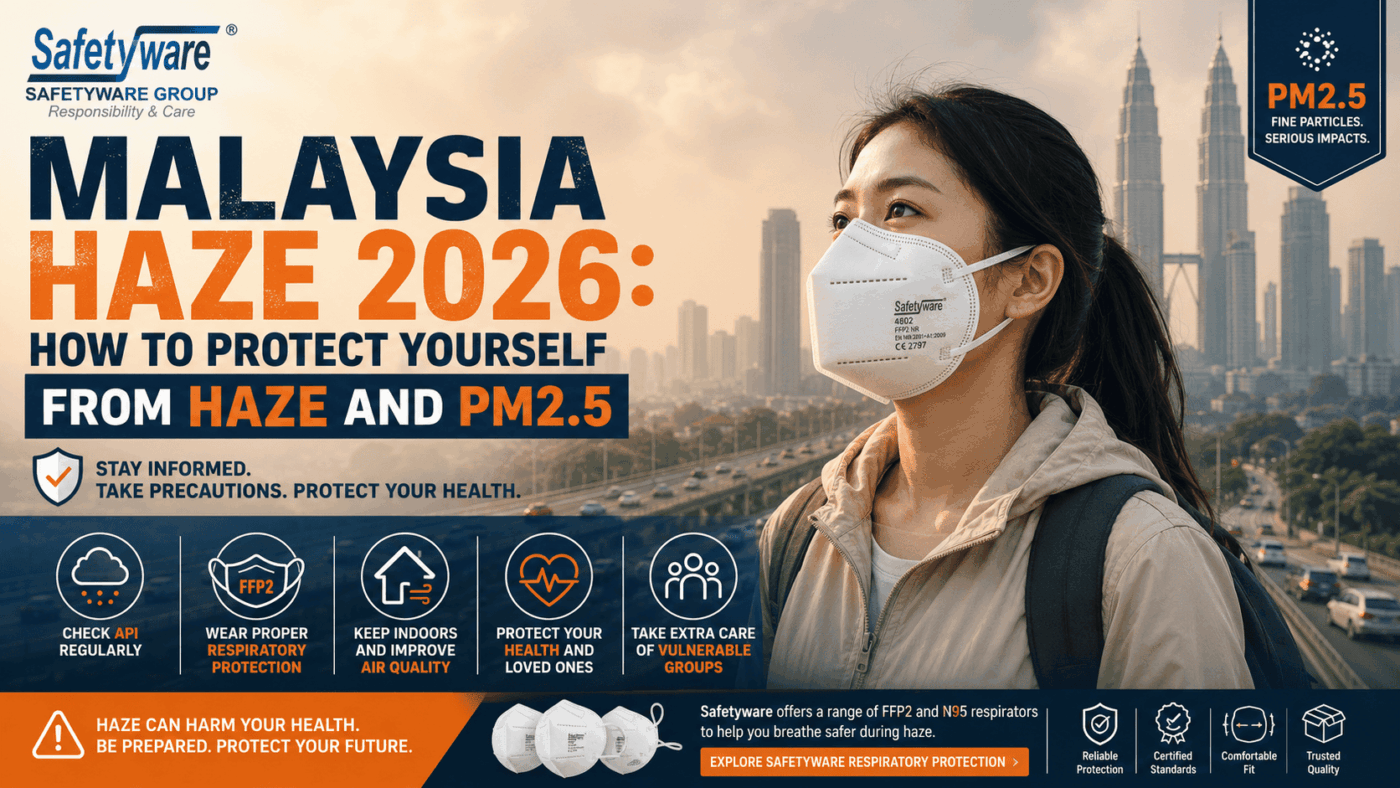
Haze is a recurring environmental issue in Malaysia, particularly during periods of dry weather and regional biomass burning. When haze occurs, the air can contain elevated levels of fine particulate matter, including PM2.5, which can penetrate deep into the respiratory system. How to Protect Yourself from Haze and PM2.5?
For people who need to spend time outdoors, commute during hazy conditions, or work in open and semi-enclosed environments, taking the right precautions can help reduce exposure. Measures such as monitoring the Air Pollutant Index (API), limiting outdoor activities, improving indoor air quality, and wearing a properly fitted N95 or equivalent particulate respirator can provide additional protection when particulate pollution is elevated.
This guide explains what causes haze in Malaysia, what PM2.5 means, how to understand API readings, and practical steps you can take to protect yourself.
What Causes Haze in Malaysia?
Haze occurs when smoke, dust, gases and fine particles accumulate in the atmosphere and reduce visibility and air quality.
In Malaysia, haze can be caused by a combination of local and regional sources.
1. Open Burning and Forest Fires
One of the major contributors to severe haze episodes in Southeast Asia is the burning of forests, peatlands and agricultural areas.
Large-scale fires can generate significant quantities of smoke and fine particulate matter. Depending on wind direction and atmospheric conditions, this pollution can travel across national borders and affect neighbouring countries, including Malaysia.
2. Agricultural Burning
Agricultural activities involving the burning of vegetation or crop residues can also contribute to particulate pollution.
When many fires occur simultaneously during dry conditions, smoke can accumulate and contribute to regional haze.
3. Dry Weather
Dry weather increases the likelihood of vegetation and peatland fires.
With less rainfall to remove particles from the atmosphere, pollutants can remain suspended for longer periods.
4. Local Sources of Air Pollution
Haze conditions can also be worsened by local emissions from:
- Vehicle exhaust
- Industrial activities
- Construction activities
- Road dust
- Open burning
- Power generation
- Other combustion sources
When atmospheric conditions prevent pollutants from dispersing effectively, these sources can contribute to poorer local air quality.
Why Does Haze Become Worse on Some Days?
Haze severity depends not only on how much pollution is produced but also on weather and atmospheric conditions.
Low wind speeds, dry weather and atmospheric conditions that limit the dispersion of pollutants can cause particulate matter to accumulate near ground level. This is why air quality can change significantly from one day to another.
What Is PM2.5?
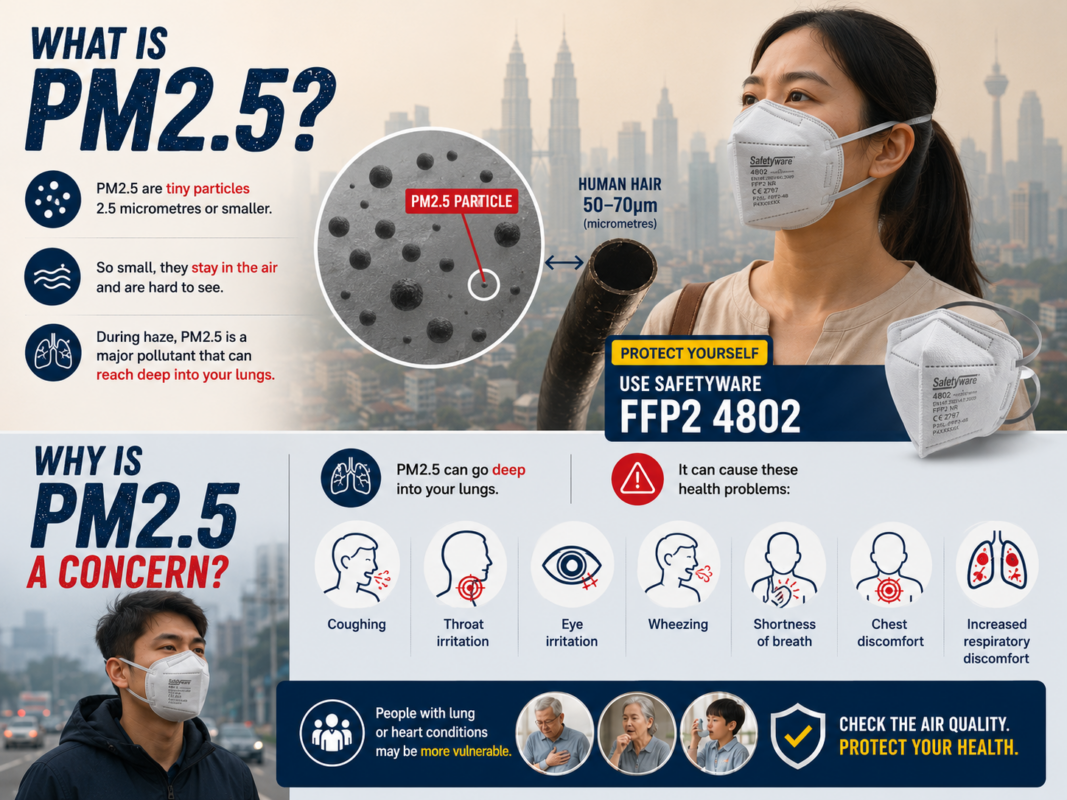
PM2.5 refers to fine particulate matter with an aerodynamic diameter of 2.5 micrometres or smaller.
These particles are extremely small compared with the width of a human hair and can remain suspended in the air.
During haze events, PM2.5 is one of the key pollutants of concern because the particles are small enough to travel deep into the respiratory system.
Why Is PM2.5 a Concern?
Unlike larger particles that may be filtered by the nose and upper respiratory tract, fine particles can penetrate deeper into the lungs.
Exposure to elevated concentrations of particulate matter can irritate the respiratory system and may cause symptoms such as:
- Coughing
- Throat irritation
- Eye irritation
- Wheezing
- Shortness of breath
- Chest discomfort
- Increased respiratory discomfort
People with existing respiratory or cardiovascular conditions may be more vulnerable to the effects of air pollution.
How Does Haze Affect Your Health?
Haze affects the body primarily through inhalation of airborne pollutants and fine particles.
Some people may experience only temporary irritation, while others can develop more significant symptoms, particularly during prolonged exposure or periods of poor air quality.
Common short-term effects
Haze exposure may cause:
- Irritated or watery eyes
- Runny nose
- Sneezing
- Sore or scratchy throat
- Coughing
- Headaches
- Chest discomfort
- Wheezing
- Shortness of breath
- Worsening asthma or other respiratory symptoms
Malaysia’s Ministry of Health advises people with respiratory or heart conditions to take additional precautions during haze and seek medical attention if existing symptoms become worse.
Who should take extra care?
Extra caution is recommended for:
- Children
- Older adults
- Pregnant people
- People with asthma
- People with chronic respiratory conditions
- People with heart disease
- People who are particularly sensitive to dust or air pollution
- Outdoor workers who may be exposed for extended periods
The risk is also greater when people perform strenuous outdoor activities because heavier breathing increases the amount of polluted air inhaled. For this reason, Malaysia’s Ministry of Health recommends avoiding outdoor activities when API exceeds 100, particularly strenuous activities.
Understanding Malaysia’s API Reading
The Air Pollutant Index (API) is used in Malaysia to communicate the status of air quality and its potential health effects.
Malaysia’s Department of Environment categorises API readings into several levels.
| API Reading | Status | General Guidance |
| 0–50 | Good | No restriction on outdoor activities for the general public |
| 51–100 | Moderate | Maintain normal activities but continue monitoring air quality |
| 101–200 | Unhealthy | High-risk groups should limit outdoor activities; the public should reduce strenuous outdoor activities |
| 201–300 | Very Unhealthy | Outdoor activities should be significantly reduced, particularly for susceptible groups |
| 301–400 | Hazardous | Outdoor exposure should be minimised; additional precautions are necessary |
| 401–500 | Hazardous | Avoid outdoor activities as much as possible |
| Above 500 | Hazardous | Follow instructions from authorities and workplace/emergency management |
The API should be treated as a real-time guide, rather than as a guarantee that a particular exposure is safe for every individual.
Malaysia’s Ministry of Health also provides workplace-specific recommendations. At API 101–200, outdoor workers may be advised to use N95 respirators, minimise strenuous outdoor tasks and reassign susceptible workers to indoor duties where possible. At higher API levels, controls become progressively stricter.
What Should You Do When API Exceeds 100?
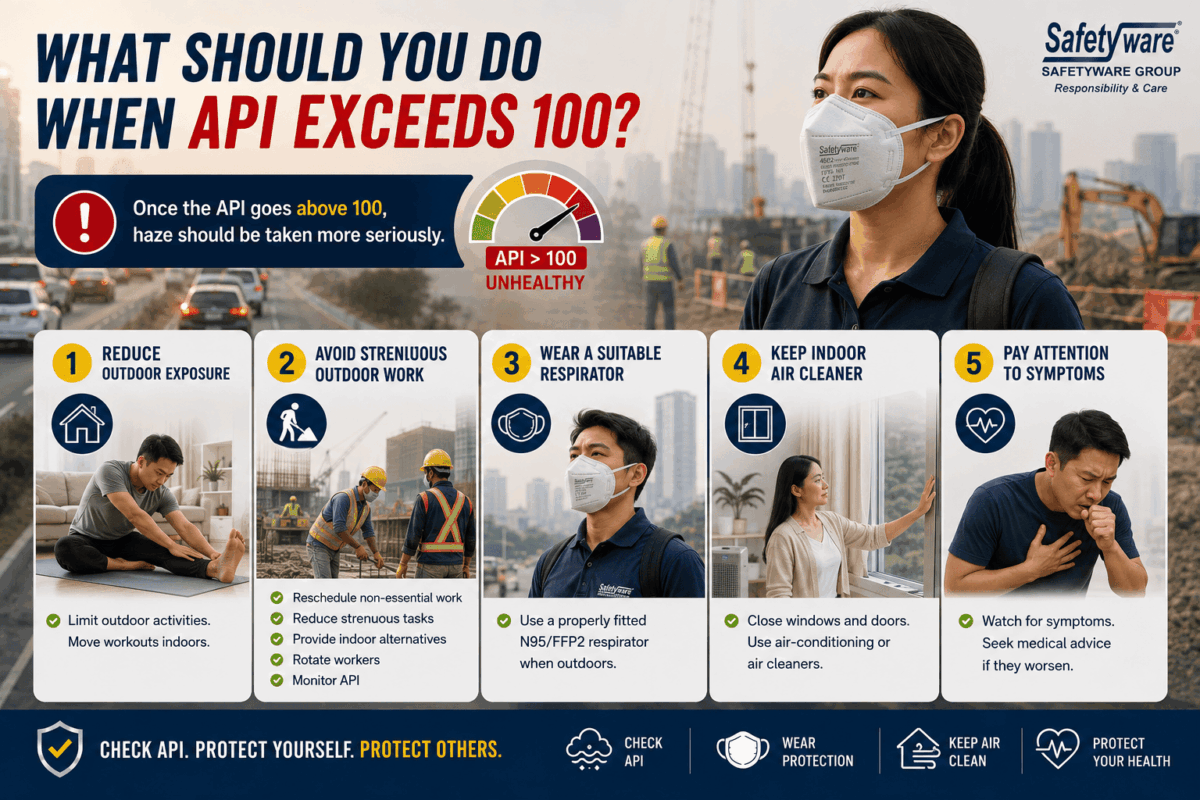
Once the API goes above 100, haze should be taken more seriously.
Malaysia’s Ministry of Health recommends limiting outdoor activities when API exceeds 100, and its workplace guidance recommends additional controls for outdoor employees.
1. Reduce unnecessary outdoor exposure
Avoid spending long periods outdoors, particularly for recreational activities.
Instead of outdoor jogging, cycling or other strenuous exercise, consider moving activities indoors until air quality improves.
2. Avoid strenuous outdoor work where possible
Heavy physical activity increases breathing rate and therefore increases the amount of polluted air inhaled.
Employers should consider:
- Rescheduling non-essential outdoor work
- Reducing strenuous tasks
- Providing indoor alternatives
- Rotating workers where appropriate
- Giving susceptible workers alternative duties
- Monitoring API throughout the workday
3. Wear a suitable respirator when outdoor exposure cannot be avoided
For people who must work or travel outdoors during haze, a properly fitted particulate respirator can reduce inhalation of fine particles.
Malaysia’s Ministry of Health specifically states that an N95 masks may be used during haze and is more appropriate for fine haze particles than a conventional surgical mask.
4. Keep indoor air cleaner
Close windows and doors when outside air quality is poor and use appropriate air-conditioning or air-cleaning systems where available.
5. Pay attention to symptoms
Do not ignore heavy cough, breathing difficulties, chest discomfort, severe wheezing or other concerning symptoms. People with existing lungs or heart conditions should follow their professional advice.
Should You Wear an N95 During Haze?
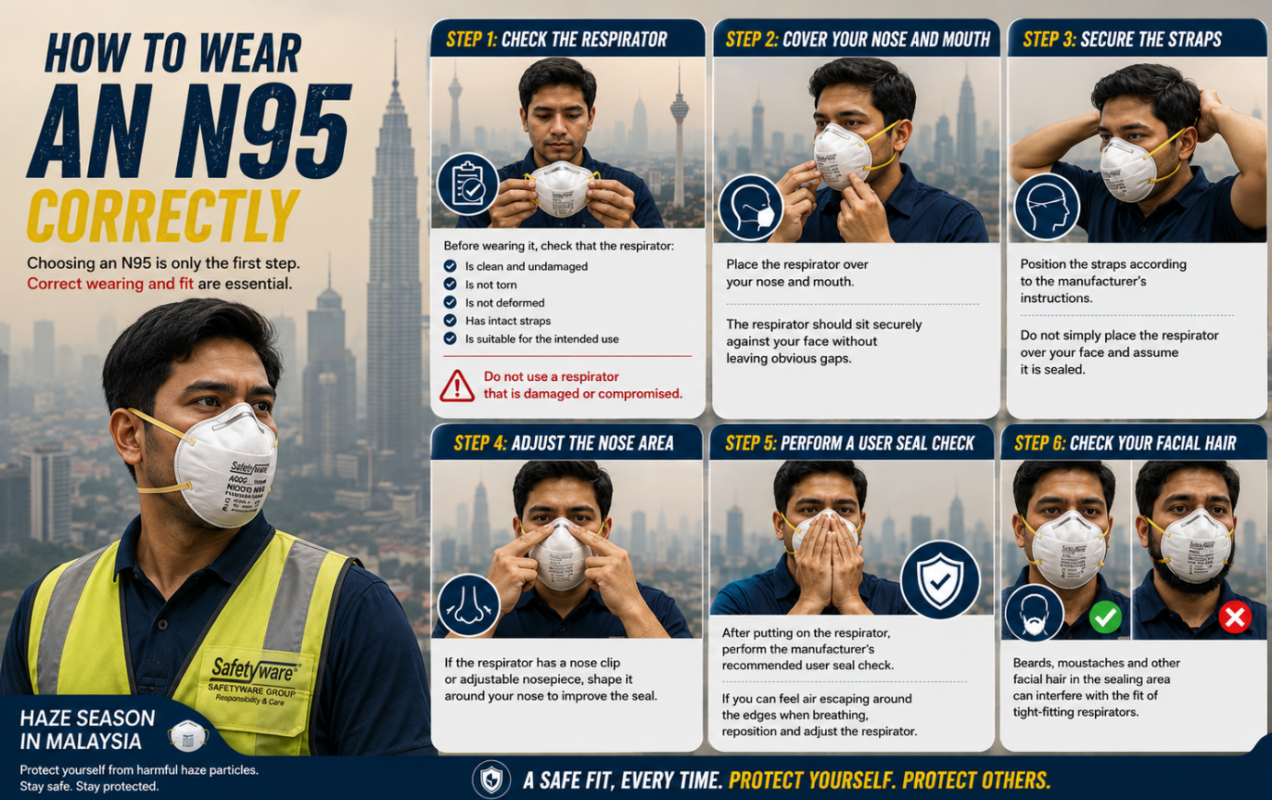
Yes, an appropriate N95 particulate respirator can help reduce inhalation of fine haze particles, particularly when you must be outdoors.
Malaysia’s Ministry of Health states that haze particles may be as small as 2.5 microns and that surgical masks do not adequately prevent inhalation of these fine particles. It recommends respirators because they provide a better seal and use filtration designed for fine airborne particles. The Ministry specifically identifies the N95 respirator as an option for protection during haze.
Why choose an N95 instead of a surgical mask?
A surgical or procedure mask is mainly designed for source control and protection against splashes and larger droplets. It generally does not form the same tight facial seal as a particulate respirator.
A properly fitted particulate respirator is designed to filter fine airborne particles and reduce leakage around the face. NIOSH guidance also notes that N95 respirators can filter PM2.5-sized particles when correctly worn and fitted.
👉 Read more on Best Mask for Haze in Malaysia: N95 vs Surgical Mask
N95 does not mean unlimited outdoor protection
An N95 is not a reason to stay outdoors for long periods during severe haze.
Respirators are one part of a broader protection strategy. Reducing exposure, moving activities indoors and following API-based health advice remain important.
Also note that particulate respirators are designed primarily for particles. A particulate respirator should not automatically be assumed to protect against all gases or chemical vapours in smoke.
How to Reduce Haze Exposure Indoors
Staying indoors does not automatically eliminate exposure. Outdoor pollutants can enter buildings through open windows, doors, ventilation systems and other openings.
1. Keep windows and doors closed
When outdoor air quality is poor, minimise the amount of outside air entering the building.
2. Use air-conditioning appropriately
When driving during haze, Malaysia’s Ministry of Health recommends using air-conditioning with the recirculation setting and keeping windows closed.
Similar principles can help reduce the introduction of polluted outdoor air into enclosed spaces.
3. Use air cleaners where appropriate
Portable air cleaners equipped with high-efficiency particle filtration can help reduce airborne particulate concentrations indoors. CDC guidance for smoke exposure also recommends high-efficiency filtration and recirculation where suitable.
4. Reduce indoor sources of pollution
During haze episodes, avoid creating additional indoor pollution.
Consider reducing:
- Indoor smoking
- Burning incense
- Candles
- Activities that generate large amounts of smoke or particles
- Unnecessary combustion indoors
5. Keep the building clean
Dust that has entered a building can become airborne again during cleaning. Regular housekeeping can help reduce accumulated dust, while cleaning methods that minimise particle disturbance can be preferable during periods of poor outdoor air quality.
6. Create a cleaner indoor area
For homes, offices or other workplaces, consider maintaining a room or area where windows can remain closed and air filtration can be maximised during periods of severe haze.
How to Protect Yourself from Haze and PM2.5?
Use this checklist whenever haze levels begin to rise:
Check the local API reading regularly.
Monitor official haze and weather updates.
Reduce unnecessary outdoor activities when API exceeds 100.
Avoid strenuous outdoor exercise during unhealthy haze.
Stay indoors as much as practical during poor air quality.
Keep windows and doors closed when outdoor air quality is poor.
Use air-conditioning in recirculation mode where appropriate.
Consider a suitable air purifier or high-efficiency filtration system.
Wear a properly fitted N95 or appropriate particulate respirator when outdoor exposure cannot be avoided.
Ensure the respirator seals properly around the face.
Do not rely on a loose surgical mask as protection against fine PM2.5 particles.
Give extra protection and consideration to children, older adults, pregnant and people with heart or respiratory conditions.
Reduce strenuous outdoor work for employees during unhealthy API levels.
Follow workplace-specific haze controls and official instructions.
Seek medical attention if respiratory or cardiovascular symptoms become severe or worsen.
Need respiratory protection during the haze?
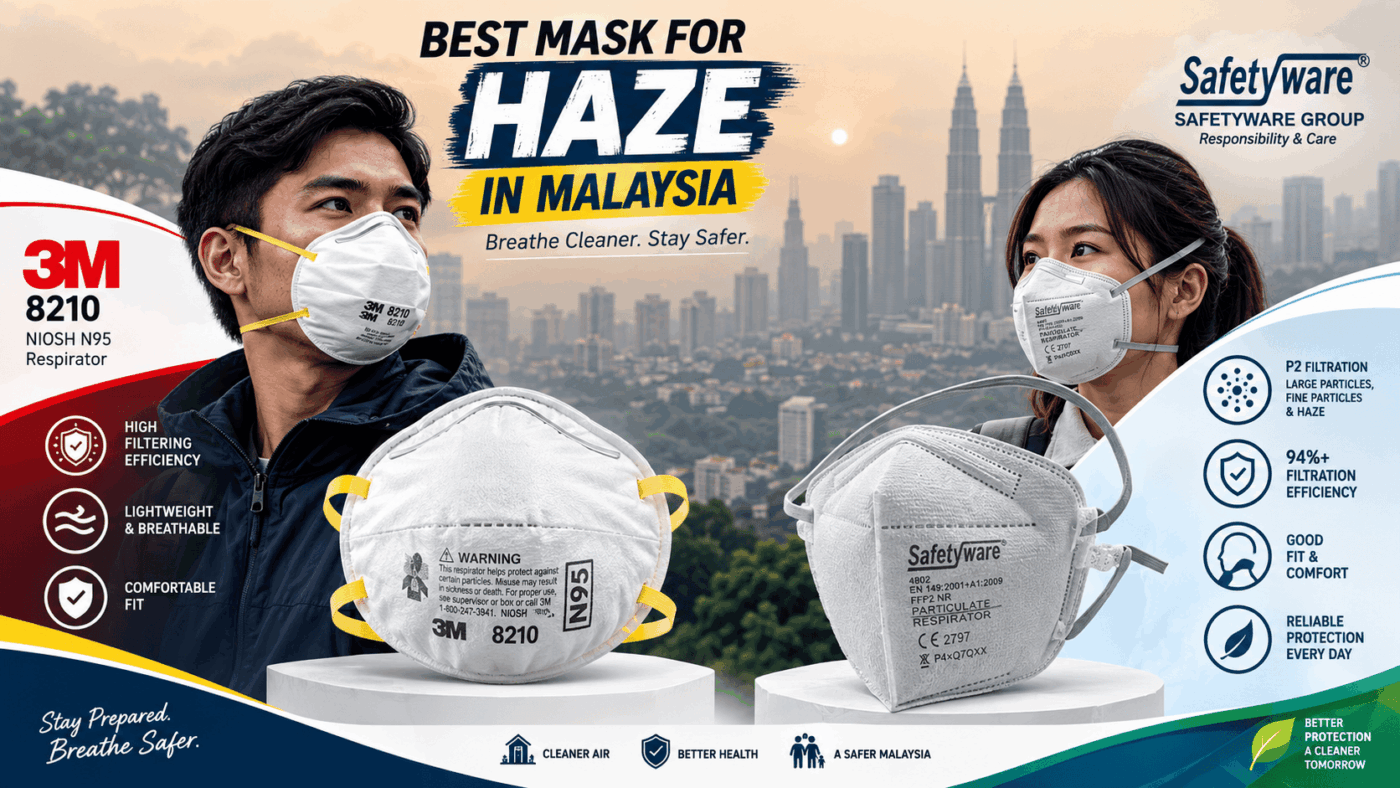
When outdoor exposure cannot be avoided during haze, selecting an appropriate particulate respirator is an important part of respiratory protection. Safetyware offers particulate respirators certified to recognised standards, including EN149 FFP2, SIRIM-DOSH FFP2 and NIOSH N95.
Don’t wait until haze conditions worsen to prepare your respiratory protection supplies. Explore Safetyware’s range of particulate respirators and respiratory protection equipment for personal and workplace use.
🔥 Shop for N95 Respirators from Safetyware in Shopee
🔥 Shop for FFP2 Respirators from Safetyware in Shopee
👉 Explore full range catalogue of our Respiratory Protection at Safetyware
👉 Read more on Best Mask for Haze in Malaysia: N95 vs Surgical Mask
Frequently Asked Questions (FAQs)
1. What API level is considered unhealthy in Malaysia?
Under Malaysia’s Air Pollutant Index (API) classification, an API reading of 101–200 is considered unhealthy. As the API increases, the potential health impact also becomes more serious, and people should progressively reduce outdoor exposure and follow official health advice.
2. What is PM2.5 and why is it dangerous?
PM2.5 refers to fine particulate matter with a diameter of 2.5 micrometres or smaller. These particles are small enough to travel deep into the lungs. Prolonged or high-level exposure can aggravate respiratory and cardiovascular conditions and cause symptoms such as coughing, wheezing and breathing difficulties.
3. How often should I check the API during haze?
Check the API regularly throughout the haze episode, especially before travelling, exercising or starting outdoor work. Air quality can change during the day depending on weather conditions, wind and local pollution sources.
4. How to Protect Yourself from Haze and PM2.5?
A properly fitted N95 or FFP2 particulate respirator can help reduce inhalation of fine airborne particles during haze, especially when outdoor exposure cannot be avoided. Malaysia’s Ministry of Health recommends the use of N95 respirators during haze conditions. A respirator should form a good seal around the face to work effectively.
📞 Need More Information?
Looking for reliable Respiratory protection solutions for your workplace?
Explore SAFETYWARE’s Respiratory protection full range at
👉Safetyware Catalogs
Our safety specialists can help evaluate workplace hazards, recommend suitable safety helmets, and support compliance with Malaysia workplace safety requirements.
If you need a quotation, feel free to contact us at:
📩 Email: [email protected]
📞 Tel: WhatsApp Us