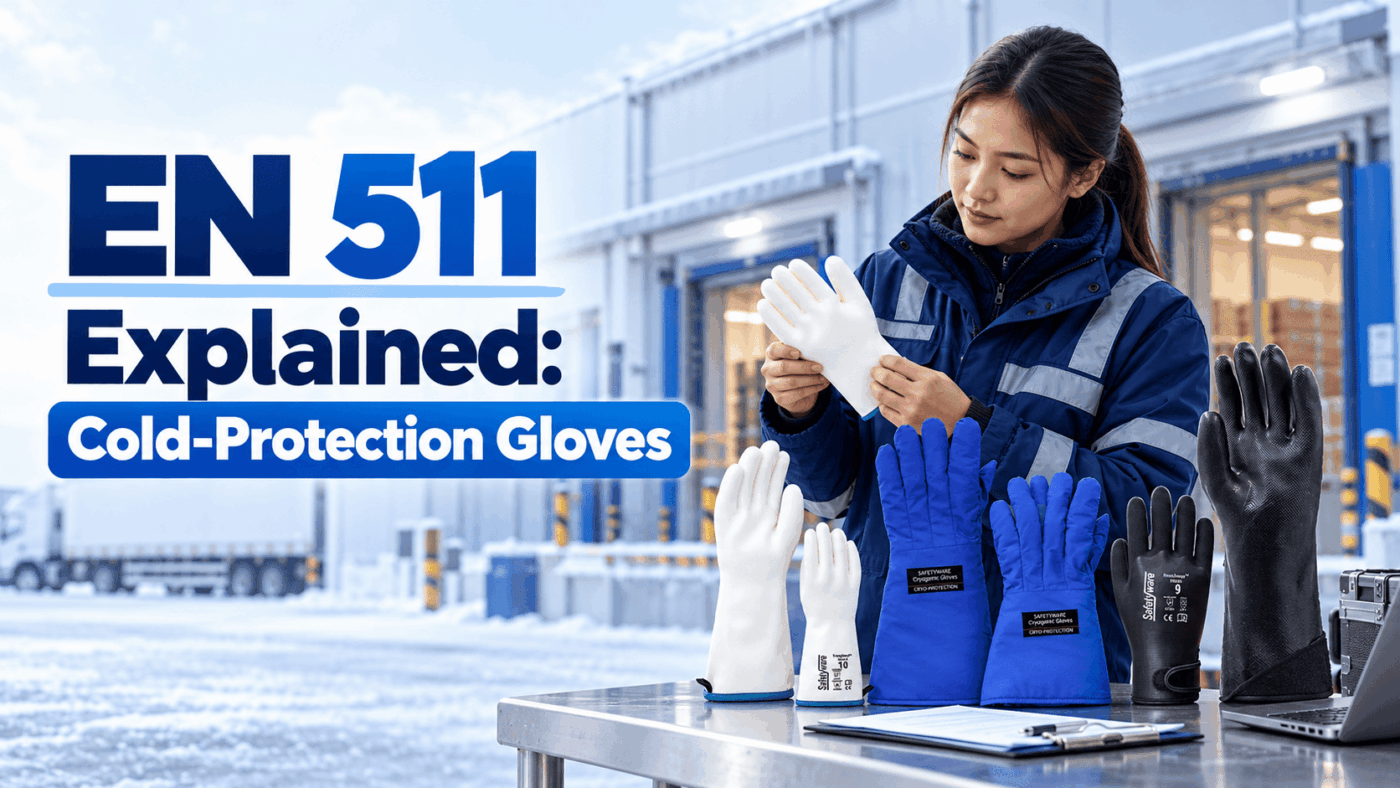
Cold work is not limited to winter weather. Refrigerated warehouses, frozen-food operations and chilled production areas can expose workers to cold air, cold surfaces and moisture—even in tropical countries.
Buying the thickest glove is not a complete solution. Workers still need to grip cartons, operate scanners and handle equipment safely. Buyers need evidence of thermal performance, but also a clear understanding of what that evidence does not prove.
EN 511 provides a framework for assessing cold-protection gloves. This guide explains its marking, how to use it in procurement and why a laboratory rating should never be treated as a guaranteed safe working temperature.
What is EN 511?
EN 511 is the European standard for protective gloves against cold. BS EN 511:2006 remains listed as current by BSI at the review date. SIS, Sweden’s national standards body, also lists its national adoption as valid. [1][2]
Its scope covers gloves protecting against convective and conductive cold down to −50°C, arising from climatic conditions or industrial activities. However, SIS explicitly distinguishes tested performance levels from actual protection levels in use. [2]
That distinction matters. The scope of a standard is not a promise that every glove carrying its marking is suitable for continuous work at −50°C. Suitability depends on the exact model, its performance results, instructions and the exposure.
Cold air and cold surfaces are different exposures
Convective cold concerns heat loss associated with the surrounding cold environment. Contact cold concerns heat transfer when a glove touches a cold object or surface. EN 511 evaluates these separately. [3]
A worker moving through a refrigerated area and a worker repeatedly gripping frozen metal may therefore need different performance priorities. The room thermometer alone does not describe either job completely.
How to read EN 511 glove ratings
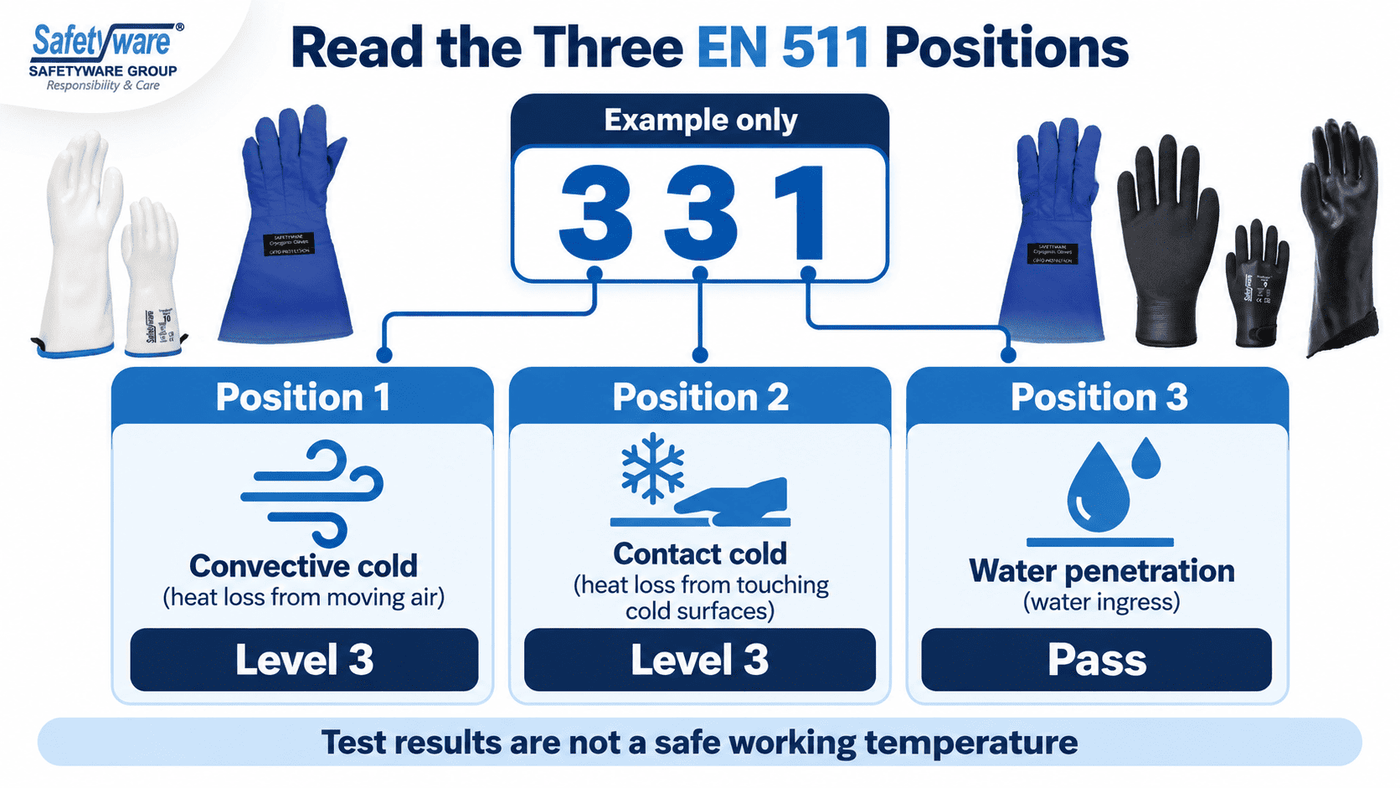
The cold-protection pictogram is accompanied by a three-position code. Read each position individually rather than treating the code as one overall score. [3][4]
Position Property Reported result Practical meaning First Convective cold 0–4, or X where not tested Higher numbered performance levels indicate greater insulation under the specified test Second Contact cold 0–4, or X where not tested Higher numbered performance levels indicate greater thermal resistance in the contact test Third Water penetration 0 or 1, or X where not tested 0 indicates penetration; 1 indicates no penetration under the specified test conditions
For the thermal positions, 0 is below the minimum level-1 threshold. X indicates that the relevant performance was not tested; it is not a substitute for a passing result. Check the manufacturer’s explanation and instructions whenever a marking is unclear. [3][4]
Example: what does 331 mean?
A code of 331 means convective cold level 3, contact cold level 3 and a passing water-penetration result. It does not mean “safe at −33°C”, “three hours of protection” or unlimited waterproof service.
Likewise, X11 identifies no tested convective result, contact cold level 1 and a passing water-penetration result. These are code-reading examples, not recommendations for a particular job. [3][4]
What EN 511 does not tell you
It does not give a universal safe exposure time
A marking cannot be converted directly into a permitted number of minutes in a cold room. Ask the manufacturer to interpret its results for the intended temperature, task and duration. Include intermittent and continuous exposure separately in the enquiry.
For example, “briefly moving sealed chilled cartons” is a different specification from “repeatedly holding frozen metal components throughout a shift”. An advertised temperature claim needs its conditions and limitations before it can support a purchasing decision.
A water test is not permission for every wet task
A passing water-penetration result is useful evidence, but it does not establish resistance to every liquid or indefinite immersion. A glove may also admit liquid through its open cuff. Describe whether exposure involves condensation, splashes, wet surfaces or immersion, and obtain task-specific advice.
Cold protection does not establish other approvals
An EN 511 marking does not by itself demonstrate suitability for chemical exposure, electrical work, direct food contact or a particular cutting hazard. Request separate evidence for each relevant property.
Nor should an ordinary cold-store glove be assumed suitable for dry ice or cryogenic liquids. These require a specialist assessment and explicit manufacturer instructions for the exact operation. Do not interpret a cold pictogram as permission to immerse a gloved hand in a cryogenic liquid.
Is EN 511 a legal requirement?
EN 511 is a technical product standard. It is not a worldwide workplace law. Distinguish three layers when writing specifications:
| Layer | What it addresses | Buyer action |
|---|---|---|
| Applicable law | Duties and product-market rules in the relevant jurisdiction | Identify the country, workplace and supply-market requirements |
| Technical standard | How specified glove properties are tested and reported | Check the edition, complete marking and model documentation |
| Company or customer specification | Additional contractual or operational expectations | Confirm whether the site requires particular ratings or approved models |
For PPE supplied to the EU market, Regulation (EU) 2016/425 sets product requirements and conformity-assessment obligations. Its Annex I places low-temperature environments with effects comparable to air temperatures of −50°C or less within Category III. This legal risk category is separate from the numbered EN 511 test results. [5]
For buyers in Malaysia, Singapore, Indonesia, the Philippines or Vietnam, do not assume an EN marking alone satisfies every local obligation. Check local requirements and site rules separately. This article does not prescribe a country-specific mandatory EN 511 rating.
How to select cold-protection gloves for the task
1. Write an exposure profile
Record ambient temperature, the surfaces handled, contact duration, air movement and moisture. Then add other hazards and the actions workers must perform.
A useful purchasing brief might read: “Refrigerated order picking, intermittent contact with sealed cartons, occasional condensation, frequent scanner use, several glove sizes required.” This gives a supplier more useful information than “send your best freezer glove”.
2. Control the cold exposure before selecting PPE
Consider insulated handles, tools that reduce direct contact, protection from draughts and arrangements for recovery in warm areas. OSHA’s cold-stress guidance recommends engineering controls, training, warm breaks, monitoring and suitable clothing as parts of prevention. These are useful programme principles; OSHA’s legal framework applies in its own jurisdiction. [6]
Gloves are one part of the system. They cannot compensate for an unsuitable work schedule or an uncontrolled exposure.
3. Match insulation to handling requirements
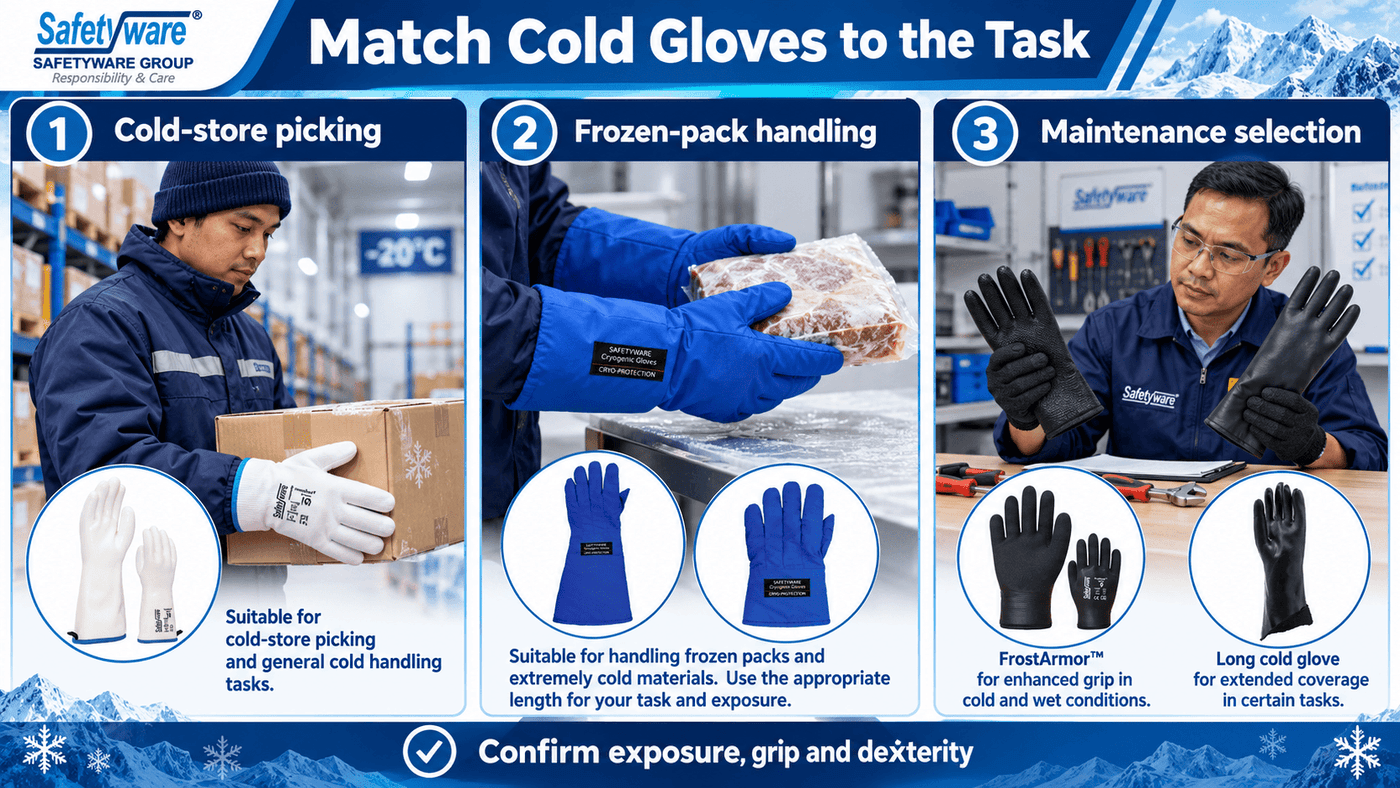
Use the following as a discussion tool, not a mandatory PPE matrix:
| Work situation | Questions for the supplier | Trial focus |
|---|---|---|
| Cold-store picking | What thermal performance is declared for this model and exposure? | Scanner operation, grip and finger movement |
| Frozen-pack handling | What evidence supports repeated contact with these surfaces? | Secure handling without excessive gripping effort |
| Wet chilled processing | How are water entry, cuff design and wet grip addressed? | Handling control and moisture inside the glove |
| Cold maintenance work | What other mechanical or substance hazards need protection? | Tool handling and compatibility with sleeves |
| Cryogenic operations | Is the exact task covered by specialist instructions? | Specialist review before any operational trial |
4. Check fit and compatibility
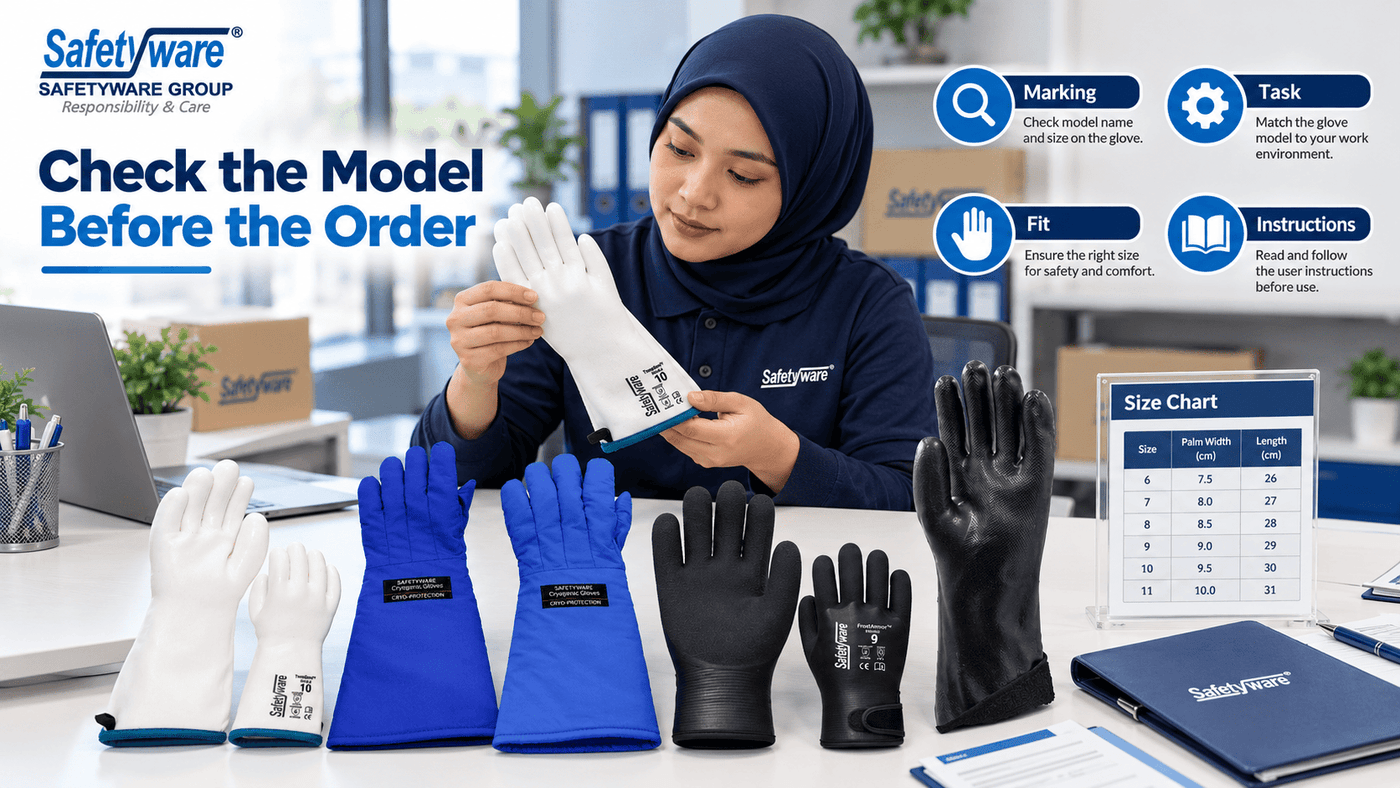
Involve representative users. Check finger length, palm fit, cuff coverage and whether the glove interferes with controls. If liners or overgloves are proposed, ask whether that combination is suitable; do not assume adding layers preserves dexterity or performance.
HSE’s selection guidance stresses exposure, wearer characteristics, fit and compatibility. Its glove guidance also recommends balancing handling ability with the relevant hazards. These are selection principles, not a substitute for local legal review. [7][8]
Procurement checklist for EN 511 gloves
Before approving a model or placing a repeat order, confirm:
- The exact manufacturer, model, size range and product revision are identified.
- The complete EN 511 code is recorded, including any X positions.
- Manufacturer instructions explain intended uses and limitations.
- Any advertised temperature claim has supporting conditions and exposure guidance.
- Water exposure and cuff entry have been considered separately.
- Additional hazards have their own supporting documentation.
- Relevant declarations and certification documents match the exact model.
- Representative workers can perform essential tasks with the glove on.
- Cleaning, drying, inspection and replacement instructions are available.
- Replacement stock and suitable sizes can be supplied reliably.
For distributors, retain these details with the quotation. Avoid reducing a detailed manufacturer claim to an unconditional statement such as “safe to −25°C”. Pass limitations through to the customer with the product information.
Inspection, care and replacement
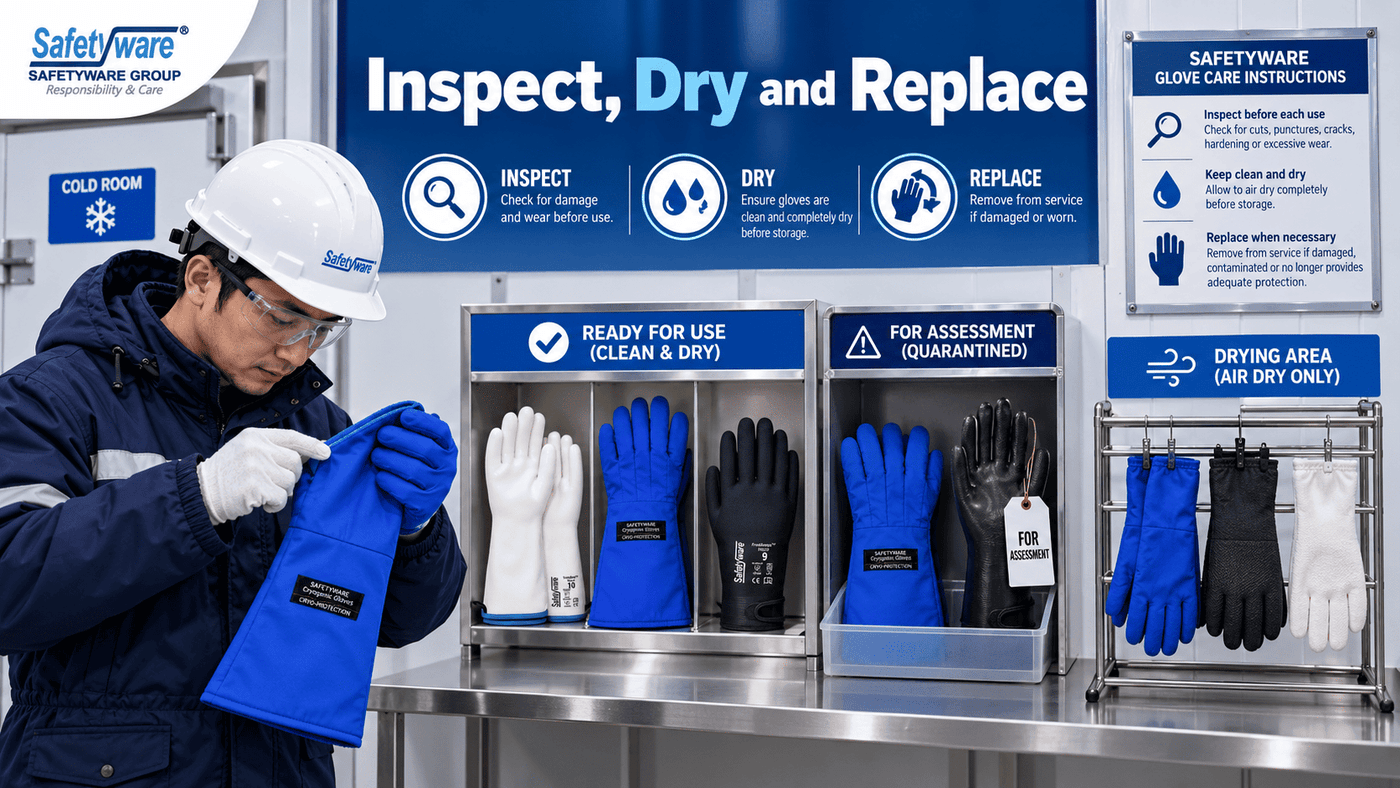
Build pre-use checks into the work routine. Look for damage to coatings, seams and liners; contamination; persistent dampness; and changes in fit or flexibility. Follow the manufacturer’s cleaning and drying method rather than applying a universal laundry rule.
Keep spare suitable gloves available when the job may leave a pair wet. OSHA recommends keeping dry and carrying replacement clothing, including gloves, as part of cold-stress preparation. [6]
Do not use continuing discomfort or loss of hand control as an informal endurance test. Workers should be able to leave the exposure safely, report the problem and have the task and protection reviewed. Train teams to recognise cold-stress warning signs and follow the workplace response procedure. [6]
SAFETYWARE Products and Solutions
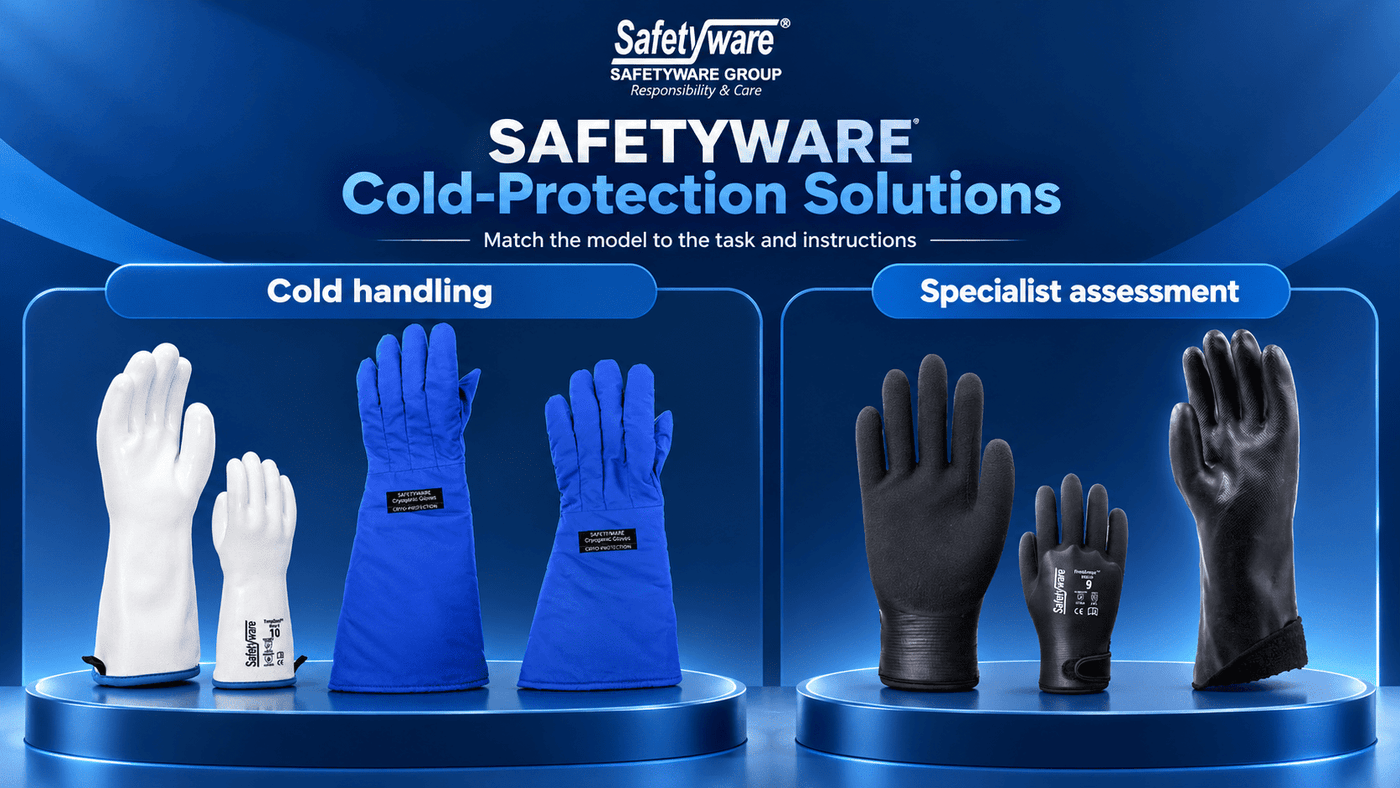
The SAFETYWARE product directory and cold-resistant glove range provide starting points for comparing options for chilled handling and specialist cold applications. [9]
FrostArmor™ CRG02 for a cold-handling shortlist
The official SAFETYWARE FrostArmor™ CRG02 product page lists a double-coated, double-liner glove with a sandy-grip palm and adjustable cuff. It references EN 388 and EN 511. [10]
Treat this as a model to assess against the job, rather than a universal freezer-work recommendation. Request the current technical sheet, complete test marking, instructions, size availability and conditions behind any temperature claim before approval. The public page contains differing liner and packing details in its sections, so confirm those purchasing details in writing.
Specialist cryogenic enquiries
SAFETYWARE also lists CryoArmor™ Cryogenic Protection Gloves. Discuss the precise operation, liquid or material involved, splash exposure, cuff length and required documentation with the supplier. [11]
An EN 511 result alone does not establish suitability for direct liquid contact or immersion. Obtain explicit application limitations for the exact model and integrate the glove with the complete specialist protection and handling procedure.
Build the enquiry around evidence
Provide SAFETYWARE with the exposure profile, sample tasks, wearer sizes and additional hazards. Ask for a documented shortlist and a controlled fit-and-handling trial. This approach helps compare models on relevant evidence and identifies missing information before a bulk order.
Conclusion
EN 511 helps buyers interpret three distinct properties: convective cold performance, contact cold performance and water penetration. The marking is valuable evidence, but it cannot replace a task assessment or define a universal safe temperature and duration.
Start with the exposure, verify the exact model’s documentation and check fit and handling with the workforce. Combine suitable gloves with exposure controls, inspection and replacement arrangements. That creates a clearer, more defensible specification for both the supplier and the people who use the equipment.
Sources and references
Sources reviewed on 30 October 2026. Public standards summaries were used; this guide does not reproduce the complete test procedures.
- BSI — BS EN 511:2006, current status
- SIS — SS-EN 511:2006, scope and status
- BIMEO testing and certification body — EN 511
- Snickers Workwear — EN 511 marking guide
- EUR-Lex — Regulation (EU) 2016/425, including Annex I
- OSHA — Cold Stress Guide
- HSE — PPE selection and use
- HSE — Choosing protective gloves
- SAFETYWARE — Cold-resistant glove range
- SAFETYWARE — FrostArmor CRG02
- SAFETYWARE — CryoArmor
📞 Need More Information?
Looking for Cold Resistance Gloves?
Explore SAFETYWARE’s safety shoes and workplace PPE range at
👉Safetyware Catalogs
Our safety specialists can help evaluate workplace hazards, recommend suitable safety helmets, and support compliance with Malaysia workplace safety requirements.
If you need a quotation, feel free to contact us at:
📩 Email: [email protected]
📞 Tel: WhatsApp Us