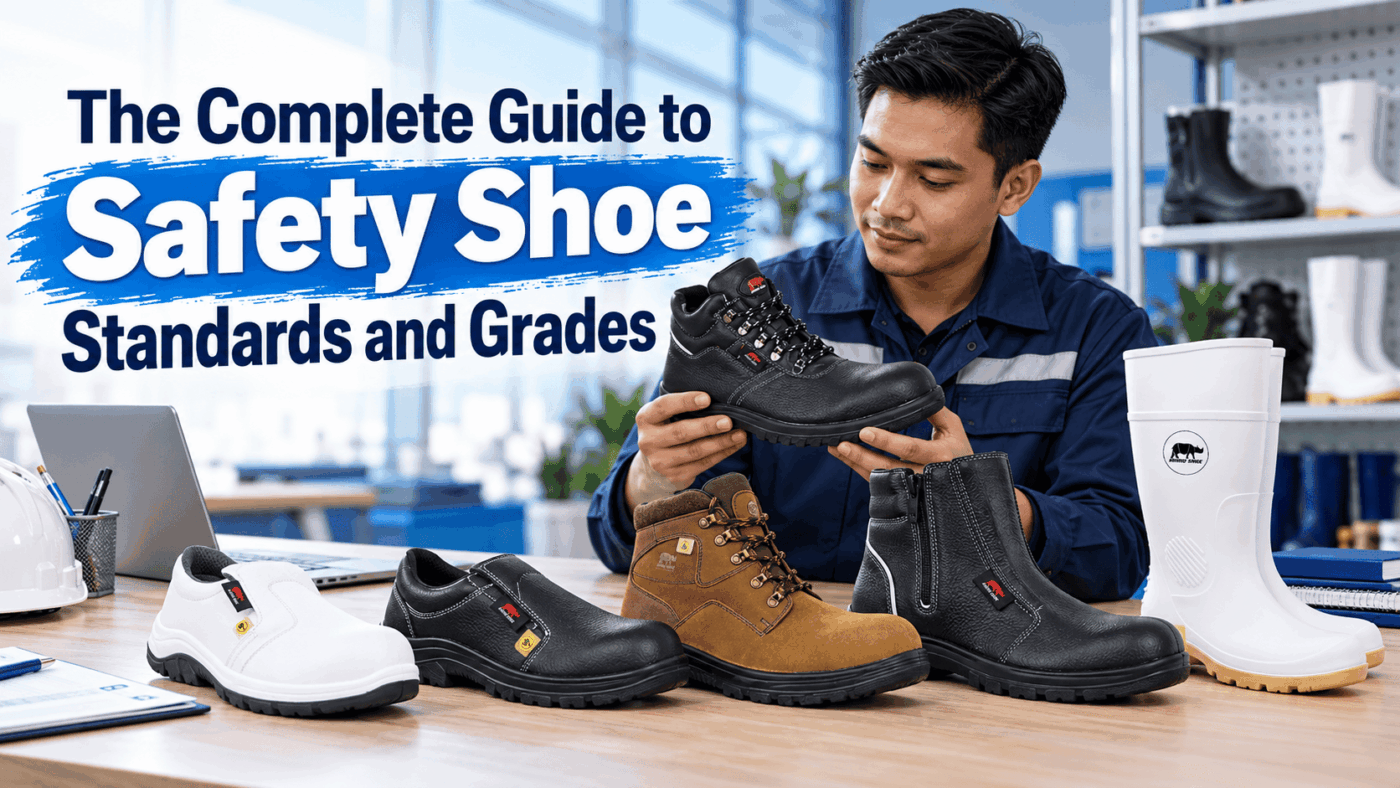
Safety shoes can look similar while offering very different protection. One pair may help protect against falling objects but lack penetration resistance. Another may control static electricity without providing the electrical insulation needed for a particular task.
For PPE buyers, employers and distributors, understanding safety shoe standards and grades helps turn a vague request for “good safety shoes” into a clear purchasing specification.
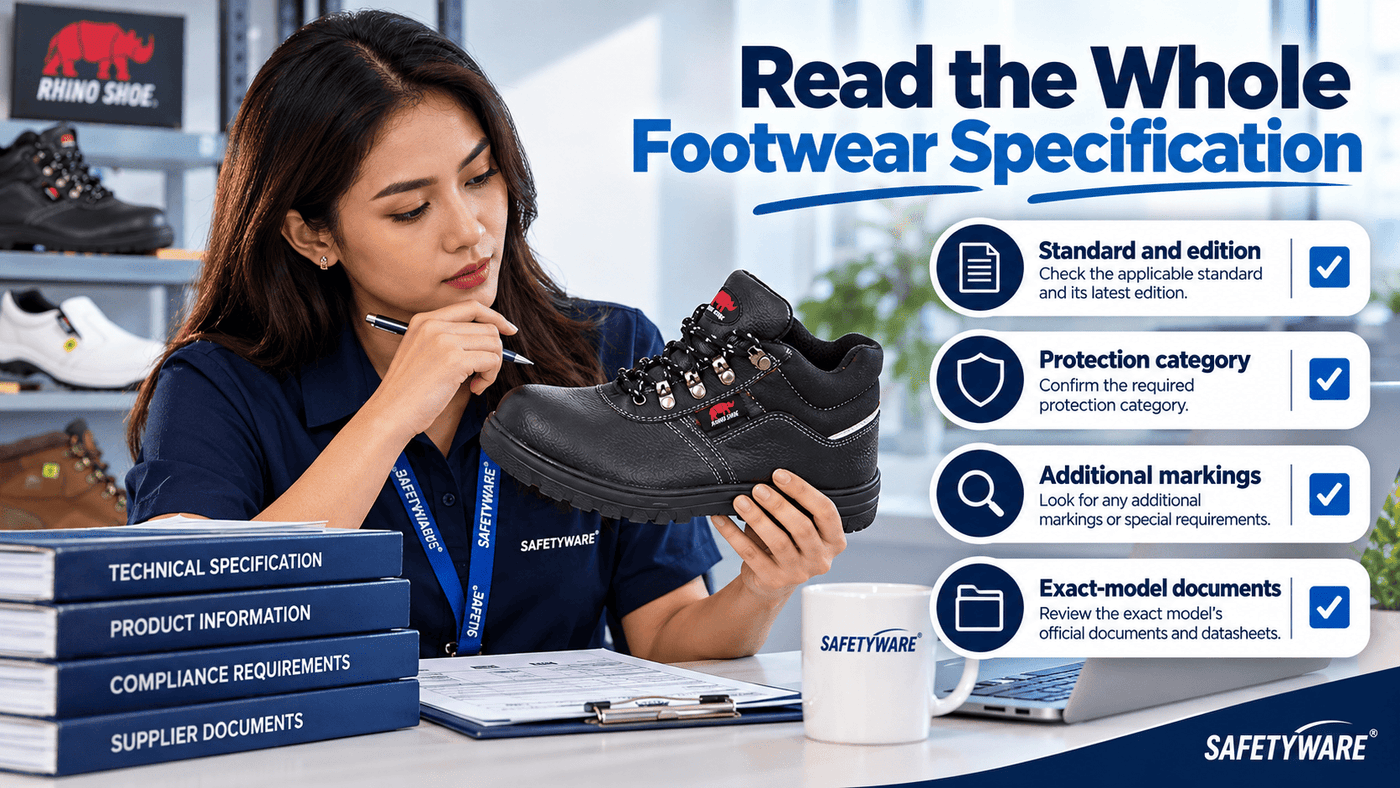
Start with the hazards, then check the standard edition, protection category, additional markings and documentation for the exact model. A higher category number is not a universal guarantee of better protection.
What is the difference between a standard, a grade and an approval?
| Term | What it tells the buyer | What to verify |
|---|---|---|
| Standard | The technical requirements or test methods used | Full reference, edition and applicable amendments |
| Category or “grade” | A defined combination of footwear properties | Exact category on the footwear and documentation |
| Additional marking | A separately identified performance feature | Whether that feature addresses the actual hazard |
| Certification or approval | Evidence assessed under a particular scheme | Exact model, issuing body, scope and validity |
| Workplace requirement | What the employer or customer requires for a task | Risk assessment, local rules and contract specification |
These are connected, but they are not interchangeable. A supplier’s brand reputation does not establish certification for every model. Equally, a familiar category such as S3 does not establish compliance with every national approval scheme.
A useful purchase description therefore identifies the model, standard, category, additional features, sizes and required documents together.
Which footwear standards should buyers recognise?
ISO 20345 and EN ISO 20345
ISO lists ISO 20345:2021, with Amendment 1:2024, for general-purpose safety footwear. Its scope includes basic and optional requirements addressing mechanical, slip and thermal risks, among others. The corresponding European reference is EN ISO 20345:2022, subsequently amended as EN ISO 20345:2022+A1:2024. Different publication years do not automatically mean different generations of requirements. [1–2]
Specialised hazards can require complementary standards. General safety footwear certification alone does not establish suitability for firefighting, live electrical work, chainsaw exposure or chemical protection.
Safety footwear versus occupational footwear
Under EN ISO 20345, safety footwear includes toe protection tested at 200 J impact energy and 15 kN compression. These are laboratory test conditions, not a promise that a shoe will prevent injury in every impact. [3]
ISO 20346 covers protective footwear, while ISO 20347 covers occupational footwear. Occupational footwear should not be assumed to have the safety-toe performance required by ISO 20345. Check the actual standard rather than relying on descriptions such as “work shoe” or “industrial shoe”. [4]
ASTM F2413
ASTM F2413-24 is the published ASTM specification for protective safety-toe footwear. Its marking system differs from EN ISO categories. Do not translate an ASTM-marked shoe into S3 or S7 without separate evidence. ASTM also warns that changes such as replacing footbeds or resoling can affect compliance. [5]
For international orders, ask which framework the receiving site requires before proposing an equivalent.
Safety shoe grades explained: SB to S7
The following is a simplified guide to the 2022 EN ISO 20345 category system. It summarises category features, not every test or exception in the standard. [3,6]
Category Main feature combination SB Basic safety-footwear requirements, including protective toe performance S1 SB plus closed heel, antistatic properties and heel-region energy absorption S1P / S1PL / S1PS S1 plus the indicated penetration-resistance type S2 S1 plus upper water penetration and absorption performance S3 / S3L / S3S S2 plus penetration resistance and a cleated outsole S4 All-rubber or all-polymeric footwear with basic protection, antistatic properties and heel energy absorption S5 / S5L / S5S S4 plus penetration resistance and a cleated outsole S6 S2 plus whole-footwear water resistance S7 / S7L / S7S Corresponding S3 category plus whole-footwear water resistance
S1, S2, S3, S6 and S7 concern Class I construction, such as leather and other materials excluding all-rubber or all-polymeric footwear. S4 and S5 concern Class II construction. These construction classes are not quality rankings.
What do P, PL and PS mean?
In the newer system, P identifies metallic penetration protection. PL and PS identify non-metallic protection tested using 4.5 mm and 3.0 mm nails respectively. This is why a newer label may say S3L or S3S. [6]
None means “puncture-proof”. Evaluate the sharp objects, forces and exposure at the site. A composite toe cap also says nothing by itself about the penetration-resistant insert below the foot.
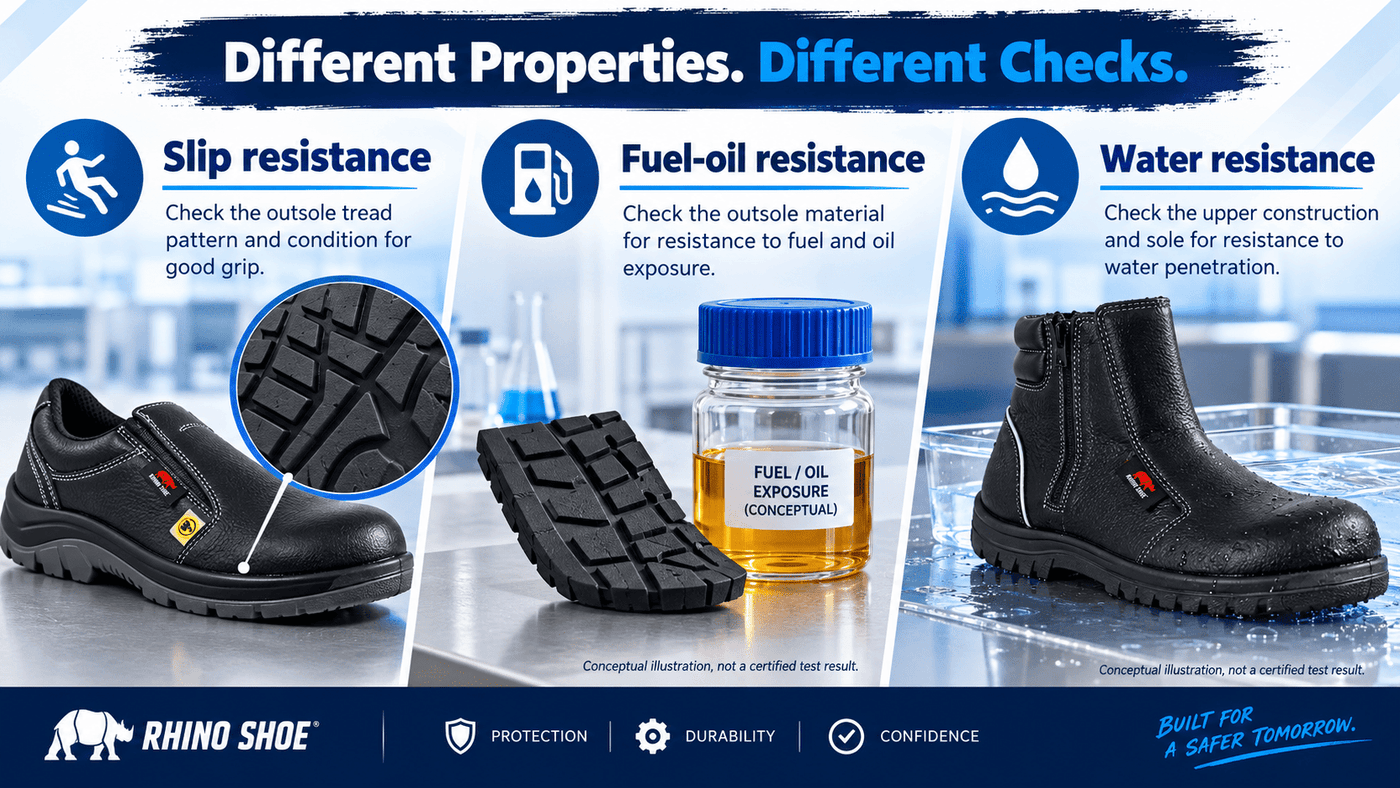
Additional markings: check the hazard behind the letters
| Marking | Property identified | Purchasing question |
|---|---|---|
| SR | Additional slip-resistance test | Does the footwear suit the actual floor and contamination? |
| FO | Outsole resistance to fuel oil | Is the relevant material resistance documented? |
| WPA | Upper water penetration and absorption | Is upper performance enough for the task? |
| WR | Whole-footwear water resistance | What exposure and use limitations apply? |
| HRO | Outsole contact-heat resistance | Is separate heat insulation also needed? |
| HI / CI | Heat / cold insulation of the sole complex | What temperatures and durations are involved? |
| M / AN | Metatarsal / ankle protection | Where could impact occur? |
| SC / LG | Scuff-cap abrasion / ladder-grip requirements | Is this additional property relevant? |
These symbols describe different tests. For example, HRO does not establish complete protection from heat throughout the shoe. [7]
Slip resistance is different from oil resistance
FO is a material-resistance property; it is not a grip rating. A shoe can resist fuel-oil damage without being suitable for every contaminated floor.
Older footwear may carry SRA, SRB or SRC markings. The newer system uses a basic slip test and the optional SR test; these are not simple renamed versions of the older tests. Basic testing uses ceramic tile with a detergent solution, while SR adds ceramic tile with glycerine. Special footwear for which testing is inapplicable can carry the relevant exemption marking. [8]
Ask for evidence relevant to the application and conduct a controlled wearer trial. Good footwear selection must be combined with cleaning, spill control and maintained walking surfaces.
Water-resistant uppers are different from whole-shoe water resistance
S2 and S3 address upper water performance. S6 and S7 add whole-footwear water resistance. Avoid describing every S3 shoe as waterproof. [8]
Even a water-resistant shoe has practical limits: water may enter over its opening, and damaged seams or inappropriate care can affect performance. Ask the supplier for the manufacturer’s use and care instructions.
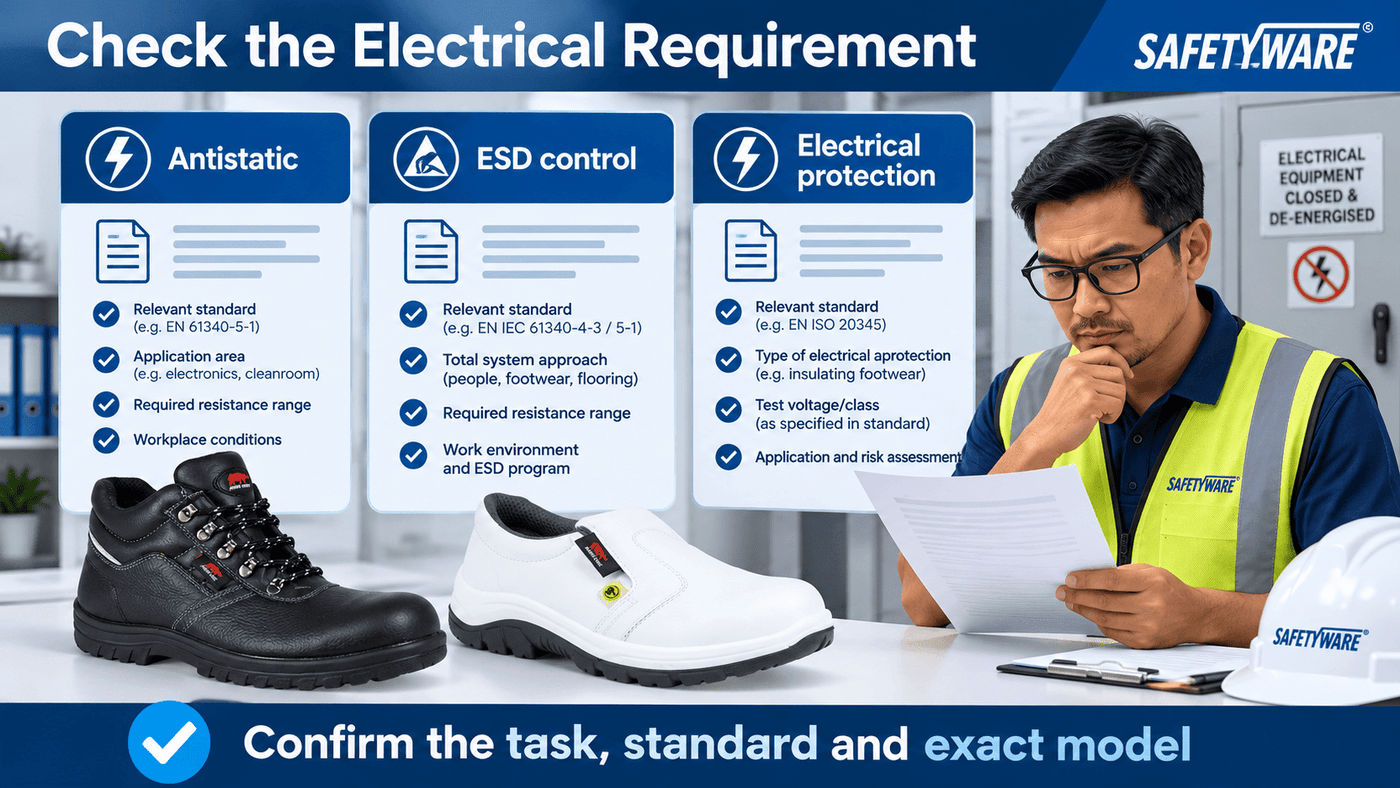
Antistatic, ESD and electrical-hazard footwear are different
Antistatic footwear helps dissipate static charge. It does not provide assured electrical insulation. SATRA specifically distinguishes antistatic and conductive footwear from electrically insulating footwear. [9]
ESD footwear supports an electrostatic-discharge control programme, typically to protect sensitive components. An ESD claim is not evidence of electrical-shock protection. Its effectiveness must be considered with the wearer, floor and workplace programme. [8]
Electrical-hazard or electrically insulating footwear must be selected against the particular electrical task, applicable standard and manufacturer’s limitations. Do not assume an antistatic S-category shoe, a non-metallic toe cap or a rubber-looking outsole makes a shoe suitable for live electrical work.
For procurement, keep static-control requirements and shock-protection requirements separate. Refer conflicting requirements to the responsible electrical-safety and ESD specialists.
Standards, law and site rules: what is actually required?
A technical standard describes performance. Whether a particular standard, approval or item is required depends on legislation, the workplace and the purchasing contract.
Malaysia: check DOSH–SIRIM documentation
DOSH’s current PPE guidance identifies foot protection within its approval framework. Its FAQ describes DOSH–SIRIM labelling and directs applicants to the relevant registration and approval process. Malaysian buyers should therefore check the exact model’s current approval and certification evidence rather than treating an overseas mark as sufficient on its own. [10]
Some official web guidance still contains legacy legislative references. For a tender or compliance decision, confirm the applicable current legal basis and approval scope with DOSH; do not copy older statutory wording into a new specification without checking it.
United States: legal references and latest editions can differ
OSHA 29 CFR 1910.136 addresses protective footwear where specified foot and electrical hazards exist. Its incorporated references include older ASTM and ANSI editions, with a provision for footwear demonstrated to be at least as effective. Therefore, the latest commercial standard edition and the edition expressly named in a regulation need not match. [11]
Other markets and customer sites
Do not assume an EN ISO category automatically fulfils every destination-country requirement. Ask the importer or site for its accepted standards, approval requirements and required documents.
A customer may also impose a stricter specification than the legal minimum. Record that as a customer or site requirement, rather than presenting it as a national law.
A practical safety-footwear purchasing checklist
Use this checklist before requesting quotations or approving alternatives:
- Identify impact, compression, penetration, slip, water, temperature, chemical and electrical hazards.
- Confirm the applicable country, site and customer requirements.
- Specify the full standard reference and accepted edition.
- Specify the category and each additional property needed.
- Match the offered model and construction to its documentation.
- Check certificate scope, approval status and manufacturer instructions.
- Trial representative sizes and widths with the intended socks.
- Confirm whether proposed insoles or adaptations are permitted.
- Check cleaning, storage, inspection and replacement instructions.
- Confirm stock, size coverage, replenishment lead time and model-change controls.
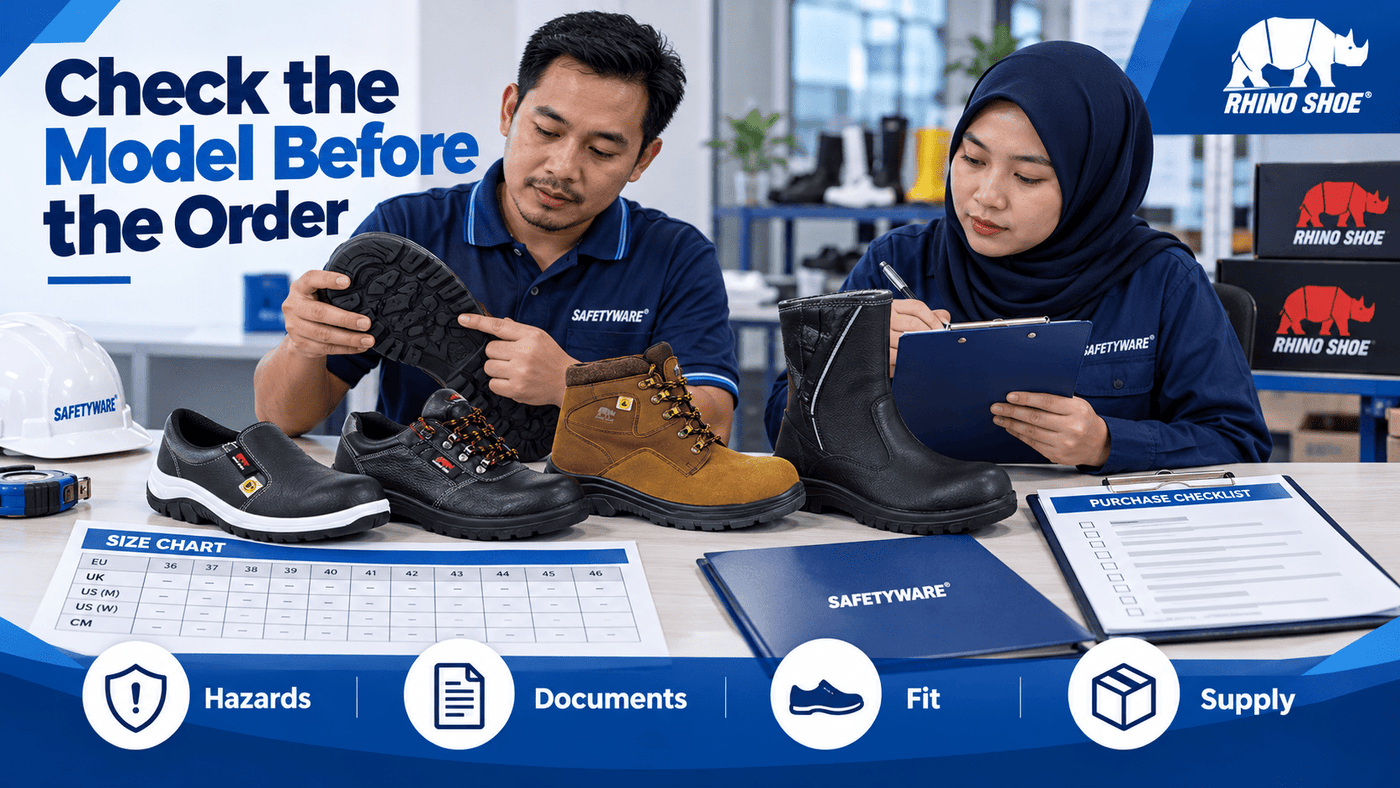
For distributor comparisons, use a simple worksheet:
| Requirement | Requested performance | Proposed model evidence | Accepted deviation |
|---|---|---|---|
| Standard and category | Enter full reference | Certificate and label | Record explicitly |
| Slip and water performance | Enter task need | Technical documentation | Record explicitly |
| Electrical properties | Identify the required function | Relevant model evidence | Specialist review where needed |
| Fit and supply | Size range and quantities | Trial results and quotation | Agree before order |
This prevents a lower price from hiding a missing requirement and makes alternative proposals easier for the end-user to assess.
Inspect and replace throughout use
Check the upper, stitching, fastening, outsole and internal condition before use. Remove footwear from service when damage or deterioration compromises protection, and follow the manufacturer’s instructions after a major impact or penetration event.
Avoid setting one universal replacement period for every workplace. Exposure, care, wear and the manufacturer’s service-life instructions should inform the replacement policy.
SAFETYWARE Products and Solutions
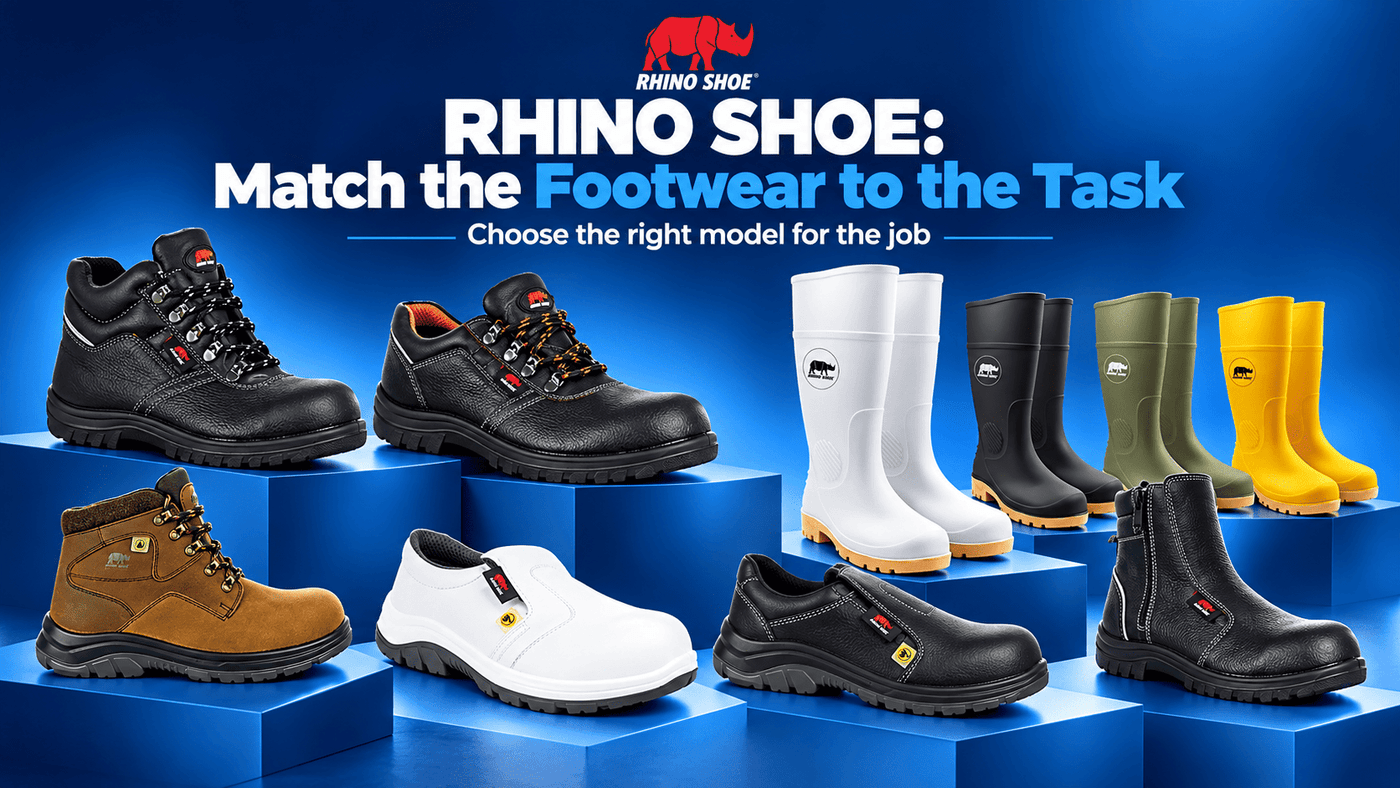
SAFETYWARE’s official product directory and foot-protection range provide starting points for comparing RHINO SHOE safety shoes, Wellington boots, static-control footwear and specialist options. The range should be shortlisted by task, then checked model by model. [12]
Requirement to discuss Relevant starting point What to request General industrial footwear RHINO SHOE safety shoes and boots Exact category, additional markings and size range Wet-area footwear Wellington boot options Toe and penetration protection, exposure limitations and cleaning instructions Electronics or static-sensitive production ESD footwear options Model documentation and compatibility with the site ESD programme Electrical work Electrical-protection footwear options Applicable electrical standard, intended use and limitations
For a specific example, SAFETYWARE lists the RHINO SHOE IV201SP Ivory Safety Shoes as a white, mid-cut lace-up model with a microfiber upper, steel toe cap, steel plate and PU outsole. Its page uses legacy SRA wording, illustrating why buyers should request the current technical sheet and certificates rather than rewrite the product into a newer category themselves. Availability and suitability require confirmation. [13]
Send SAFETYWARE your hazard assessment, destination market, required standard, sizes, quantities and delivery date. Ask the team to identify any differences between your specification and the proposed model before placing the order.
Conclusion
The right safety shoe is the one whose documented performance matches the work. Read the standard and edition, understand the category, check additional markings and confirm the exact model’s approval and certification evidence.
Use a wearer trial and clear purchasing checklist to complete the decision. This gives employers a practical basis for selection, helps distributors explain alternatives accurately and reduces the risk of buying footwear that misses an essential requirement.
Sources and references
Sources reviewed on 28 October 2026. Public publisher records establish standard references and scope; technical summaries below support the selection explanations. Consult the complete applicable standard and model documentation for certification decisions.
- ISO: ISO 20345:2021 and Amendment 1:2024.
- SATRA: Amendments to EN ISO 20345.
- uvex: Safety footwear standards and category overview.
- ISO: ISO 20346:2021 and ISO 20347:2021.
- ASTM: F2413-24.
- uvex: 2022 protection categories and penetration markings.
- uvex: Changes to EN ISO 20345.
- Arbesko: Guide to safety footwear.
- SATRA: Electrical properties of footwear.
- DOSH Malaysia: PPE approval guidance and PPE approval FAQs.
- OSHA: 29 CFR 1910.136 — Foot protection.
- SAFETYWARE: Products and foot protection.
- SAFETYWARE: RHINO SHOE IV201SP.
📞 Need More Information?
Looking for Reliable Safety Shoes in ASEAN?
Explore SAFETYWARE’s safety shoes and workplace PPE range at
👉Safetyware Catalogs
Our safety specialists can help evaluate workplace hazards, recommend suitable safety helmets, and support compliance with Malaysia workplace safety requirements.
If you need a quotation, feel free to contact us at:
📩 Email: [email protected]
📞 Tel: WhatsApp Us