
Workplace safety depends on clear communication. Employees, visitors, and contractors must understand workplace hazards and safety instructions quickly.
Safety signage plays an important role in preventing accidents by providing visual warnings, instructions, and emergency information. Proper signage helps workers identify hazards and respond correctly in dangerous situations.
In industrial environments, clear safety signs improve workplace awareness, strengthen compliance, and support safer daily operations.
What Is Safety Signage?
Safety signage refers to visual signs used to communicate important safety information within workplaces.
These signs may include:
- Hazard warnings
- Mandatory instructions
- Emergency exits
- PPE requirements
- Restricted area notices
- Fire safety information
Safety signs help people react quickly and make safer decisions during work activities.
Why Safety Signage Is Important in the Workplace
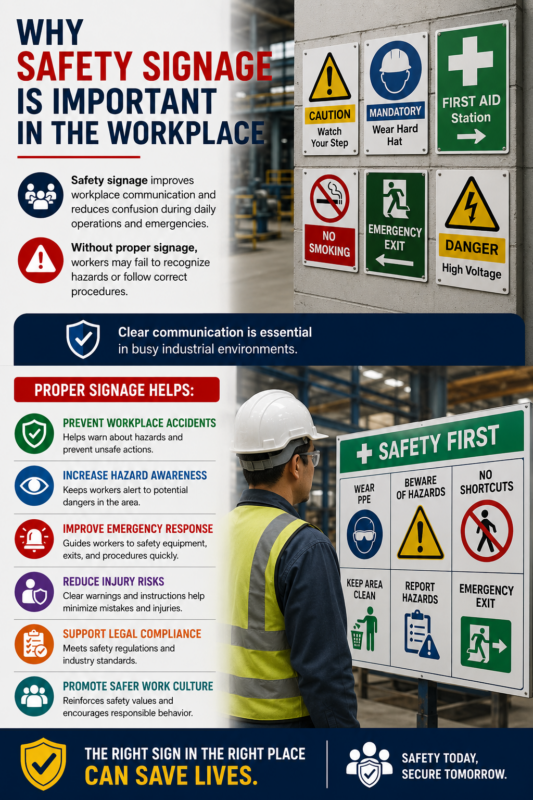
Safety signage improves workplace communication and reduces confusion during daily operations and emergencies.
Without proper signage, workers may fail to recognize hazards or follow correct procedures.
Proper signage helps:
- Prevent workplace accidents
- Increase hazard awareness
- Improve emergency response
- Reduce injury risks
- Support legal compliance
- Promote safer work culture
Clear communication is essential in busy industrial environments.
Importance of Safety Signage
| Importance of Safety Signage | Description |
|---|---|
| Prevents Workplace Accidents | Safety signs warn workers about hazards such as slippery floors, electrical hazards, chemical dangers, forklift movement, falling objects, and restricted areas. Visible warnings help workers stay alert and avoid accidents. |
| Improves Hazard Awareness | Proper signage helps workers quickly identify risks such as high voltage areas, hot surfaces, confined spaces, flammable materials, and chemical storage zones. Quick hazard recognition helps reduce injuries. |
| Supports PPE Compliance | PPE reminder signs encourage workers to wear safety helmets, protective gloves, safety footwear, eye protection, respiratory protection, and hearing protection before entering hazardous areas. |
| Improves Emergency Response | Emergency signs help workers locate emergency exits, fire extinguishers, eyewash stations, first aid kits, assembly points, and emergency contact information during emergencies. |
| Reduces Confusion for Visitors and Contractors | Safety signage guides visitors and contractors safely through the workplace by showing restricted areas, PPE requirements, vehicle routes, emergency exits, and safe walkways. |
| Supports Workplace Safety Compliance | Proper signage helps organizations comply with occupational safety regulations and industry standards while improving safety management, inspection readiness, and risk control measures. |
Industries That Require Safety Signage
Safety signage is important across many industries in Malaysia.
Common industries include:
- Manufacturing
- Warehousing and logistics
- Construction
- Oil and gas
- Chemical processing
- Food processing
- Laboratories
- Electrical and engineering sectors
Each industry requires signs based on operational hazards.
Best Practices for Workplace Safety Signage
To maximize effectiveness, safety signs should:
- Be clearly visible
- Use understandable symbols
- Remain clean and readable
- Be placed near hazards
- Use durable materials
- Follow standard color coding
Regular inspection and maintenance help ensure sign effectiveness.
Why Choose SAFETYWARE Safety Signage

Safetyware supports workplace safety through reliable Safety Signage.
Key advantages include:
- Reliable industrial safety products
- Compliance with recognized standards
- Durable workplace safety solutions
- Suitable for Malaysia industries
- Trusted by safety professionals
Safetyware helps organizations improve workplace safety awareness and protection.
Conclusion
Safety signage plays a critical role in preventing workplace accidents and improving hazard awareness. Clear signs help workers identify risks, follow safety procedures, and respond correctly during emergencies.
Proper signage also strengthens compliance, improves communication, and supports safer workplace environments.
Combining effective signage with proper PPE creates stronger workplace safety protection for employees and visitors.
Frequently Asked Questions (FAQs)
1. Why is safety signage important in workplaces?
Safety signage helps communicate hazards, instructions, and emergency information clearly.
2. What are the common types of safety signage?
Common types include warning signs, mandatory signs, prohibition signs, emergency signs, and fire safety signs.
3. How does safety signage improve workplace safety?
Safety signs improve hazard awareness and help reduce workplace accidents.
4. Where should safety signs be placed?
Safety signs should be placed near hazards, entrances, emergency equipment, and restricted areas.
5. Does safety signage help with compliance?
Yes. Proper signage supports workplace safety compliance and inspection readiness.
📞 Need More Information?
Your safety matters. If you have questions about which Signage is right for your workplace, we’re here to help!
Visit our website: www.safetyware.com
Work safely, work confidently – with Safetyware! 🔪✨
Learn more from SAFETYWARE Signage by clicking HERE!
If you need a quotation, feel free to contact us at:
📩 Email: [email protected]
📞 Tel: WhatsApp Us