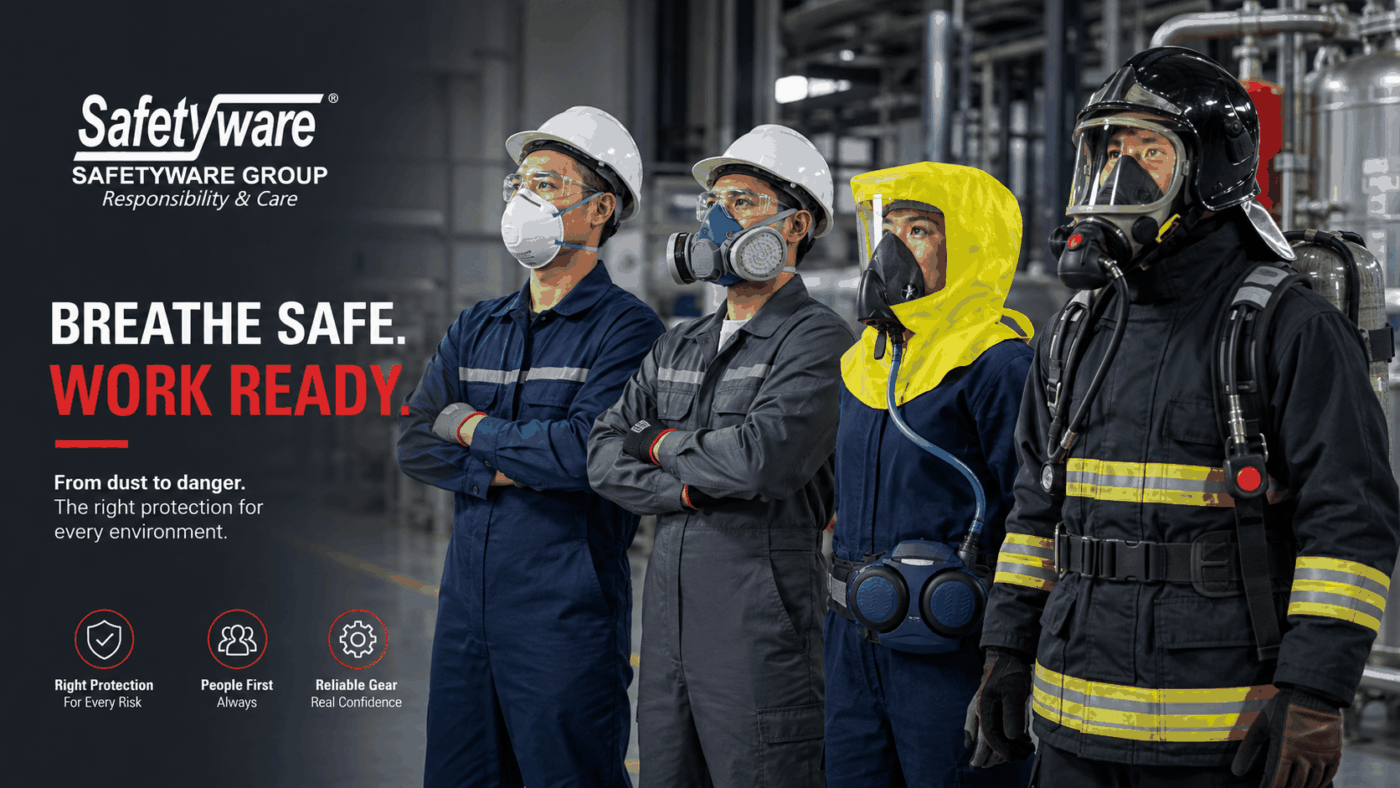
First, remember that workers cannot always see airborne hazards. For example, fine dust, welding fumes, chemical vapours, gases, biological aerosols and low-oxygen air can all harm workers. As a result, some exposures cause sudden poisoning or suffocation, while others lead to work-related asthma, lung disease or other long-term harm.
Respiratory protection means using suitable respiratory protective equipment (RPE) within a planned system that reduces what workers inhale. However, one respirator cannot solve every problem. Therefore, match the respirator to the hazard, concentration, oxygen level, task, wearer and local legal rules.
Just as importantly, RPE should support—not replace—more reliable controls. First, employers should consider elimination, substitution, enclosure, ventilation and safer work methods. For example, Malaysia’s USECHH Regulations follow this order of controls for chemicals that can harm health. Similarly, NIOSH describes respiratory protection as the last line of defence in the hierarchy of controls. (Malaysia DOSH USECHH Regulations 2000; NIOSH respirator selection and use)
Important: This guide supports initial understanding and procurement discussions. A competent person should complete a site-specific risk and exposure assessment before selecting RPE.
What Is Respiratory Protection?
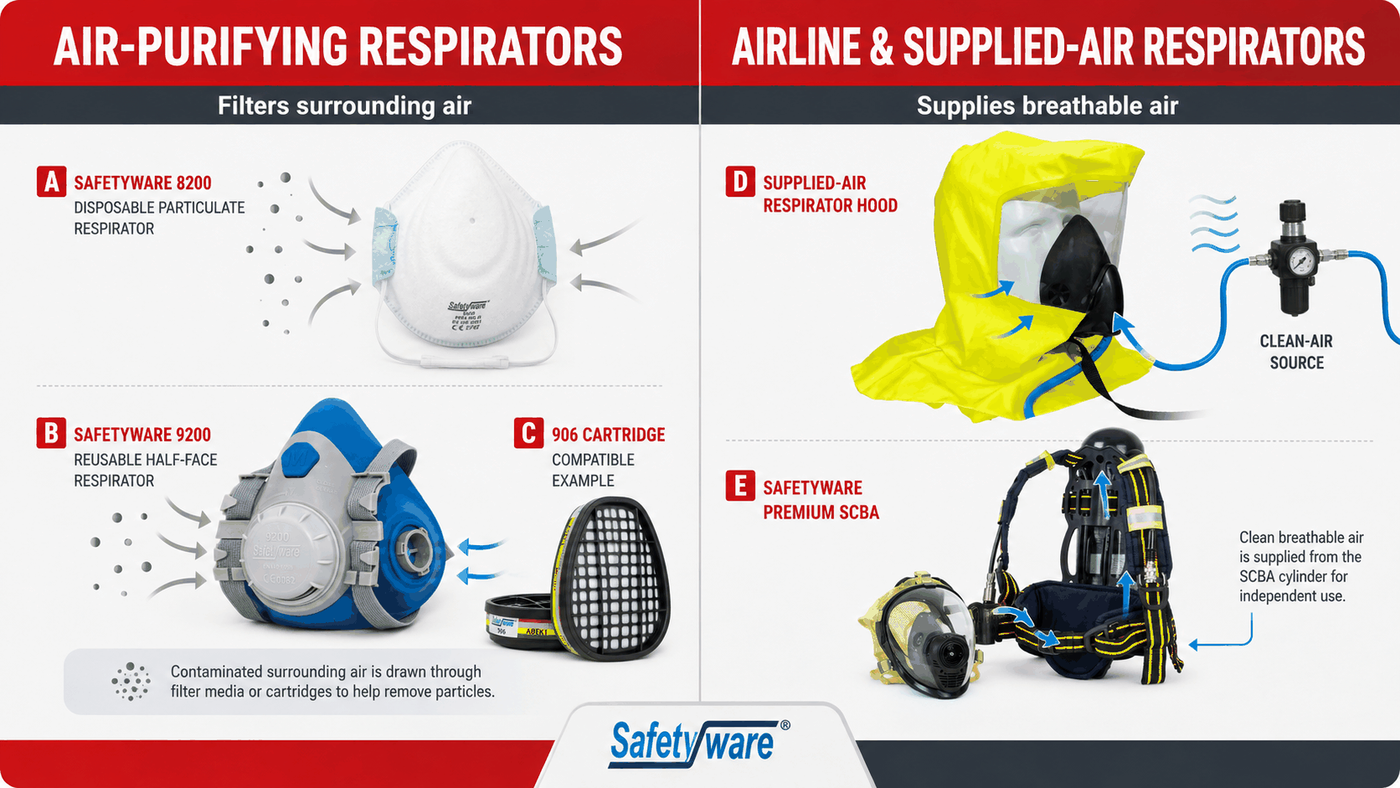
In simple terms, respiratory protection either filters harmful substances from inhaled air or supplies clean breathing air from a safe source. Overall, the two main families are:
- Air-purifying respirators (APR): These remove selected contaminants from the surrounding air through filters, cartridges or canisters.
- Atmosphere-supplying respirators: These provide breathing air from an independent source through an airline or a cylinder.
However, the difference is critical. An air-purifying respirator does not create oxygen. Therefore, never use one in low-oxygen air, an unknown atmosphere or any situation outside its approved conditions.
Also, respirators differ from loose surgical or hygiene masks. Manufacturers design filtering facepiece respirators to seal against the face and filter inhaled air. However, users must select the right model and fit it correctly. In contrast, a surgical mask mainly blocks droplets and splashes, so it does not automatically provide the same close-fitting protection.
The Main Types of Respiratory Protection
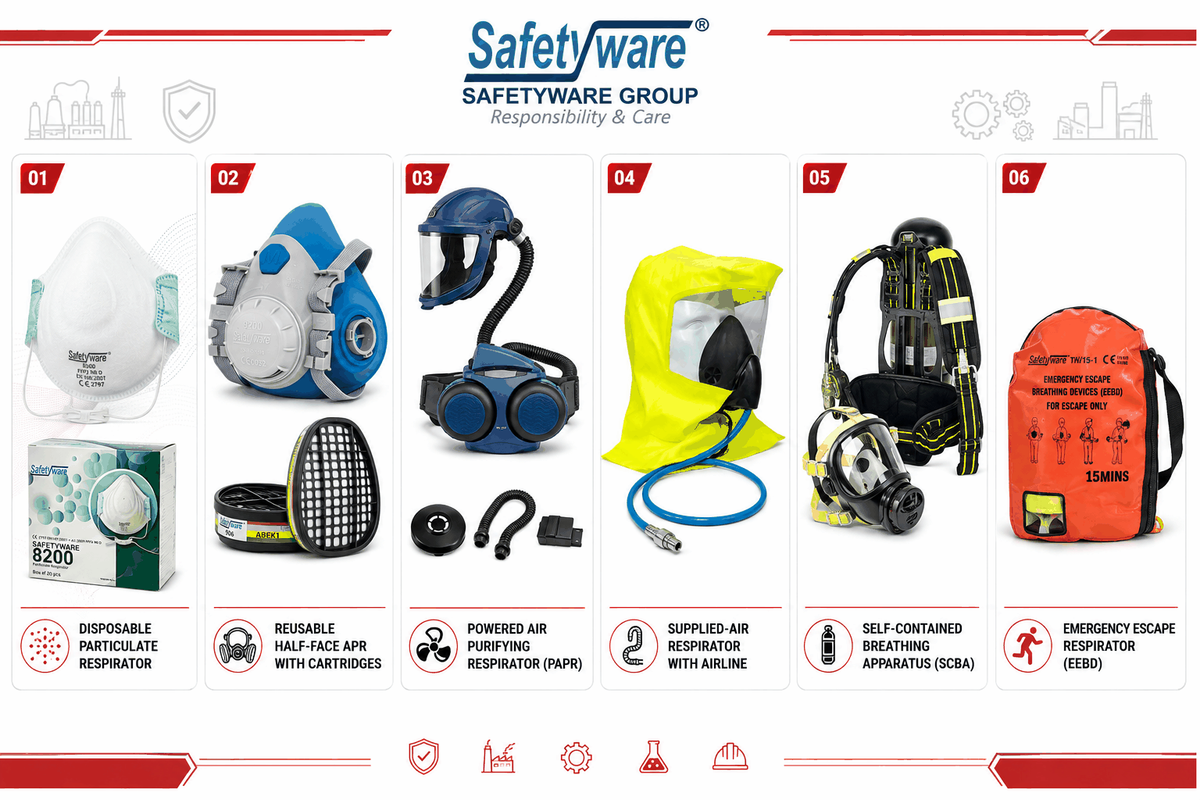
1. Disposable particulate respirators
First, disposable filtering facepiece respirators cover the nose and mouth. Their filter material reduces exposure to airborne particles. Depending on their class and approved use, they may suit hazards such as dust, certain fumes and mists.
For example, common ratings include FFP1, FFP2 and FFP3 under EN 149, as well as N95, N99, N100, R or P series under the US NIOSH system. However, these labels come from different approval systems, so do not treat them as the same. NIOSH explains that N-series filters do not resist oil, R-series resist some oil and P-series strongly resist oil. (NIOSH filtering facepiece respirators)
Use when: the identified hazard is a particulate, the model’s approval covers that hazard and concentration, and the wearer can achieve the required fit.
Do not use for: gases, vapours, oxygen deficiency, unknown contaminants or emergency entry—unless the product is specifically approved as part of another suitable system.
2. Reusable half-face and full-face air-purifying respirators
Second, reusable APRs use filters or chemical cartridges that workers can replace. A half-face mask covers the nose and mouth. In addition, a full-face mask covers the eyes and may help when the system must address both breathing and eye exposure.
However, the filter or cartridge matters as much as the facepiece. Particulate filters do not control gases or vapours. Likewise, an organic-vapour cartridge cannot filter every chemical. Therefore, buyers must confirm:
- Each contaminant and its concentration
- Filter or cartridge type and class
- Facepiece-to-filter compatibility
- Expected service life and changeout schedule
- Potential for eye or skin irritation
- Oxygen level and the possibility of an IDLH atmosphere
Never rely only on smell or taste when deciding when to change a chemical cartridge. Under the US OSHA standard, covered workplaces must use an end-of-service-life indicator for gas and vapour cartridges. If no indicator exists, employers must set a change schedule based on objective data. (OSHA 29 CFR 1910.134)
3. Powered air-purifying respirators (PAPR)
Third, a PAPR uses a battery-powered blower to pull air through matching filters. Then, it sends the filtered air to a facepiece, hood, helmet or visor. Depending on the approved setup, a PAPR can support longer, hotter or more demanding tasks.
However, the fan does not turn a PAPR into a supplied-air device. It still filters air from the work area. Therefore, do not use a PAPR in low-oxygen or unknown air unless a separate approved supplied-air system controls the hazard.
4. Supplied-air or airline respirators (SAR)
Fourth, a supplied-air respirator sends breathing air from a remote source through a hose. For example, these systems may suit long tasks such as painting, blasting, industrial cleaning and some confined-space work. However, the full system, air quality and emergency plan must match the task.
Still, users must check the full system: head top or facepiece, regulator, hose, couplings, air source, air-quality controls and any escape unit. In addition, the risk check must cover hose routes, damage, compressor pollution, loss of air and worker movement.
5. Self-contained breathing apparatus (SCBA)
Fifth, an SCBA carries breathing air in a cylinder. Trained emergency teams use SCBA for firefighting, rescue and dangerous or low-oxygen air where an air-purifying device cannot provide safe protection.
For example, the US OSHA respiratory standard sets strict rules for entry into an IDLH atmosphere. It requires a full-facepiece pressure-demand SCBA with a minimum rated service life of 30 minutes, or a full-facepiece pressure-demand supplied-air respirator with an auxiliary self-contained air supply. However, other countries may set different rules. Therefore, local law and the emergency plan must guide the choice. (OSHA 29 CFR 1910.134(d)(2))
Because SCBA protects life in severe hazards, only trained users should operate it. Users need medical checks, fit testing where the rules require it, training, pre-use checks, planned service, cylinder control and realistic emergency drills.
6. Escape respirators and emergency escape devices
Finally, manufacturers design escape devices to help wearers leave a dangerous area. A device may address a certain gas, smoke hazard, industrial emergency or short escape time. However, never assume that an escape device suits hazard entry, rescue or normal work.
When Do Workers Need Respiratory Protection?
Employers may require RPE when a risk check shows that airborne exposure remains too high after other controls. In addition, they may need RPE while workers install engineering controls, during emergencies or for special short tasks.
| Hazard or situation | Possible RPE direction | Essential warning |
|---|---|---|
| Construction, cement, silica or process dust | Approved particulate respirator | Control dust at source first; select from measured exposure and applicable silica rules |
| Welding or thermal-process fumes | Suitable particulate or powered system | Assess metals, gases, process, ventilation and work environment—not “welding fumes” alone |
| Solvent vapours, paint spraying or adhesives | Compatible gas/vapour or combination cartridge, or supplied air | Use the SDS and exposure assessment; set a cartridge change schedule |
| Acid gases, ammonia or mixed chemicals | Hazard-specific cartridge/canister or supplied air | A cartridge for one chemical may not protect against another |
| Biological aerosols | Certified particulate respirator selected for the task | Infection-control procedures and local health guidance still apply |
| Oxygen deficiency, unknown concentration or IDLH atmosphere | Appropriate positive-pressure atmosphere-supplying equipment | Do not use an APR or PAPR; entry requires a rescue and emergency plan |
| Firefighting, spill response or rescue | Task-approved SCBA or other specified emergency system | Only trained and medically suitable personnel should enter |
| Emergency evacuation | Hazard-specific escape device | Escape-only equipment must not be used for routine work or rescue entry |
However, this table only gives a starting direction. For example, two painting jobs may need different systems because the coating, spray method, enclosure and measured level differ.
How to Choose the Right Respirator
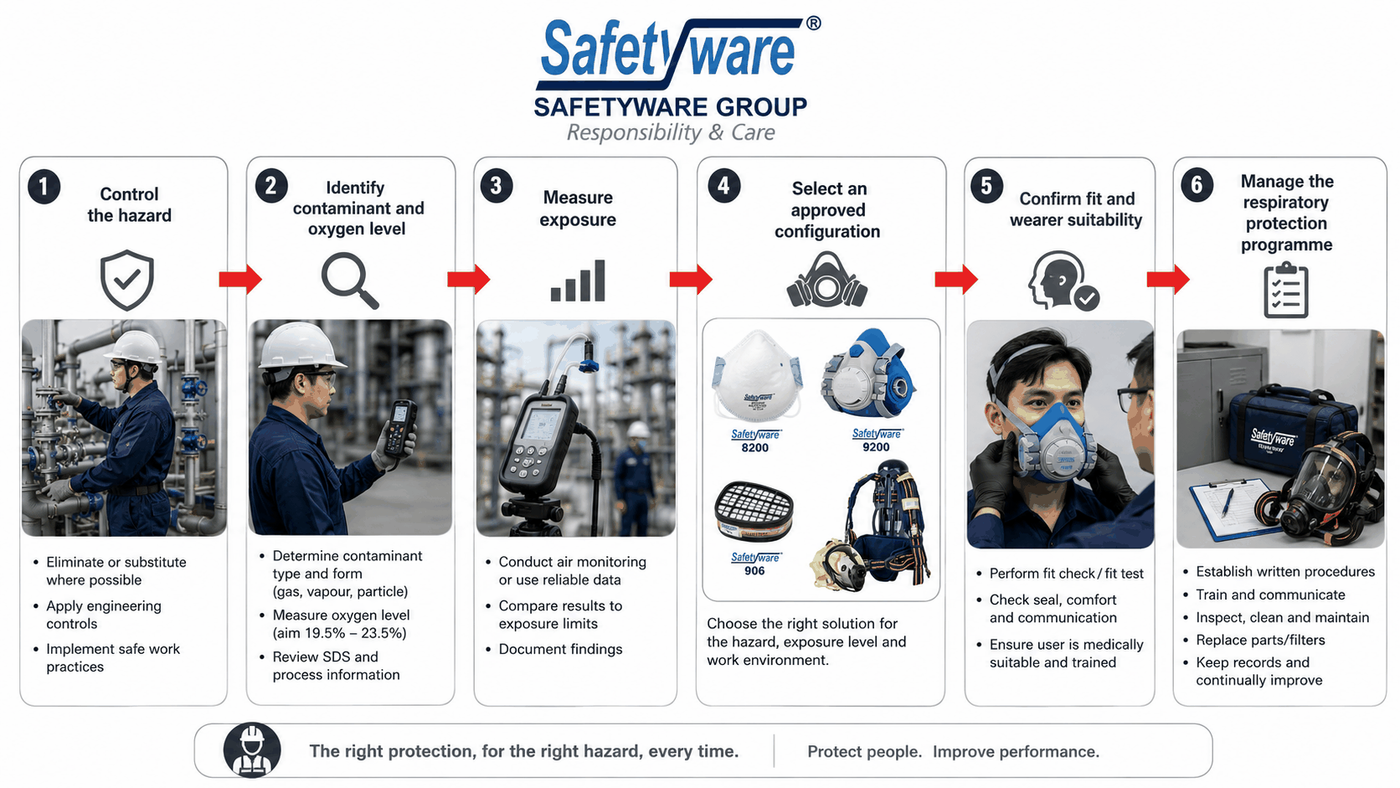
Step 1: Control the hazard at source
First, ask whether you can remove the substance or replace it with a safer option. Then, assess enclosure, local exhaust ventilation, wet methods, automation and safer work steps. RPE should control a clear risk that remains after these steps.
Step 2: Identify the airborne hazard
Next, review the safety data sheet, process details, workplace readings and by-products. Then, decide whether the air contains particles, gases, vapours, biological aerosols, a mixture or too little oxygen. Terms such as “chemical work” and “dusty area” do not give enough detail for a safe choice.
Step 3: Determine exposure concentration and limits
After that, compare the measured or well-estimated exposure with the relevant work exposure limit. Also, check short peaks, task length, heat, humidity and emergency events. If you do not know the hazard or its level, follow the stricter approach under the local rules.
Step 4: Select an approved complete configuration
Next, choose an RPE type that provides enough protection for the exposure. Then, verify the assigned protection factor that the country or region uses. Use it to check whether the respirator can keep exposure below the limit. Also, check the complete model and setup—not only the filter label.
For buying, confirm the approval or standard required in the destination market. For example, the official NIOSH Certified Equipment List helps US buyers verify approved setups. Meanwhile, Malaysia DOSH publishes its own approval list for respiratory protective equipment. (NIOSH Certified Equipment List; Malaysia DOSH respiratory protection approvals)
Step 5: Confirm fit and wearer suitability
Tight-fitting respirators depend on a firm seal. For example, facial hair, unsuitable eyewear, the wrong size or a damaged sealing surface can cause leaks.
A fit test checks whether a certain model and size fit one wearer. In contrast, a wearer performs a brief user seal check every time they put on the respirator. This check does not replace fit testing. Malaysia’s DOSH chemical-PPE guidance calls for fit testing of tight-fitting air-purifying and supplied-air respirators before first use, when the facepiece changes and at least once a year. Similarly, US OSHA sets its own fit-test steps for covered workplaces. (Malaysia DOSH PPE guideline; OSHA fit-testing procedures)
Step 6: Build a respiratory protection programme
Finally, buying masks covers only one part of the control plan. A practical programme should name the people in charge and cover:
- Hazard and exposure assessment
- Selection of approved RPE and compatible components
- Medical or wearer-suitability assessment where required
- Fit testing for tight-fitting respirators
- Training, donning, doffing and user seal checks
- Cartridge or filter change schedules
- Cleaning, disinfection, inspection, storage and repair
- Breathing-air quality for supplied-air systems
- Emergency, rescue and escape arrangements
- Records, periodic review and programme evaluation
For example, ISO/TS 16975-1:2016 gives global guidance for setting up an RPE programme. It covers risk checks, selection, training, use and upkeep. However, this guidance does not replace national or local law. (ISO/TS 16975-1:2016)
Legal Requirements, Standards and Good Practice: What Is the Difference?
Although these terms relate to one another, they do not mean the same thing.
| Category | What it means | Examples |
| Law or regulation | Legally binding requirements within its jurisdiction and scope | Malaysia USECHH Regulations 2000; US OSHA 29 CFR 1910.134; EU PPE Regulation (EU) 2016/425 for placing PPE on the EU market |
| Product standard | Technical requirements and test methods for a product type; it becomes legally significant when adopted or referenced by law, approval, contract or tender | EN 149 filtering half masks; EN 143 particle filters; EN 14387 gas/combined filters; EN 136 full-face masks; EN 137 open-circuit SCBA |
| Programme guidance or industry practice | A framework or accepted method for selection, use and management; it does not automatically become law | ISO/TS 16975-1, fit-testing programmes, documented cartridge change schedules and scheduled inspections |
Malaysia
First, Malaysia’s USECHH Regulations control exposure to chemicals that can harm health. Regulation 15 sets an order of control measures. However, Regulation 16 allows approved PPE when preferred controls are not practical, while employers put them in place, or when those controls do not reduce exposure enough. In addition, employers must set steps for issue, upkeep, checks and training. The PPE must also suit and fit workers without harming their health or medical condition. (Malaysia USECHH Regulations 2000)
Therefore, buyers should check the exact model, standard, approval number and valid dates on the official DOSH respiratory protection list. The list covers specific products, so a general claim that a brand is “approved” is not enough.
United States
Meanwhile, OSHA 29 CFR 1910.134 applies to covered US workplaces. When workers need respirators, employers must create a written plan for that work site. The plan covers selection, medical checks, fit testing for tight-fitting respirators, use, upkeep, breathing-air quality, training and regular review. In addition, employers must use NIOSH-approved respirators for the intended task. (OSHA respiratory protection standard)
European Union
In the European Union, Regulation 2016/425 sets legal market rules for PPE design, manufacture and conformity checks. PPE that protects against risks with very serious results, including death or permanent harm, falls under Category III. Also, CE marking shows that the product follows the relevant EU law; it is not simply a general quality badge. Harmonised standards can help show conformity. However, the regulation and the product standard remain different documents. (EUR-Lex: Regulation (EU) 2016/425)
Finally, other markets use different rules. Therefore, employers, importers and distributors should confirm the law, product approval, standard edition and workplace plan for every destination market.
Common Respiratory Protection Mistakes
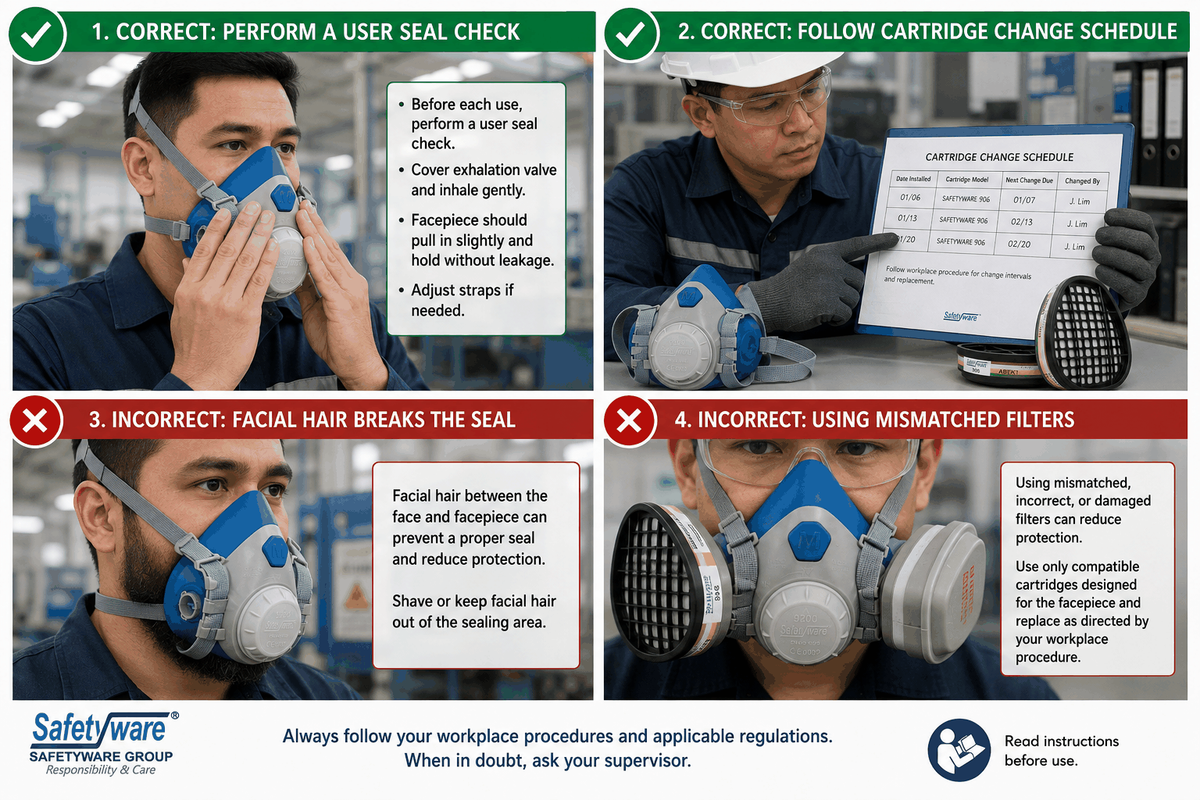
Before buying products or reviewing a programme, use this short checklist:
- Selecting by product name alone without identifying the contaminant
- Using a particulate respirator for gases or vapours
- Using an APR or PAPR where oxygen may be deficient or the atmosphere is unknown
- Mixing facepieces, filters, hoses or regulators that are not approved as one system
- Assuming FFP2, N95 and other classifications are automatically identical
- Ignoring facial hair or eyewear that crosses a tight-fitting seal
- Treating a user seal check as a substitute for fit testing
- Waiting for smell or taste before changing a chemical cartridge
- Reusing, cleaning or storing equipment against the manufacturer’s instructions
- Buying emergency equipment without training, inspection, maintenance or rescue planning
SAFETYWARE Products and Solutions
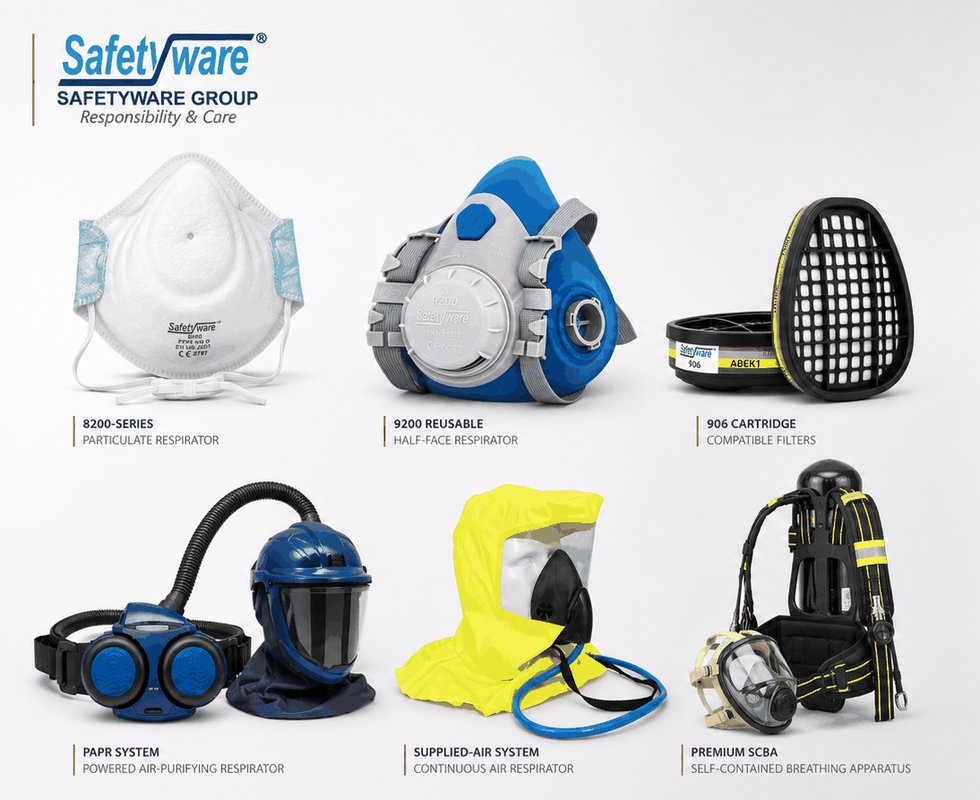
To support a hazard-based programme, SAFETYWARE offers several types of respiratory protection. However, buyers should start with the site’s exposure details—not a preferred product model.
Particulate respirators
First, the SAFETYWARE particulate respirator range includes disposable choices for dust, fumes, mists and haze where the rating, approval and fit match the exposure. For example, SAFETYWARE lists the SAFETYWARE 8200 as FFP2 NR to BS EN 149:2001+A1:2009. However, buyers should confirm the exact model, current approval, wearer fit and task before purchase.
Reusable APR facepieces, cartridges and filters
For repeat tasks involving suitable particle, gas or vapour hazards in air with enough oxygen, consider the SAFETYWARE air-purifying respirator range. For example, SAFETYWARE offers the 9200 half-face respirator in several sizes. Pair it only with matching filters or cartridges chosen for the assessed hazard.
In addition, the cartridge and filter range includes particle, organic-vapour, acid-gas, multigas and combination choices. However, a filter colour or label offers only a first clue. Confirm the match, class, service life and every hazard in the exposure profile.
PAPR and supplied-air systems
Next, review SAFETYWARE’s PAPR systems and supplied-air respirator systems when the task needs powered airflow, a hood or helmet, longer work time, or a remote clean-air source. However, always configure a full matching system. This includes the head top, hose, fan or regulator, filters, power supply or air source, and emergency parts.
SCBA for emergency and hazardous-atmosphere planning
Finally, the SAFETYWARE SCBA range supports trained emergency, firefighting, rescue and dangerous-atmosphere teams that need to carry breathing air. For example, SAFETYWARE lists the Premium SCBA with a 6.8-litre, 30 MPa composite cylinder and to EN 137:2006 and EN 136:1998+AC:2003. Before buying, confirm the full specification, certificates, duration calculation, service support, training and emergency plan for the market and task.
For broader selection support, visit the SAFETYWARE respiratory protection category. Alternatively, contact SAFETYWARE with the safety data sheet, hazard, measured level, oxygen level, task length, work setting, wearer details, required standard and quantity.
Conclusion
Effective respiratory protection starts with the hazard, not the mask. First, identify the hazard, oxygen level and exposure level. Next, control the risk at its source. Then, choose an approved respirator that provides the right protection, fit and compatibility.
Finally, support the equipment with a complete programme. Training, medical or wearer checks, fit testing, filter and cartridge control, inspection, cleaning, storage, breathing-air quality and emergency planning all affect how well RPE works. Therefore, a sound selection process helps PPE buyers and safety managers protect workers and avoid costly buying mistakes.
📞 Need More Information?
Looking for certified Respiratory protection for Haze?
Explore SAFETYWARE’s safety shoes and workplace PPE range at
👉Safetyware Catalogs
Our safety specialists can help evaluate workplace hazards, recommend suitable safety helmets, and support compliance with Malaysia workplace safety requirements.
If you need a quotation, feel free to contact us at:
📩 Email: [email protected]
📞 Tel: WhatsApp Us