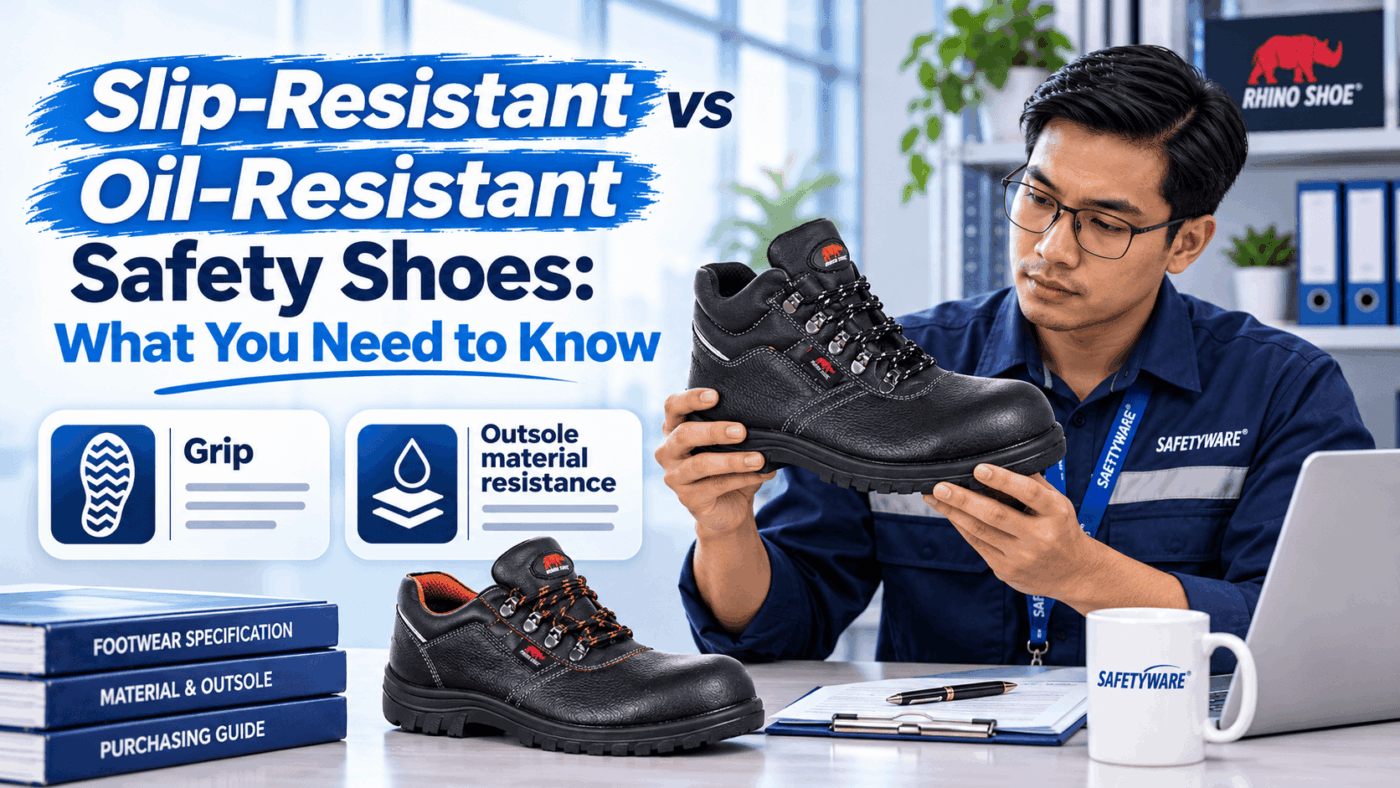
A safety shoe can resist damage from fuel oil and still provide unsuitable grip on a particular contaminated floor. Equally, a shoe with good slip-test results should not automatically be treated as resistant to every oil or chemical encountered at work.
That distinction matters in workshops, warehouses, food production and maintenance areas. Buyers often see “oil-resistant”, “anti-slip” and “non-slip” used together in product descriptions, but those terms do not establish the same performance.
This guide explains the difference, shows how to read SR and FO markings, and provides a practical framework for comparing footwear. The goal is to turn a vague request for “good safety shoes” into a specification that a supplier can evaluate.
The main difference: grip and material resistance
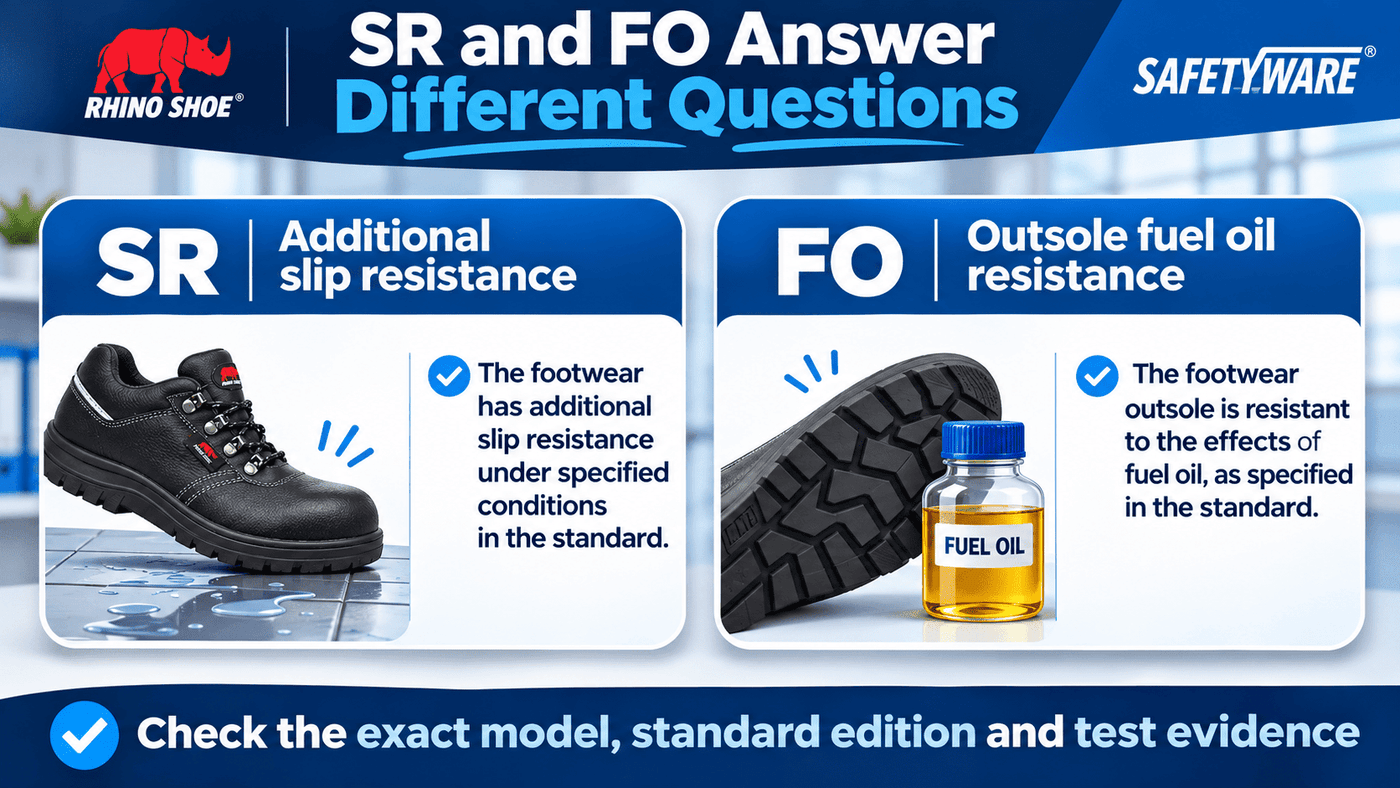
Slip resistance concerns friction between footwear and a walking surface under specified conditions. Oil resistance concerns the material’s response to oil exposure. HSE specifically warns that an oil-resistant sole should not be assumed to be slip-resistant. [1]
Question Slip resistance Fuel oil resistance What are you evaluating? Footwear traction under defined test conditions Outsole resistance to the specified fuel-oil test exposure What evidence is useful? Slip-test method, surface, contaminant and results Relevant outsole test result and declared marking Relevant newer EN ISO marking SR for the additional slip test FO for fuel oil resistance What does it not establish? Safe grip on every workplace surface Safe grip on an oily floor or resistance to every chemical
A workplace may need both properties. Treat them as separate questions in the purchasing enquiry instead of accepting one as evidence of the other.
Why “non-slip” should not end the discussion
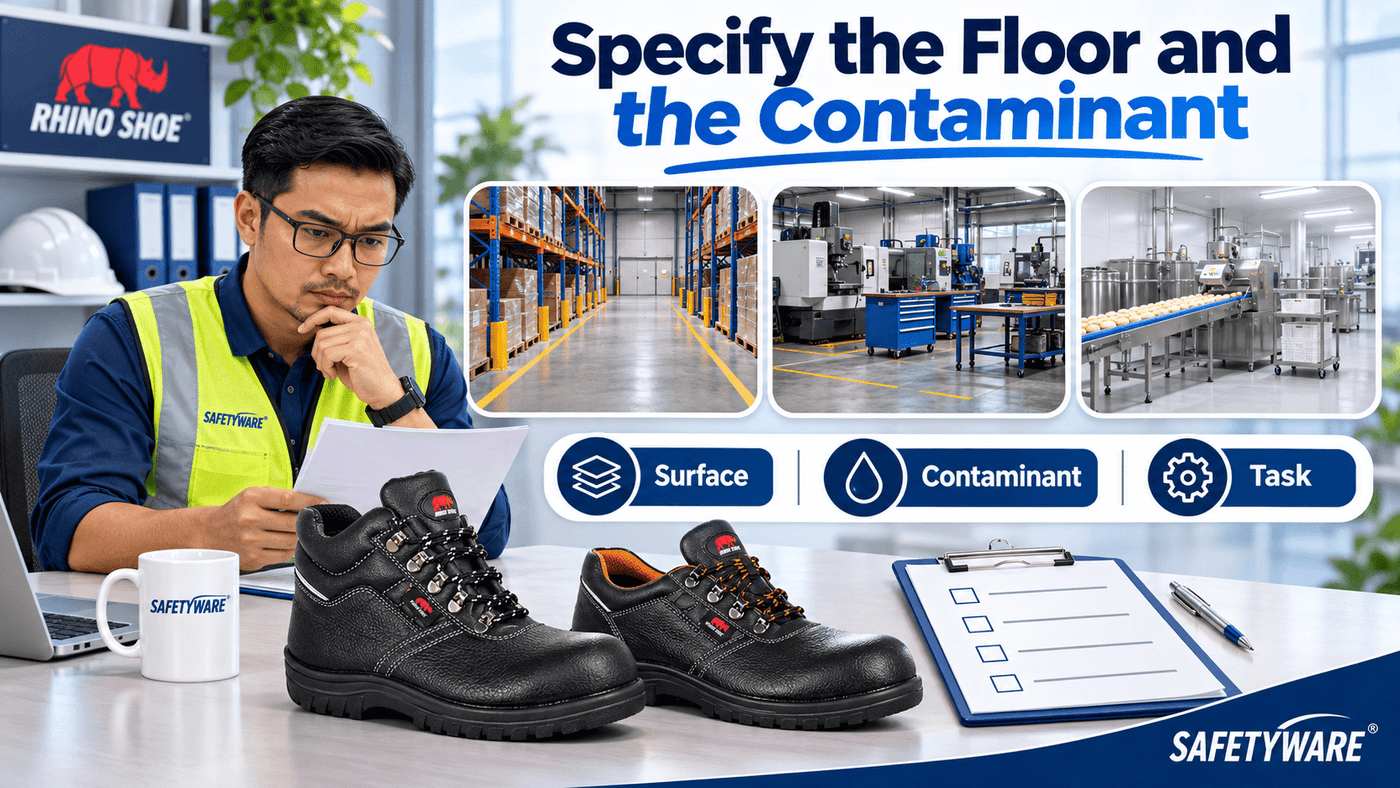
“Non-slip” is a broad sales description, not a guarantee that a person cannot fall. Ask which test supports the claim and whether its conditions are relevant to your workplace. HSE recommends describing the actual floors and contaminants to the supplier and considering additional representative testing where needed. [1]
For example, a maintenance department should distinguish a dry concrete walkway from a smooth area affected by hydraulic-fluid leaks. The two locations should not disappear into a single enquiry labelled “factory use”.
Understand the standard and edition first
ISO lists ISO 20345:2021 as the international safety-footwear standard, with Amendment 1:2024. BSI lists BS EN ISO 20345:2022+A1:2024 as its current release. The different ISO and EN publication years do not, by themselves, indicate a documentation error. [2][3]
ISO 20345 addresses basic and optional requirements for general-purpose safety footwear. It also identifies specialist risks that fall under complementary standards, including chemical protection and electrical insulation. [2]
Therefore, record the complete standard designation from the product documentation. Do not remove the year from a comparison sheet or combine ratings taken from different versions without explanation.
Earlier slip markings: SRA, SRB and SRC
These markings belong to the earlier system discussed in HSE’s footwear guidance: [1]
Earlier marking Test conditions represented SRA Ceramic tile with dilute soap solution SRB Steel with glycerol SRC Both SRA and SRB conditions
HSE’s page remains useful for selection principles, but its marking discussion describes that earlier system. Use current technical sources to interpret newer footwear documentation.
Newer slip marking: SR
Under EN ISO 20345:2022, conventional safety footwear has a basic ceramic-tile/soap-solution slip test without a separate slip code. SR identifies the additional ceramic-tile/glycerol test. Test modes also changed, so SRC and SR are not identical tests with different names. [4]
Special-purpose footwear outside the slip-test applicability may carry Ø. Consequently, the absence of SR alone does not mean a conventional safety shoe has no tested slip performance. Read the complete marking and instructions. [4]
FO is a separate outsole property
FO means resistance to fuel oil. In the 2022 framework, fuel oil resistance is separate from the grouped categories. Do not infer FO merely from a designation such as S3; check the explicit claim and supporting documentation. [4][5]
FO does not certify whole-shoe chemical protection. Nor should it be expanded into a promise of resistance to every lubricant, solvent, cleaning product or food oil. If a specific substance matters, name it and request application evidence.
Do you need slip resistance, oil resistance or both?
Use the following as an enquiry guide, not a universal footwear prescription:
| Work situation | Questions to investigate | Information to send the supplier |
|---|---|---|
| General warehouse | Are entrance areas wet? Are there smooth transitions or spill-prone zones? | Floor types, indoor/outdoor routes, tasks and other foot hazards |
| Vehicle or machine workshop | Which fuels, oils or fluids can reach the floor or shoe? | Substance names, exposure pattern, floor condition and cleaning method |
| Food processing | Are water, fats, food debris or cleaning residues present? | Process area, contaminants, hygiene needs and cleaning regime |
| Outdoor loading | Are rain, mud and changing surfaces involved? | Route photographs, surface transitions and weather exposure |
| Chemical maintenance | Is there a substance-contact hazard beyond loss of grip? | Safety data sheets and a separate chemical-protection assessment |
The table is a suggested way to organise purchasing information. It does not make a particular sole material or category suitable for every task in that industry.
Example: a workshop purchase brief
A more useful request than “oil-proof, anti-slip shoes” would be:
“Please propose safety footwear for maintenance staff working on painted concrete, with occasional exposure to the listed lubricants. Provide slip-test information, explicit FO documentation where claimed, substance limitations, available sizes and care instructions. Toe and penetration hazards must also be assessed.”
This wording gives the supplier distinct questions to answer. It also helps the buyer identify a quotation that relies on general advertising language instead of model-specific evidence.
Footwear selection belongs within slip prevention
Start by controlling the source of contamination. HSE recommends identifying leaks, spills, cleaning activity and other routes by which material reaches the floor, then preventing or controlling them. [6]
Practical measures can include repairing leaks, using appropriate containment and keeping a safe route available during cleaning. Cleaning must suit the floor and contaminant; a process that leaves a smooth floor wet can introduce a fresh slip hazard. Restrict access until the area is safe to use. [6][7]
This changes the purchasing conversation. A footwear complaint may reveal a housekeeping or flooring problem as well as a product-selection issue. Record the location and conditions before assuming that changing shoe brands will resolve it.
Include the wearer in the decision
HSE’s PPE selection guidance emphasises exposure, fit, compatibility and user characteristics. [8] For footwear, a structured fitting session should record size, heel security, toe space and whether the worker can perform normal movements comfortably.
Use a controlled trial with agreed reporting criteria. Never create an oily floor or ask employees to attempt a slip to demonstrate performance. Where representative slip testing is necessary, arrange it through competent testing support.
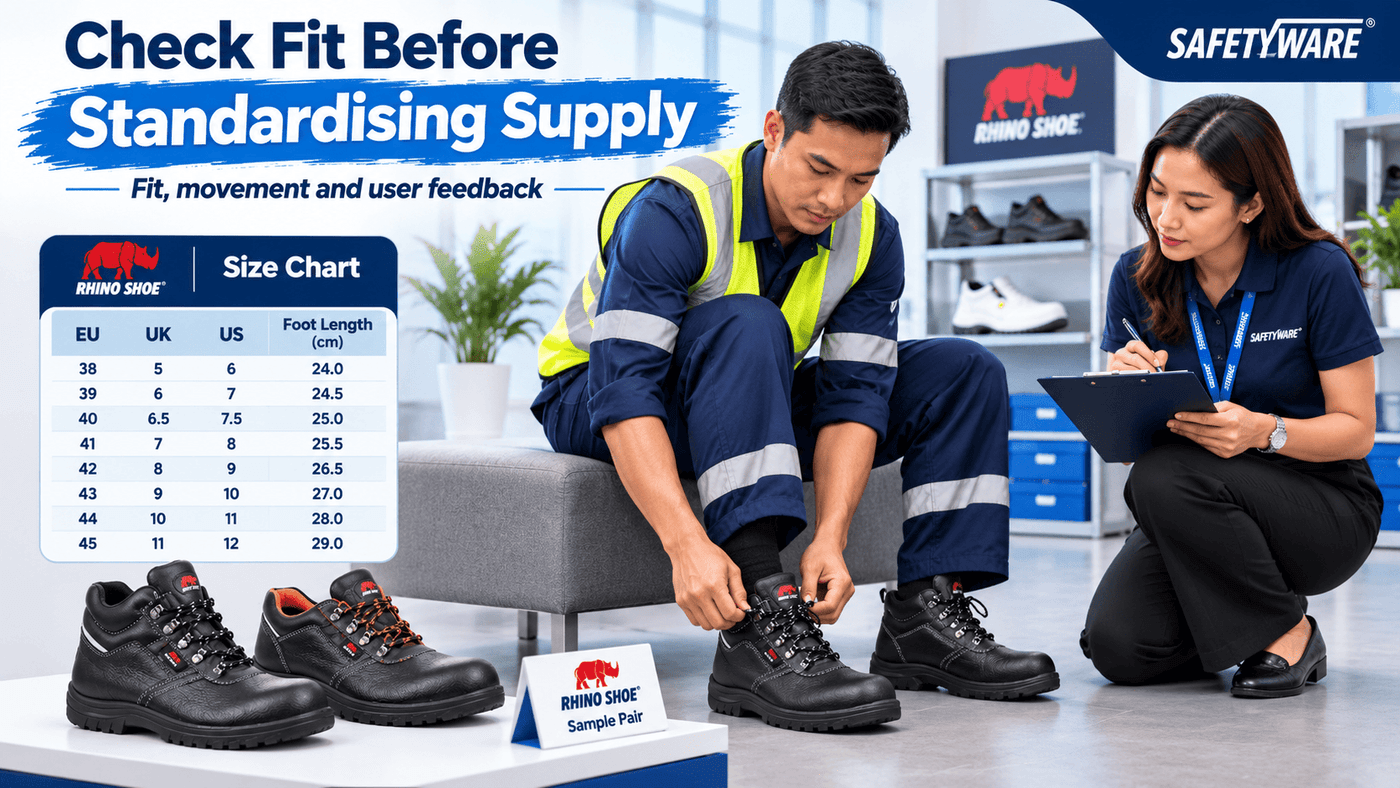
Buyer checklist: compare the exact model
Before approving a purchase, confirm:
- The supplier identifies the full model code and variant.
- The complete standard and edition are recorded.
- Slip claims have supporting test information.
- FO is explicitly supported if fuel oil resistance is required.
- Relevant workplace surfaces and contaminants have been described.
- Other hazards—such as toe impact, penetration, water or electrical exposure—have separate requirements.
- Product documentation and labels agree.
- Any local approval required for the destination and product is verified.
- Sizes, fitting arrangements and user feedback are addressed.
- Care, storage and replacement instructions are available.
- The quotation identifies the supplied product condition and specification.
- Repeat orders will use the same approved model or undergo review if changed.
Keep technical standards separate from legal duties
This is a technical buying guide, not a country-specific legal checklist. A product standard establishes defined requirements and tests; applicable law and site assessments determine what protection must be provided in a particular workplace.
Do not describe SR or FO as universally mandatory across Malaysia, Singapore, Indonesia, the Philippines and Vietnam. Verify the destination’s rules, any applicable approvals and the employer’s specification separately. Similarly, a catalogue reference to a standard is not a substitute for current documentation for the exact model.
Check documentation before repeating a familiar order
A familiar product name can conceal a changed suffix, outsole or certification scope. Build a simple comparison record with columns for model, standard edition, slip evidence, FO evidence, sizes, instructions and approval status.
For distributors, retain the wording of the supported claim. Avoid changing “fuel oil-resistant outsole” into “chemical-proof shoe” or “safe on all oily surfaces”. These statements promise different performance.
Inspection and replacement
Follow the manufacturer’s instructions for inspection, cleaning and storage. Check for damaged soles, separation, contamination and changes in fit. Ask the supplier to define replacement indicators for the specific footwear rather than assigning one service-life limit to every shoe.
Keep the issue date, model and reported concerns in the footwear record. If several users report a problem in one location, review that location and the product evidence together. Do not continue issuing the same model solely because it appears on an old approved list.
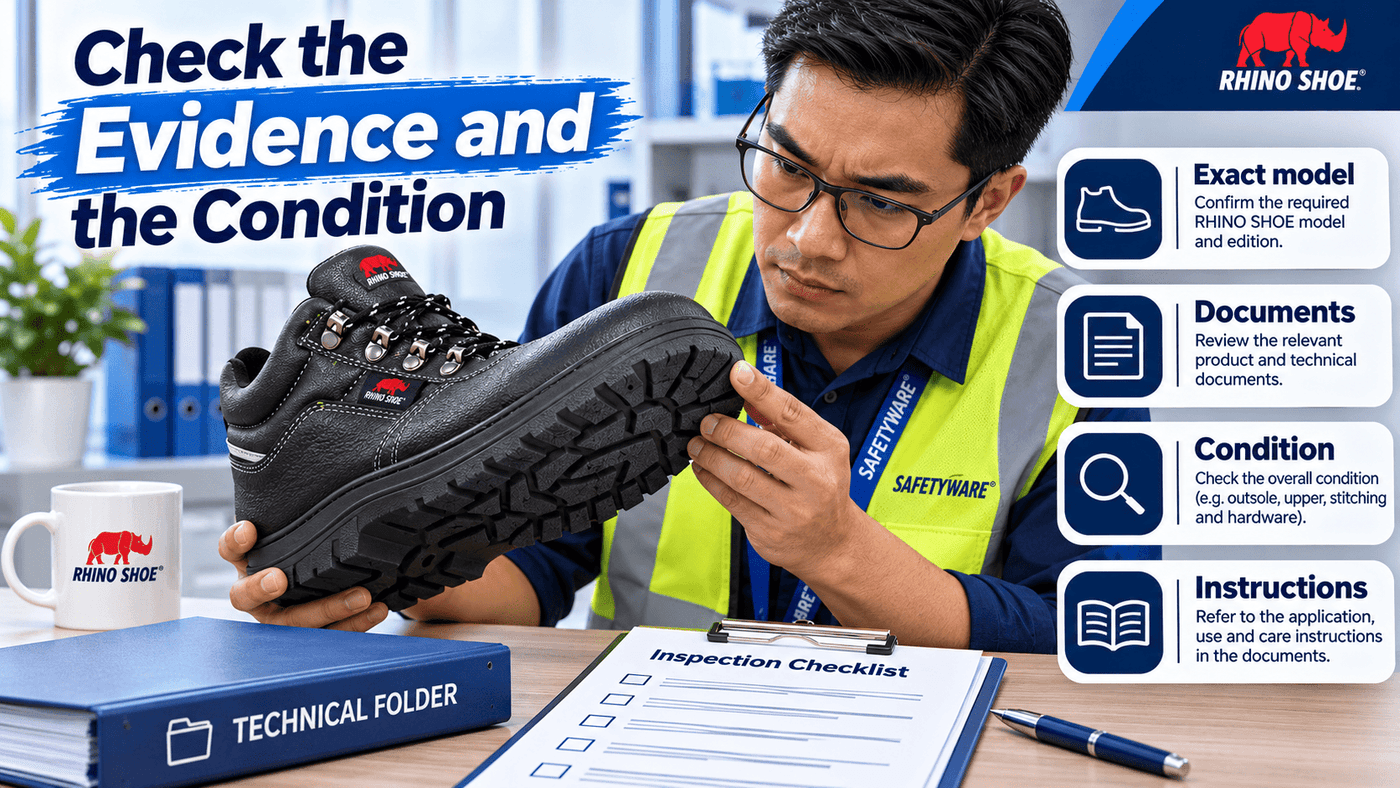
SAFETYWARE Products and Solutions
The SAFETYWARE product directory includes RHINO SHOE footwear and supporting workplace safety solutions. Start with the floor conditions and complete hazard assessment, then request a documented shortlist.
RHINO SHOE PU101SP-SD as a model to evaluate
The official RHINO SHOE PU Series SafeGuard PU101SP-SD product page describes a low-cut, lace-up shoe with a full-grain buffalo-leather upper, single-density PU outsole, steel toe cap and stainless-steel midsole plate. It also links technical and approval documents. [9]
Treat those features as the start of an evaluation. Confirm the exact variant, current marking, slip-test evidence, FO claim and suitability for the intended contaminants before ordering. This article does not certify that model for every oily or wet workplace.
Request a complete comparison
Send SAFETYWARE your floor types, contaminant list, workforce sizes, other hazards and destination requirements. Ask for:
- A model-specific technical sheet and relevant supporting documents
- A clear explanation of the claimed slip and fuel oil performance
- Suitable sample sizes for fitting
- Cleaning and replacement guidance
- Stock, lead-time and repeat-order information
For water-heavy or specialist work, use the directory to discuss alternative footwear constructions. Confirm each model separately rather than transferring the claims of one RHINO SHOE product to the entire range.
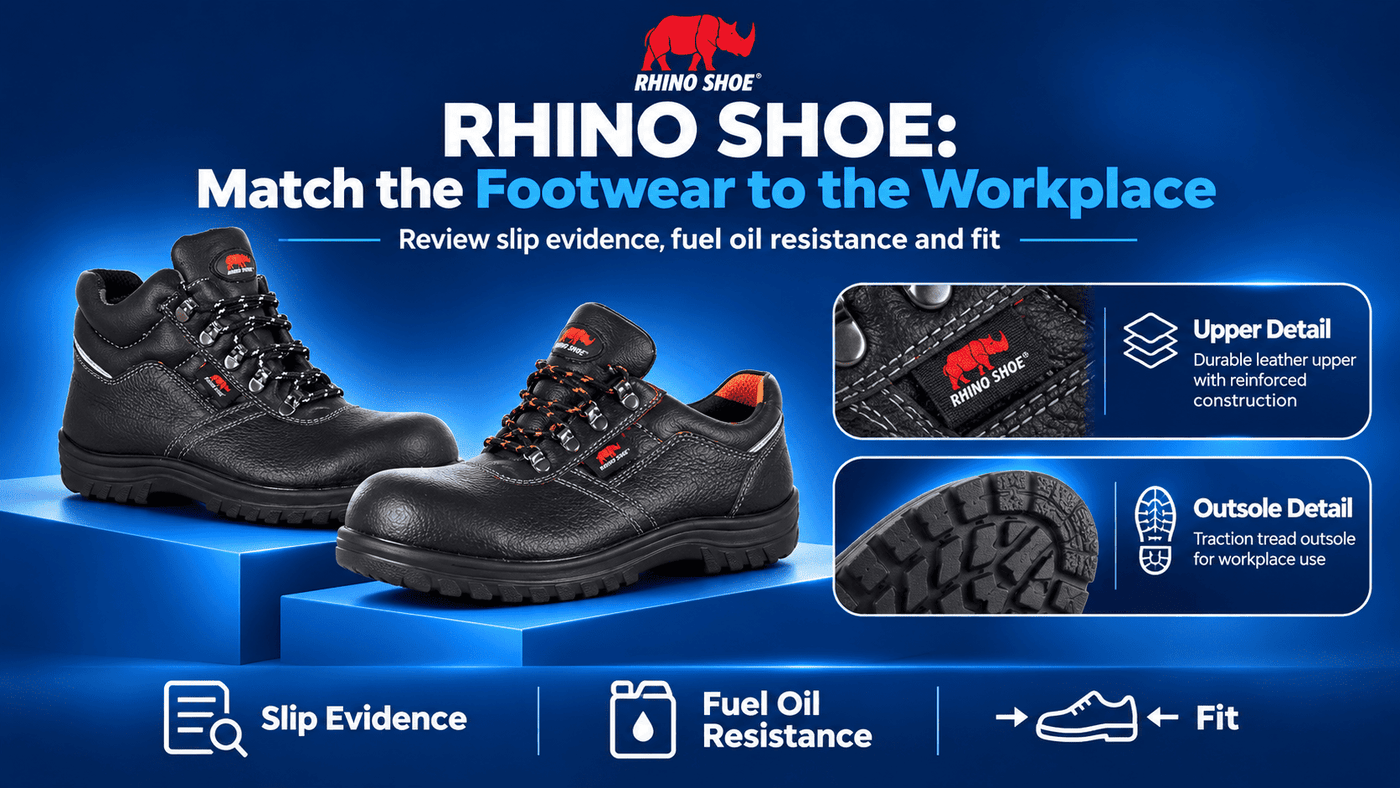
Conclusion
Slip resistance and oil resistance address different properties. A useful footwear specification asks for evidence of both when the task requires them, reads SR and FO in the context of the stated standard edition, and checks the actual workplace conditions.
Give the supplier a clear exposure brief, review the exact model documents and involve workers in fitting. Combine footwear selection with effective contamination control and a replacement process. That gives buyers a more defensible decision than relying on “anti-slip” or “oil-resistant” wording alone.
Sources and references
Reviewed 4 November 2026. The older HSE marking examples and the historical transition commentary in the technical article should not be treated as current market-access rules.
- HSE — Slip-resistant footwear
- ISO — ISO 20345:2021 and Amendment 1:2024
- BSI — Current BS EN ISO 20345 release
- UK Slip Resistance Group — EN ISO 20345 changes, technical article by SATRA’s Hannah Coe
- SATRA — FO and SR classification example
- HSE — Contamination control
- HSE — Cleaning and slip prevention
- HSE — PPE selection and use
- SAFETYWARE — RHINO SHOE PU101SP-SD and product directory
📞 Need More Information?
Looking for Certified Safety shoes?
Explore SAFETYWARE’s safety shoes and workplace PPE range at
👉Safetyware Catalogs
Our safety specialists can help evaluate workplace hazards, recommend suitable safety helmets, and support compliance with Malaysia workplace safety requirements.
If you need a quotation, feel free to contact us at:
📩 Email: [email protected]
📞 Tel: WhatsApp Us