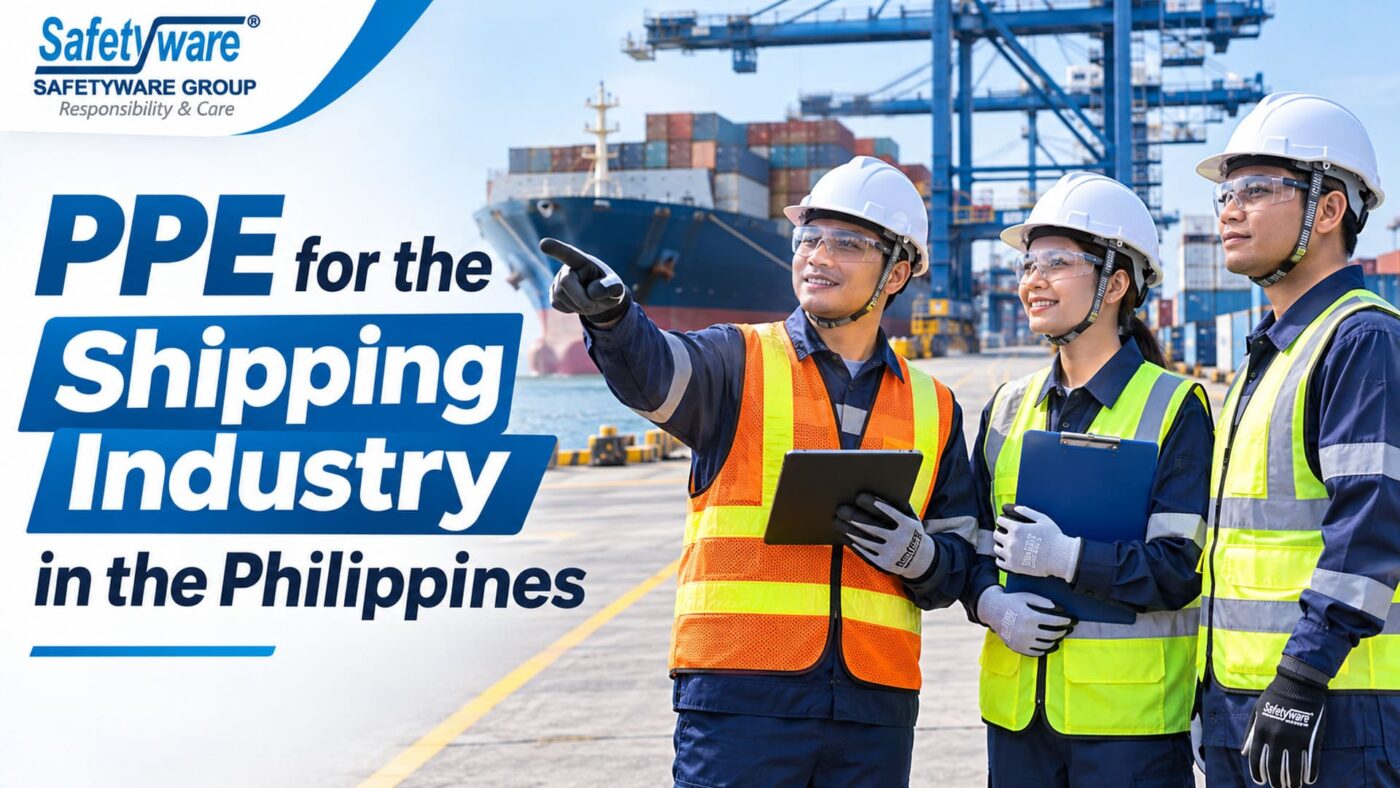
A shipping operation may involve a cargo terminal, a domestic ferry, an international vessel and several maintenance contractors. Although their workers share many hazards, they do not necessarily share the same legal framework or PPE specification.
For PPE buyers and safety managers in the Philippines, the starting point is therefore the worker, the task and the vessel. A helmet-and-vest rule at the gate cannot answer every question about chemical handling, enclosed-space entry or work near water.
This guide explains the main compliance distinctions and offers a practical purchasing framework. It also separates everyday work PPE from emergency life-saving appliances, which require their own vessel-specific checks.
Start by identifying the workplace and responsibility
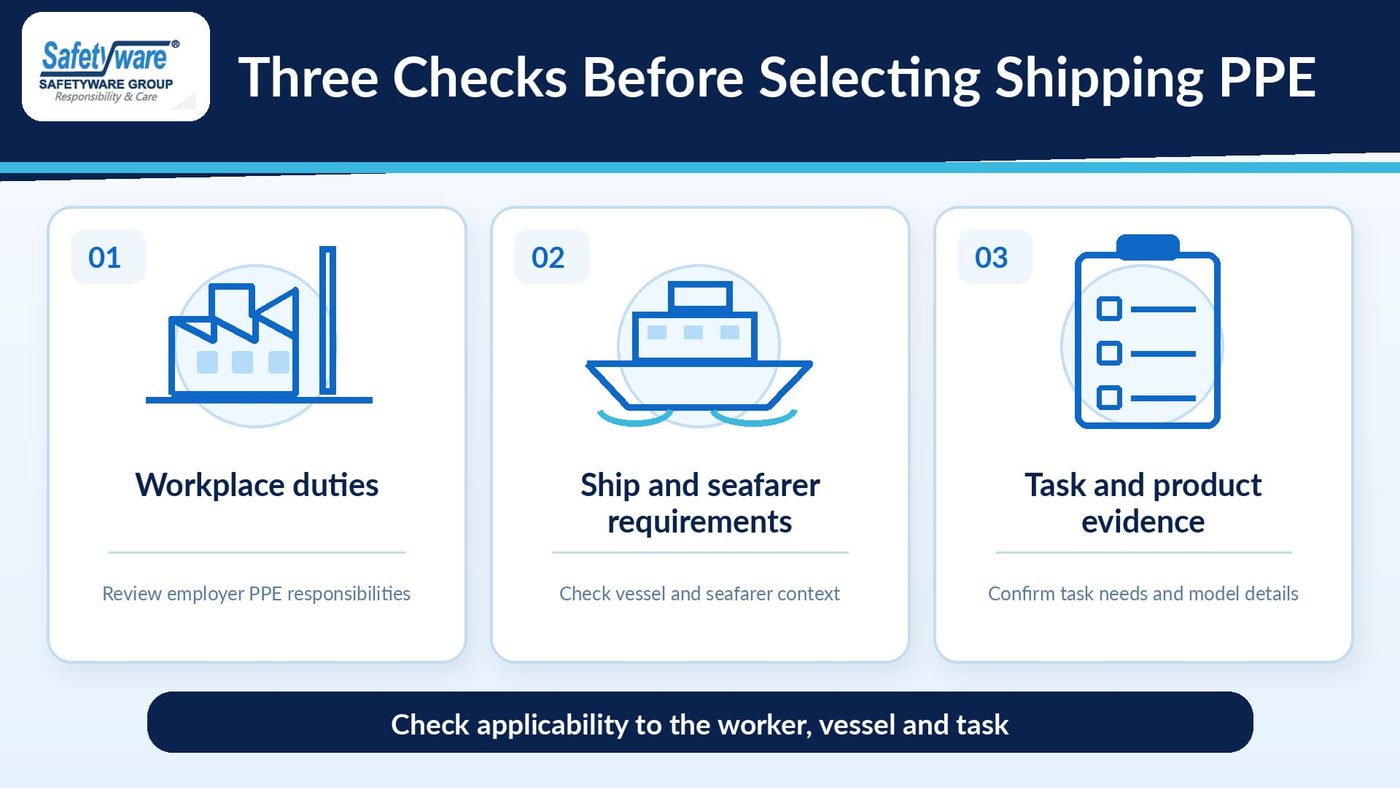
Use a separate assessment for each operating context:
| Workplace or activity | Main question before specifying PPE |
|---|---|
| Philippine port or terminal | Which workplace duties, terminal rules and contractor arrangements apply? |
| Philippine-registered domestic vessel | Which domestic maritime, labour and vessel requirements govern this operation? |
| Philippine-registered international vessel | Which Philippine requirements and applicable international instruments must be addressed together? |
| Filipino seafarer on a foreign-flag vessel | Which flag-state rules, employment protections and shipboard procedures apply? |
| Ship repair or contractor attendance | Who coordinates permits, isolation, PPE and emergency arrangements between ship and contractor? |
Do not classify every person visiting a vessel as a seafarer or assume a vessel’s minimum PPE list covers a contractor’s specialist work. Record who selects, supplies, inspects and replaces each item, and who authorises the task.
Philippine PPE duties and maritime requirements
RA 11058: necessary PPE must be supplied without charge
Section 8 of Republic Act No. 11058 requires employers, contractors and subcontractors to provide necessary PPE free of charge. It links provision to hazardous processes and environments and places PPE use within the safety officer’s evaluation and recommendation. The section also addresses appropriate equipment tested and approved by DOLE according to its standards. [1]
For procurement, this means a low purchase price is not the only criterion. The selected equipment must address the identified exposure, and the supplier’s documentation must support the exact product being ordered.
Use the revised OSH implementing rules
DOLE Department Order No. 252-25 is the revised implementing framework for RA 11058. DOLE’s Bureau of Working Conditions states that it took effect on 16 May 2025 and highlights its risk-based approach through hazard identification, risk assessment and control. [2]
Do not build a current compliance file using only older summaries of Department Order No. 198-18. Review the revised rules and the maritime provisions relevant to the operation. This guide does not assign a universal staffing level, PPE kit or certification requirement to every shipping business.
Maritime OSH guidance for Philippine-registered ships
DOLE Department Order No. 132-13 covers Philippine-registered ships on domestic and international voyages where the specified employment or engagement relationship exists. Its exclusions include warships, non-commercial government ships and fishing vessels. [3]
Its PPE provisions place responsibility on the shipowner to supply appropriate protection at its expense and maintain its adequacy and condition. Its hazard-prevention provisions also require attention to the work environment and safe procedures. [3]
The Magna Carta of Filipino Seafarers, RA 12021, is another part of the legal framework. It distinguishes government responsibilities for domestic and overseas seafarers. Use it alongside applicable implementing rules rather than treating one older issuance as the entire compliance system. [4]
MLC: provide equipment that fits the wearer
For covered ships, Maritime Labour Convention Standard A4.3 addresses risk evaluation, training, accident prevention and necessary, appropriately sized PPE. The ILO identifies suitable PPE sizing among the 2022 amendments that entered into force on 23 December 2024. [5]
A practical implication is to procure a genuine size range. A loose glove, poorly fitting respirator or oversized garment should not become the default because it is the only item available onboard.
Law, standards and site practice are different
A product standard describes specified performance or testing. A law establishes obligations within its scope. A terminal’s PPE rule may add operational requirements. These three layers can work together, but they are not interchangeable.
An EN, ANSI or ISO reference alone does not establish Philippine regulatory acceptance, suitability for a particular ship, or compliance with every hazard. Confirm the exact standard and edition stated on the product documents, the required performance and applicable local or vessel approvals.
Match PPE to shipping tasks
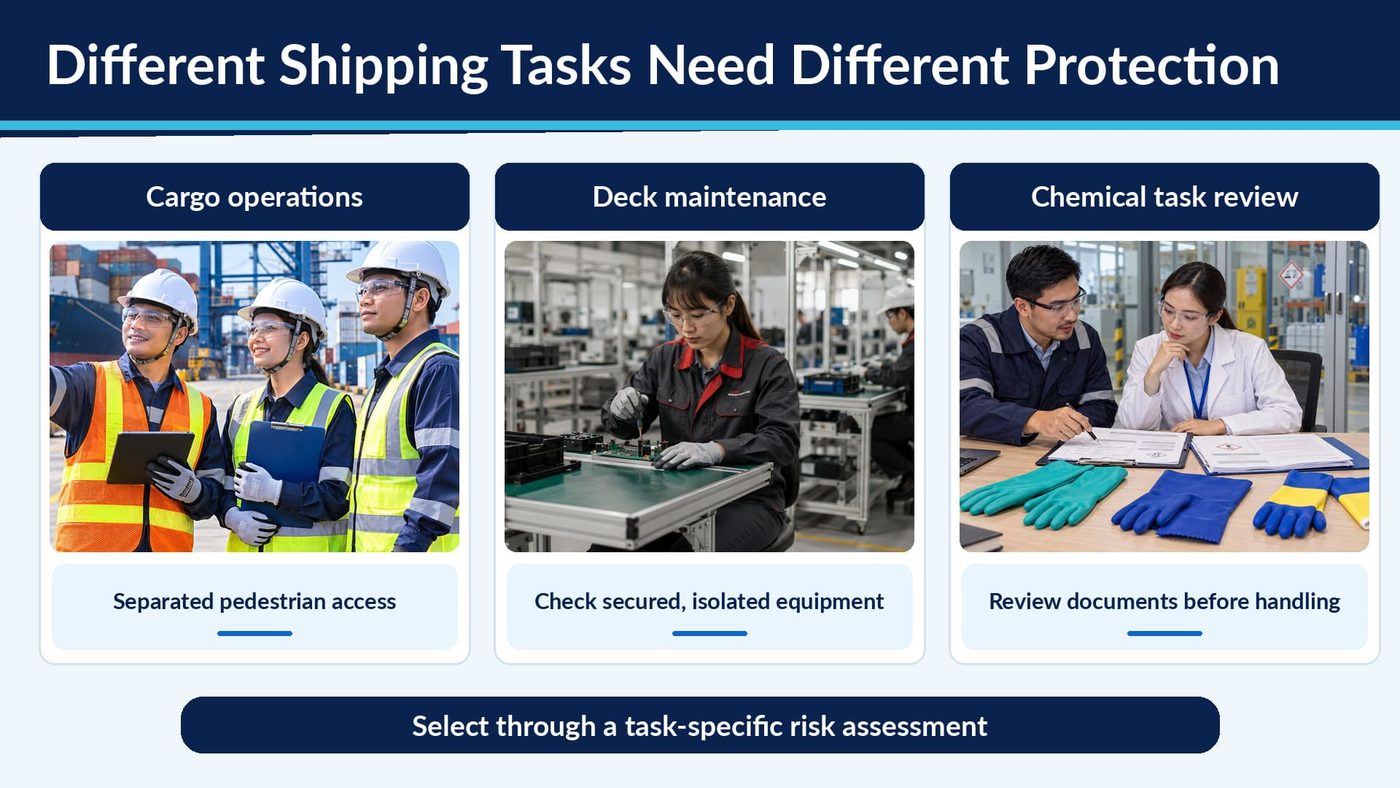
The following is a planning aid, not a list of equipment legally mandatory for every worker. The ILO’s revised code of practice on safety and health in ports is a useful industry reference; it should not be presented as a Philippine statute. [6]
Task Hazards to assess Controls to address first PPE selection questions Cargo and terminal work Vehicles, dropped objects, sharp edges, noise Traffic separation, lifting controls, exclusion zones Are head, foot, eye, hand and visibility requirements defined for the task? Deck maintenance Slips, tools, corrosion, moving machinery Housekeeping, guards, isolation, safe access Do footwear grip, gloves and eyewear suit the actual surface and work? Mooring Line recoil, crushing, entanglement, falling overboard Mooring plan, equipment condition, communication, safe positioning Is PPE compatible with line handling and the work-near-water assessment? Engine-room work Noise, heat, oils, machinery Noise control, insulation, ventilation, isolation Are hearing protection, clothing and gloves appropriate without impairing safe work? Painting and chemical handling Splash, vapour, mist, skin exposure Substitution, containment, ventilation, SDS review Are gloves, clothing, eye protection and respirators matched to the substance and exposure? Hot work Sparks, radiation, fumes, fire Permit, isolation, ventilation, fire precautions Are welding filters, thermal protection and respiratory measures selected together? Work at height Falls, dropped objects Avoidance, guarded access, suitable platforms Is any personal fall-protection system complete, compatible and supported by rescue arrangements? Work near water Drowning, poor access, wet exposure Barriers, access control, lighting, retrieval arrangements Does flotation equipment suit the wearer, task, clothing and rescue plan?
This matrix should become a set of specific purchase descriptions. “Chemical glove for deck work” is too vague. Include the chemical identity and concentration, contact pattern, duration, temperature and other handling hazards before asking for a recommendation.
Enclosed spaces require an entry system
IMO adopted Resolution MSC.581(110) on 27 June 2025, setting out revised recommendations for entering enclosed spaces aboard ships. It addresses risks including oxygen depletion, oxygen enrichment, toxicity and flammability. It also references separate SOLAS requirements for relevant drills and atmosphere-testing instruments. [7]
Review entry procedures against this newer guidance and the vessel administration’s requirements. Do not treat the recommendations themselves as a universal standalone law for every operation.
A safe process must address authorisation, isolation, atmospheric assessment, communication and emergency response. PPE is only one element. A gas detector does not make entry safe by itself, and an unplanned rescue can expose additional people.
Air-purifying respirators do not supply oxygen. NIOSH explains that they cannot be used in oxygen-deficient or immediately dangerous atmospheres. [8] Do not choose a dust mask or cartridge respirator for an unknown shipboard atmosphere. Specialist respiratory and rescue equipment must follow the assessed conditions and a competent entry plan.
Separate work flotation from emergency life-saving appliances
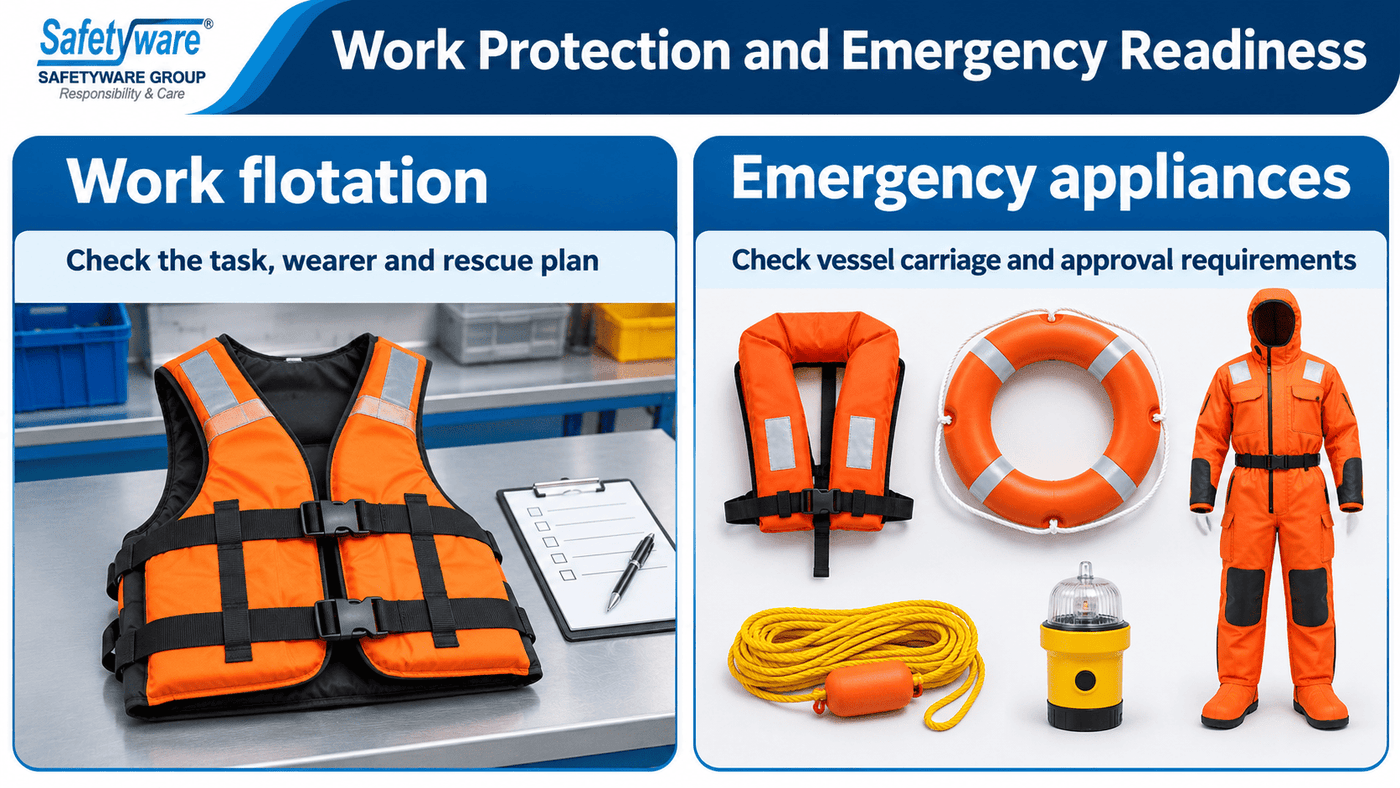
IMO explains that SOLAS Chapter III governs life-saving appliances and arrangements, while the mandatory LSA Code sets technical requirements. Personal life-saving appliances include lifejackets, lifebuoys, immersion suits and other specified equipment. [9]
For purchasing purposes, keep two questions separate:
- Work protection: What flotation device suits this activity, wearer and retrieval plan?
- Emergency carriage: What approved appliance, quantity, stowage and maintenance arrangement does this vessel require?
Do not assume that one device satisfies both questions. Confirm vessel type, voyage, flag-administration acceptance and the documentation for the precise model. A product name containing “marine” or an orange colour is not evidence of statutory approval.
A procurement checklist for marine PPE buyers
Use a model-by-model approval sheet before standardising supply:
- Define the worker, task, workplace and vessel context.
- Record the hazard and controls already in place.
- Identify applicable Philippine, flag-state, port and contractual requirements.
- Specify the exact product standard, edition and required performance where relevant.
- Match declarations, reports and approvals to the actual model and variant.
- Provide sizes that fit the intended workforce.
- Check compatibility between helmets, eyewear, hearing protection and respirators.
- Assess flotation and fall-protection compatibility where both are required.
- Obtain inspection, cleaning, storage and replacement instructions.
- Confirm consumables, spare parts, service support and replenishment lead times.
- Retain issue and maintenance records.
- Confirm separate approval and carriage documentation for statutory marine appliances.
Write a useful supplier enquiry
A clear enquiry describes the task rather than asking for “a complete shipping PPE set”. For example:
“Please propose hand protection for crew handling wet packaged cargo. Include grip suitability, mechanical performance, available sizes, cleaning instructions and model documents. Chemical handling and hot work will be assessed separately.”
For distributors, preserve the manufacturer’s limitations in the quotation. Do not turn a general category description into a claim that every model is certified for a vessel or accepted by a Philippine authority.
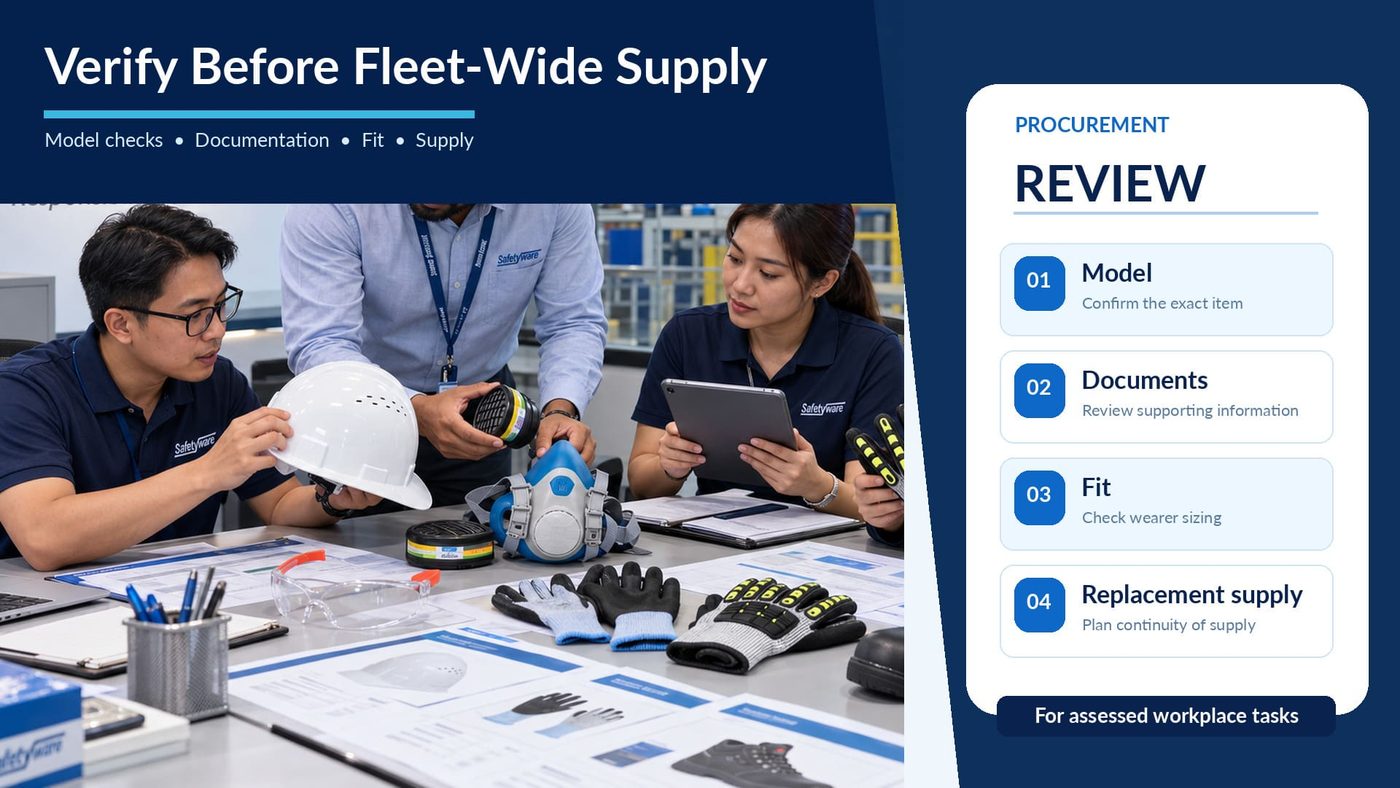
Trial fit before a fleet-wide order
Use a controlled fitting and handling trial with representative users. Check whether workers can operate radios, read instruments and move safely while wearing the proposed combination. Record problems and resolve them before repeating the same specification across several vessels.
Manage PPE throughout its service life
A practical issue register should include the user or location, exact model, issue date, inspection requirements and replacement action. Use manufacturer instructions to define checks and care; avoid inventing one service-life limit for all products.
Keep usable stock separate from damaged or unserviceable equipment. When a worker reports poor fit, fogging, restricted movement or difficulty communicating, review the selection and the working conditions together.
Plan replenishment before a voyage or maintenance period. A correct specification is of little practical value if the appropriate size, filter or replacement component is unavailable when work begins.
SAFETYWARE Products and Solutions
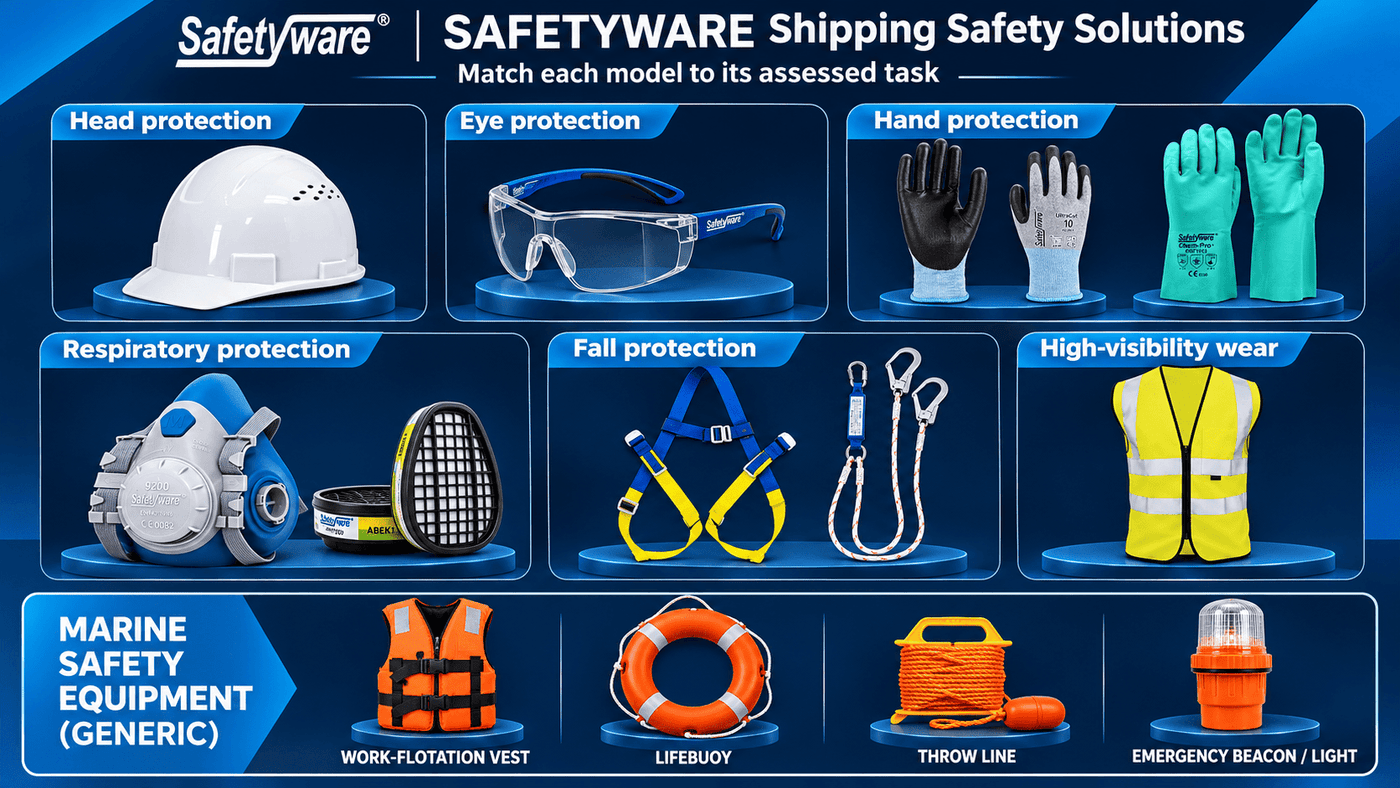
The SAFETYWARE product directory provides a starting point for head-to-toe PPE and supporting safety equipment. Use the task assessment to shortlist products rather than treating the directory as a ready-made vessel compliance list.
Relevant verified official ranges include:
| SAFETYWARE range | How to use it in the selection process |
|---|---|
| Hand and arm protection | Compare handling, chemical and other task-specific glove options against the exposure profile |
| Respiratory protection | Request a complete compatible configuration based on known contaminants and atmospheric conditions |
| Fall protection | Review components as part of a designed system, including anchorage, clearance and rescue needs |
| Marine safety equipment | Request model-specific documentation for flotation and emergency-equipment requirements |
Share the destination, vessel or workplace details, quantities, sizes, required approvals and delivery date with SAFETYWARE. Request current technical sheets and relevant evidence before confirming an order. Listing a range here does not establish approval of any particular model for Philippine vessel carriage.
Conclusion
Effective PPE for the shipping industry in the Philippines starts with a clear understanding of the workplace, vessel and task. Apply the relevant labour and maritime requirements, select equipment using model-specific evidence and keep emergency life-saving appliances under their separate approval and carriage arrangements.
For buyers, the next step is practical: build a task matrix, identify missing documents and sizes, then request a focused supplier shortlist. Combine the chosen PPE with safe procedures, training and reliable replacement supply so that the specification works in daily operations.
Sources and references
Reviewed 2 November 2026. The links support the distinctions above; confirm applicable implementing and vessel-specific requirements before procurement.
- Philippine Supreme Court E-Library — RA 11058, especially Section 8
- DOLE-BWC — Revised OSH rules and effective date of DO 252-25; official issuance page
- Philippine Supreme Court E-Library — DOLE DO 132-13
- Philippine Supreme Court E-Library — RA 12021
- ILO — MLC Standard A4.3; 2022 amendments and PPE sizing
- ILO — Safety and health in ports, revised 2016
- IMO — Resolution MSC.581(110), revised enclosed-space recommendations
- NIOSH — A Guide to Air-Purifying Respirators
- IMO — Life-saving appliances
- SAFETYWARE — Products, with verified category links in the product section above.
📞 Need More Information?
Looking for Marine Safety Shoes?
Explore SAFETYWARE’s safety shoes and workplace PPE range at
👉Safetyware Catalogs
Our safety specialists can help evaluate workplace hazards, recommend suitable safety helmets, and support compliance with Malaysia workplace safety requirements.
If you need a quotation, feel free to contact us at:
📩 Email: [email protected]
📞 Tel: WhatsApp Us