

The COVID-19 pandemic fundamentally changed how Malaysian healthcare institutions think about Personal Protective Equipment (PPE). What was once a procurement afterthought became a matter of national urgency—and when supply chains failed, the consequences were measured in healthcare worker infections. Today, PPE planning has moved to the boardroom at Ministry of Health (MOH) hospitals, private hospital groups, and corporate occupational health departments alike.
Healthcare workers in Malaysia follow PPE guidelines issued by the MOH and aligned with WHO recommendations. The minimum PPE for clinical care includes: medical gloves, a surgical mask or N95 respirator (depending on aerosol risk), eye protection (safety glasses or face shield), and a fluid-resistant gown. For aerosol-generating procedures (AGPs) or patients with airborne-transmissible infections, PPE is escalated to include an N95 or PAPR respirator, full fluid-resistant gown, double gloves, and a face shield.
This guide covers every major PPE category for Malaysian healthcare environments, how to select protection appropriate to the risk level, the standards procurement teams should specify, and how to don and doff PPE safely—the step where most self-contamination occurs.
Malaysian MOH PPE Guidelines for Healthcare Workers
MOH Infection Prevention and Control Framework
The Ministry of Health Malaysia issues Infection Prevention and Control (IPC) guidelines for healthcare facilities, aligned with the WHO Core Components of IPC Programmes. These guidelines form the basis of PPE policy in all MOH-administered hospitals—Government hospitals, district hospitals, health clinics, and dental clinics.
Key principles of the Malaysian MOH IPC framework: * Standard Precautions: Applied to all patients, regardless of known diagnosis, when there is contact with blood, body fluids, secretions, non-intact skin, or mucous membranes. Standard precautions require medical gloves, and add a mask, eye protection, or gown based on the anticipated exposure.
- Transmission-Based Precautions: Added on top of standard precautions when a patient is known or suspected to be infected with a pathogen requiring additional containment. Three categories apply:
- Contact precautions: Gloves and gown for all patient contact.
- Droplet precautions: Surgical mask (within 1 metre of patient).
- Airborne precautions: N95 respirator (or PAPR), ideally in a negative-pressure room.
Private Hospital Obligations: Private healthcare employers in Malaysia are bound by OSHA 1994 in the same way as industrial employers. Healthcare workers are protected under the Occupational Safety and Health (USECHH) Regulations 2000, which covers biological agents as occupational health risks.
The 5 Core PPE Categories for Healthcare Settings
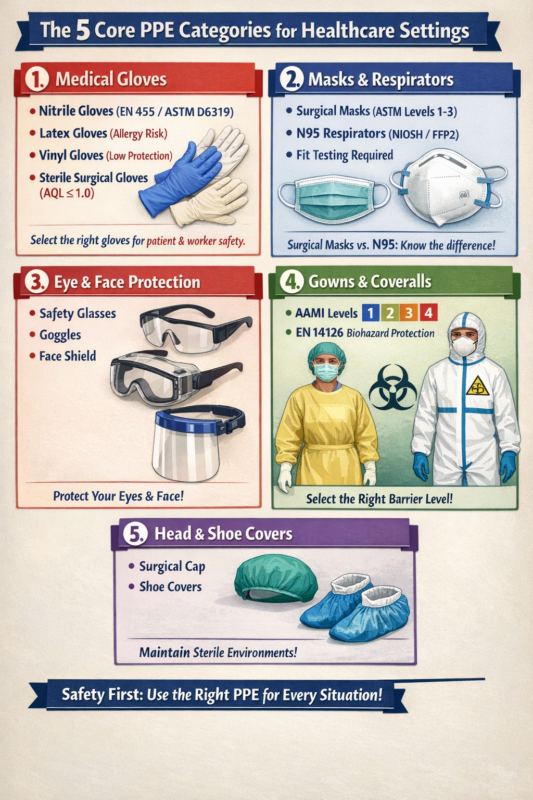
1. Medical Gloves
Selecting the right glove is a patient safety issue (allergy risk) and a worker protection issue.
- Nitrile examination gloves: The current standard in Malaysia, following the recognition of latex allergy risks. Certified to EN 455 or ASTM D6319.
- Latex examination gloves: Increasingly replaced by nitrile due to Type I latex allergy risk.
- Vinyl (PVC) gloves: Lower barrier performance; appropriate only for low-risk, non-invasive tasks.
- Sterile surgical gloves: Required for invasive procedures. Must meet EN 455 Part 2 with an AQL of ≤1.0.
2. Masks and Respirators
The distinction between surgical masks and N95 respirators is critical for safety:
- Surgical Masks: Fluid-resistant barriers (ASTM F2100 Level 1, 2, or 3). They protect against droplets but do not filter small airborne particles.
- N95 Respirators: Tight-fitting filters (NIOSH certified or EN 149 FFP2). Required for Aerosol-Generating Procedures (AGPs) like intubation or nebulisation.
Pro Tip: Fit testing is a NIOSH requirement for all tight-fitting respirators. A poor seal can result in a 40% loss of protection.
3. Eye and Face Protection
The conjunctival mucosa (eyes) is a portal of entry for pathogens.
- Safety Glasses: Frontal protection; must be anti-fog.
- Goggles: Full circumferential protection; required for high splash risks.
- Face Shields: Protects the entire face. Eye & face protection should always be worn with a mask.
4. Protective Gowns and Coveralls
Gowns are classified by the AAMI PB70 standard:
| AAMI Level | Fluid Resistance | Recommended Use |
| Level 1 | Minimal | Basic care, standard isolation |
| Level 2 | Low | Blood draw, ICU general care |
| Level 3 | Moderate | Arterial blood draw, ER trauma |
| Level 4 | Highest | Long, fluid-intensive surgery |
For infectious diseases like Ebola or high-pathogen influenza, gowns must meet EN 14126 standards for biological hazard protection. Explore our range of Disposable Hygiene Apparel for certified options.
5. Head and Shoe Covers
- Surgical Caps: Required to prevent hair/skin cell contamination in sterile zones.
- Shoe Covers: Necessary in OTs and for disposable coveralls used during infectious disease management.
How to Don and Doff PPE Correctly
Most self-contamination occurs during removal. Follow this strict sequence:
Donning Sequence (Putting PPE On)
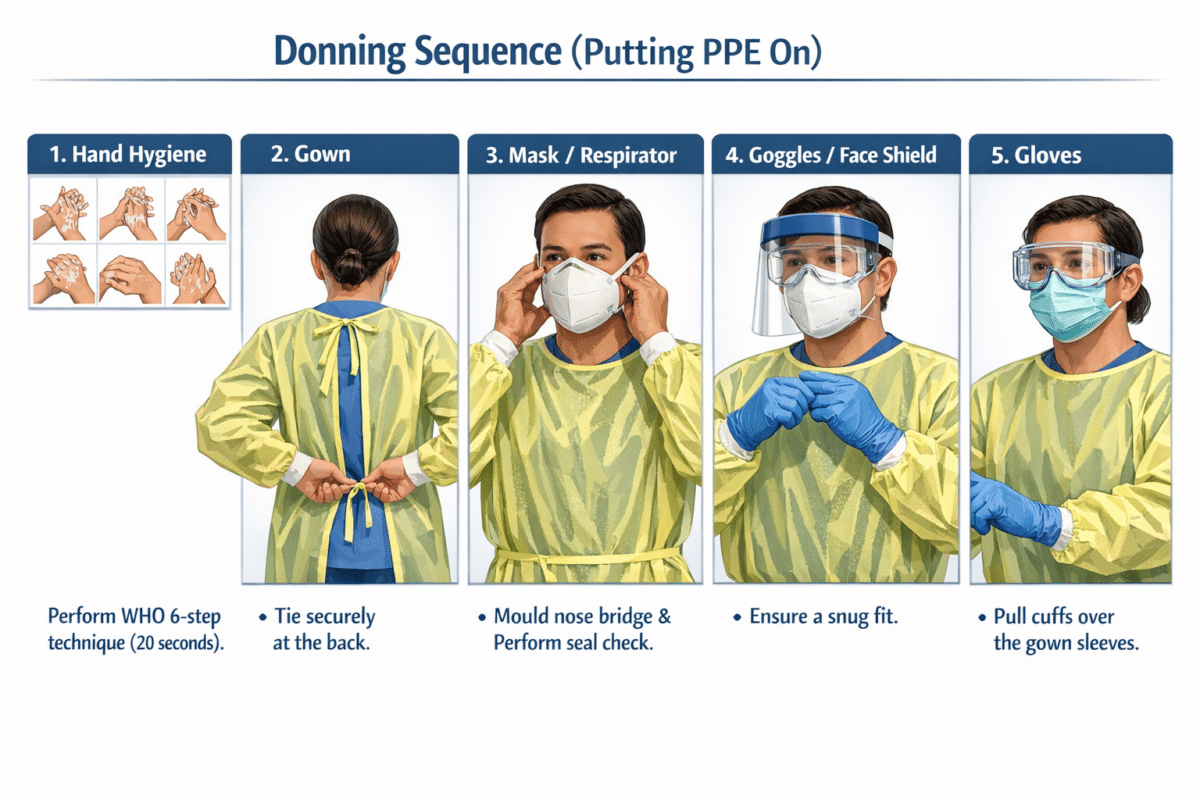
- Hand Hygiene: Perform WHO 6-step technique (20 seconds).
- Gown: Tie securely at the back.
- Mask/Respirator: Mould nose bridge and perform seal check.
- Goggles/Face Shield: Ensure a snug fit.
- Gloves: Pull cuffs over the gown sleeves.
Doffing Sequence (Taking PPE Off — DO THIS SLOWLY)
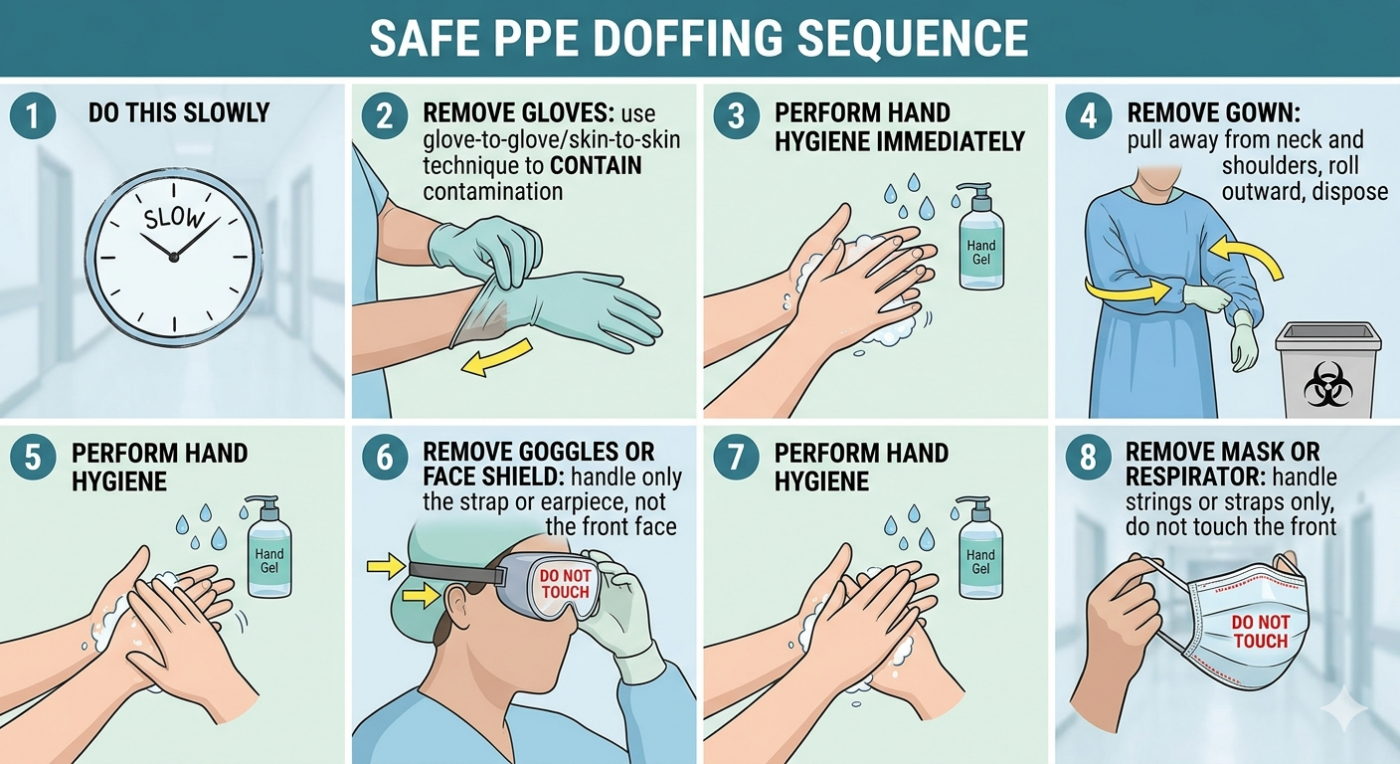
- Remove gloves: use glove-to-glove/skin-to-skin technique to contain contamination
- Perform hand hygiene immediately
- Remove gown: pull away from neck and shoulders, roll outward, dispose
- Perform hand hygiene
- Remove goggles or face shield: handle only the strap or earpiece, not the front face
- Perform hand hygiene
- Remove mask or respirator: handle strings or straps only, do not touch the front
- Perform hand hygiene
PPE by Healthcare Setting and Risk Level
| Setting | Standard Precautions PPE | Droplet Precautions Add-on | Airborne Precautions Add-on |
| General Ward | Gloves; mask/apron where contact with fluids | Surgical mask (Level 2) + eye protection | N95 + face shield + gown |
| ICU / HDU | Gloves + gown for all patient contact | Surgical mask + eye protection | N95 + face shield + full gown |
| Emergency Department | Gloves + eye protection | + surgical mask + gown | N95 or PAPR + face shield + coverall |
| Operating Theatre | Sterile gloves + surgical mask + gown + cap + shoe cover | — | PAPR in designated cases |
| Laboratory (clinical) | Gloves + safety glasses + lab coat | + face shield | Biosafety cabinet + full face respirator |
| Isolation Room (AIR) | Full standard + gown + gloves | + surgical mask | N95 + face shield + gown + gloves |
| Ambulance / Prehospital | Gloves + surgical mask + eye protection | + gown | N95 + face shield + full coverall |
Frequently Asked Questions — Healthcare PPE Malaysia
What is the difference between an N95 and a surgical mask? A surgical mask is a loose-fitting fluid barrier. An N95 is a tight-fitting device that filters 95% of particles ≥0.3 microns. N95s are mandatory for airborne precautions and AGPs.
Is fit testing mandatory in Malaysian hospitals? Yes. MOH IPC guidance and WHO require annual fit testing for all staff using N95 respirators to ensure an effective seal.
Does Safetyware supply PPE to Malaysian Ministry of Health facilities? Yes. Safetyware Group covers medical gloves, masks, N95s, and gowns, all aligned with AAMI, EN 14126, and NIOSH standards. Contact our healthcare supply team for institutional pricing.
Safetyware Group offers comprehensive healthcare PPE from Malaysia’s own certified manufacturing base.
📞 Need More Information?
Your safety matters. If you have questions about what PPE is right for your workplace, we’re here to help!
Visit our website: www.safetyware.com
wear wisely, work Safely – with Safetyware! ✨
If you need a quotation, feel free to contact us at:
📩 Email: [email protected]
📞 Tel: WhatsApp Us