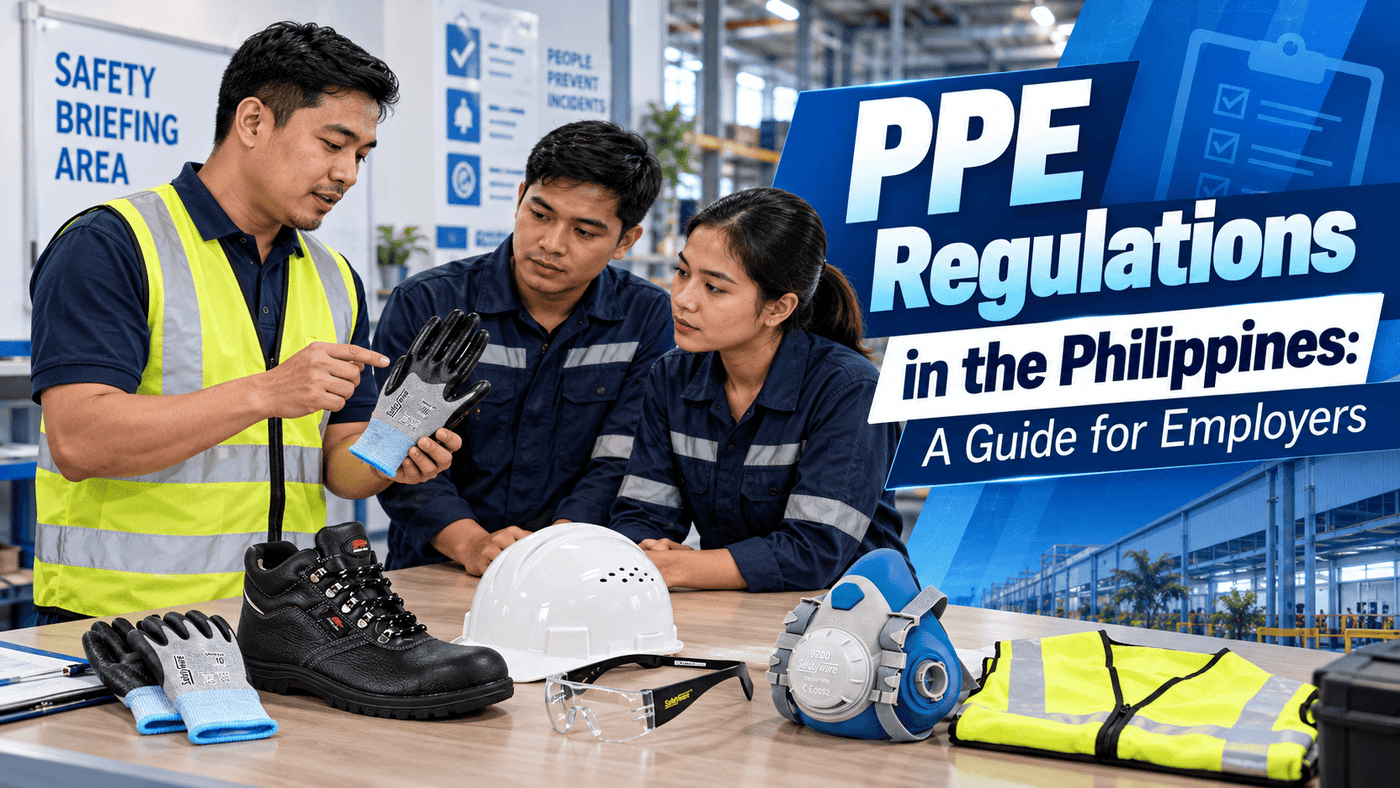
Buying safety equipment is only one part of protecting a workforce. Employers also need to understand which hazards require protection, who pays for it, how workers will use it and what evidence supports the selection.
For employers reviewing PPE regulations in the Philippines, the starting point is Republic Act No. 11058, DOLE’s revised implementing rules and the applicable Occupational Safety and Health Standards. The practical goal is straightforward: make suitable protection available where it is needed and manage its use throughout the working day.
This guide focuses on industrial workplace PPE. It helps employers, safety managers, purchasing teams and distributors turn those responsibilities into a workable procurement and use programme.
Which Philippine rules govern workplace PPE?
Three references are particularly useful when reviewing an employer’s PPE arrangements:
| Reference | Role in a PPE review |
|---|---|
| Republic Act No. 11058 | Establishes employer responsibilities and workers’ rights, including necessary PPE supplied free of charge under Section 8. |
| DOLE Department Order No. 252-25 | Provides the revised implementing rules for RA 11058. Use this revised framework when reviewing current procedures. |
| Occupational Safety and Health Standards, Rule 1080 | Contains provisions for protective equipment, including suitability, maintenance and specific protection categories. Read it together with later applicable issuances. |
RA 11058 covers workplaces including PEZA establishments, while excluding the public sector from the Act’s stated coverage. DO 252-25 provides further scope details, including contractors and subcontractors in private and public sectors and GOCCs without original charters. Government agencies and GOCCs with original charters follow a separate public-sector policy framework. Confirm the framework that applies to the organisation and the work arrangement. [1][2][3]
Legal requirements, technical standards and company rules
These are related, but they serve different purposes:
- Legal requirements establish duties under Philippine legislation and applicable DOLE rules.
- Technical product standards describe performance and test requirements for particular equipment.
- Company or client specifications define the equipment accepted for a particular site or contract.
For example, ISO 20345:2021, with Amendment 1:2024, is a technical safety-footwear reference. It addresses general-purpose footwear requirements; specialist risks may require complementary standards. A reference to ISO 20345 alone does not establish compliance with every Philippine workplace obligation. [4]
When a specification says only “international standard”, ask for the exact standard, edition, protection level and supporting documents for the proposed model. Have the safety officer resolve any mismatch between the product documentation and the site requirement before ordering.
What must employers provide?
Necessary PPE at no cost to workers
Section 8 of RA 11058 requires employers, contractors and subcontractors to supply necessary PPE free of charge where workplace hazards make it necessary. It ties PPE use to the safety officer’s evaluation and recommendation and requires appropriate equipment tested and approved under DOLE’s framework. Section 12 includes PPE provision and use within the workplace OSH programme. [1]
Budget for the equipment needed to do the work safely. A purchasing plan should also anticipate replacement stock, sizes, consumables and compatible spare parts so workers are not left waiting when an item becomes unusable.
DO 252-25, Section 8, also specifies appropriate PPE tested and approved by DOLE or its recognised testing partners, using the applicable standards and/or other verification methods. It recognises the right to refuse unsafe work when appropriate PPE is not supplied for high-risk activities. [2]
Suitable equipment that remains serviceable
Rule 1080 makes employers responsible for PPE adequacy and proper maintenance. It also requires approved design and construction appropriate to the exposure and work. Respiratory protection has additional programme provisions covering selection, instruction, care and workplace conditions. [3]
Treat PPE as a managed system. A signed issue form is useful, but it does not show whether the equipment still fits, remains in good condition or suits a changed task.
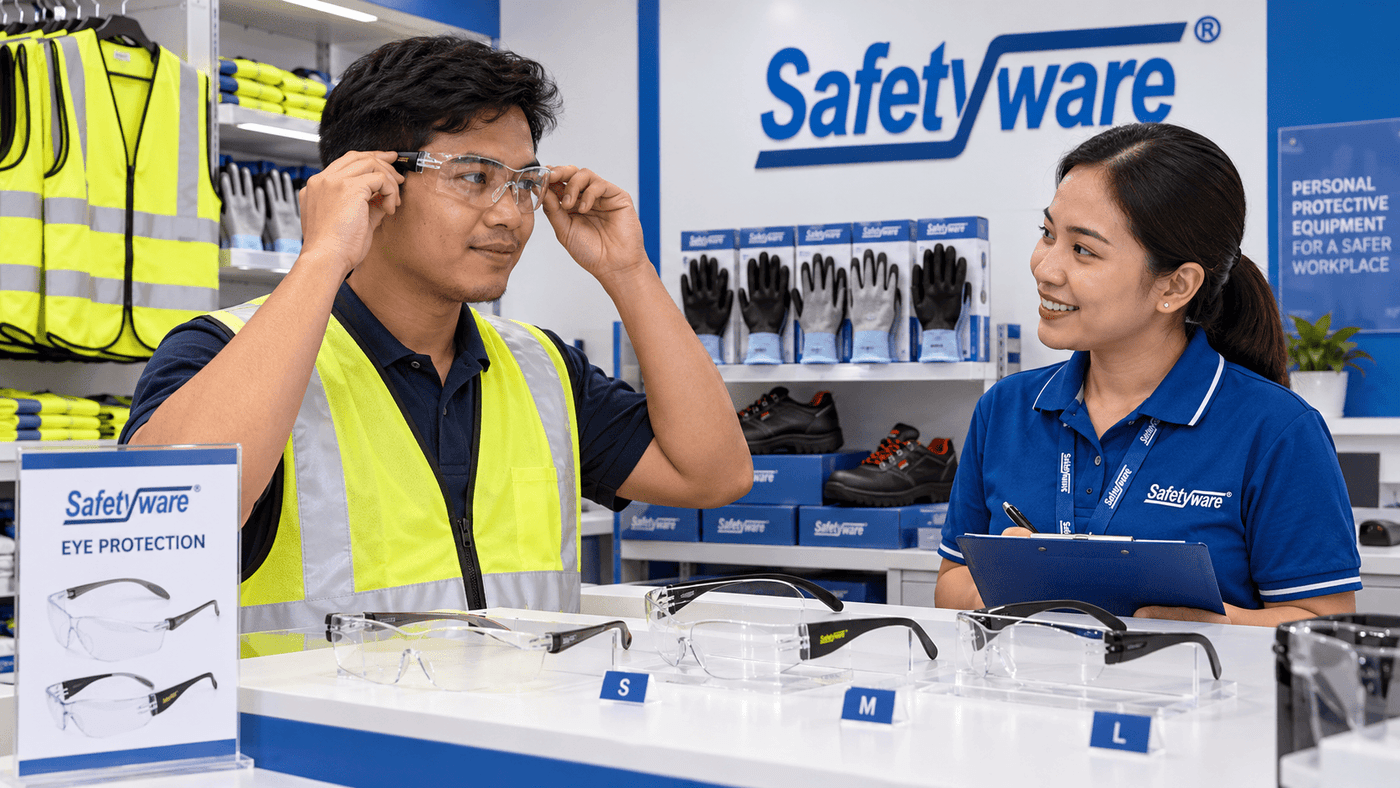
Start with the hazard assessment
A standard PPE pack can simplify purchasing, but it should follow the task assessment. Two employees with the same job title may face different exposures during maintenance, cleaning, loading or production.
Use the hierarchy of controls: consider elimination, substitution and engineering controls before relying on administrative controls and PPE. NIOSH explains this as a general prevention approach; it is not presented here as Philippine legislation. [5]
For the assessment meeting, ask:
- What could injure the worker, and during which task?
- Can the hazard be removed or reduced at source?
- What exposure remains after other controls?
- Which body parts need protection, and for how long?
- What product evidence, fit and compatibility checks are needed?
For example, improving a material-handling method may reduce contact with sharp edges. The remaining handling task can then be assessed for suitable gloves. Buying a glove first and redesigning the task around it reverses the decision process.
A practical PPE selection worksheet
The examples below are purchasing prompts, not a statutory list or final specification for every workplace.
| Task or exposure | PPE category to evaluate | Information to take to the supplier |
|---|---|---|
| Handling sharp-edged components | Hand and arm protection | Edge type, handling method, grip conditions, required dexterity and exposure duration |
| Handling or transferring chemicals | Chemical gloves, eye/face and body protection | Safety data sheet, substance and concentration, temperature, splash/contact conditions |
| Work with airborne contaminants | Respiratory protection | Contaminant identity, measured or assessed concentration, oxygen conditions and work duration |
| Work with head-impact hazards | Head protection | Impact scenarios, surrounding hazards and compatibility with other worn equipment |
| Handling loads or walking through industrial areas | Safety footwear | Impact, puncture, floor contamination, wet conditions and specialist risks |
| Noise-exposed work | Hearing protection | Noise assessment, communication needs and other PPE worn together |
| Work at height | Fall-protection system where the assessment requires it | Work method, access, anchor arrangements, clearance and rescue plan |
Route specialist respiratory, electrical and fall-protection decisions through competent personnel. A general-purpose product category is not enough to approve a system for those tasks.
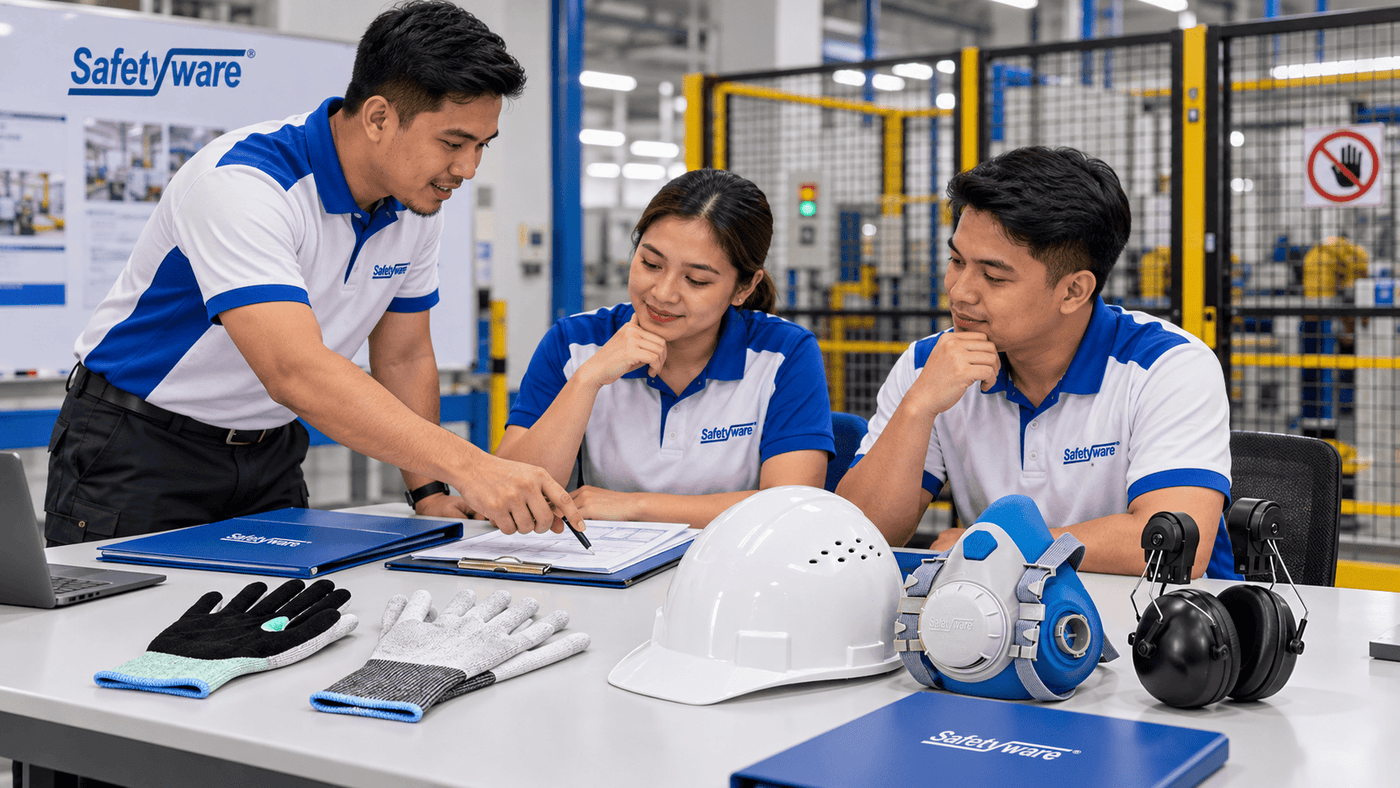
Check the exact product before approving it
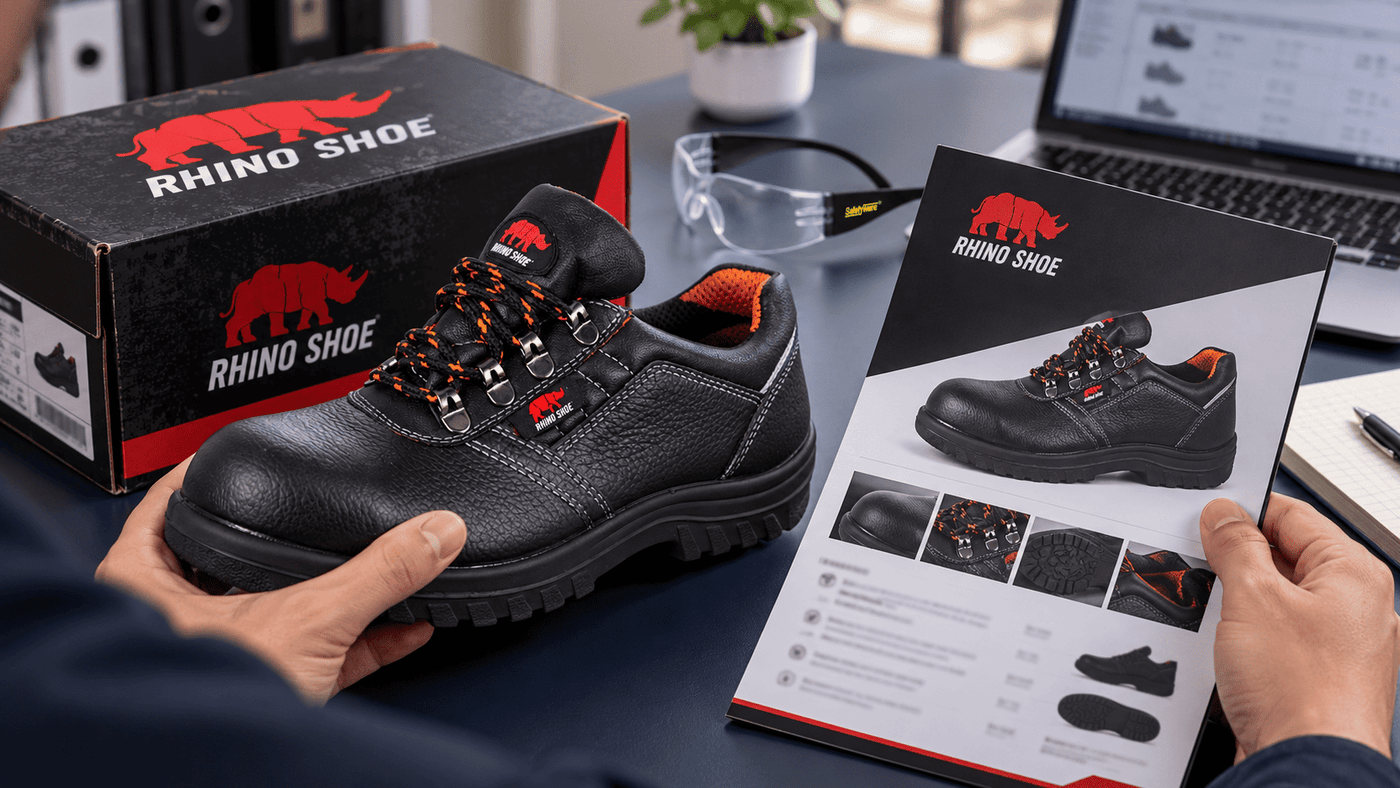
A certificate for a different model, an unclear product description or a supplier’s general brand brochure can make comparisons difficult. Build a product file that links the quoted item to the item received.
Questions for PPE suppliers and distributors
- What is the exact manufacturer, model and variant?
- Which standard and edition appear on the equipment and supporting documents?
- Which protection ratings apply, and what are the limitations?
- What testing or approval evidence supports the model for the intended Philippine application?
- Are instructions, sizing information and maintenance guidance available?
- Which accessories or replacement parts are compatible?
- Can the supplier provide a sample before a bulk order?
- What are the delivery lead time and replacement-stock arrangements?
Ask the safety officer to review the answers. Where the applicable approval route or documentation is unclear, seek clarification from DOLE or OSHC for the category and use concerned. Do not turn a foreign certificate, a familiar logo or a marketing claim into an unsupported statement of Philippine approval.
For distributors, keep the same model description across the quotation, sample, technical documents and delivered packaging. If a substitution becomes necessary, obtain a fresh technical review before supply.
Train workers and make replacement straightforward
This is a legal duty as well as good practice: DO 252-25, Section 8, requires PPE issuance to be accompanied by training on application, use, handling, cleaning and maintenance in accordance with the manufacturer’s recommendations. [2]
Explain the task, the reason for the selected protection and its limitations. Then ask the worker to demonstrate how to put it on, adjust it and check it. Training should be understandable to the workforce and relevant to the equipment actually issued.
As a practical implementation checklist, cover:
- When the equipment is needed and where it must be worn.
- How to achieve the correct fit and use it with other PPE.
- What damage, contamination or malfunction should be reported.
- How to clean and store it according to the manufacturer’s instructions.
- How to obtain a replacement or report a poor fit.
Plan a trial with a representative group of wearers before standardising a model. Ask about fit, visibility, grip, communication and interference between items. Record the feedback and have the safety officer assess any proposed change.
Avoid setting one universal replacement interval for all PPE. Base the programme on the manufacturer’s instructions, exposure, condition and applicable requirements. Quarantine doubtful items for assessment and provide suitable alternatives before the affected task resumes.
Keep records that explain your decisions
The following is a recommended working file for internal control and review. It is not a claim that DOLE prescribes these exact document names or a single retention period for every record.
| Recommended record | What it should make clear |
|---|---|
| Task and hazard assessment | Why protection is needed and which controls are already in place |
| Approved PPE list | The accepted model, use, ratings and limitations |
| Product evidence file | The link between the model, instructions and relevant test/approval documents |
| Issue and sizing record | Who received which item, in what size and on what date |
| Training and demonstration record | What the worker was taught and any follow-up needed |
| Inspection and replacement record | Defects found, action taken and replacement arrangements |
| Contractor coordination record | Who provides, checks and replenishes PPE for each work group |
Use DOLE’s official forms where prescribed. The Bureau of Working Conditions maintains an OSH forms page with programme and reporting resources. Verify the applicable form and submission requirements for the establishment rather than assuming an internal spreadsheet replaces a statutory report. [6]
A quick employer review
- The current legal references and relevant industry rules are identified.
- The safety officer has reviewed PPE needs for the actual tasks.
- Necessary PPE is available free of charge to workers.
- Product documents match the equipment purchased.
- Wearers have suitable sizes and practical instruction.
- Inspection, replacement and storage arrangements work in practice.
- Contractor responsibilities and supply arrangements are clear.
- Changes in tasks, substances or equipment trigger a review.
SAFETYWARE Products and Solutions
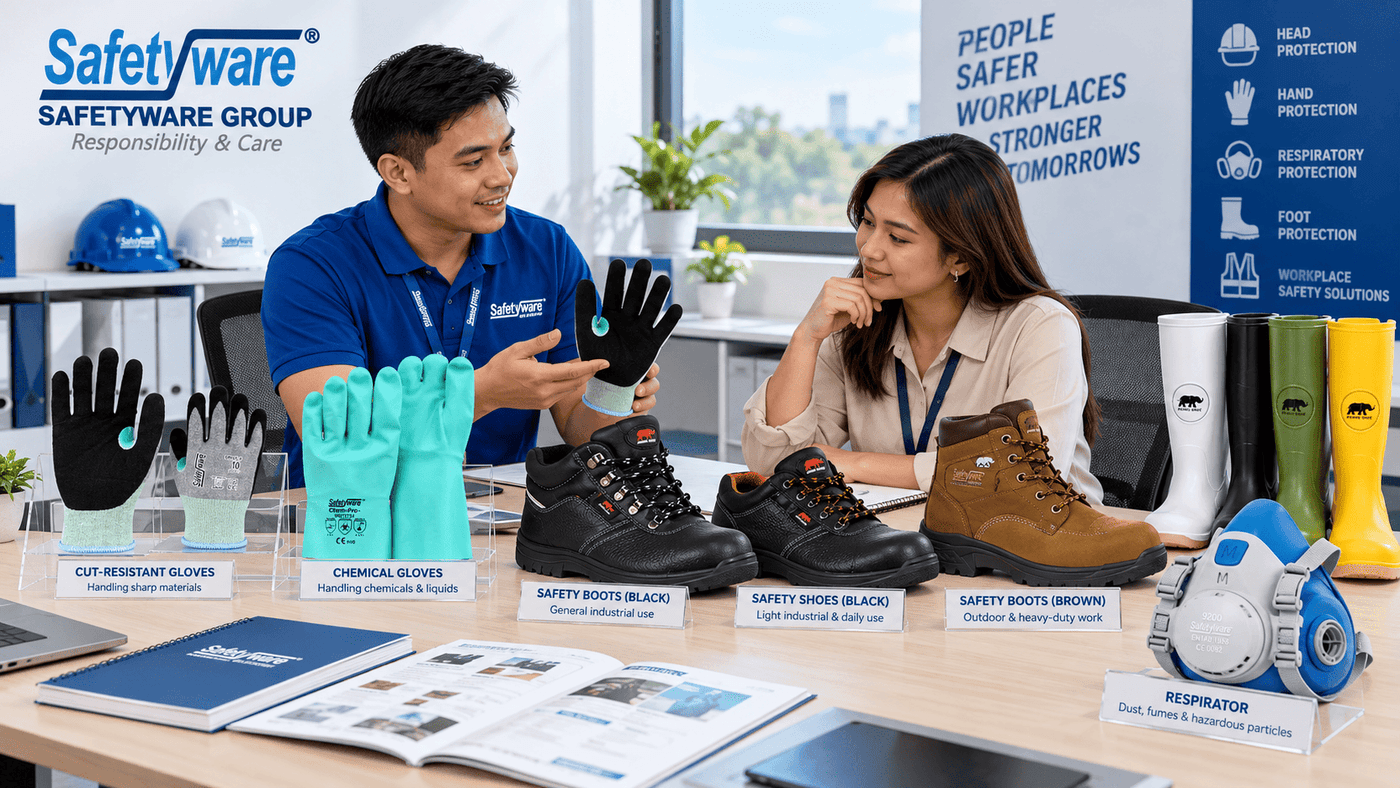
SAFETYWARE’s official product catalogue offers a starting point for comparing workplace protection. Share the hazard assessment and required documentation with the team so the discussion begins with the application.
| Requirement | Relevant official range | Focus of the product discussion |
|---|---|---|
| Industrial footwear | Foot Protection and RHINO SHOE | Model, protection features, sizing and supporting documents |
| Hand and arm protection | Hand & Arm Protection | Task, glove material, performance rating and wearer trial |
| Eye and face protection | Eye & Face Protection | Exposure, coverage, prescription needs and compatibility |
| Industrial head protection | Head Protection | Helmet selection and compatible accessories |
| Respiratory protection | Respiratory Protection | Exposure assessment, equipment type and compatible components |
SAFETYWARE manufactures RHINO SHOE footwear and offers its own PPE brands alongside selected international brands. Certification and suitability remain specific to the item and application; a category listing does not establish approval for every Philippine workplace. [7]
For a useful quotation, provide the delivery location in the Philippines, task description, required standard or approval, sizes, quantities and target date. For chemical-related enquiries, include the safety data sheet. Ask about samples, documentation and replacement availability before committing to a bulk order.
Contact SAFETYWARE to discuss your PPE requirements.
Conclusion
A practical PPE programme connects the workplace assessment to the equipment people receive, understand and use. Start by reviewing one task: confirm its hazards, check the selected model and speak with the people wearing it. Then close gaps in fit, documentation, training or replacement supply.
For the next purchase, give the supplier a clear specification and ask for evidence tied to the exact item. That creates a stronger basis for both worker protection and consistent procurement across your operation.
Sources and references
Checked on 12 October 2026. Legal references should be read with applicable later amendments and industry-specific issuances.
- Republic Act No. 11058 — full legislative text, especially Sections 2, 8 and 12.
- DOLE Department Order No. 252-25 — revised implementing rules, official BWC PDF and DOLE issuance announcement.
- DOLE Occupational Safety and Health Standards — 2019 compilation, Rule 1080, printed pages 34–38. The historical compilation is used for Rule 1080; its older IRR appendix is not the current revised IRR.
- ISO: ISO 20345:2021 and Amendment 1:2024.
- NIOSH — Hierarchy of Controls, general prevention guidance.
- Bureau of Working Conditions — Occupational Safety and Health Forms.
- SAFETYWARE: Products, PPE overview and the official category and enquiry links in the Products and Solutions section.
📞 Need More Information?
Looking for Global Standard PPE?
Explore SAFETYWARE’s safety shoes and workplace PPE range at
👉Safetyware Catalogs
Our safety specialists can help evaluate workplace hazards, recommend suitable safety helmets, and support compliance with Malaysia workplace safety requirements.
If you need a quotation, feel free to contact us at:
📩 Email: [email protected]
📞 Tel: WhatsApp Us