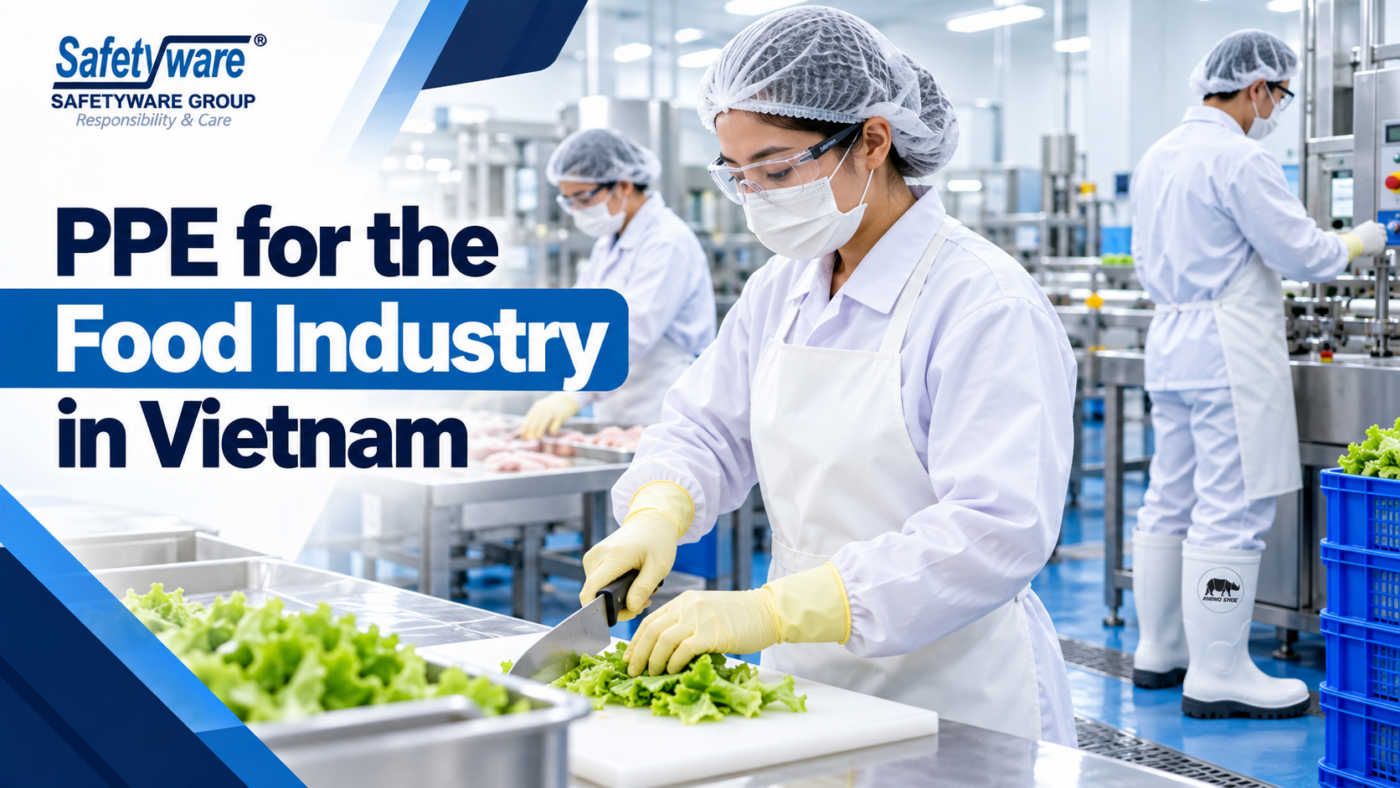
A food factory can look hygienic while leaving its workers inadequately protected. A hair cover helps control contamination, but it does not protect against a falling object. A disposable food-handling glove is not automatically suitable for sanitising chemicals, knives or frozen products.
Choosing PPE for the food industry in Vietnam therefore means answering two questions: what could injure the worker, and what could contaminate the food?
For seafood processors, meat plants, bakeries, beverage producers and ready-meal facilities, the most useful starting point is a task-by-task assessment. Build the PPE specification around the work being performed, then check that the selected equipment is compatible with the facility’s hygiene controls.
Vietnam’s requirements: separate legal duties from guidance
Employer duties for providing and managing PPE
Vietnam’s Circular 25/2022/TT-BLĐTBXH, issued on 30 November 2022 and effective from 1 April 2023, sets out the regime for providing PPE at work. It implements provisions of the Law on Occupational Safety and Health, No. 84/2015/QH13.
Articles 3–7 establish several important principles:
- Employers must assess and control workplace hazards and use technological and technical measures to eliminate or minimise them before relying on PPE.
- PPE must be suitable for the hazards and satisfy applicable technical standards, national technical regulations and other relevant legal requirements.
- Employers must use the occupation/task list in Appendix I, while adding protection where unlisted work or additional hazards require it.
- Workers do not pay for the use of PPE provided under this regime.
- Employers must instruct workers in correct use, check use and replace lost, damaged or expired equipment; storage and care also require attention.
Do not treat a generic food-factory shopping list as a substitute for checking Appendix I against actual jobs. Official circular and signed text. genui{“citation”:{“ref”:”turn17search19″}}
Food hygiene duties are a separate consideration
Vietnam’s Food Safety Law No. 55/2010/QH12, issued on 17 June 2010 and effective from 1 July 2011, addresses food-production conditions. Article 19 includes requirements concerning the health, knowledge and practices of people directly producing or trading food. Article 25 requires preparation and processing arrangements that prevent cross-contamination and exposure to contaminants.
These provisions do not establish one universal PPE outfit for every food worker. Sector-specific rules and the facility’s processes still matter. Official law. genui{“citation”:{“refs”:[“turn18view5″,”turn15search4”]}}
Standards, guidance and site rules play different roles
| Basis for a requirement | How buyers should use it |
|---|---|
| Applicable Vietnamese law and technical regulations | Establish the obligations that apply to the business, job and equipment. |
| Product standards and test reports | Check the exact model’s tested performance, limitations and stated edition. A logo alone is insufficient evidence. |
| FAO/Codex hygiene guidance | Inform contamination-control procedures; do not label international guidance as Vietnamese legislation. |
| Customer specifications and site procedures | Translate the assessed risks into practical rules, such as changing areas or zone-specific apparel. Distinguish these from national legal mandates. |
FAO’s personal-hygiene guidance, published on 14 April 2023, emphasises policies, training and practices that prevent food handlers from contaminating food. PPE procurement should support those procedures rather than operate separately from them. FAO personal hygiene guidance.
Build the PPE list around the task
The following is an illustrative selection matrix, not a legal minimum or a complete risk assessment. Confirm the necessary protection, materials and performance for each job.
| Work area or task | Hazards or hygiene concerns to assess | Equipment to consider after other controls |
|---|---|---|
| Open-food handling and packing | Hair, clothing and hand contamination | Clean workwear, suitable hair/beard covers and task-appropriate food-contact gloves where the hygiene procedure calls for them |
| Manual trimming, deboning or knife work | Cuts to hands, forearms or body | Knife-task-specific gloves, sleeves or protective apron, with hygienic cleaning arrangements |
| Wet processing and washdown | Wet floors, splashes and possible dropped loads | Suitable slip-resistant waterproof footwear; add toe protection where impact/compression risks exist |
| Chemical preparation and sanitation | Skin/eye contact and possible inhalation exposure | Chemical-compatible gloves and clothing, suitable eye/face protection, footwear and assessed respiratory protection where necessary |
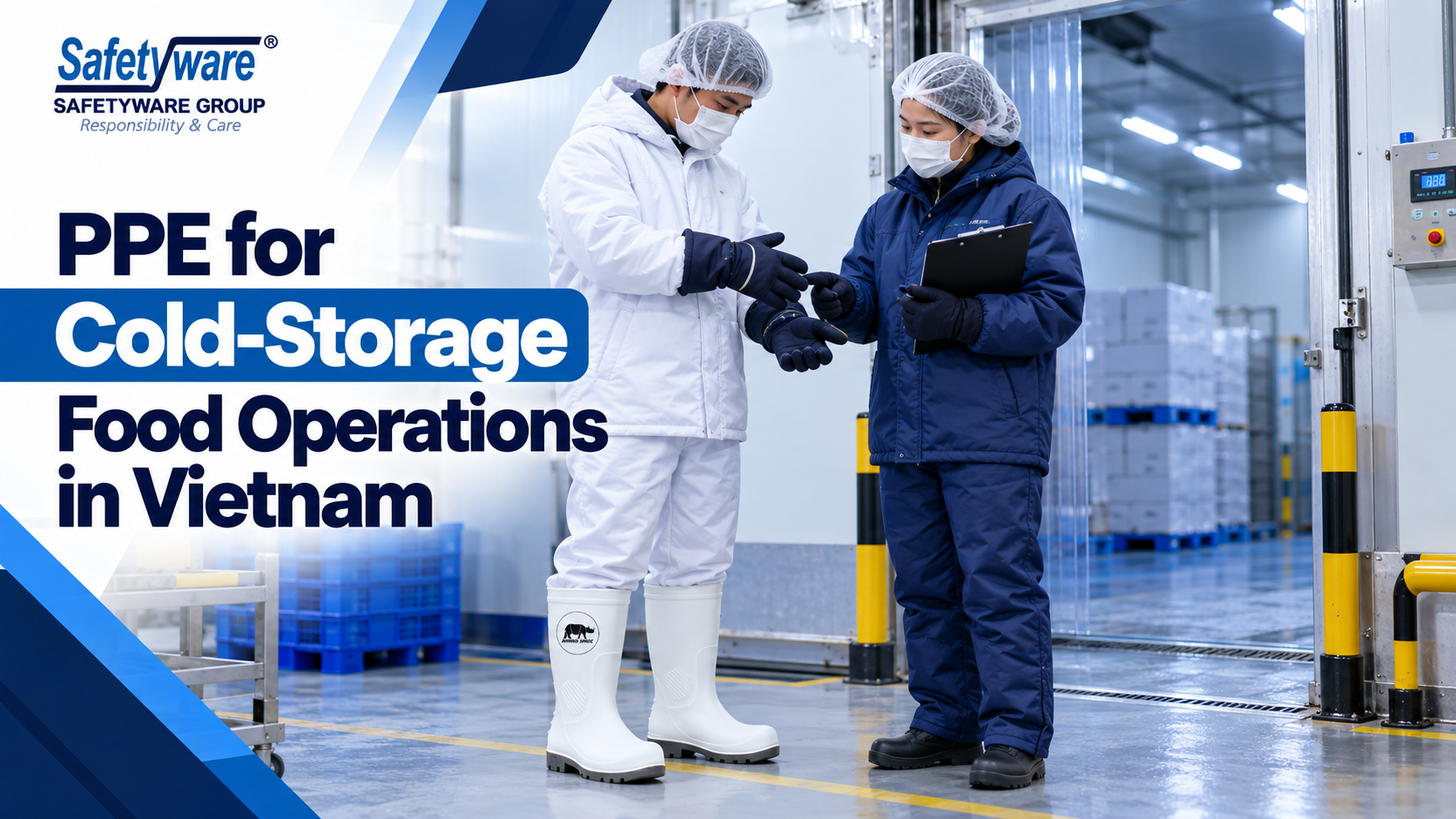
| Chilled and frozen storage | Cold exposure, wetness and reduced dexterity | Insulating clothing, gloves and footwear matched to temperature, exposure time and moisture |
| Hot trays, ovens and hot equipment | Contact heat or other thermal exposure | Heat-protective gloves and clothing selected for the specific heat source and task |
| Noisy processing and dry ingredient handling | Noise or airborne contaminants | Hearing or respiratory protection selected from exposure assessment, alongside engineering controls |
Before approving this matrix, involve both the occupational-safety team and the food-safety team. For example, a protective glove may address a worker hazard but need a different cleaning method or an approved outer layer before it is acceptable near exposed food.
Choose gloves for the exposure, not the colour
Food-contact suitability and protection are different checks
Ask suppliers for evidence covering the intended food contact, including relevant food types, temperature and duration. A generic “food grade” description does not answer every application question.
Separately, identify the worker-protection requirement. A glove intended for brief food handling should not be assumed to resist cleaning chemicals or knife contact. If multiple gloves will be worn together, assess fit, dexterity, grip and the complete cleaning or replacement procedure.
Colour can support a site’s visual controls, but it does not establish protection. Document your own colour system and train workers rather than assuming that every factory uses the same meaning.
Knife work needs a task-specific specification
For frequent hand-knife work, assess the hand holding the product, exposed forearms and the body. HSE’s food-industry guidance identifies knife-resistant protection according to the task assessment, alongside safe knife storage and maintenance. This is useful technical guidance, not Vietnamese law. HSE food-industry safety guidance. genui{“citation”:{“ref”:”turn20view2″}}
Do not interpret “cut-resistant” as “cut-proof” or assume that a cut rating demonstrates protection against stabbing or powered blades. Specify the actual hazard and ask the manufacturer to confirm the intended application.
Hygiene gloves do not remove the need for clean hands
Build glove changes into the hygiene procedure: changing tasks, contamination, damage and movement between incompatible areas should trigger the relevant action. Provide convenient replacement supplies and waste disposal so the procedure is practical throughout the shift.
Select footwear for the floor and the job
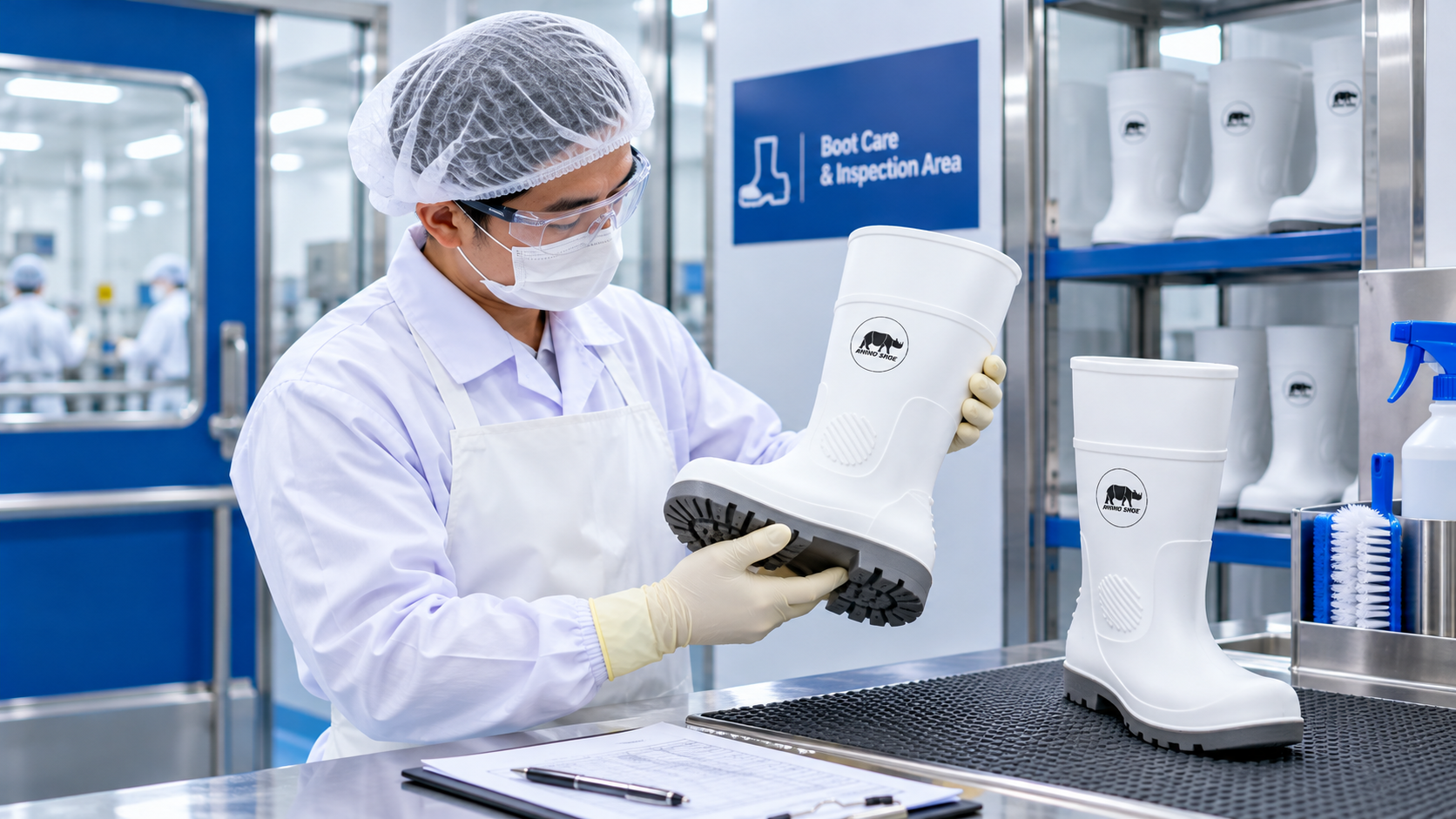
Water, food residues and cleaning processes can create different underfoot conditions. HSE recommends controlling floor contamination and selecting suitable footwear, noting that outsole effectiveness varies. Footwear is one part of slip prevention, alongside drainage, housekeeping and floor maintenance. genui{“citation”:{“ref”:”turn20view2″}}
For purchasing, record the conditions that the footwear must handle:
- Wet or dry work, floor surface and typical contaminants.
- Need for toe protection, waterproof construction or thermal insulation.
- Cleaning products and the manufacturer’s care instructions.
- Fit, comfort and compatibility with trousers or other protective clothing.
- Replacement triggers, including damaged uppers or worn tread.
An oil-resistant material claim does not, by itself, demonstrate slip resistance on an oily floor. Likewise, a disposable shoe cover is not a substitute for protective footwear. Check the intended combination before introducing covers over work shoes.
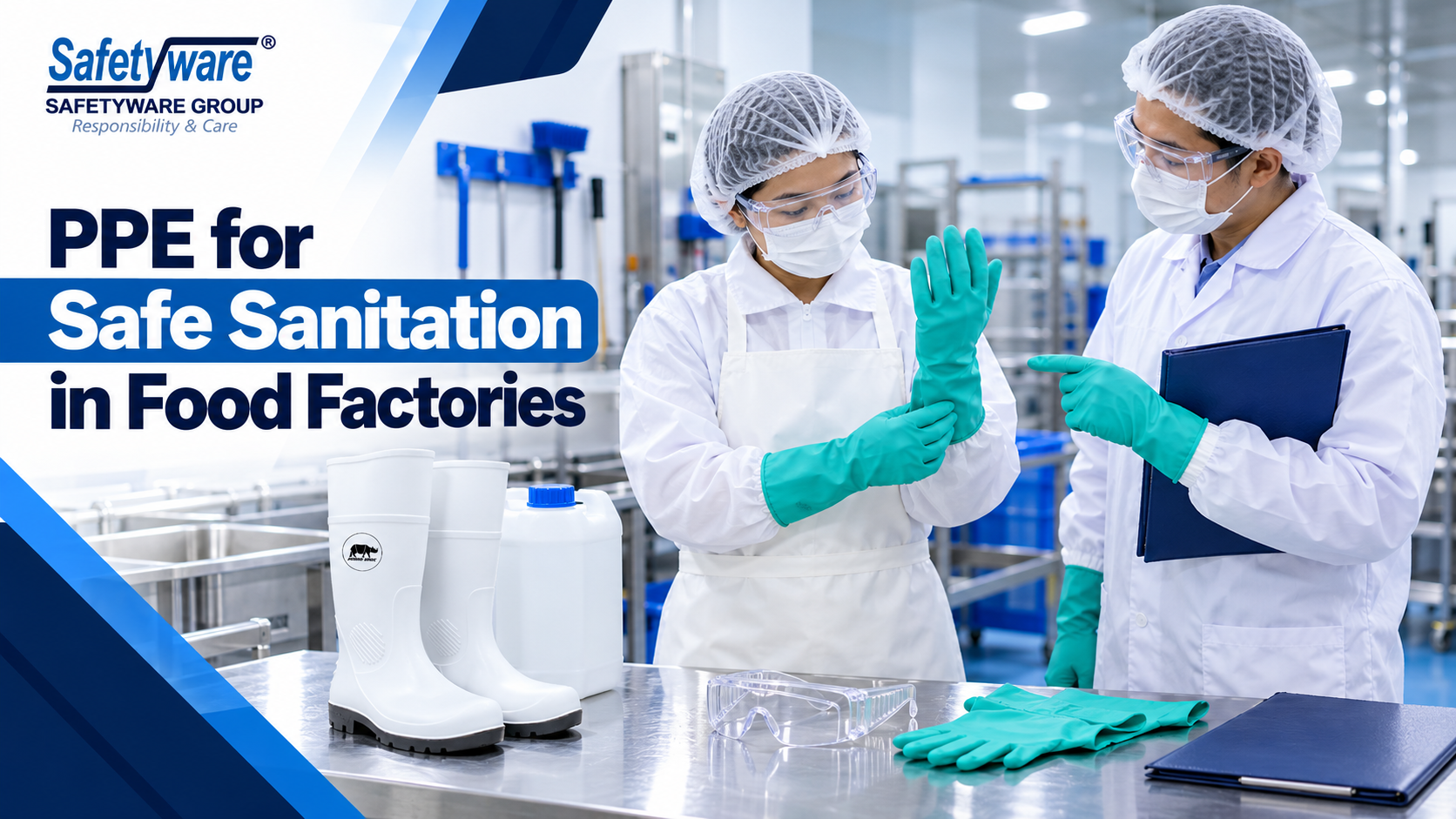
Treat cleaning and sanitising as a separate PPE task
The PPE worn during production may be unsuitable for sanitation. Review the chemical’s safety data sheet and the PPE manufacturer’s compatibility information for the actual concentration, temperature, application method and contact duration.
Choose gloves, garments and boots as a compatible protective system. Select eye and face protection for the splash hazard; where a face shield is needed, determine the appropriate primary eye protection beneath it. Do not assume that a disposable hygiene apron provides chemical protection.
HSE’s disinfectant guidance, updated 3 August 2026, highlights exposure during application, the importance of material resistance, inspection and safe removal of contaminated equipment. Its UK legal references do not apply automatically in Vietnam. HSE disinfectant guidance. genui{“citation”:{“ref”:”turn19view2″}}
Provide a clearly defined changeover between sanitation and food-handling work. The equipment, cleaning arrangements and storage locations should make it difficult to carry contamination back into a production area.
Make the PPE programme workable on every shift
A purchasing specification should describe more than a model and quantity. Record who uses the equipment, for which task, in which zone and under what replacement conditions.
For cold rooms, document temperature, time spent inside, moisture and the need for precise hand movements. For hot work, distinguish contact with a hot tray from exposure to steam or hot liquids; one thermal claim should not be stretched to cover all three.
Trial proposed equipment with representative workers. Check whether gloves prevent a secure grip, goggles fog, clothing restricts movement or footwear becomes uncomfortable during a normal shift. Treat worker feedback as evidence to refine the specification, not a reason to remove necessary protection.
[Image placement 5 — Before the checklist: a supervisor and worker reviewing PPE at a cold-room entrance. Full brief below.]
Food-industry PPE buyer checklist
- Map production, cleaning, cold-storage and maintenance tasks separately.
- Check the applicable Vietnamese requirements and the circular’s occupation/task list.
- Specify the hazard, exposure conditions and required performance for each item.
- Obtain exact-model technical information and supporting test or conformity documents.
- Confirm food-contact suitability where relevant; do not infer it from a protection rating.
- Check fit and compatibility when several items are worn together.
- Define issue, cleaning, storage and replacement arrangements.
- Include contractors and visitors in the relevant site procedures.
- Train workers using instructions they understand and observe practical use.
- Review the selection when chemicals, processes, equipment or tasks change.
SAFETYWARE Products and Solutions
The SAFETYWARE product catalogue provides starting points for both hygiene supplies and hazard-specific protection. The following verified official listings are options to assess, not a pre-approved PPE package for every Vietnamese food facility.
| Product or range | Where it can support selection | What to confirm before ordering |
|---|---|---|
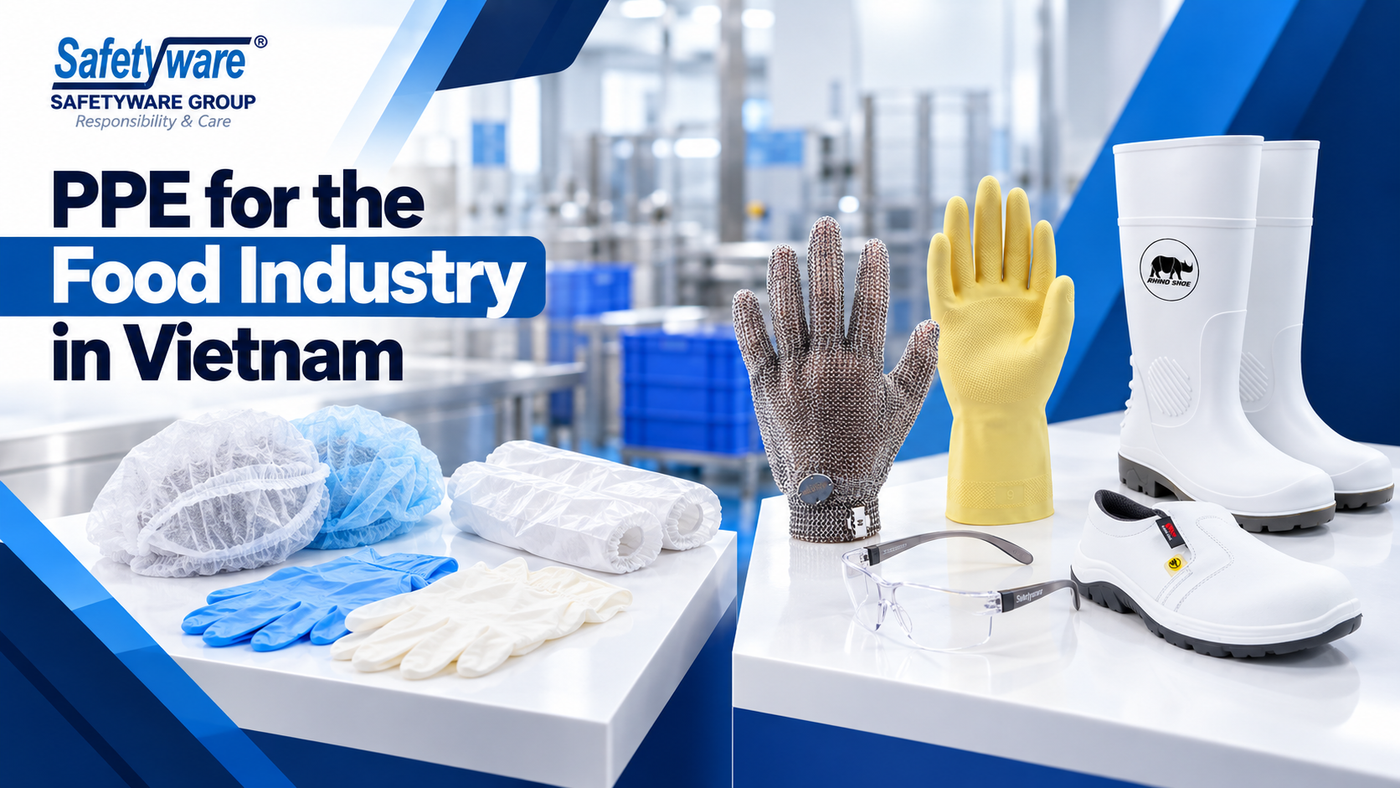
| SAFETYWARE Non-Woven PP Mob Cap | Disposable hair covering for hygiene-sensitive operations | Coverage, fit and the site’s change/disposal procedure; it is not impact head protection |
| SAFETYWARE HDPE Glove | A disposable-glove option listed for food-handling and hygiene applications | Intended food-contact conditions and task suitability; do not assume chemical or cut protection |
| Disposable Hygiene Apparel | Hair/beard covers, sleeve covers, aprons and other hygiene items | Material, coverage and hygiene-zone compatibility; verify any additional protection claim separately |
| RHINO SHOE PVC Wellington Boots | A footwear range to review for wet-processing and washdown tasks | Exact-model slip performance, toe protection where required, cleaning compatibility and fit |
| Hand & Arm Protection | Categories covering cut, chemical, cold and heat protection | Model-specific evidence for the exposure; food-contact suitability where applicable |
The official pages confirm these products and categories, but category membership does not establish that every listed model meets a particular facility’s specification. genui{“citation”:{“refs”:[“turn15view1″,”turn13view5″,”turn13view4″,”turn18view2″,”turn23view1”]}}
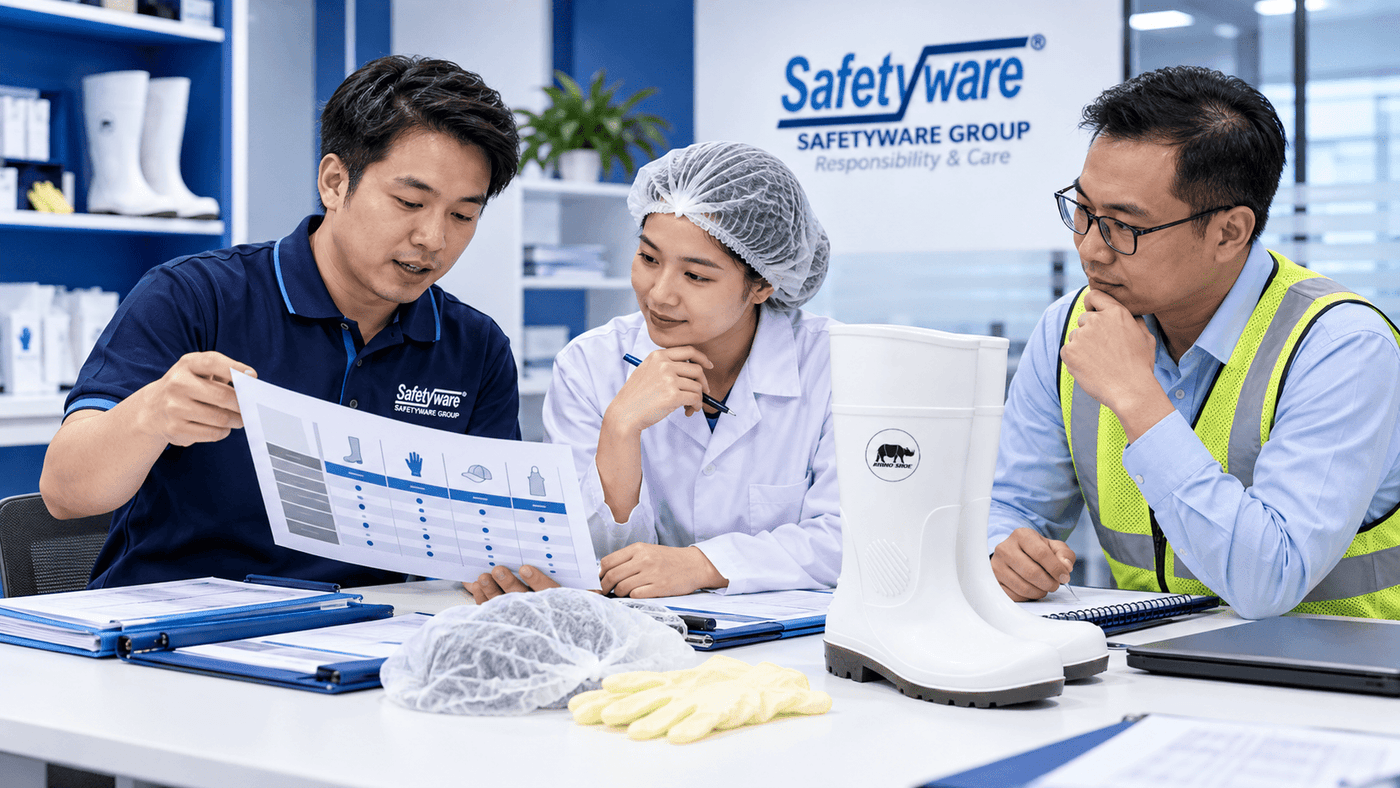
When discussing a shortlist with SAFETYWARE, share your task matrix, chemical information, hygiene-zone rules, sizes and expected use conditions. Request the current technical documents and confirm supply arrangements for Vietnam before committing to a model. This makes the conversation about suitability, not simply unit price.
Conclusion
Effective PPE for the food industry in Vietnam protects people without undermining food hygiene. Start with the applicable legal duties and a task-level assessment, then select equipment for the actual exposure and operating conditions.
Keep three decisions separate: protection for the worker, suitability around food, and compatibility with the site’s procedures. Verify each one, trial the equipment and make correct use practical on every shift. The result is a more defensible purchasing decision and a PPE programme that workers can follow consistently.
Sources and references
Primary legal and technical sources reviewed on 14 October 2026:
- Vietnam Government: Circular 25/2022/TT-BLĐTBXH — official record, signed circular, Articles 3–7, and Official Gazette dates.
- Vietnam Government: Food Safety Law 55/2010/QH12, Articles 19 and 25, with Official Gazette dates.
- FAO: GHP and HACCP Toolbox — Personal hygiene, 14 April 2023.
- UK HSE: Safety hazards in food and drink manufacturing and Disinfectants in the food and drink industry. Technical guidance, not Vietnamese legislation.
- SAFETYWARE official catalogue: Products, Non-Woven PP Mob Cap, HDPE Glove, Disposable Hygiene Apparel, PVC Wellington Boots, and Hand & Arm Protection.
📞 Need More Information?
Looking for Food Grade PPE?
Explore SAFETYWARE’s safety shoes and workplace PPE range at
👉Safetyware Catalogs
Our safety specialists can help evaluate workplace hazards, recommend suitable safety helmets, and support compliance with Malaysia workplace safety requirements.
If you need a quotation, feel free to contact us at:
📩 Email: [email protected]
📞 Tel: WhatsApp Us