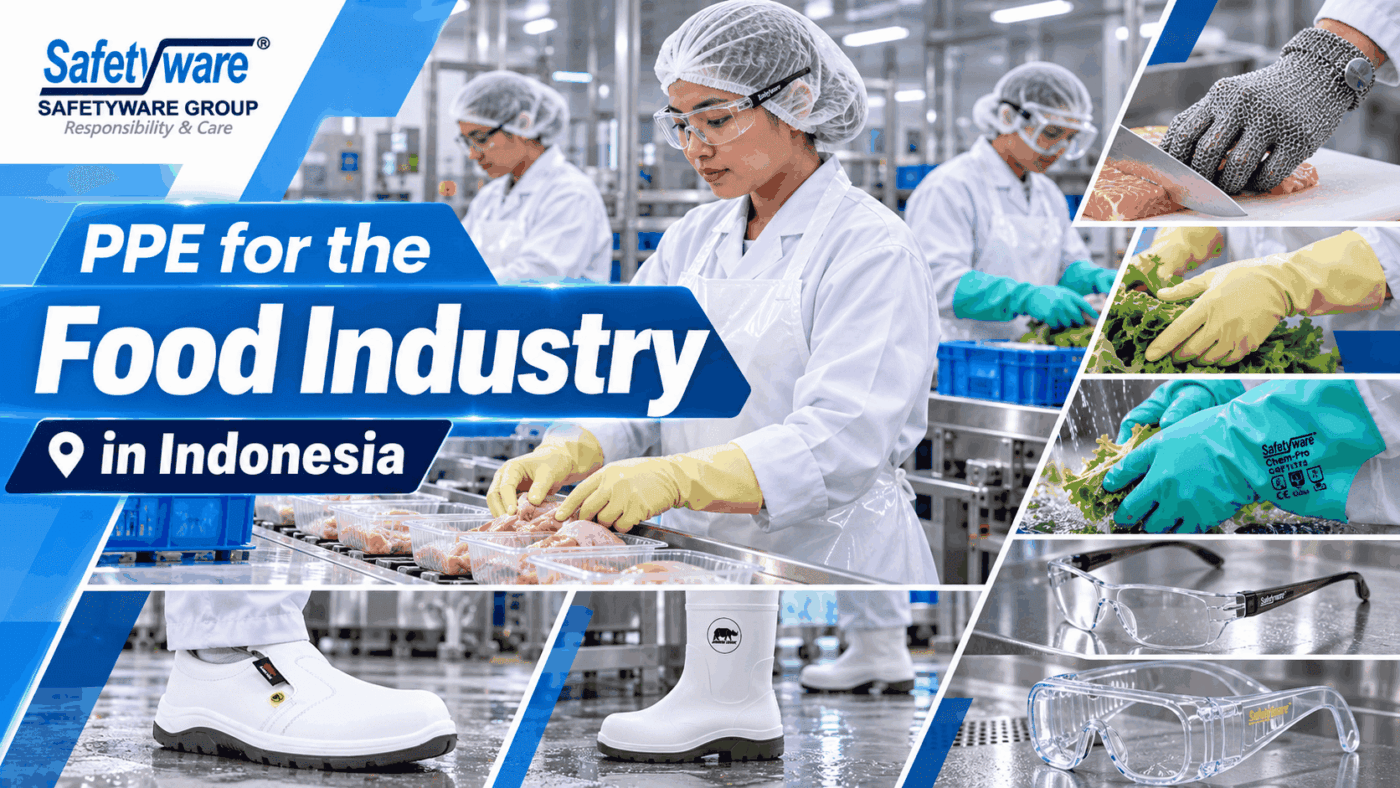
A clean production line can still expose workers to sharp tools, wet floors, cleaning chemicals and heat. Meanwhile, the equipment workers wear can carry contamination between production zones. Choosing PPE for the food industry in Indonesia therefore means protecting both people and the food they handle.
The right starting point is the task. A worker packing finished snacks needs a different combination from someone cleaning a mixing vessel or moving frozen cartons. This guide helps buyers, safety managers and distributors build a practical selection plan for food processing and related storage operations.
Understand Indonesia’s PPE and food hygiene requirements
Legal duties for workplace PPE
Indonesia’s Ministry of Manpower lists PER.08/MEN/VII/2010 on Alat Pelindung Diri (APD) as in force. Article 2 requires employers to provide PPE free of charge and requires conformity with SNI or applicable standards. Articles 5–7 address written PPE requirements and signage, use according to hazards, and PPE management, including selection, training, care, storage and inspection. [1]
This does not establish one identical outfit for every food worker. Determine the hazards of each job, then specify suitable protection. For imported PPE, check the applicable Indonesian product requirements and supporting documents for the exact item; a foreign standard reference alone does not settle every local compliance question.
Food hygiene and contamination control
Indonesia’s 75/M-IND/PER/7/2010 sets out the CPPOB guidelines for good processed-food manufacturing practice; the national regulatory database lists it as in force. BPOM’s official CPPOB teaching material places personnel hygiene, sanitation and contamination control within the wider production system. [2]
Consequently, hygiene clothing belongs within the factory’s food safety procedures. A hair covering helps control contamination, while a chemical glove protects against a different hazard. Neither replaces the other.
Standards and site practices
| Basis | What it means for purchasing |
|---|---|
| Indonesian legal requirements | Establish employer duties and applicable local obligations. |
| Product standards | Describe test methods and performance requirements. Check the edition, model and actual test results. |
| Site and customer specifications | Define local arrangements such as clothing colours, zone changes and visitor procedures. Record these clearly. |
For example, ISO lists ISO 20345:2021, with Amendment 1:2024, for safety footwear. This technical reference does not mean every waterproof boot meets that standard or that every Indonesian food job requires the same footwear class. [3]
Match PPE to each food processing task
Start with safer equipment and working methods. Control leaks, separate people from vehicles, guard machinery and reduce exposure at source. Then select PPE for the remaining risk.
The following matrix is a purchasing starting point, not a universal legal checklist. HSE’s food-manufacturing guidance identifies wet floors, machinery, transport, dust, skin exposure and noise as relevant hazards; its UK guidance supplies practical examples here, not Indonesian law. [4, 5]
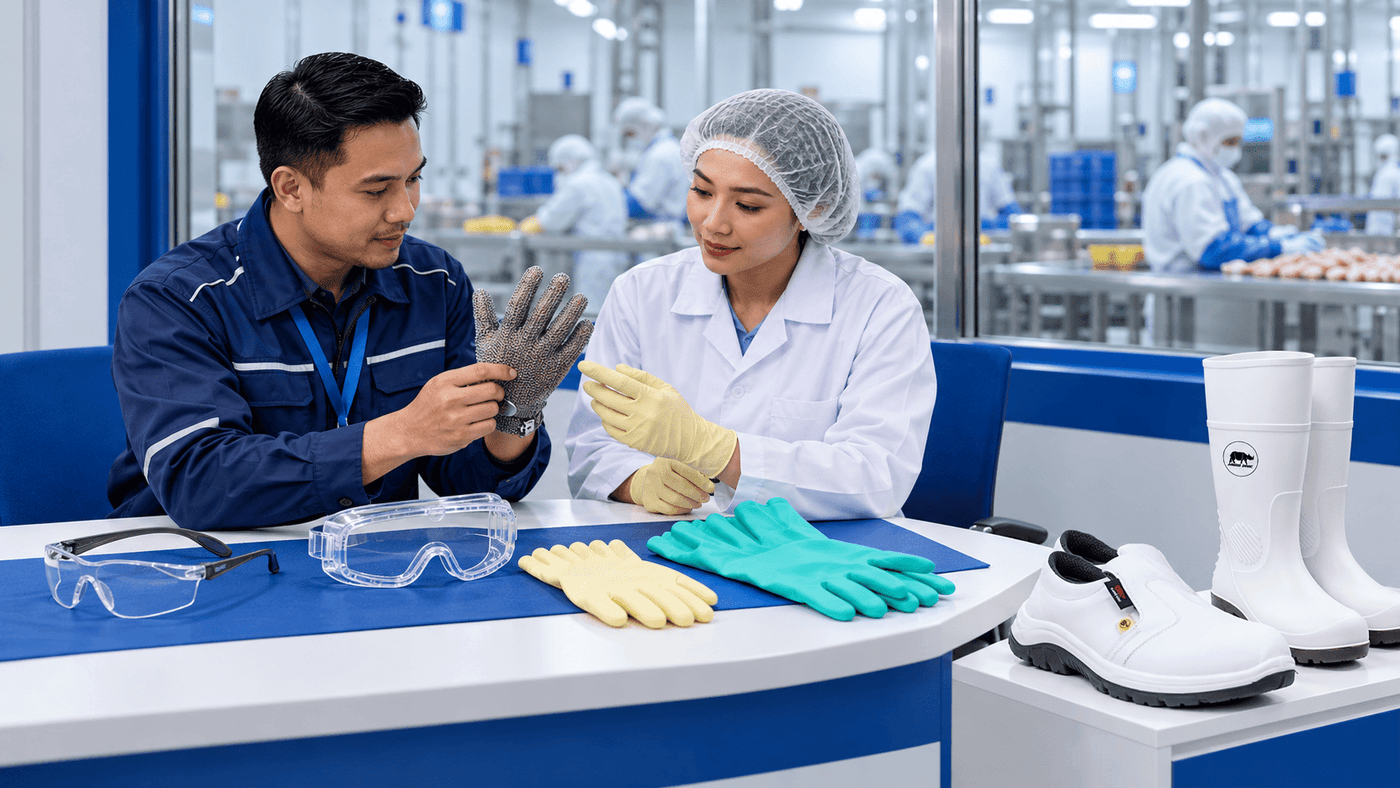
Work area or task Main selection concern PPE to assess Food preparation and packing Product contamination and incidental contact Hygiene clothing, hair or beard coverage and suitable food-contact gloves where the procedure requires them Manual cutting and trimming Cuts and possible punctures Hand and arm protection matched to the tool, technique and food-contact conditions Wet processing and washdown Wet floors, splashes and sustained moisture Waterproof footwear with suitable grip, protective apron and task-specific gloves Chemical dilution and cleaning Skin, eye and face exposure Chemically compatible gloves and clothing, splash goggles and additional face protection where needed Hot trays and cooking equipment Hot surfaces, liquids or steam Thermal protection selected for the actual exposure and handling time Chilled rooms and frozen storage Cold, moisture and reduced dexterity Insulated clothing, gloves and footwear appropriate to the work conditions Flour or ingredient handling Airborne dust Exposure controls first; assessed respiratory protection where necessary Bottling and noisy equipment Noise exposure Hearing protection selected from an exposure assessment Loading and pallet movement Vehicle movement and falling goods Suitable safety footwear and visibility clothing; head protection where the assessment requires it
For each row, add the model, size range, cleaning method, replacement trigger and person responsible for approval. This turns a general list into a usable purchasing specification.
Choose gloves for the job and the food contact
Separate food handling from chemical cleaning
Ask whether the glove will touch food, protect against a workplace hazard, or do both. Then request documentation that addresses each use.
For food contact, specify the food type, contact temperature and duration. For cleaning, provide the chemical’s safety data sheet, concentration, temperature and expected contact time. Nitrile describes a material; it does not prove that every nitrile glove suits every disinfectant.
HSE’s disinfectant guidance stresses that gloves, garments and boots need resistance to the chemical involved. It also highlights exposure during removal of contaminated PPE. Therefore, include safe removal and replacement in the cleaning procedure. [6]
Keep hand hygiene in the routine
Wash and dry hands as instructed before putting gloves on. Change gloves when damaged, contaminated or when moving between incompatible tasks. Do not carry cleaning gloves into food handling.
Also encourage workers to report itching, redness or cracked skin early. Frequent wet work and unsuitable glove use can contribute to skin problems. HSE’s skin guidance supports suitable gloves, careful hand hygiene and early reporting. [7]
For cutting tasks, assess cut and puncture risks separately. Do not assume a disposable food glove offers knife protection. Likewise, follow the machine-specific assessment where gloves could become caught in moving parts.
Select footwear for wet floors and handling risks
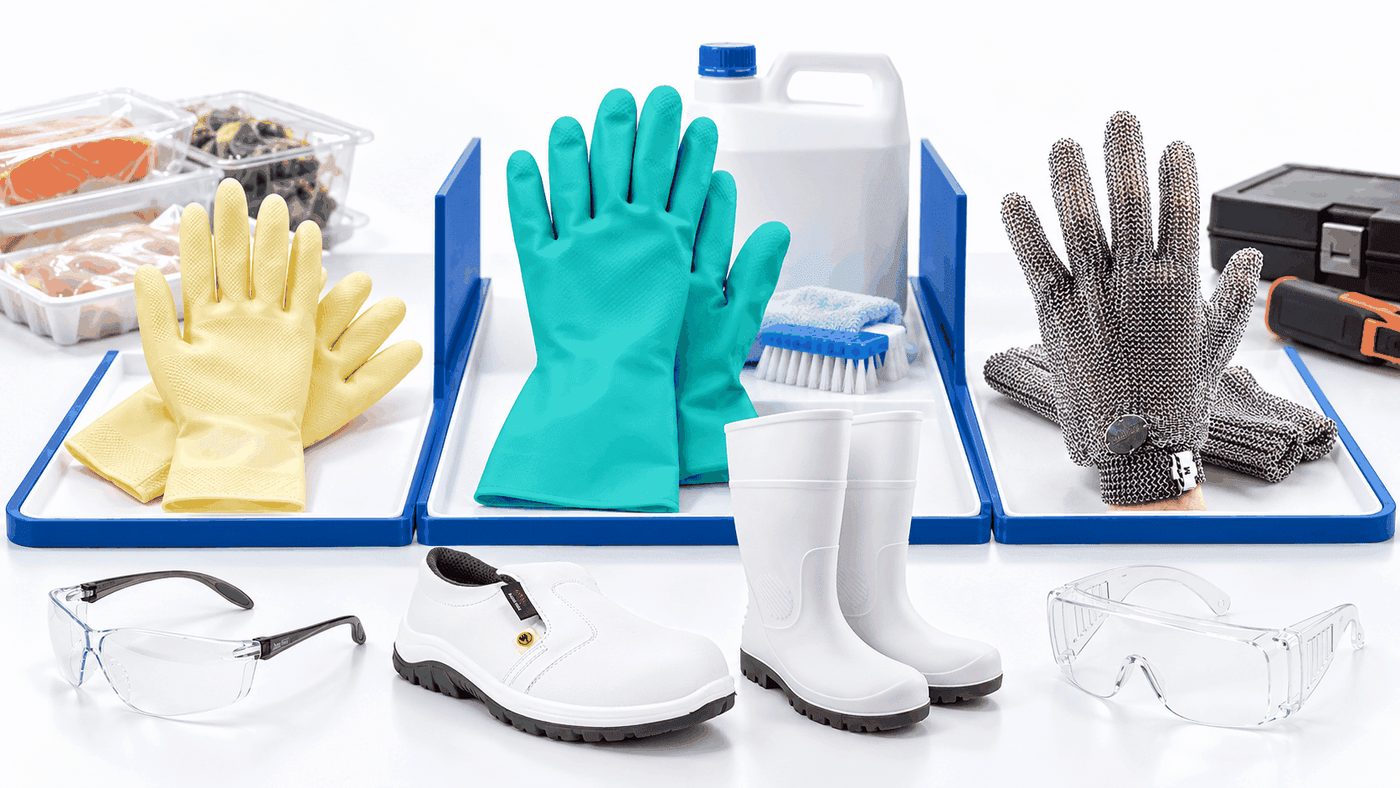
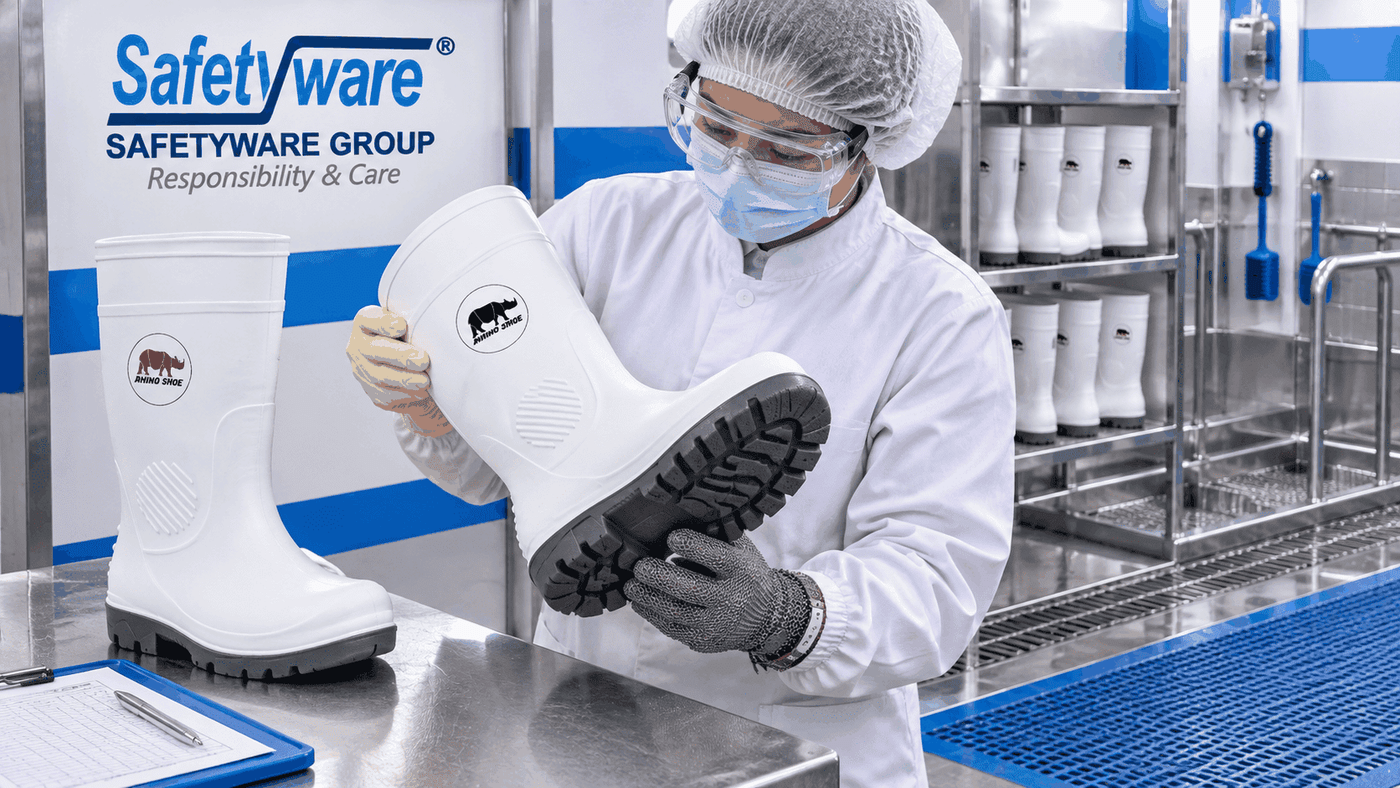
A waterproof boot keeps out water, but buyers still need to check grip, fit and the protection required for the task.
Before ordering, ask:
- Does the worker handle heavy crates or equipment that could injure the toes?
- Which floor surfaces and contaminants are present?
- Will cleaning chemicals contact the footwear?
- Does the cleaning procedure suit the boot material?
- Can workers walk, bend and climb access steps comfortably?
Run a controlled wearer trial in representative conditions. Record fit, comfort and cleaning feedback without asking workers to deliberately walk through hazardous spills. HSE recommends testing footwear suitability for the actual environment and wearer. [8]
Oil resistance and slip resistance describe different properties. Request the relevant performance evidence instead of treating either claim as a guarantee of grip on food fats, detergent or water.
Image placement 4 — Food factory footwear: After this section. Use Prompt 4.
Plan cleaning PPE as a separate activity
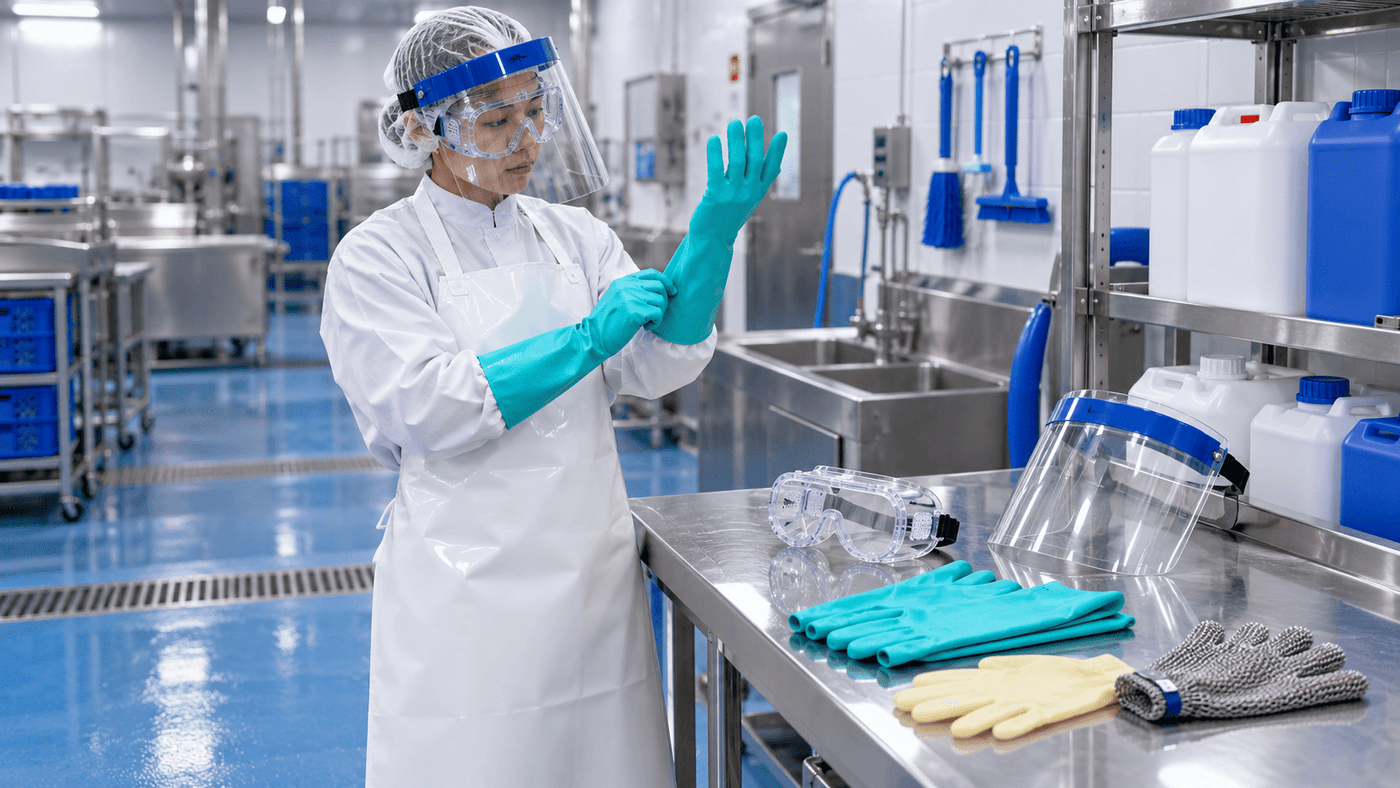
Cleaning changes the exposure profile. A line that normally handles food may expose staff to concentrated detergent, splashes or disinfectant aerosols during sanitation.
Use the chemical instructions and risk assessment to select the full combination. Confirm that goggles, face protection, gloves, apron and footwear work together. A thin hygiene apron does not automatically provide the chemical protection the task needs.
Where spraying or fogging can create an inhalation hazard, assess the process and respiratory protection specifically. Do not assume an ordinary hygiene mask makes chemical exposure safe. HSE distinguishes these application methods because they produce different exposure risks. [6]
Keep chemical-cleaning PPE in a designated location away from clean food-handling items. Make the storage arrangement easy for every shift to follow.
Make PPE practical across shifts and hygiene zones
For an Indonesian site, provide instructions in Bahasa Indonesia and any additional language workers need. Demonstrate the actual items and ask workers to show the correct use back to the trainer.
Agree the following arrangements with production, quality assurance, safety and purchasing:
| Practical decision | What to document |
|---|---|
| Zone entry | Which clothing and footwear workers change, and where |
| Colour coding | The site’s own meaning for each colour |
| Compatibility | Whether gloves preserve grip and eyewear works with other equipment |
| Cleaning and storage | Approved methods and separation of clean and used items |
| Replenishment | Minimum stock by size, shift and work area |
| Product substitution | Who checks a replacement model before use |
Blue gloves or white boots can support a local hygiene system, but colour alone proves neither food-contact suitability nor protective performance. Similarly, follow the site’s hair and beard coverage procedure without claiming that a single colour scheme applies across Indonesia.
Use a purchasing and daily inspection checklist
Before approving a bulk order:
- Record the job, hazards and exposure conditions.
- Separate occupational protection from food-contact suitability.
- Match the supplied item code to its datasheet and evidence.
- Confirm the required standard edition and relevant performance results.
- Trial sizes with the people who will use them.
- Check cleaning compatibility and product-change procedures.
- Confirm replacement stock, delivery lead time and local supply arrangements.
At the start of each shift, check for torn gloves, cracked boots, worn tread, damaged eye protection and contaminated clothing. Remove defective items from use and make replacements accessible. Include reusable items in the manufacturer’s care and inspection programme.
For chemical gloves, appearance alone cannot establish remaining protection. Follow the approved replacement schedule and chemical-resistance guidance.
SAFETYWARE Products and Solutions
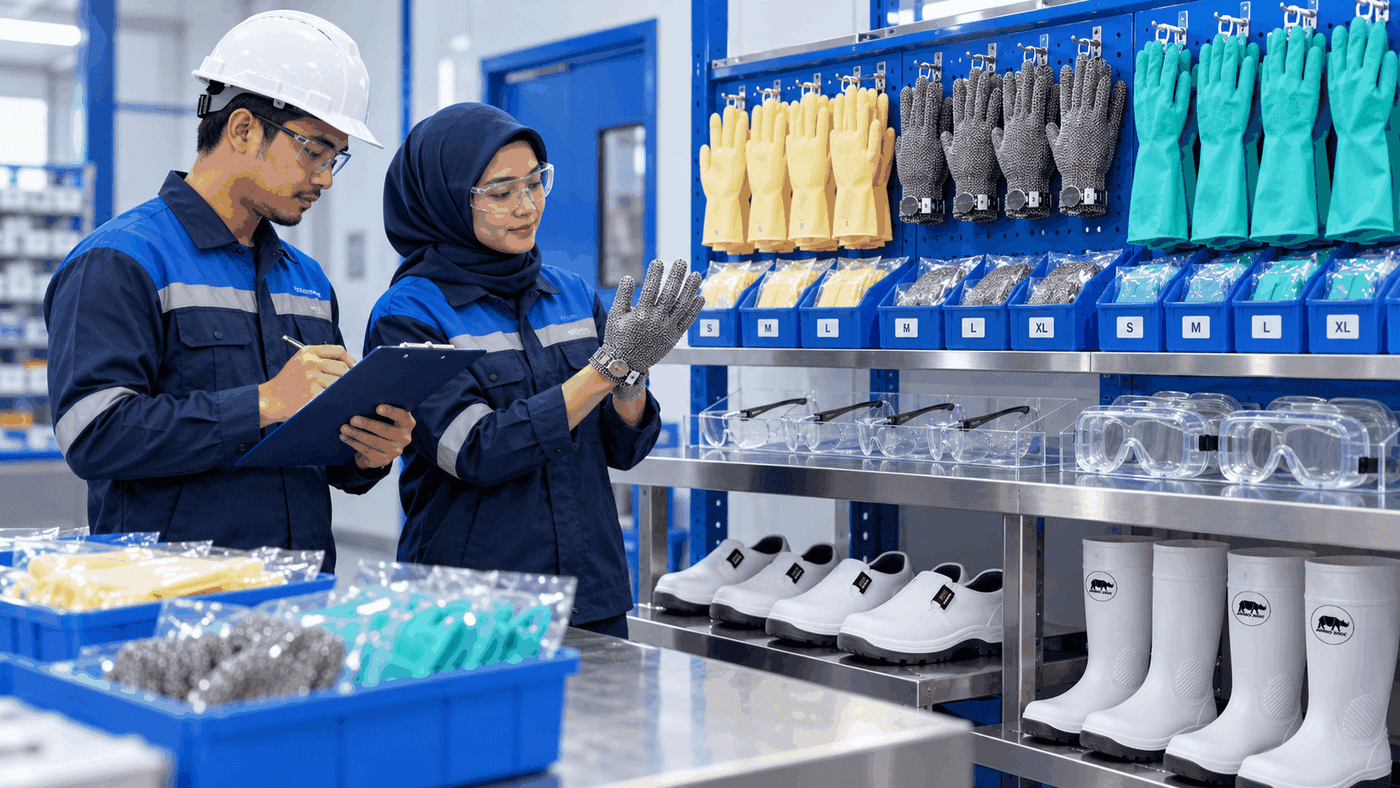
Start with the SAFETYWARE product range and shortlist by task. The following official ranges provide useful options for a discussion with the safety and quality teams.
| Product or range | Where to begin the discussion | What to confirm |
|---|---|---|
| SAFETYWARE Chem-Pro GNU1513 unlined nitrile gloves | The official page lists a 15 mil, 13-inch unlined glove and food-processing applications. | Food-contact conditions, chemical compatibility, sizing and current documentation for the supplied model |
| SAFETYWARE disposable hygiene apparel | Hairnets, mob caps, beard covers, sleeve covers and aprons for contamination-control procedures | Coverage, material, zone use and disposal; do not infer chemical protection from hygiene use |
| RHINO SHOE PVC Wellington boots | Waterproof footwear options for wet processing and washdown areas | Actual grip evidence, safety features, cleaning compatibility and fit |
| SAFETYWARE eye and face protection | Goggles and compatible face shields for assessed splash tasks | Hazard rating, coverage, fit and compatibility with the full PPE combination |
One useful distinction within the boot range is the RHINO SHOE WB300-OB. Safetyware lists it as waterproof PVC footwear, while the official product specification identifies no steel toe cap or steel midsole. Do not select this model for a job that requires those protective features. Review an appropriate safety model and its documentation instead. [9]
For an Indonesian quotation, share the work tasks, chemical names, quantities, sizes and delivery location. Ask Safetyware to confirm the model evidence, available supply route and lead time. Product suitability and local compliance should form part of that discussion.
Conclusion
Effective PPE for the food industry in Indonesia starts with a clear task assessment. Combine suitable gloves, footwear, clothing and face protection with the plant’s hygiene procedures, training and replacement arrangements.
Begin with one production area, agree its requirements with the people who use the equipment, and complete a wearer trial. Then use that approved specification to make future purchasing more consistent.
Explore SAFETYWARE Products and Solutions to discuss a PPE combination that fits your process and workforce.
Sources and references
Checked on 7 October 2026. Indonesian sources support local legal context; HSE sources provide technical guidance, not Indonesian legal requirements.
- Ministry of Manpower — PER.08/MEN/VII/2010 status and official regulation text, Articles 2 and 5–8.
- Indonesian regulatory database — 75/M-IND/PER/7/2010 on CPPOB; BPOM — CPPOB training material, 8 May 2023.
- ISO — ISO 20345:2021 and Amendment 1:2024.
- HSE — Safety hazards in food and drink manufacturing.
- HSE — Occupational health risks in food and drink manufacturing.
- HSE — Disinfectants in the food and drink industry.
- HSE — Preventing work-related skin disease.
- HSE — Preventing slips and trips at work.
- SAFETYWARE — WB300-OB product page and Wellington boots specification.
- SAFETYWARE — official product and category pages linked in the Products and Solutions section.
📞 Need More Information?
Looking for ASEAN PPE Supplier?
Explore SAFETYWARE’s safety shoes and workplace PPE range at
👉Safetyware Catalogs
Our safety specialists can help evaluate workplace hazards, recommend suitable safety helmets, and support compliance with Malaysia workplace safety requirements.
If you need a quotation, feel free to contact us at:
📩 Email: [email protected]
📞 Tel: WhatsApp Us