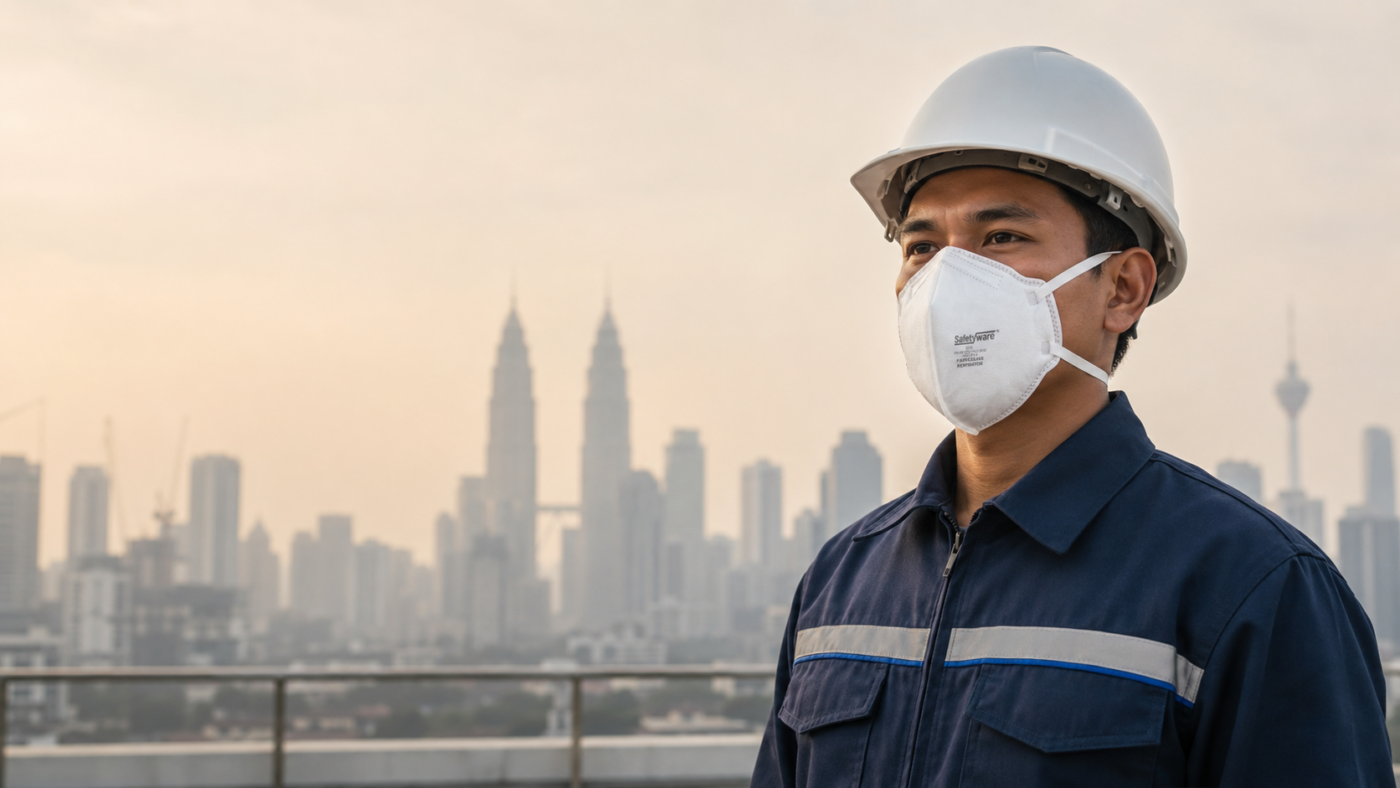
Haze has returned to many parts of Malaysia, affecting visibility, outdoor activities and lung health. On 28 August 2026, 18 areas showed unhealthy Air Pollutant Index (API) readings as of 7:00 a.m. For example, Sri Aman had the highest reading at 189. Stations in Kuala Lumpur, Putrajaya, Selangor, Penang, Perak, Kedah and other locations also showed unhealthy air.
However, air quality can change quickly. Therefore, households and employers should check the official Malaysia Air Pollutant Index Management System (APIMS) before planning outdoor activities. At the time of publication, METMalaysia also forecast hazy weather in Kuala Lumpur into early September.
Although haze may look like ordinary mist, it can carry fine particles into the lungs. First, reduce the time you spend in polluted air. However, if you must go outdoors, choose a suitable particulate respirator, make sure it fits and wear it correctly.
Situation update: This article reflects information available on 28 August 2026. Always check APIMS and official health advisories for the latest conditions in your area.
What Causes Haze in Malaysia?
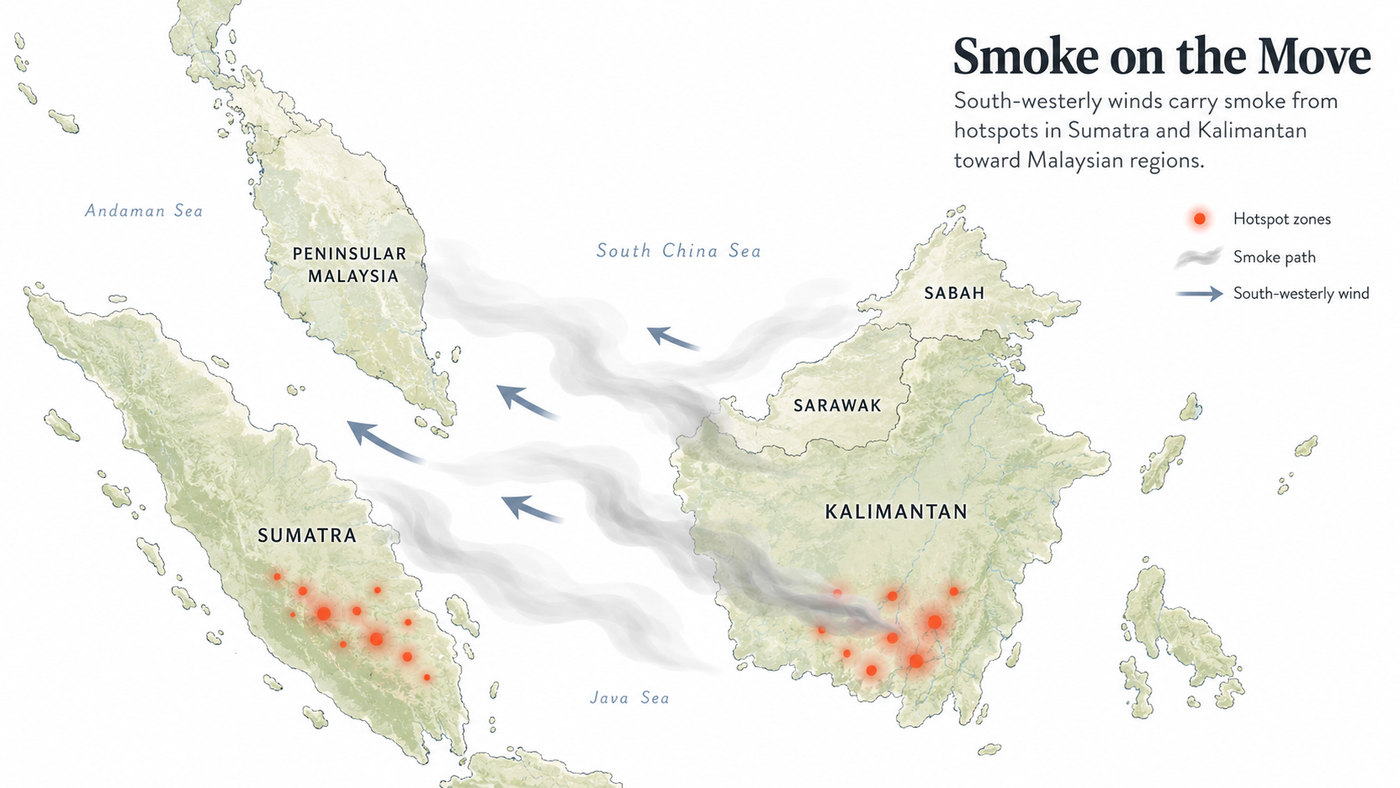
Haze forms when smoke, dust and other pollutants build up in the air. During long dry periods, forest and peatland fires can produce large amounts of smoke. Then, winds may carry that smoke across states and national borders.
In August 2026, fires and active hotspots in Sumatra and Kalimantan caused poor air quality across the region. Meanwhile, south-westerly winds carried haze towards parts of Peninsular Malaysia, Sabah and Sarawak.
From a health point of view, fine particulate matter such as PM2.5 causes the greatest concern. These particles measure 2.5 micrometres or less and can travel deep into the lungs. In addition, haze may contain gases and vapours. However, a disposable particulate respirator only filters particles; it does not supply oxygen or protect against every gas or vapour.
How Haze Can Affect Your Health
Short-term haze exposure may cause:
- Eye, nose and throat irritation
- Coughing, wheezing or shortness of breath
- Headache, tiredness or chest discomfort
- Worsening asthma or other respiratory symptoms
- Reduced comfort and performance during outdoor work
For example, people with asthma, chronic obstructive pulmonary disease, heart disease or other health conditions may face a higher risk. In addition, older adults and children may need extra care.
Therefore, Malaysia’s Ministry of Health advises the public to reduce outdoor physical activity, keep indoor air clean and use a suitable respirator when they must go outside. If anyone develops severe breathing problems, chest pain, confusion or other worrying signs, they should move to cleaner air and seek medical help.
Understanding Malaysia’s Air Pollutant Index
The API offers a simple way to understand current air quality. Malaysia groups the readings as follows:
| API reading | Air-quality category | Practical response |
|---|---|---|
| 0-50 | Good | Continue monitoring if conditions are changing. |
| 51-100 | Moderate | Sensitive individuals should watch for symptoms and avoid unnecessary exposure. |
| 101-200 | Unhealthy | Reduce prolonged or strenuous outdoor activity and use suitable protection when exposure cannot be avoided. |
| 201-300 | Very unhealthy | Avoid outdoor exposure where possible and follow official instructions. |
| Above 300 | Hazardous | Stay in a cleaner indoor environment and follow emergency public-health guidance. |
However, the API can rise or fall throughout the day. Therefore, employers should check the latest reading before they plan outdoor work.
Why a Surgical Mask Is Not the Same as a Respirator
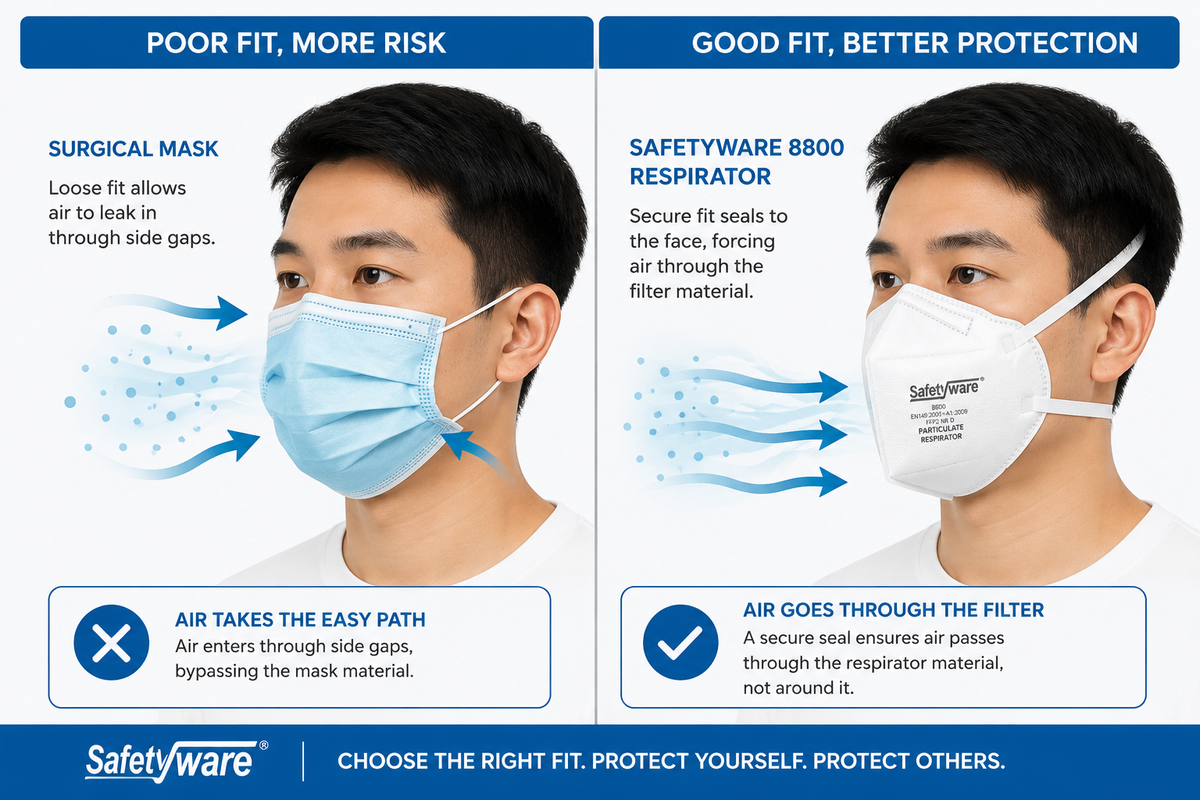
A loose surgical or disposable face mask mainly blocks droplets and splashes. However, it does not seal firmly around the face. As a result, polluted air can enter through gaps near the cheeks, nose and chin.
In contrast, a particulate respirator fits more closely and sends inhaled air through filter media. Therefore, Malaysia’s Ministry of Health names N95 respirators as an option during haze. It also explains that ordinary surgical masks do not block fine haze particles well enough.
However, the standard mark alone cannot protect the wearer. A user must choose the right fit, check the respirator for damage and wear it correctly. In addition, facial hair under the sealing edge can cause leaks and lower protection.
How to Choose a Respirator for Haze
Consider these points before selecting a haze respirator:
1. Check the Certification
First, check the product standard. N95 and FFP2 are high-efficiency particulate-respirator ratings under different systems.
- N95: A NIOSH classification that provides at least 95% filtration efficiency against certain non-oil-based particles when tested and used as specified.
- FFP2: A European EN 149 classification with at least 94% particle filtration efficiency, together with other performance requirements under the standard.
However, each system uses different tests and rules, so N95 and FFP2 do not mean exactly the same thing. Therefore, buyers should choose the required standard based on the task, work-site risk check and local rules.
2. Prioritise a Secure Face Seal
Next, choose a model that covers the nose, mouth and chin without clear gaps. In general, head straps support a closer fit than loose ear loops. Then, shape the nosepiece carefully and perform a user seal check each time you put on the respirator.
3. Select a Shape That the Wearer Can Use Correctly
Also, consider the shape. Foldable respirators take up less storage space, while cup-shaped models keep their form and may suit different faces. Therefore, choose a certified model that seals well and feels comfortable enough for the wearer to keep it on correctly.
4. Decide Whether a Valve Is Appropriate
Meanwhile, an exhalation valve can reduce heat and moisture inside the respirator. As a result, it may improve comfort during outdoor work. However, a valve does not raise the filtration rating. Also, do not use a valved model where the work area needs filtered exhaled air or source control, such as some healthcare or clean settings.
5. Replace the Respirator When Necessary
Finally, replace a disposable respirator when it becomes dirty, wet, damaged, hard to breathe through or unable to keep a seal. Also, follow the maker’s instructions and check the expiry or shelf-life details before use.
How to Wear a Particulate Respirator Correctly
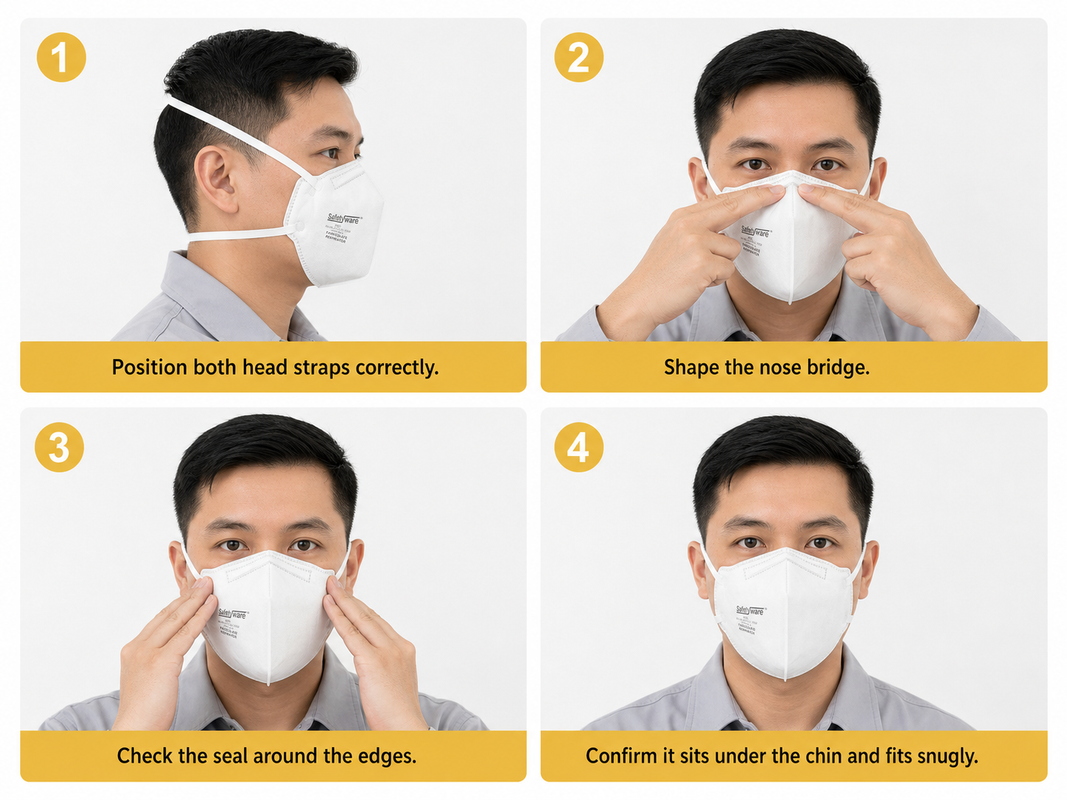
- Clean and dry your hands before handling the respirator.
- Inspect it for damage, dirt, moisture or loose components.
- Position it over the nose, mouth and under the chin.
- Place both head straps correctly according to the product instructions.
- Shape the nosepiece with both hands instead of pinching it with one hand.
- Perform a user seal check before entering the affected area.
- Avoid touching or repeatedly adjusting the respirator while wearing it.
- Leave the polluted area immediately if breathing becomes difficult or you feel dizzy or unwell.
Because tight-fitting respirators add breathing resistance, some people may feel discomfort. People with heart or lung conditions should get medical advice if this happens. Therefore, never rely on a respirator that does not fit properly.
Haze Protection for Outdoor Workers
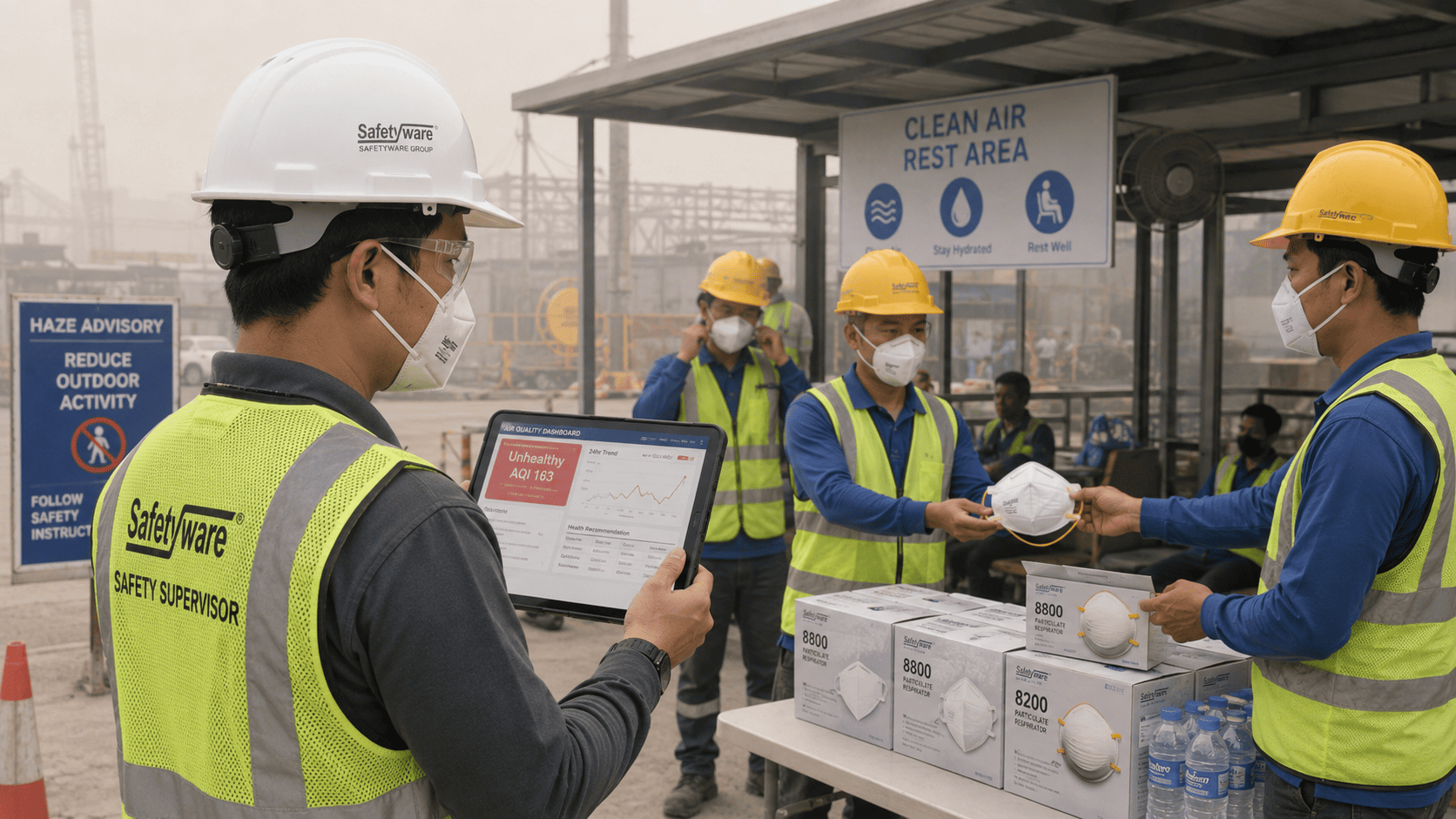
However, respirators form only one part of a workplace haze plan. First, employers should reduce exposure through simple controls:
- Check APIMS readings and weather forecasts before each shift.
- Reschedule heavy outdoor work to periods with better air quality.
- Move suitable tasks indoors or to less affected locations.
- Reduce work intensity and provide more frequent rest breaks.
- Create a cleaner rest area with closed windows and suitable air filtration.
- Keep vehicle air-conditioning on recirculation mode when appropriate.
- Provide drinking water and watch for heat stress as well as haze symptoms.
- Train workers to select, wear, inspect and replace respirators correctly.
- Conduct fit testing when respirator use forms part of a workplace respiratory-protection plan.
SAFETYWARE Products and Solutions for Haze Protection
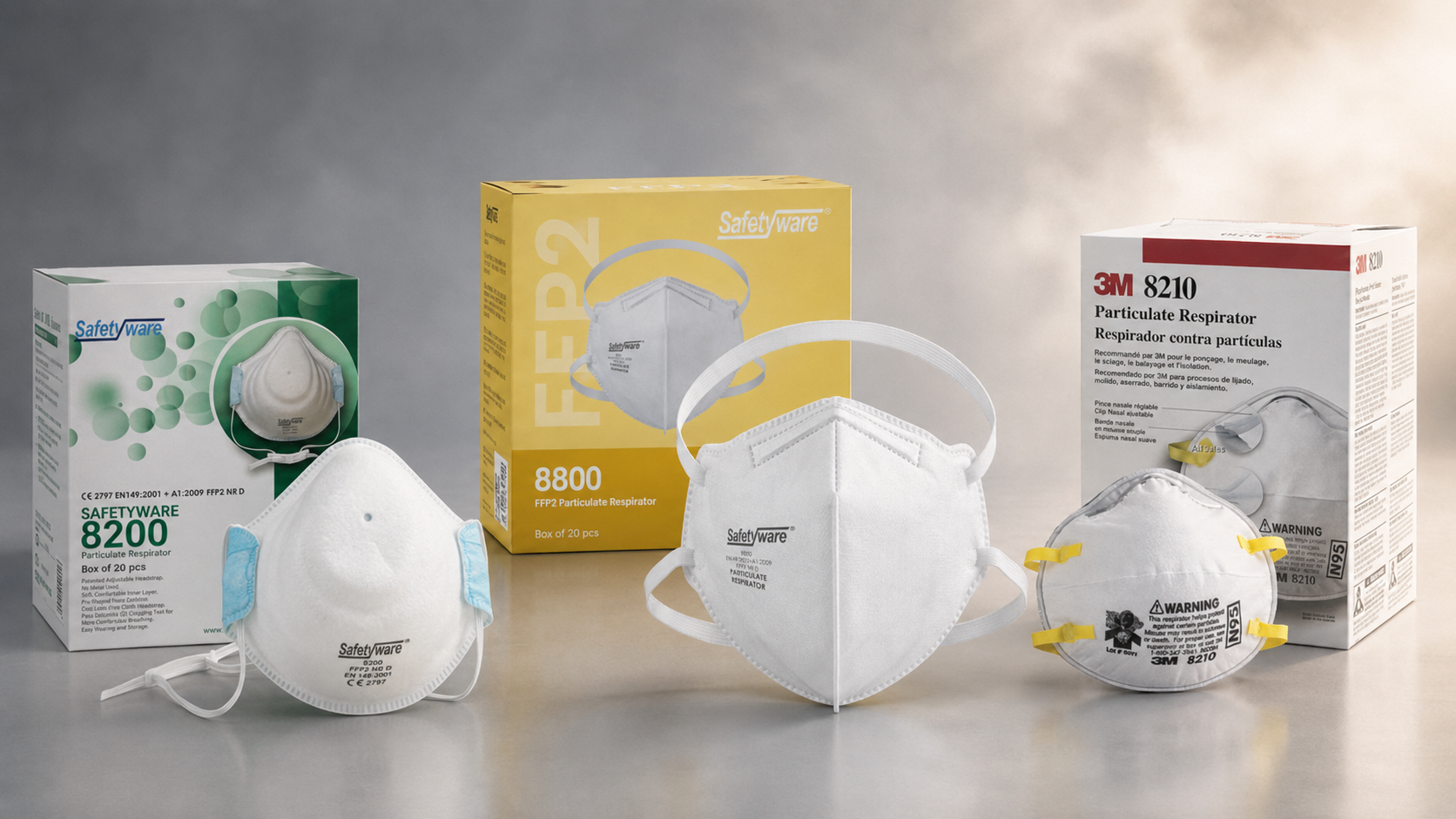
To help companies prepare for haze, SAFETYWARE supplies several particulate respirators for public and workplace use. Therefore, buyers should check the required standard, wearer fit, valve choice, exposure time and site rules.
SAFETYWARE 8800 Series Foldable FFP2 Particulate Respirator
The SAFETYWARE 8800 Series is a foldable FFP2 respirator that meets CE EN 149:2001+A1:2009. According to the supplied product sheet, its filter media provides 94% filtration efficiency.
Key features include:
- Foldable design for convenient carrying and storage
- Individually packed units for hygienic distribution
- Adjustable head-strap buckle for different facial sizes
- Latex-free textile-braided head strap
- Concealed nose bridge with no exposed metal parts
- Staple-free construction to reduce contact between the skin and metal
- Continuous-loop strap that allows the respirator to hang around the neck when not in use
- Smooth polypropylene inner and outer layers for wearer comfort
The range includes:
- 8800: FFP2 particulate respirator without a valve
- 8800V: FFP2 particulate respirator with an exhalation valve
- 8800CV: FFP2 NR organic-vapour particulate respirator with a valve; confirm suitability for the specific exposure before use
Overall, the 8800 offers a practical choice for businesses that want a compact, single-packed EN 149 respirator for staff, travel kits or emergency stock.
SAFETYWARE 8200 Series FFP2 Particulate Respirator
For buyers who prefer a cup shape, the SAFETYWARE 8200 offers FFP2 NR particle protection. SAFETYWARE lists SIRIM and CE compliance with BS EN 149:2001+A1:2009 for the series.
In addition, its design includes an adjustable head strap, soft nose cushion, metal-free build and an embossed edge that supports the seal and comfort. The range offers several choices:
- 8200: Non-valved FFP2 NR respirator
- 8200V: Valved FFP2 NR D respirator
- 8200AV: Valved FFP2 NR D respirator with an activated-carbon layer
Therefore, the 8200 Series may suit companies that want a firm cup shape, an adjustable fit and several comfort choices.
3M 8210 N95 Particulate Respirator
Meanwhile, SAFETYWARE supplies the 3M 8210, a NIOSH-approved N95 respirator. It provides at least 95% filtration efficiency against certain non-oil-based particles.
In addition, the light cup-shaped design includes 3M Advanced Electrostatic Media, soft nose foam, an adjustable nose clip and stretchable headbands. Because the Ministry of Health names N95 respirators for haze protection, the 3M 8210 offers a familiar choice for buyers who need N95.
Quick Product Comparison
| Model | Classification | Design | Notable features | Suitable selection context |
| SAFETYWARE 8800 | FFP2, EN 149 | Foldable, non-valved | Individually packed, adjustable continuous-loop head strap, metal-free and staple-free | Portable personal issue, emergency stock and organisations specifying FFP2 |
| SAFETYWARE 8800V | FFP2, EN 149 | Foldable, valved | 8800 features with exhalation valve | Outdoor use where heat and moisture comfort are important and a valve is acceptable |
| SAFETYWARE 8200 | FFP2 NR, BS EN 149 | Cup-shaped, non-valved | Adjustable head strap, soft nose cushion, metal-free construction | Structured cup-style fit and organisations specifying FFP2 |
| SAFETYWARE 8200V / 8200AV | FFP2 NR D, BS EN 149 | Cup-shaped, valved | Valve option; 8200AV includes an activated-carbon layer | Longer outdoor tasks where a valved model is appropriate; confirm exposure suitability |
| 3M 8210 | NIOSH N95 | Cup-shaped, non-valved | Advanced electrostatic media, nose foam, adjustable nose clip and headbands | Procurement requiring N95 and general particulate protection where the model fits correctly |
Still, no single respirator fits every person or hazard. For workplace use, employers should confirm the hazard, exposure level, oxygen level, local rules and wearer fit before they issue a product.
Next, explore SAFETYWARE particulate respirators or view the wider respiratory-protection range. If you need help with product choice or bulk supply, contact SAFETYWARE with the model, quantity, delivery country and required standard.
Conclusion
Malaysia’s haze can turn from a visibility issue into a health and work-safety concern within hours. Therefore, check the API, spend less time outdoors and keep indoor air clean.
When people must go outside, a suitable respirator with a good seal can reduce exposure to fine particles. To meet different needs, SAFETYWARE offers the foldable 8800 Series, the cup-shaped 8200 Series and the NIOSH-approved 3M 8210 N95.
Ultimately, the best respirator is not simply the one with the highest number on its label. Instead, choose an approved model that matches the hazard, fits the wearer and supports correct use every time.
📞 Need More Information?
Looking for certified Respiratory protection for Haze?
Explore SAFETYWARE’s safety shoes and workplace PPE range at
👉Safetyware Catalogs
Our safety specialists can help evaluate workplace hazards, recommend suitable safety helmets, and support compliance with Malaysia workplace safety requirements.
If you need a quotation, feel free to contact us at:
📩 Email: [email protected]
📞 Tel: WhatsApp Us