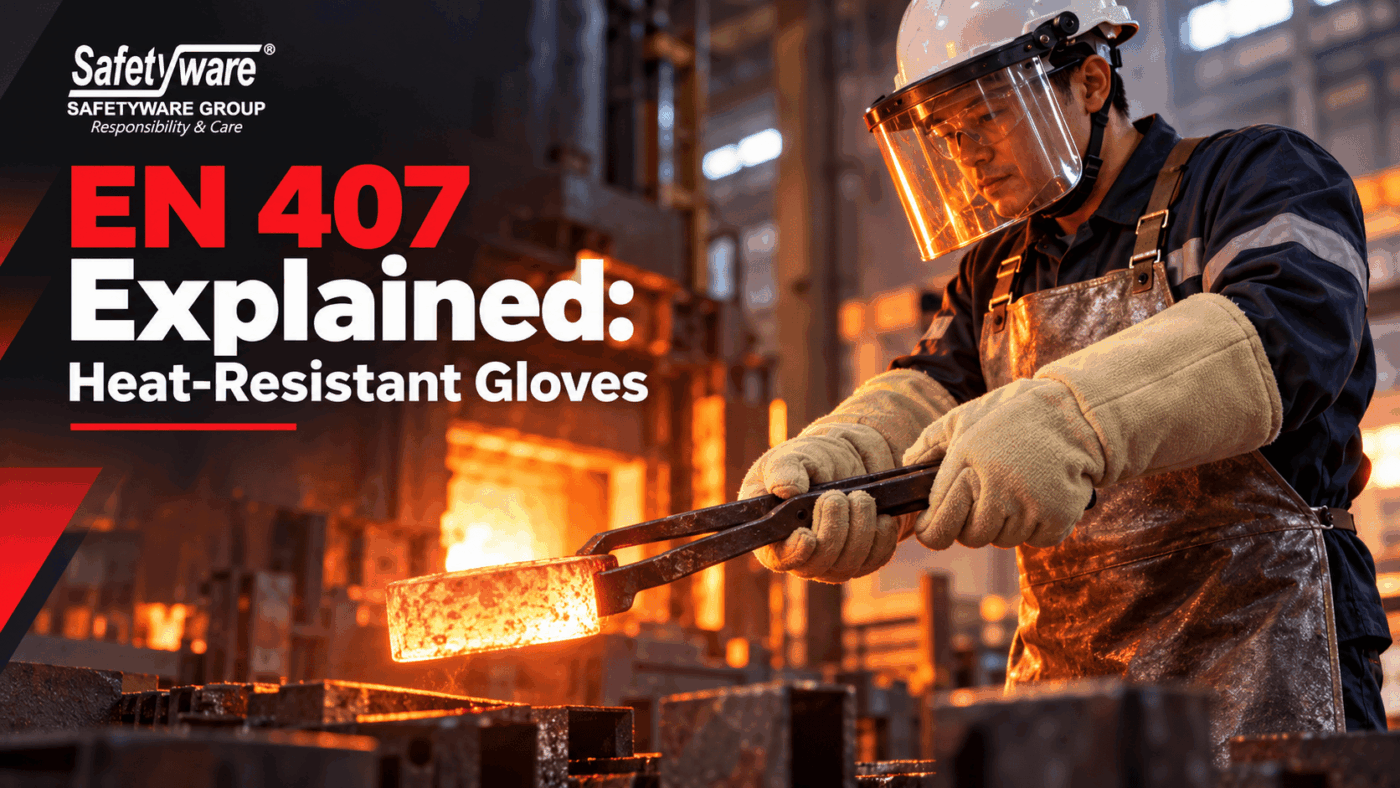
Heat-resistant gloves can protect against very different hazards. One worker may briefly handle a hot metal component, while another faces radiant furnace heat, sparks or molten-metal splash. Although both jobs involve heat, they do not require the same glove.
EN 407 helps buyers compare protective gloves and other hand-protection equipment against six thermal risks. However, its marking is not one overall “heat score.” Each position in the code represents a different test. Therefore, a glove with excellent contact-heat performance may provide little or no declared protection against flame or molten metal.
This guide explains how to read EN 407 ratings, understand their limitations and choose suitable gloves through a task-based risk assessment.
Quick answer: Read the six-character EN 407 code from left to right. Match the relevant test positions to the actual heat source, temperature, contact time and secondary hazards. Never treat a laboratory contact temperature as a safe working temperature or holding time.
What Is EN 407?
EN 407:2020 is the current European standard titled Protective gloves and other hand protective equipments against thermal risks (heat and/or fire). It specifies requirements, test methods, performance levels and markings for protection against:
- Limited flame spread
- Contact heat
- Convective heat
- Radiant heat
- Small splashes of molten metal
- Large quantities of molten metal
The 2020 edition replaced EN 407:2004 as the current technical edition published by European standards bodies. It works with the general protective-glove requirements in EN ISO 21420, which cover areas such as glove design, innocuousness, comfort, sizing, marking and manufacturer information.
Nevertheless, buyers should check both the declared standard edition and the product’s current certification documents. The year matters because the marking rules and some test requirements changed between the 2004 and 2020 editions.
EN 407 Is a Standard, Not a Workplace Law
EN 407 describes how thermal hand protection is tested and marked. It does not decide whether a particular workplace must use gloves, and it does not replace a risk assessment.
In the European Union, Regulation (EU) 2016/425 sets the legal framework for PPE placed on the market. Harmonised standards can provide a presumption of conformity with the essential health and safety requirements they cover.
There is an important 2026 detail. Commission Implementing Decision (EU) 2026/1279, as amended in September 2026, still lists EN 407:2004 in the EU harmonised-standards framework. EN 407:2020 is the current technical edition, but it is not the edition shown for presumption of conformity in that list as checked on 28 September 2026.
This does not mean EN 407:2020 cannot be used. Instead, manufacturers and EU economic operators must ensure that their chosen conformity-assessment route and technical file demonstrate compliance with the PPE Regulation. Buyers should request the EU Declaration of Conformity, product marking, instructions for use and relevant certificate rather than relying on a catalogue statement alone.
Outside Europe, local occupational-safety and product-approval rules apply. For example, US OSHA 29 CFR 1910.138 requires employers to select suitable hand protection where workers face thermal burns or harmful temperature extremes. Selection must consider performance, the task, workplace conditions, duration and identified hazards. OSHA does not make EN 407 a universal legal requirement.
How to Read the EN 407 Marking
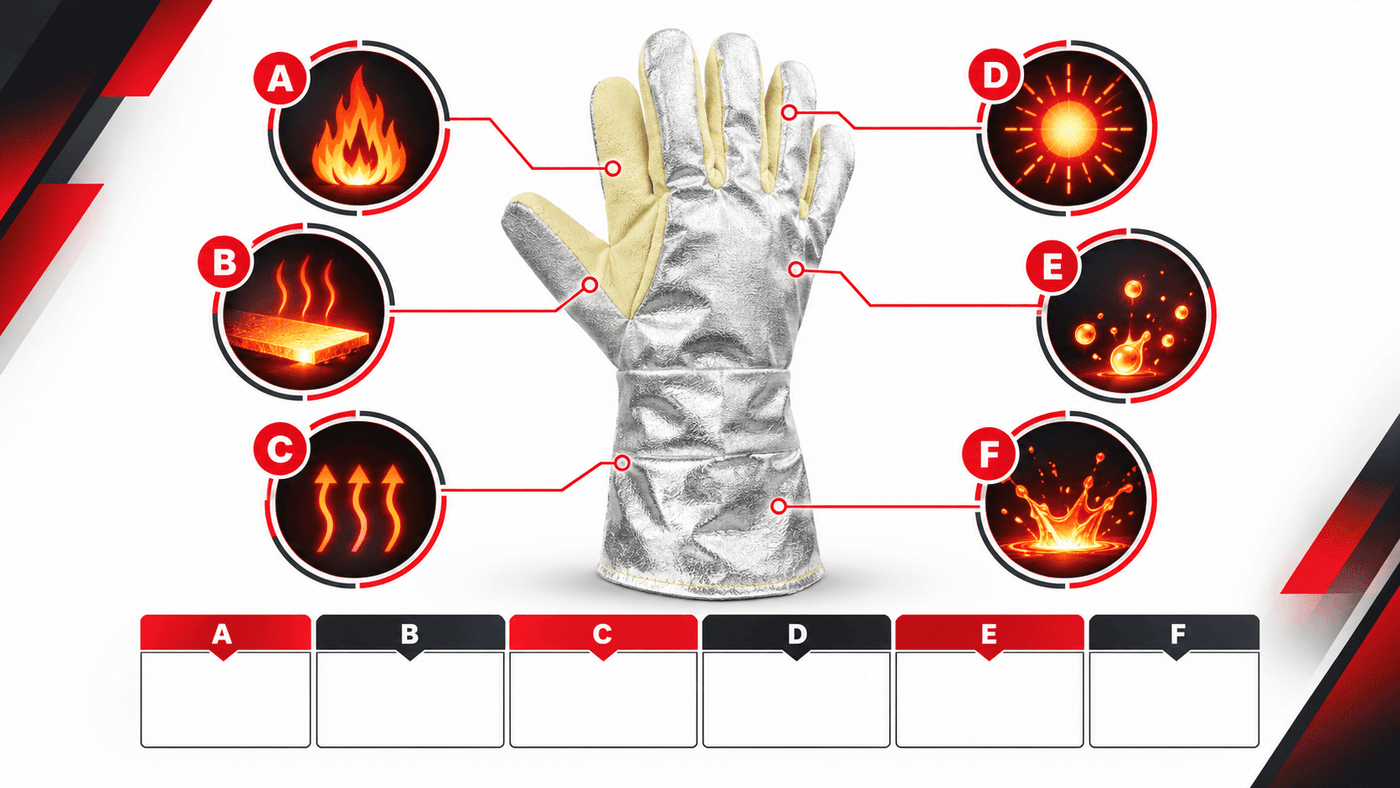
An EN 407 marking shows a thermal-hazard pictogram with a six-position code. Read the positions from left to right as A B C D E F.
| Position | Thermal hazard | Performance scale | What it helps evaluate |
|---|---|---|---|
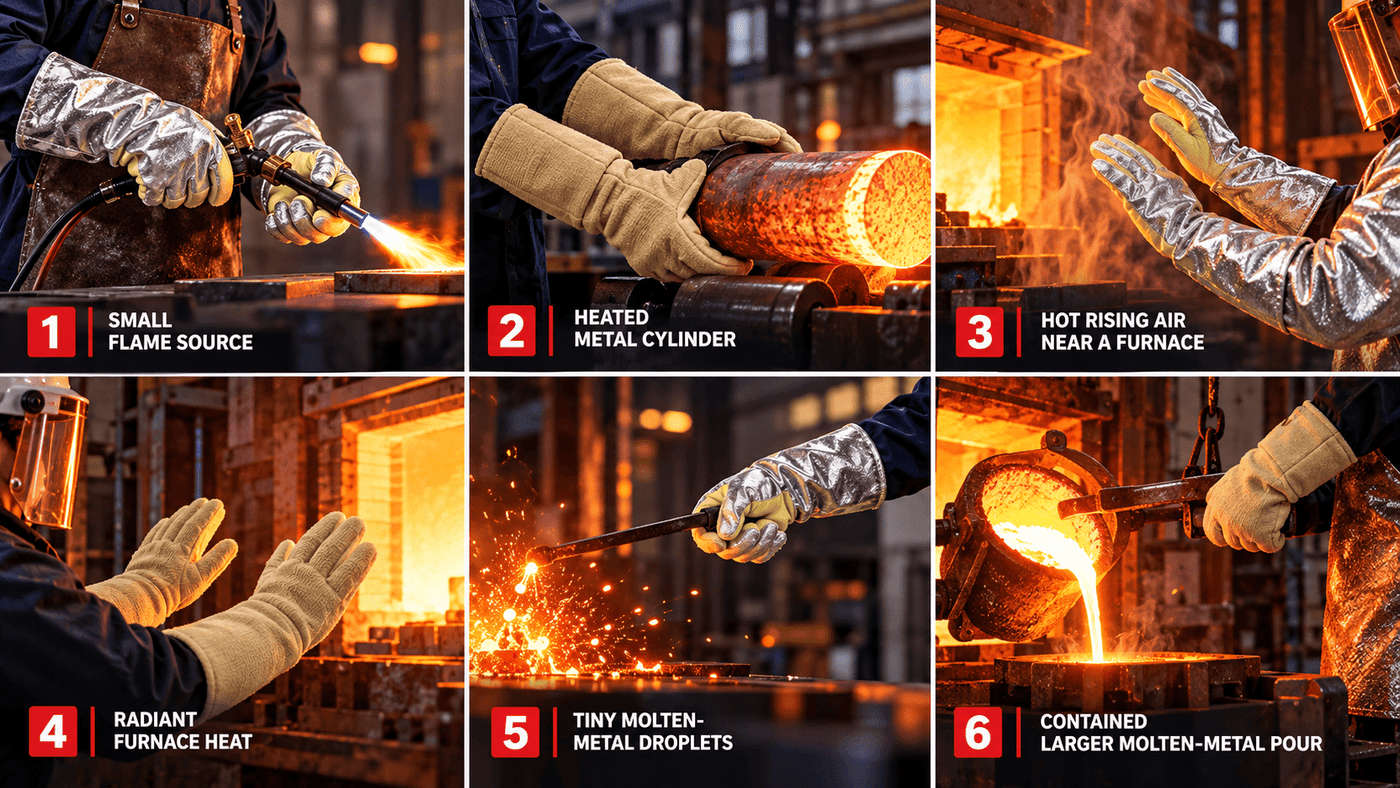
| A | Limited flame spread | 1–4 | How long the material continues to flame or glow after ignition is removed |
| B | Contact heat | 1–4 | Heat transfer when the glove touches a heated surface |
| C | Convective heat | 1–4 | Heat transfer from a flame-generated hot-gas source |
| D | Radiant heat | 1–4 | Heat transfer from a radiant heat source |
| E | Small splashes of molten metal | 1–4 | Number of molten-metal droplets required to raise the temperature inside the glove |
| F | Large quantities of molten metal | 1–4 | Mass of molten iron required to damage simulated skin beneath the sample |
A higher number means better performance within that specific test. It does not allow direct comparison between different columns.
- X means the glove was not tested for that property or no performance level is claimed.
- 0 means the test result did not reach Level 1.
For example, a code of X2XXXX declares Level 2 contact-heat performance but no result in the other five positions. It should not be promoted as flame-resistant, radiant-heat protective or suitable for molten metal based on that code.
EN 407:2020 introduced a separate pictogram for thermal protection without a flame claim. Therefore, buyers should review the pictogram, six-position code and instructions together, especially when comparing products marked to different editions.
[Image placement suggestion 2 — Six-position EN 407 code: see the complete prompt at the end.]
The Six EN 407 Performance Tests Explained
A — Limited Flame Spread
This test measures the glove material’s continued flaming and glowing after an ignition source is removed. It does not mean the glove cannot burn.
| Level | Maximum after-flame time | Maximum after-glow time |
|---|---|---|
| 1 | 15 seconds | No requirement |
| 2 | 10 seconds | 120 seconds |
| 3 | 3 seconds | 25 seconds |
| 4 | 2 seconds | 5 seconds |
A higher level indicates faster self-extinguishing behaviour under the specified test. Workers still need suitable procedures, clothing and emergency arrangements where open flame is present.
B — Contact Heat
The contact-heat test places glove material against a heated cylinder. The performance level depends on the test temperature at which the temperature on the inner side takes at least 15 seconds to rise by 10°C.
| Contact-heat level | Test temperature | Minimum threshold time |
|---|---|---|
| 1 | 100°C | 15 seconds |
| 2 | 250°C | 15 seconds |
| 3 | 350°C | 15 seconds |
| 4 | 500°C | 15 seconds |
This is often misunderstood. Level 4 does not mean a worker may safely hold a 500°C object for 15 seconds in every situation. Real performance depends on pressure, contact area, glove condition, moisture, object shape, previous exposures, movement and the complete glove construction. The threshold also describes a controlled temperature rise, not the onset of pain or a guaranteed burn-free time.
For procurement, obtain the full instructions for use and any manufacturer-specific maximum contact duration. Then validate the glove in a controlled trial that stays within the documented limits.
C — Convective Heat
Convective heat can occur when hot gases or flame-driven air transfer heat to the glove. The test reports a heat-transfer index, with higher levels requiring a longer time for heat to reach the specified temperature rise.
| Convective-heat level | Minimum heat-transfer index |
|---|---|
| 1 | 4 seconds |
| 2 | 7 seconds |
| 3 | 10 seconds |
| 4 | 18 seconds |
This test is relevant to flame and hot-gas exposure, but it should not be confused with direct contact heat.
D — Radiant Heat
Radiant heat travels from a hot source without direct contact. Furnaces, kilns, molten material and heated surfaces can produce strong radiant exposure.
| Radiant-heat level | Minimum heat-transfer time |
|---|---|
| 1 | 7 seconds |
| 2 | 20 seconds |
| 3 | 50 seconds |
| 4 | 95 seconds |
Aluminised materials may help reflect radiant energy, while insulated palm materials address contact heat. A glove used near a furnace may need both properties.
E — Small Splashes of Molten Metal
This test counts the number of small molten-metal droplets needed to produce the specified temperature rise inside the glove.
| Small-splash level | Minimum number of droplets |
|---|---|
| 1 | 10 |
| 2 | 15 |
| 3 | 25 |
| 4 | 35 |
The result relates to the standard test conditions. It does not prove protection against every molten material, droplet size or exposure angle.
F — Large Quantities of Molten Metal
This test uses molten iron and assesses the mass required to damage simulated skin beneath the sample.
| Large-splash level | Molten-iron mass |
|---|---|
| 1 | 30 g |
| 2 | 60 g |
| 3 | 120 g |
| 4 | 200 g |
Material behaviour varies. Aluminium, iron, steel and other molten substances do not interact with glove materials in exactly the same way. Consequently, foundries should confirm suitability for the actual molten metal and process rather than relying only on the Level F number.
The 2020 edition also includes controls linking higher thermal claims to limited flame-spread performance. Buyers assessing Level 3 or 4 claims should therefore review the complete code and certification, not one isolated digit.
EN 407:2020 Versus EN 407:2004
The two editions use a six-position concept, but buyers should not assume their markings and requirements are identical.
Key updates in the 2020 edition include:
- Updated title covering gloves and other hand-protection equipment
- “Burning behaviour” renamed “limited flame spread”
- Revised test methods and sampling requirements
- A new pictogram for heat protection without a flame claim
- Requirements linked to glove length for molten-metal protection
- Additional warnings and removal considerations for some high-level molten-metal claims
- Alignment with EN ISO 21420 general glove requirements instead of the older EN 420 framework
When tender documents simply say “EN 407,” ask which year is required. The manufacturer’s marking, Declaration of Conformity, certificate and instructions should all be consistent.
How to Choose Heat-Resistant Gloves by Task
The correct EN 407 positions depend on the heat-transfer mechanism and the way the worker performs the job.
| Task or environment | Main thermal concerns | EN 407 positions to examine | Other important factors |
|---|---|---|---|
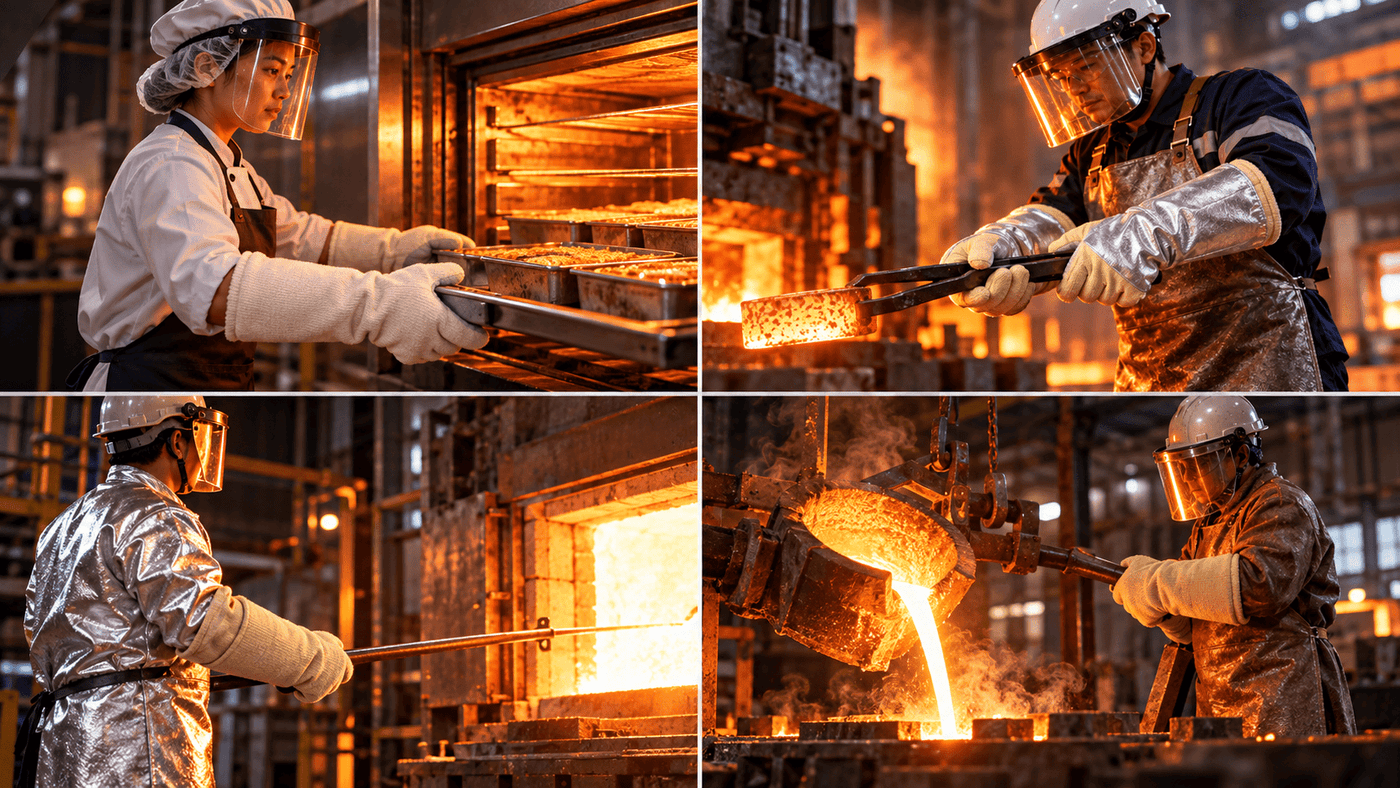
| Removing trays or components from an oven | Direct contact heat | B | Grip, dexterity, contact time, food-contact needs where applicable |
| Handling hot castings or metal parts | Contact and possible radiant heat | B and D | Cut, abrasion, puncture, cuff length and handling tools |
| Working beside a furnace or kiln | Radiant and convective heat | C and D | Whole-body PPE, face protection and heat-stress controls |
| Welding and cutting | Flame, sparks, contact heat and mechanical risk | A, B and C as applicable | EN 12477 welding-glove requirements, cuff coverage, dexterity |
| Foundry pouring or casting | Radiant heat and molten-metal splash | D, E and F | Actual metal, splash direction, quick removal and full PPE ensemble |
| Food processing and baking | Contact heat, moisture and hygiene | B | Food-contact documentation, cleanability, grip and liquid penetration |
| Laboratory hotware handling | Short contact heat | B | Object shape, breakage risk, dexterity and contamination controls |
| Steam, hot water or hot chemicals | Heat plus liquid or chemical exposure | EN 407 alone is insufficient | Liquid-proof construction and substance-specific chemical compatibility |
Start With Exposure Details
Before comparing gloves, document:
- Heat source and transfer mechanism
- Surface or material temperature
- Expected and worst-case contact duration
- Frequency of contact and recovery time between contacts
- Pressure and contact area
- Presence of flame, sparks or molten splash
- Hot liquids, steam, oil or chemicals
- Cut, abrasion, puncture and impact hazards
- Required dexterity and grip
- Wrist and forearm exposure
- Need for rapid glove removal
This information prevents a common mistake: selecting a thick glove with a high contact-heat claim for a task dominated by radiant heat, flame or liquid splash.
Check Secondary Standards and Hazards
Heat-resistant gloves may also need other performance evidence:
- EN 388 for mechanical risks such as abrasion, cut, tear, puncture and, where declared, impact
- EN 12477 for protective gloves used in manual metal welding, cutting and related processes
- EN ISO 374 where hazardous chemicals are present
- EN 511 for cold protection
- Relevant electrical-insulating glove standards for electrical work
- Food-contact compliance where gloves may contact food
Do not assume EN 407 covers chemicals, electricity, liquid penetration, chainsaw hazards or all mechanical risks.
Balance Protection With Safe Movement
Extra insulation and long cuffs can reduce dexterity. However, a glove that is too bulky may increase the chance of dropping a hot object or becoming caught near machinery.
Conduct a wearer trial that evaluates:
- Secure grip on the actual object
- Ability to operate tools and controls
- Finger movement and hand fatigue
- Cuff compatibility with sleeves and other PPE
- Ease of putting on and removing the glove
- Fit across the available size range
- Performance after realistic periods of use
Gloves can create an entanglement hazard near rotating machinery. Use engineering controls, isolation and safe operating procedures; do not wear gloves near moving parts where the risk assessment prohibits them.
Common EN 407 Selection Mistakes
Treating 500°C as a Safe Working Temperature
The Level 4 contact-heat test uses 500°C under controlled conditions. It does not declare indefinite protection at 500°C, and it does not cover every glove area or real-world contact condition.
Reading the Six Digits as One Score
A code such as 41324X is six separate results, not “41,324 points.” Read each position against the relevant hazard.
Ignoring an X or 0
An X is not a pass. It means no performance level is declared for that position. A 0 means Level 1 was not achieved.
Using Heat Gloves for Hot Liquids or Steam Without Checking
Porous thermal gloves may allow hot liquid or steam to reach the skin. Confirm liquid resistance, seam construction, cuff design and compatibility with the specific substance.
Selecting by Material Name Alone
Leather, para-aramid, cotton, silicone and aluminised materials behave differently. Construction, thickness, lining, seams and coverage also affect performance. Always verify the finished glove’s declared results.
Forgetting the Rest of the PPE Ensemble
Gloves cannot protect exposed wrists, forearms, the face or the body. High-heat and molten-metal work requires compatible clothing, eye and face protection, footwear, emergency procedures and often specialised engineering controls.
Procurement Checklist for EN 407 Gloves
- Complete a task-specific heat and hand-hazard assessment.
- Identify which of the six EN 407 test positions apply.
- State the required edition: EN 407:2020 or another accepted project reference.
- Obtain the exact six-position performance code.
- Check the glove and packaging markings against the datasheet.
- Request the Declaration of Conformity and current certificate where applicable.
- Review the instructions for use, limitations and contact-duration guidance.
- Check EN ISO 21420 and relevant secondary standards.
- Confirm protection for chemicals, liquids, cuts or electricity separately.
- Verify cuff length and compatibility with clothing and sleeves.
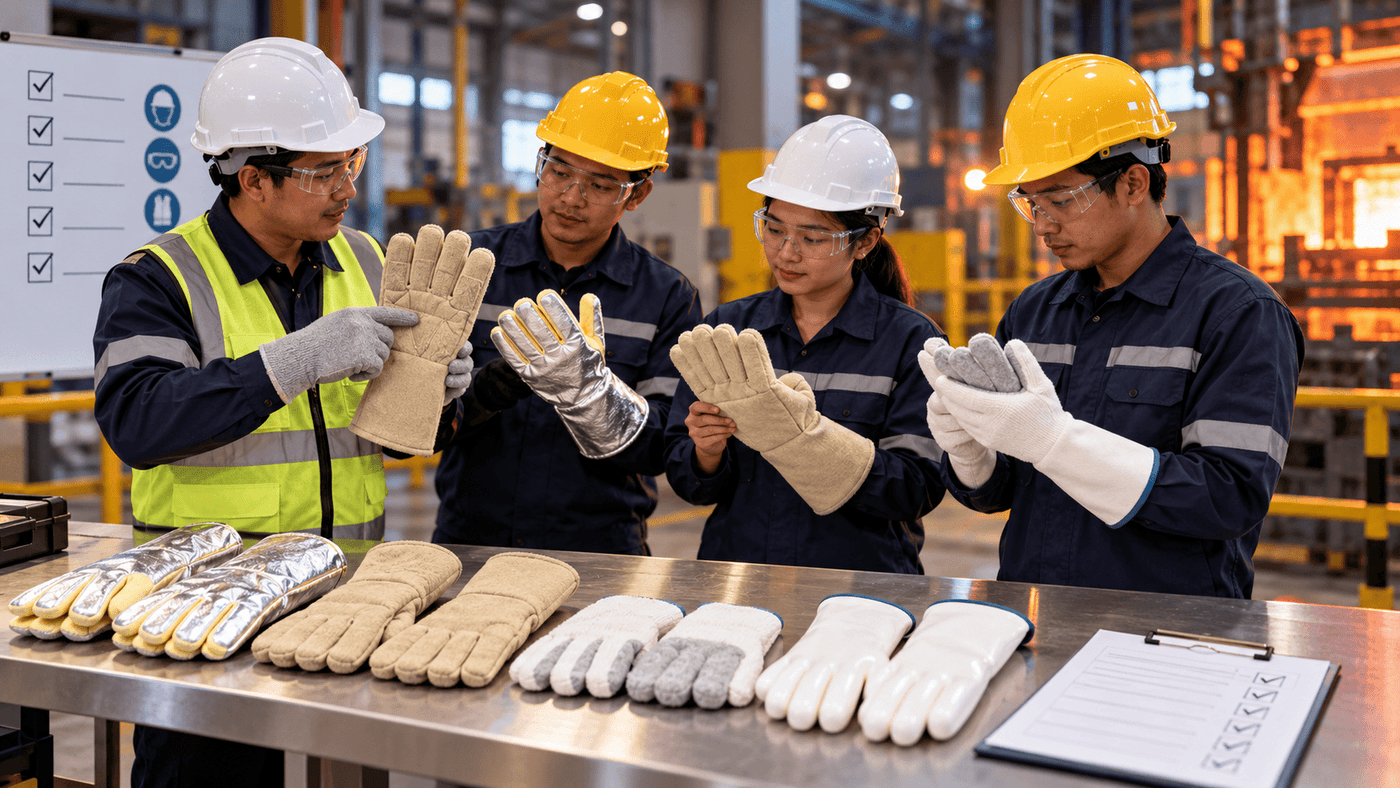
- Run a controlled wearer trial with representative workers.
- Train users to inspect, remove, clean and store the gloves correctly.
- Define replacement criteria before issuing the gloves.
Inspection, Care and Replacement
Inspect heat-resistant gloves before every use. Remove them from service if you find:
- Holes, cuts, tears or open seams
- Worn or compressed insulation
- Delamination, cracking or hardening
- Burn marks, charring, melting or glazing
- Chemical, oil or combustible contamination
- Wetness inside an absorbent thermal glove
- Damaged cuffs or reduced coverage
- Loss of grip, fit or flexibility
- Exposure beyond the manufacturer’s stated limits
Contamination can change thermal behaviour. For example, oil or solvent on a glove can add a fire hazard, while moisture may accelerate heat transfer. Follow the manufacturer’s approved cleaning method because incorrect laundering can damage coatings, insulation or flame-resistant properties.
Do not rely on appearance alone after a serious exposure. Quarantine the glove and follow the manufacturer’s replacement guidance.
SAFETYWARE Products and Solutions
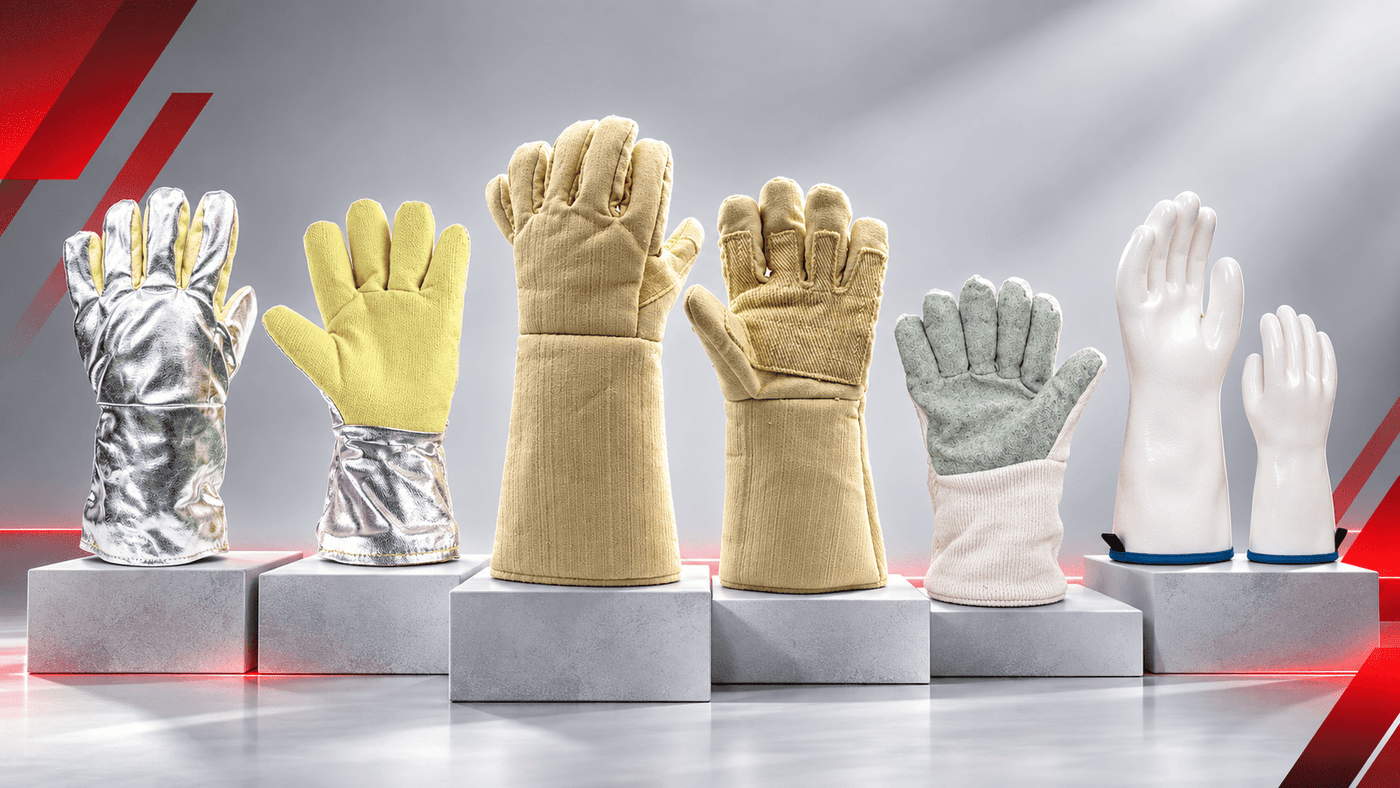
SAFETYWARE offers a range of heat-resistant gloves for different hot-handling tasks. The models below illustrate why selection should begin with the hazard rather than a single maximum-temperature claim.
SAFETYWARE ThermoGard™ HRG01
The ThermoGard HRG01 uses meta-aramid materials and an insulating felt construction. It is designed for hot handling where contact-heat protection, flexibility and mechanical durability require consideration. Request the current EN 407 performance code and instructions before matching it to a task.
SAFETYWARE ThermoGard™ HRG03
The ThermoGard HRG03 combines a para-aramid felt palm with an aluminised back. This construction is relevant when a task involves both hot-object handling and radiant exposure. Buyers should still verify the declared values for contact and radiant heat, as well as cuff coverage and handling time.
SAFETYWARE ThermoGard™ HRG04 and HRG05
The ThermoGard HRG04 and ThermoGard HRG05 use para-aramid felt/twill construction for high-temperature handling. HRG04 provides a shorter 13-inch format, while HRG05 provides an 18-inch format for added forearm coverage. Choose the length and rating from the actual exposure, and review the current product specification and test documentation before use.
SAFETYWARE TempGard™ HCG14
The TempGard HCG14 uses a silicone outer with an insulating textile liner and is offered for hot and cold handling, including suitable food-processing applications. Because current online materials may state different temperature ranges, obtain the latest controlled product specification, EN 407 code and food-contact documents for the supplied version before approval.
Conclusion
EN 407 gives safety professionals a structured way to compare thermal-protective gloves, but it must be read correctly. Each of the six positions measures a different hazard, while X and 0 do not indicate positive protection.
Start with the task: identify whether heat reaches the hand through contact, convection, radiation, flame or molten-metal splash. Then assess temperature, duration, pressure, secondary hazards, cuff coverage and dexterity. Finally, verify the standard edition, exact marking, conformity documents and manufacturer limitations before conducting a controlled wearer trial.
The best heat-resistant glove is not the one with the highest number in one column. It is the glove with the right combination of verified performance for the complete task.
[Image placement suggestion 6 — Closing heat-safety programme image: see the complete prompt at the end.]
Sources and References
Information and links checked on 28 September 2026.
- BSI — BS EN 407:2020, protective gloves against thermal risks
- European Commission — Harmonised standards for personal protective equipment
- Commission Implementing Decision (EU) 2026/1279
- Commission Implementing Decision (EU) 2026/1971, September 2026 amendment
- Regulation (EU) 2016/425 on personal protective equipment
- US OSHA 29 CFR 1910.138 — Hand protection
- UK HSE — Selecting and using PPE
- SAFETYWARE — Heat-resistant gloves
📞 Need More Information?
Looking for Heat Resistant Gloves?
Explore SAFETYWARE’s safety shoes and workplace PPE range at
👉Safetyware Catalogs
Our safety specialists can help evaluate workplace hazards, recommend suitable safety helmets, and support compliance with Malaysia workplace safety requirements.
If you need a quotation, feel free to contact us at:
📩 Email: [email protected]
📞 Tel: WhatsApp Us