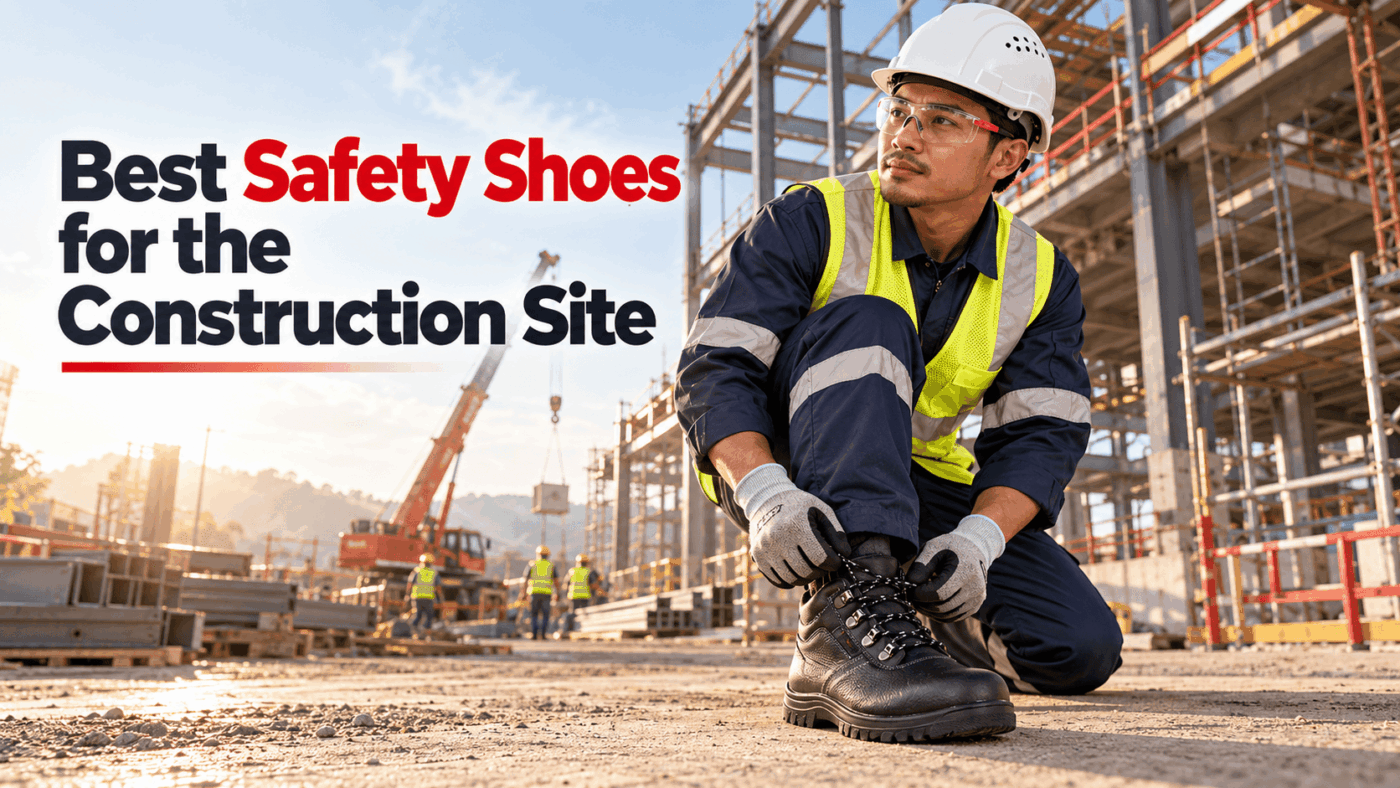
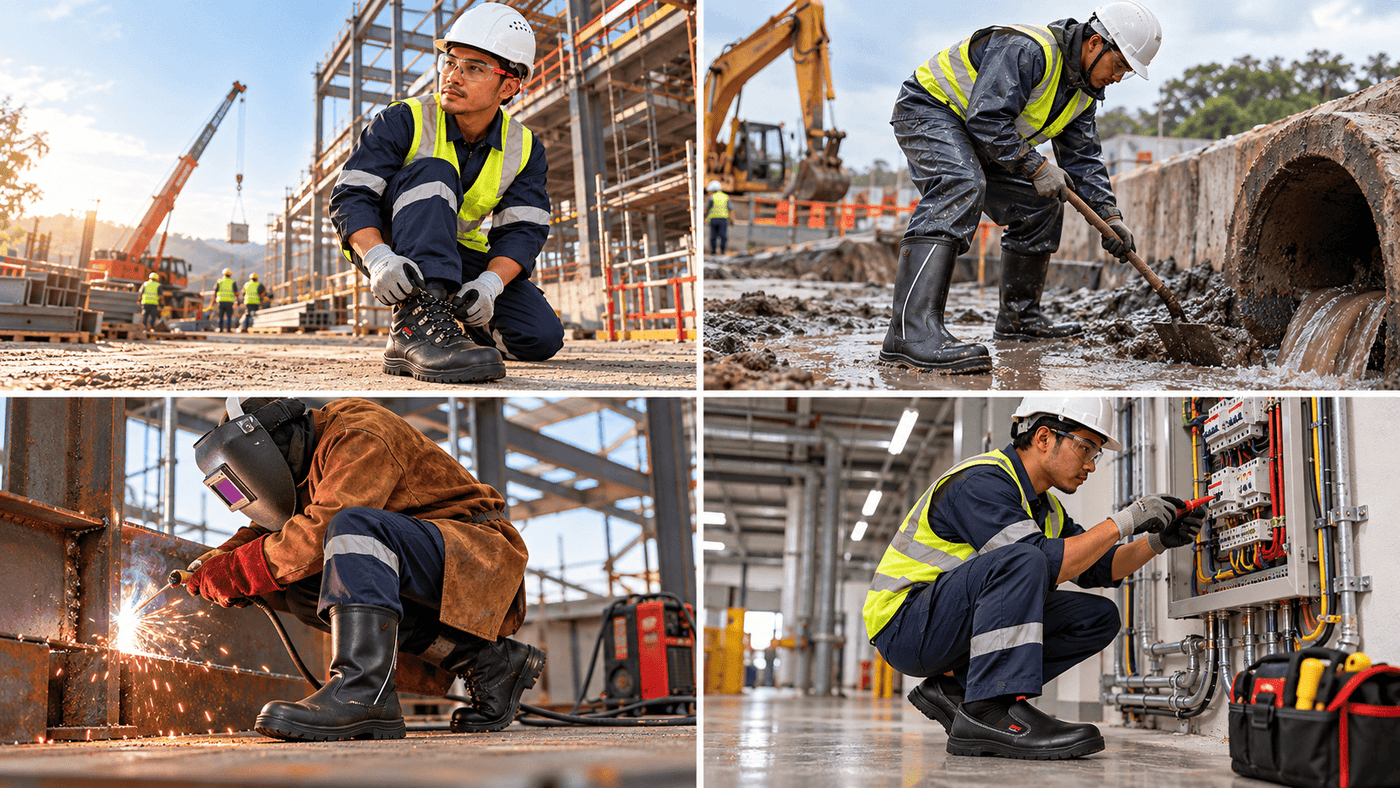
Construction workers face changing ground conditions, sharp debris, heavy materials, wet concrete, ladders, machinery and long hours on their feet. Consequently, the “best” construction safety shoe is not one universal model. It is the footwear that matches the worker’s task, site conditions and local requirements.
A dry indoor fit-out worker may need lightweight safety footwear with toe and puncture protection. In contrast, a civil worker in mud or standing water may need waterproof safety boots. An electrician, welder or foundry contractor may need additional protection that standard construction footwear does not provide.
This guide helps PPE buyers, contractors and safety managers identify the right protection, understand current markings and compare suitable SAFETYWARE RHINO SHOE options.
[!CALLOUT] 👷
Quick recommendation: Start with toe impact and sole-penetration risks. Then assess grip, water, heat, electrical, ankle and metatarsal hazards. Verify the exact standard edition, certificate and model marking before purchase, and conduct a representative wearer trial on the site.
Why Construction Footwear Requires a Task-Based Choice
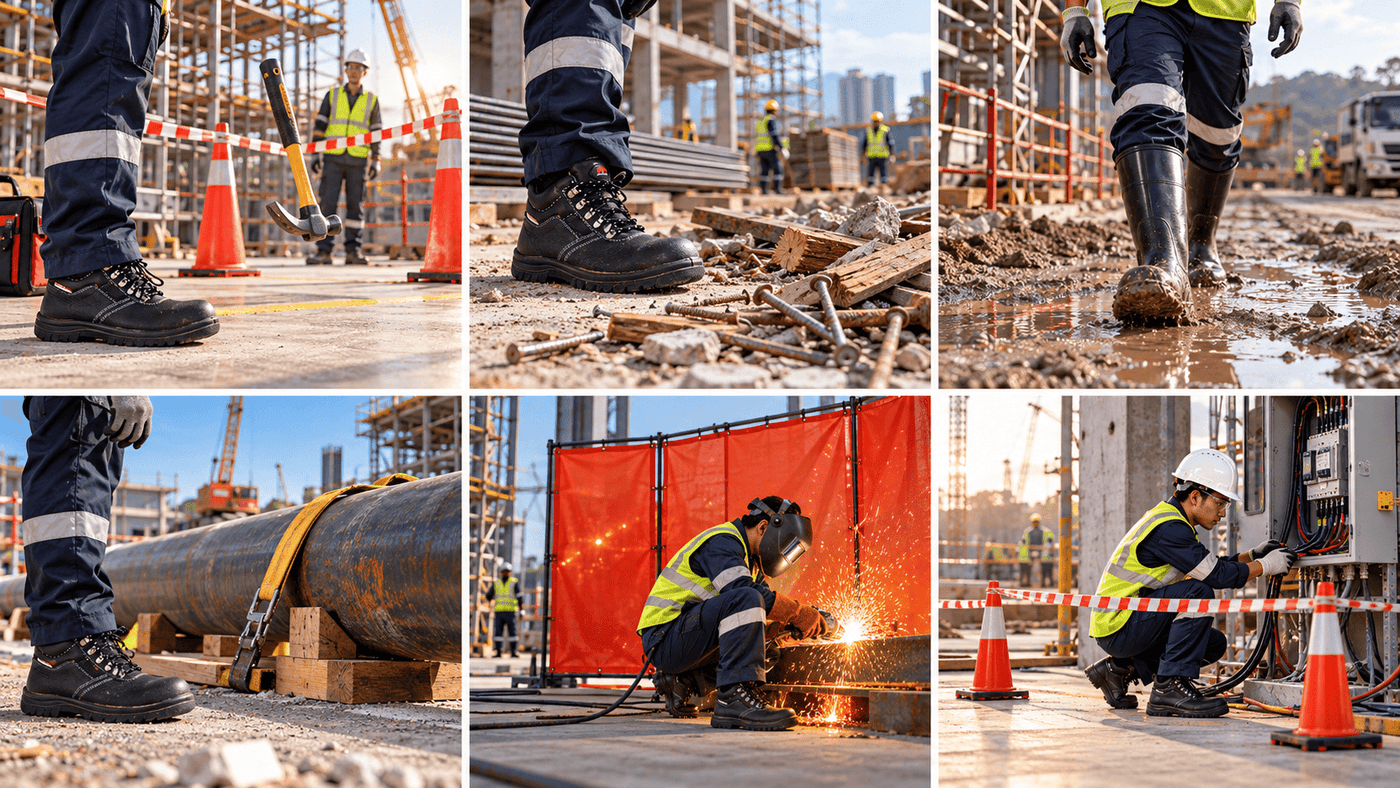
A construction site may contain several work environments at the same time. Footwear that suits a dry interior may perform poorly in an excavation, while a heavy waterproof boot may cause unnecessary fatigue during finishing work.
Common foot hazards include:
- Falling bricks, tools, steel sections and equipment
- Rolling pipes, cylinders, trolleys and plant components
- Nails, screws, tie wire, sharp offcuts and broken materials
- Wet concrete, mud, rainwater, oil and uneven ground
- Heat, sparks and hot surfaces during welding or roofing
- Electrical contact or step-and-touch potential
- Chemicals, fuels, cement and cleaning agents
- Ladder use and prolonged standing
- Cold, heat and moisture inside footwear
Safety footwear is only one control. Employers should first reduce hazards through housekeeping, material storage, debris removal, safe access routes, edge protection and suitable work methods. Footwear then helps manage the residual risk.
Legal Requirements, Product Standards and Site Rules
These three concepts are related but not interchangeable.
Legal Duties Depend on the Country
Construction employers must follow the law that applies where the work takes place. For example, US OSHA 29 CFR 1926.96 addresses occupational foot protection in construction. OSHA’s wider PPE rules also require hazard assessment, appropriate selection, proper fit and worker use.
In Malaysia, the Department of Occupational Safety and Health operates a PPE approval framework. DOSH states that approved PPE requires full type-test documentation and product certification from its appointed independent certification body. Buyers should check the current DOSH foot-protection approval list for the exact brand and model rather than assuming that approval covers an entire footwear range.
Singapore’s Workplace Safety and Health (Construction) Regulations address slipping hazards, falling objects and suitable PPE on construction sites. Project specifications may also reference SS 513 or other accepted footwear standards.
Therefore, international buyers should confirm destination-country law, product approval and project requirements before issuing a purchase order.
ISO 20345 Is a Product Standard
ISO 20345:2021, together with Amendment 1:2024, specifies basic and additional requirements for general-purpose safety footwear. It covers areas such as mechanical protection, slip resistance, thermal risks and ergonomic behaviour.
The European adoption is EN ISO 20345:2022+A1:2024. The European Commission has published this reference within the PPE harmonised-standards framework, which connects it to Regulation (EU) 2016/425 for relevant EU conformity assessment.
However, a standard marking does not prove suitability for every construction task. Special risks—including electrical insulation, foundry work, welding and chainsaw use—may require additional or separate standards.
Site Rules Add Practical Controls
Many contractors specify ankle-height boots, a particular colour, laces instead of pull-on construction, or footwear dedicated to certain zones. These may be sensible site practices, but they are not automatically universal legal requirements.
Keep the tender clear: state which requirements come from law, which come from a product standard and which are project-specific rules.
Understanding Current Safety Footwear Markings
The marking inside the footwear, its packaging and its certificate should identify the model and standard edition. Buyers must check the complete marking because a category symbol combines several properties.
Core Construction Categories
| Marking family | General meaning | Typical construction relevance |
|---|---|---|
| SB | Basic safety-footwear requirements, including protective toe | Limited starting point; usually insufficient for sharp-debris sites without additional properties |
| S1 | Closed heel plus antistatic and heel-energy-absorption properties | Dry indoor work where water penetration is not a concern |
| S1P, S1PL or S1PS | S1-type footwear with sole-penetration protection, depending on edition and insert type | Dry construction and fit-out work with nail or sharp-debris risk |
| S2 | S1 properties plus water penetration and absorption requirements for the upper | Damp work where sole-penetration protection is not required |
| S3, S3L or S3S | Combines water-related upper performance, sole-penetration protection and a cleated outsole, depending on edition | Common direction for outdoor and mixed-condition construction sites |
| S4 | Class II moulded footwear with safety-toe and specified protective properties | Wet work without an identified sole-penetration requirement |
| S5, S5L or S5S | Class II waterproof footwear with sole-penetration protection and cleated outsole, depending on edition | Muddy, wet or washdown construction tasks with sharp-debris risk |
The exact combination depends on the cited edition. Do not write “S3 is always better than S1P” without considering water exposure, insert type, outsole, fit and the task.
Why P, PL and PS Matter
The newer ISO 20345 edition distinguishes sole-penetration protection more clearly:
- P generally identifies the metallic penetration-resistant insert route.
- PL and PS identify non-metallic insert test routes using different nail diameters and requirements.
This change matters because thin nails and sharp construction debris can challenge inserts differently. Buyers should specify the required current marking and test edition instead of requesting only “steel plate” or “puncture-proof shoes.” No safety shoe is completely puncture-proof under every condition.
SR Replaced the Old SRA, SRB and SRC System
The 2021 ISO framework revised slip testing. The older SRA, SRB and SRC markings were removed, and the newer SR additional marking was introduced alongside the basic slip requirement.
Therefore, avoid converting an older SRC rating directly into a newer SR claim. Ask for the certificate, test conditions and edition. Then trial the footwear on representative site surfaces because laboratory floors cannot reproduce every combination of mud, dust, oil, water and wear.
Useful Additional Markings
Depending on the job, buyers may also examine:
- HRO — outsole resistance to hot contact
- WR — whole-footwear water resistance
- WPA — water penetration and absorption performance of the upper
- FO — resistance of the outsole to fuel oil
- AN — ankle protection
- M — metatarsal protection
- LG — ladder-grip requirement
- CI or HI — cold or heat insulation
Not every construction worker needs every property. Extra features can increase weight, stiffness or cost, so select them from the risk assessment.
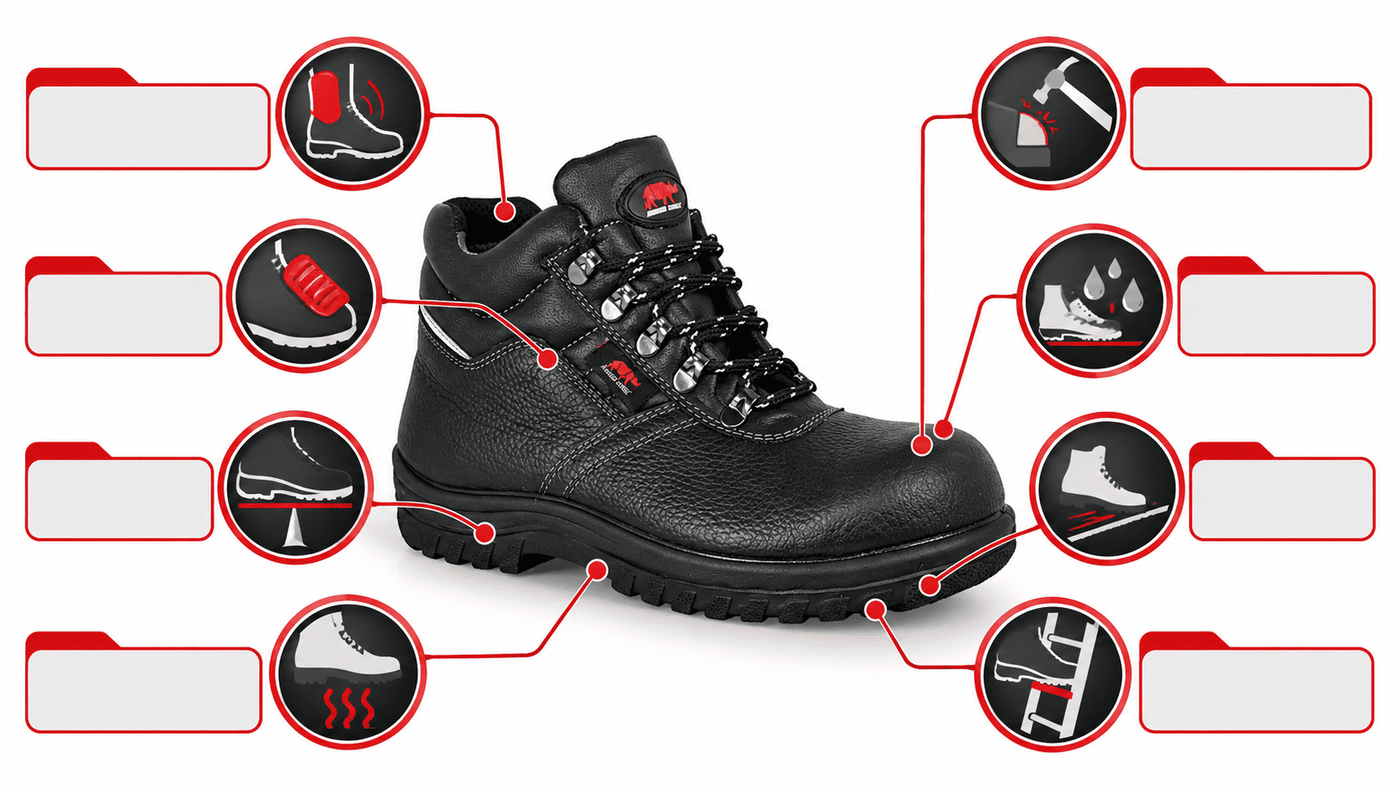
[Image placement suggestion 3 — Safety-footwear marking guide: see the complete prompt at the end.]
Seven Features to Prioritise on Construction Sites
1. Protective Toe Performance
Toe protection helps manage impact and compression hazards from falling or rolling objects. ISO 20345 safety footwear uses a 200-joule toe-impact basis, while ASTM F2413 uses its own marking and performance system.
Steel, aluminium and non-metallic toe caps can all provide certified protection when built and tested as part of the complete shoe. Material alone does not determine compliance. Confirm the whole-footwear certificate and allow enough toe room for the worker.
2. Sole-Penetration Protection
Nails, screws, tie wire and sharp offcuts make sole protection important on many construction sites. Metallic inserts and non-metallic textile inserts have different strengths, flexibility and test markings.
Choose the tested footwear system rather than focusing only on insert material. Damage, wear, modifications and incompatible replacement insoles may affect performance.
3. Grip for the Actual Surface
Construction surfaces vary from smooth indoor concrete to dusty tiles, metal decking, wet timber, mud and sloped access routes. One outsole cannot provide maximum grip everywhere.
The UK Health and Safety Executive recommends considering the real floor and contaminant and, where needed, trialling footwear rather than choosing only from catalogue descriptions. Also remember that oil-resistant describes resistance to material degradation; it does not automatically mean slip-resistant.
4. Water Management
Water-resistant leather or microfibre footwear may suit occasional damp exposure. However, standing water, excavation work and heavy rain may require fully waterproof footwear.
Check the distinction between upper water penetration resistance and whole-footwear waterproofing. Also evaluate boot height, entry from the top, drying time and moisture management inside the boot.
5. Sole Construction and Durability
Construction footwear often encounters abrasion, sharp edges, fuels, cement residue and rough terrain. Review:
- Outsole material and tread design
- Bonding or direct-injection construction
- Resistance to the actual oils and chemicals
- Flexing and abrasion performance
- Scuff protection at the toe
- Ease of removing lodged debris
A harder outsole may last longer but may not provide the same grip or cushioning as a softer compound. Balance durability, traction and comfort.
6. Secure Fit and Ankle Support
Mid-cut or high-cut footwear can provide more coverage and may support stability, but boot height alone does not prove certified ankle protection. Look for an AN marking when certified ankle protection is required.
The heel should remain secure, the toes should not strike the toe cap and the footwear should allow safe stair and ladder movement. Test the complete system with the socks workers will use.
7. Comfort for the Full Shift
Workers may walk several kilometres and stand for hours. Heavy or poorly fitted footwear can increase fatigue and may discourage correct use.
Check cushioning, forefoot width, weight, flexibility, breathability and size availability. Conduct a structured trial with workers from different trades and foot shapes before standardising the model.
Best Safety Shoes by Construction Task
| Construction task | Main hazards | Practical footwear direction | Additional checks |
|---|---|---|---|
| General building and fit-out | Falling objects, nails, dry debris | Safety toe plus penetration-resistant sole; low-cut or mid-cut according to site rule | Grip, fit, cushioning and toe scuff resistance |
| Outdoor civil and infrastructure work | Mud, rain, uneven ground, sharp debris | S3/S3L/S3S-type safety boot or equivalent current marking | Water performance, tread clearing and ankle coverage |
| Excavation, drainage and wet works | Standing water, mud, sharp objects | Waterproof S5/S5L/S5S-type Wellington boot where suitable | Boot height, calf fit, top-entry risk and comfort |
| Roofing and hot-surface work | Heat, slopes, sharp debris | Footwear selected for grip and required thermal properties | HRO where justified, roof material, slope and fall controls |
| Welding and hot work | Sparks, hot particles, contact heat | Specialist high-cut or pull-on footwear suitable for hot work | EN ISO 20349 where applicable; smooth closures; trouser overlap |
| Electrical installation | Impact, puncture and possible electrical hazard | Certified electrical-hazard or dielectric footwear where assessment requires it | Dry conditions, voltage/task rating and supplementary status |
| Steel fixing and heavy material handling | Impact, compression, sharp steel | Toe and penetration protection; consider metatarsal protection | M marking where required, secure closure and abrasion resistance |
| Ladder-intensive work | Rung pressure and repeated climbing | Secure heel and suitable sole profile | LG marking where specified, ladder compatibility and fatigue |
Electrical Work Requires Special Care
Antistatic footwear and electrical-hazard footwear serve different purposes. Antistatic footwear controls electrostatic charge within a specified resistance range; it is not electrical insulation against live circuits.
ASTM F2413-24 includes performance requirements for protective-toe footwear against several hazards, including electrical shock resistance. OSHA describes electrical-hazard or dielectric footwear as supplementary protection where step-and-touch potential remains and primary electrical controls do not provide complete protection.
Electrical footwear has limitations. Water, wear, contamination and damage can reduce protection. A competent electrical-safety person should determine the required footwear, work method and inspection process. Never use a general S3 or antistatic claim as proof of electrical protection.
When Standard Construction Shoes Are Not Enough
Use specialist footwear and standards for hazards outside ordinary construction use, including:
- Welding and foundry exposure
- Chainsaw operation
- Live electrical work requiring dielectric footwear
- Molten-metal splash
- Significant chemical contact
- Explosive atmospheres requiring conductive or static-control measures
- Firefighting and emergency response
Do not combine incompatible requirements without technical review. For example, conductive footwear and electrical-hazard footwear address opposite electrical concerns.
Construction Safety Footwear Procurement Checklist
- Divide the site into tasks and surface conditions.
- Record impact, compression, penetration, slip, water, thermal and electrical hazards.
- Check destination-country legal and approval requirements.
- State the required standard and edition in the purchase specification.
- Obtain the complete footwear classification and additional markings.
- Verify the exact brand, model, size range and certificate.
- Confirm whether the puncture insert is marked P, PL or PS under the relevant edition.
- Review slip testing without directly equating old SRC and new SR markings.
- Check chemical and fuel compatibility against actual site substances.
- Run a representative wearer trial on real site surfaces.
- Confirm compatibility with ladders, trousers and other PPE.
- Provide training on fastening, cleaning, drying and inspection.
- Define replacement and incident-inspection criteria.
Daily Inspection and Replacement
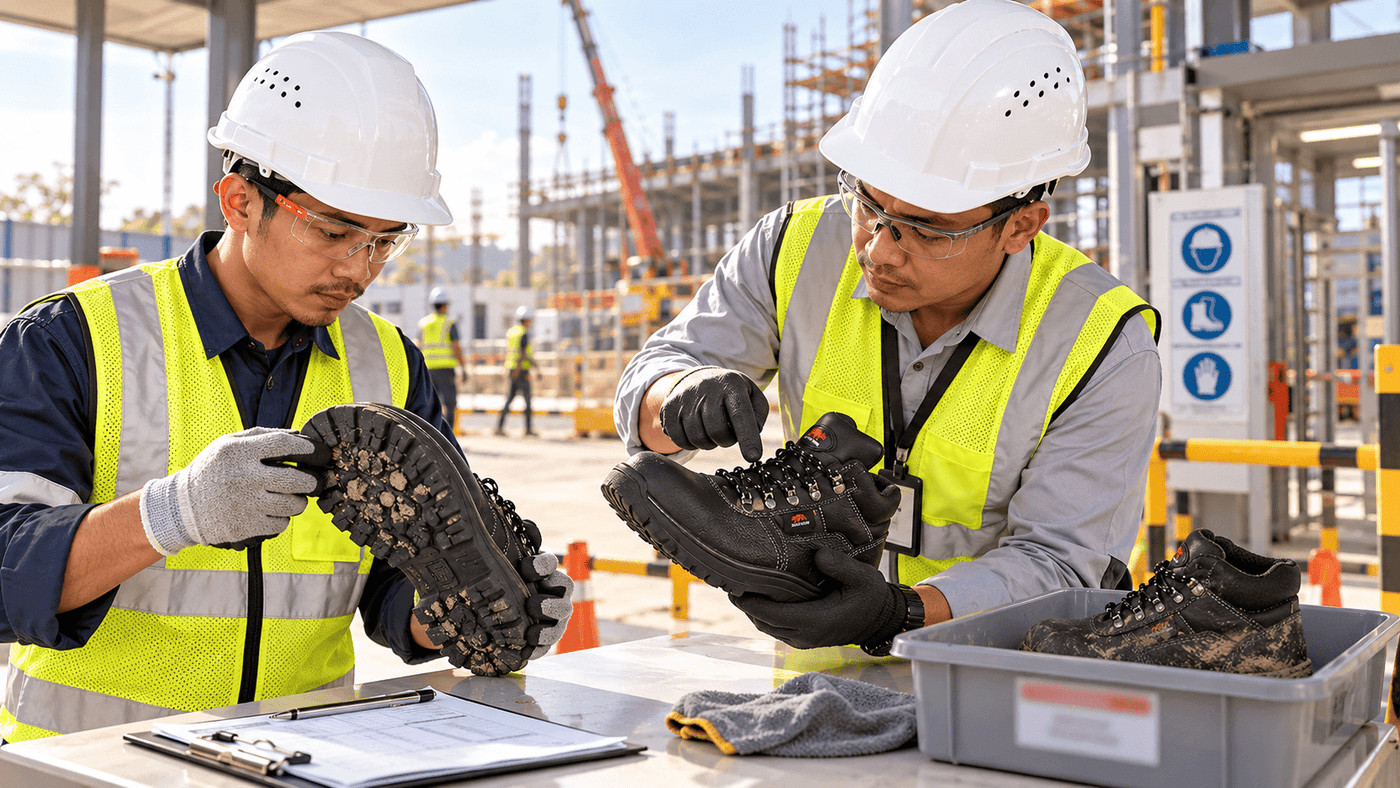
Workers should inspect safety footwear before use. Check for:
- Worn, smooth, cracked or separated outsoles
- Cuts, holes or open seams in the upper
- Exposed or damaged toe caps
- Penetration damage or embedded nails
- Broken laces, eyelets, zips or pull tabs
- Tread packed with mud, concrete or debris
- Chemical, fuel or oil contamination
- Wet or damaged lining and insoles
- Loss of fit, heel security or cushioning
- Damage after impact, compression, heat or electrical exposure
Replace footwear when damage can affect protection or safe movement. Do not wait for the outsole to become completely smooth. Follow the manufacturer’s cleaning and drying instructions; direct high heat can damage some materials and bonding systems.
Avoid unapproved repairs, resoling or aftermarket components that could affect certified performance. ASTM F2413-24 specifically warns that changes to original components may invalidate the marking.
Common Buying Mistakes
- Buying one shoe for every trade. Civil workers, electricians and indoor fit-out teams face different hazards.
- Choosing only by boot height. A high-cut boot does not automatically provide certified ankle protection.
- Assuming steel is always stronger. Certified non-metallic components can meet relevant requirements when tested as part of the footwear.
- Treating oil resistance as slip resistance. They are different properties.
- Confusing antistatic and electrical-hazard footwear. They address different electrical risks.
- Ignoring the standard year. Old and new classification symbols are not always directly comparable.
- Selecting the cheapest compliant model without a trial. Poor fit, fatigue or unsuitable grip can defeat the programme.
- Approving a brand instead of a model. Certification and local approval normally apply to named models, not every product under the brand.
SAFETYWARE Products and Solutions
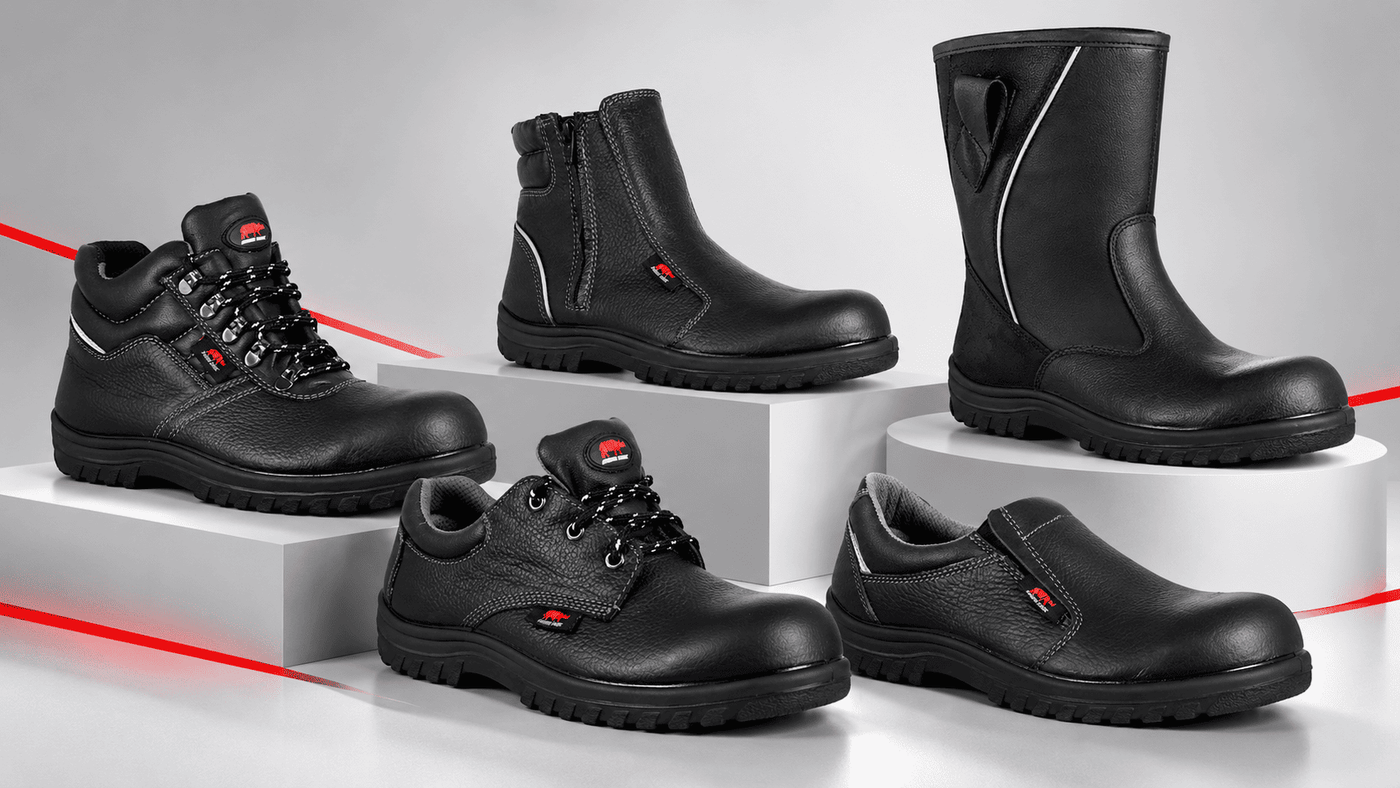
SAFETYWARE manufactures and supplies RHINO SHOE safety footwear for construction and industrial work. The following models suit different hazard profiles; buyers should confirm current documentation and task suitability before ordering.
RHINO SHOE Ultranite UN201SP Mid-Cut Safety Shoes
The UN201SP uses a mid-cut lace-up design, full-grain leather upper, protective toe, non-metallic penetration-resistant midsole and direct-vulcanised nitrile-rubber outsole. Its published S1P HRO SRC documentation relates to an older marking system, so buyers should review the current certificate and project acceptance requirements. It is a practical candidate for dry general construction and fabrication tasks where heat-resistant outsole and penetration protection are relevant.
RHINO SHOE Ultranite UN203SP Mid-Cut Zip-Up Safety Shoes
The UN203SP combines a mid-cut format with laces and a side zip for practical access. SAFETYWARE publishes S3 HRO SRC documentation for this model. It may suit mixed indoor and outdoor construction work where toe, penetration and water-related upper performance are needed. Confirm the supplied model’s current marking and certificate.
RHINO SHOE Ultranite UN302SP High-Cut Pull-Up Safety Boots
The UN302SP is a high-cut pull-up leather boot with a protective toe, penetration-resistant midsole and nitrile-rubber outsole. The pull-on design removes exposed laces, while the high shaft increases coverage. Consider it for demanding general construction and hot-work support only after reviewing the task, fit and current documentation.
RHINO SHOE UltraMax WB500-S5 Wellington Boots
The WB500-S5 is a waterproof PVC Wellington safety boot with a protective toe and penetration-resistant plate. It is a possible option for wet civil work, drainage, muddy ground and washdown environments. Verify chemical compatibility, outsole performance, calf fit and current certification for the destination market.
RHINO SHOE VoltGuard EH101KP Electrical-Hazard Safety Shoes
The EH101KP is intended for work where electrical-hazard footwear is identified as supplementary protection. SAFETYWARE provides ASTM test documentation for the model. A competent electrical-safety person should confirm the application, voltage exposure, dry-use limitations and inspection programme; it is not a substitute for isolation or primary electrical PPE.
SAFETYWARE can support contractors, distributors and project buyers with model comparison, sizing, product specifications and available certification. Request the latest documents for the exact model and destination country before final approval.
Conclusion
The best safety shoes for a construction site are the shoes that match the task. General building work often requires protective toes, sole-penetration resistance and reliable grip. Wet civil work may require waterproof S5-type boots, while hot work, electrical tasks and foundry exposure need specialist properties.
Read the entire marking, including the edition and additional symbols. Do not compare old SRC or S1P labels directly with newer SR, S1PL or S1PS classifications without reviewing the test basis. Most importantly, verify the exact model’s certificate and local approval, then conduct a wearer trial on representative site surfaces.
A well-designed footwear programme combines product performance with fit, training, inspection, housekeeping and timely replacement.
Sources and References
Information and links checked on 30 September 2026.
- ISO 20345:2021 — Personal protective equipment: Safety footwear
- ISO 20345:2021/Amd 1:2024
- European Commission Decision (EU) 2024/2599 — Harmonised footwear standards
- ASTM F2413-24 — Protective toe-cap footwear
- US OSHA 29 CFR 1926.96 — Occupational foot protection
- UK HSE — Slip-resistant footwear
- Malaysia DOSH — PPE approval requirements
- Malaysia DOSH — Approved foot-protection models
- Singapore WSH Construction Regulations
- SAFETYWARE — General-purpose safety shoes
- SAFETYWARE — PVC Wellington safety boots
📞 Need More Information?
Looking for Reliable Safety Shoes in Malaysia?
Explore SAFETYWARE’s safety shoes and workplace PPE range at
👉Safetyware Catalogs
Our safety specialists can help evaluate workplace hazards, recommend suitable safety helmets, and support compliance with Malaysia workplace safety requirements.
If you need a quotation, feel free to contact us at:
📩 Email: [email protected]
📞 Tel: WhatsApp Us