

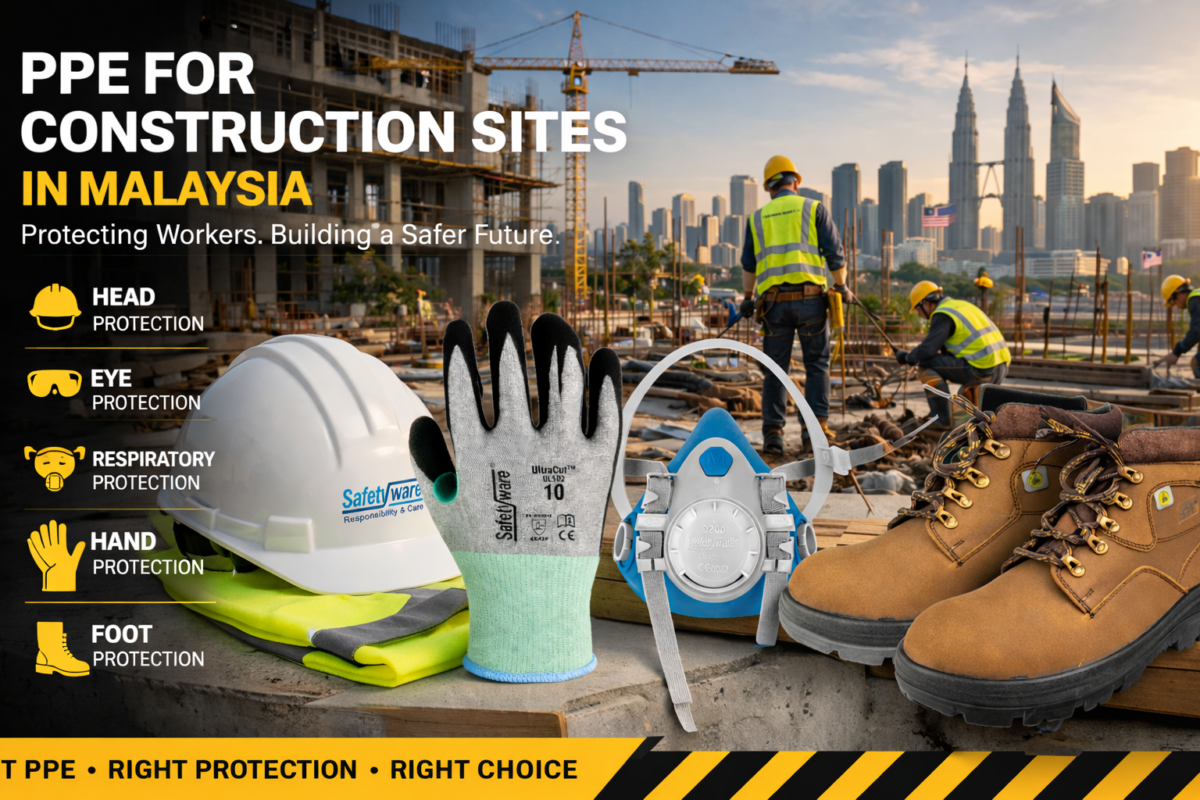
Construction remains one of the highest-risk industries in Malaysia. According to the Department of Occupational Safety and Health, the sector consistently ranks among the top contributors to workplace fatalities. Common causes include falls from height, struck-by incidents, and electrocution.
However, many of these incidents are preventable. In most cases, failures in basic safety controls — especially improper use of Personal Protective Equipment (PPE) — contribute to these accidents. Therefore, using the correct PPE for construction sites in Malaysia plays a critical role in site safety.
Malaysia regulates construction safety through the Occupational Safety and Health Act 1994, the Factories and Machinery Act 1967, and CIDB and DOSH guidelines. Under these laws, employers must provide appropriate PPE based on site-specific risk assessments. As a result, compliance with PPE for construction sites in Malaysia becomes both a legal and operational priority.
In practice, workers use several types of PPE for construction sites in Malaysia. These include safety helmets (SIRIM or CE certified), EN ISO 20345 safety footwear, high-visibility clothing, and fall protection systems for work at height (commonly above 2 metres). In addition, workers must use task-specific PPE such as eye and respiratory protection. Therefore, teams must select the right PPE for construction sites in Malaysia based on actual site hazards.
Overall, this guide explains the key PPE categories, certifications checked during DOSH inspections, trade-specific requirements, and a practical compliance checklist for your site.
This guide is based on Malaysian DOSH guidelines, international PPE standards (EN, ISO), and industry best practices in construction safety.
What is PPE in construction?
Personal Protective Equipment (PPE) refers to safety gear worn by construction workers to reduce exposure to workplace hazards such as falling objects, sharp materials, airborne dust, hazardous chemicals, and high noise levels.
What PPE Is Legally Required on Construction Sites in Malaysia?
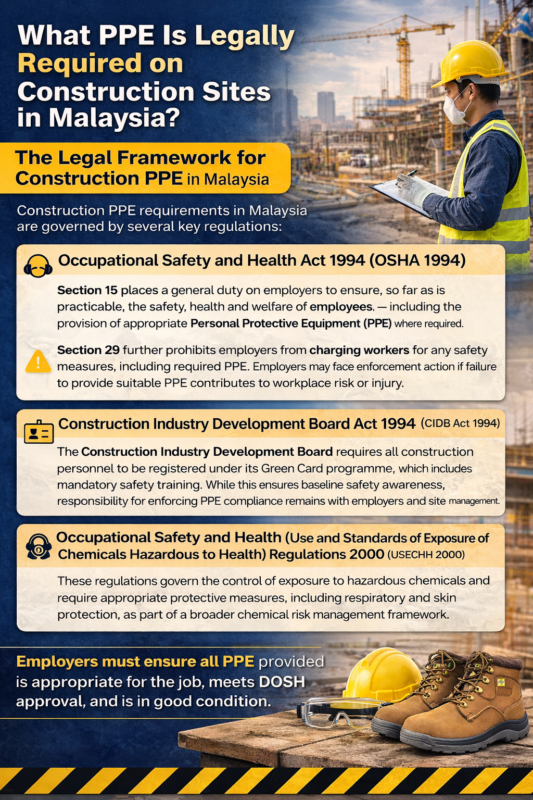
The Legal Framework for Construction PPE in Malaysia
Construction PPE requirements in Malaysia are governed by key regulations, including OSHA 1994, the CIDB Act 1994, and USECHH 2000. These laws require employers to provide appropriate PPE, ensure workers receive proper safety training, and control exposure to workplace hazards. Employers must also supply PPE at no cost and ensure it remains suitable for site risks.
The poster above summarises the key legal requirements for construction PPE in Malaysia.
DOSH officers from the Department of Occupational Safety and Health conduct both announced and unannounced inspections on construction sites. Enforcement actions may include stop-work orders, improvement notices, and prosecution. Under OSHA 1994 (as amended), penalties can reach fines of up to RM 500,000 and/or imprisonment for serious non-compliance.
Read more 👉 OCCUPATIONAL SAFETY AND HEALTH ACT 1994
The 7 Essential PPE Categories for Construction Sites in Malaysia

1. Head Protection — Safety Helmets
The safety helmet is one of the most recognisable and heavily scrutinised pieces of construction PPE. In Malaysia, helmets used on construction sites must comply with MS 1869:2015 (the Malaysian Standard aligned with EN 397) or an equivalent internationally recognised standard such as EN 397-certified helmets.
Key EN 397 performance requirements include impact absorption, penetration resistance, and lateral deformation performance under standardised test conditions. Depending on site-specific risks, additional optional properties may be required, including:
- Electrical insulation (e.g. up to 440V AC) — may be required for certain electrical works based on risk assessment
- Very low temperature performance — relevant for cold storage or refrigerated facility construction
- Chin strap retention — commonly required where there is a risk of helmet displacement, such as work at height
Do safety helmets expire?
Yes — but not based on a single fixed legal rule. Most manufacturers specify a service life, commonly around 3–5 years depending on usage and storage conditions.
Helmets should be inspected regularly (at least monthly) for cracks, deformation, brittleness, or UV-related discolouration. Any helmet that has sustained a significant impact should be replaced immediately, even if no visible damage is present.
👉 Key certification: MS 1869 / EN 397
👉 Browse our range of certified safety helmets suitable for construction sites in Malaysia.
2. Foot Protection — Safety Boots
Foot Protection — Safety Boots
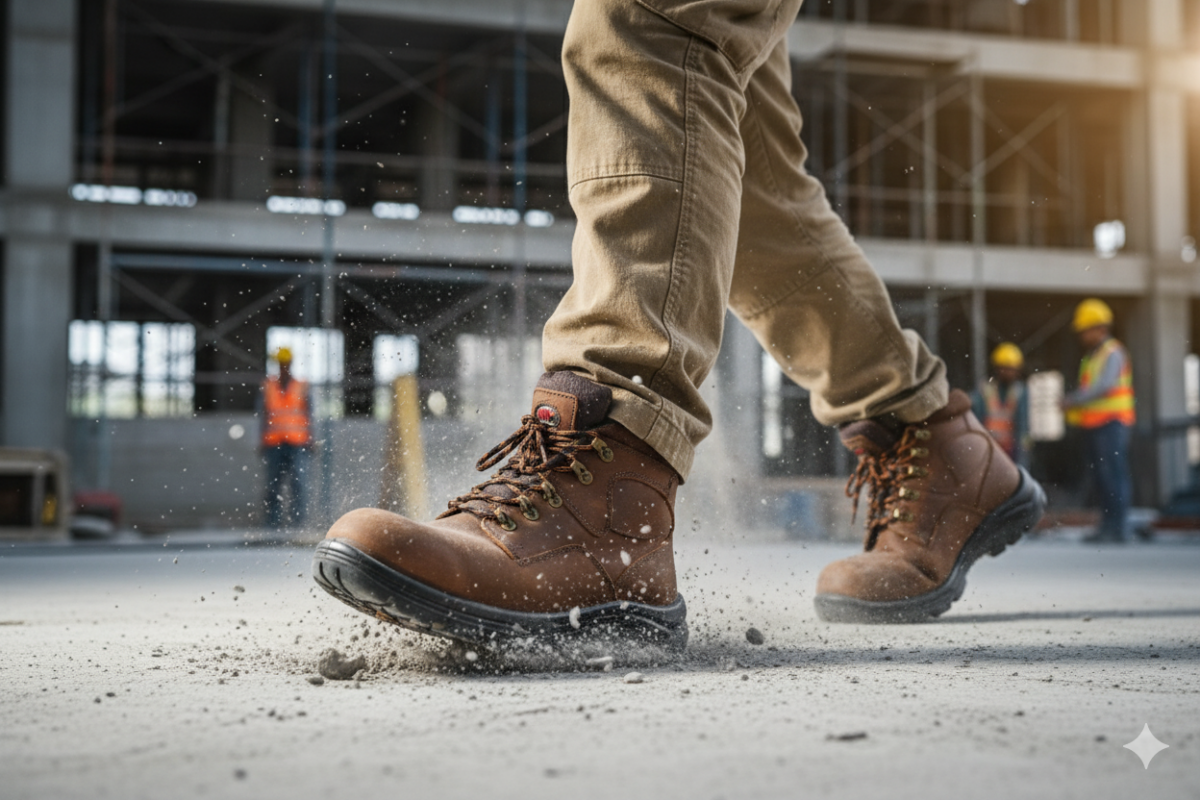
Malaysian construction sites often have uneven ground, exposed rebar, sharp materials, and heavy loads. Therefore, workers must wear durable and protective footwear. In most cases, this means using footwear compliant with EN ISO 20345, with S3-rated boots as the standard choice.
S3 vs S5 Safety Boots
- S3: Provides a 200-joule toe cap, anti-penetration midsole, slip-resistant outsole, and water-resistant upper. As a result, workers use S3 boots for most construction environments.
- S5: Offers the same protection as S3 but with a fully waterproof design. Therefore, teams use S5 boots in wet conditions such as foundation, excavation, and piling works.
Electrical Hazard (EH) Footwear
For electrical work, teams may require electrical hazard (EH)-rated footwear. Manufacturers test these boots under standards such as ASTM F2892 to resist electrical shock under controlled conditions.
However, workers must not rely on EH footwear as the primary protection. Instead, they must follow proper electrical isolation and lockout procedures at all times.
👉 Key certification: EN ISO 20345 (S3/S5) | ASTM F2413 / F2892 (EH-rated footwear)
👉 Browse our range of EN ISO 20345 safety boots for construction use.
3. Fall Protection — Safety Harnesses
Fall Protection — Safety Harnesses
Falls from height remain the leading cause of construction fatalities in Malaysia, according to the Department of Occupational Safety and Health. Therefore, site teams must prioritise fall protection on all construction projects.
When Is a Safety Harness Required?
DOSH guidelines recommend using a full-body harness when workers operate at heights of 2 metres or above. In addition, teams must use fall protection whenever a fall risk exists and no adequate edge protection—such as guardrails or toe boards—is in place.
Key Components of a Fall Arrest System
A harness alone does not provide full protection. Instead, workers must use a complete fall arrest system, which includes:
- Anchorage point: Teams must install a properly designed anchor that can withstand at least 12–15 kN (EN 795) or 5,000 lbs (OSHA guidance)
- Connecting element: Workers should use lanyards (EN 354) or self-retracting lifelines (EN 360)
- Energy absorber: This component limits arrest forces to safe levels (typically ≤6 kN under EN 355)
In addition, teams must calculate fall clearance distance and position anchor points correctly to prevent ground impact.
👉 Key certifications: EN 361 (harness) | EN 795 (anchor devices) | EN 354 (lanyards) | EN 360 (self-retracting lifelines)
👉 Explore our full range of certified safety harness and fall protection systems.
4. Eye and Face Protection
Flying debris, concrete and cement dust, grinding sparks, and chemical splashes are constant hazards on construction sites. Eye injuries are often severe, sometimes permanent, and almost always preventable with appropriate protection.
The selection of eye and face protection should be task-specific and compliant with recognised standards such as EN 166 or ANSI Z87.1.
| Task | Required Protection | Standard |
| General carpentry, formwork | Safety glasses with side shields | EN 166 / ANSI Z87.1 |
| Grinding and cutting | Face shield over safety glasses (dual protection) | EN 166 |
| Concrete breaking / demolition | Sealed or dust-resistant safety goggles | EN 166 |
| Chemical handling (release agents, solvents) | Indirect-vent goggles rated for liquid splash (EN 166 marking “3”) | EN 166 |
| Arc welding | Welding helmet with auto-darkening filter | EN 379 |
| Oxy-fuel cutting | Goggles with appropriate filter shade (typically shade 4–5) | EN 169 |
| Working at height (falling dust/debris) | Safety goggles | EN 166 |
When selecting eye protection, additional markings should be considered, including optical class (Class 1 for continuous use), impact resistance ratings, and specific hazard markings (e.g. dust, liquid splash, or molten metal protection).
👉Key certifications: EN 166 (Europe) | ANSI Z87.1 (USA)
👉 View our selection of certified eye and face protection
5. High-Visibility Clothing
High-Visibility Clothing
Workers on Malaysian construction sites often operate near moving vehicles and plant equipment such as excavators, cranes, mixers, and forklifts. Therefore, they must wear high-visibility clothing to stay visible and reduce accident risks.
Employers typically require garments compliant with EN ISO 20471. In addition, they must choose the correct class based on site risk and visibility conditions.
Class 2 vs Class 3
- Class 2: Provides at least 0.50 m² of fluorescent material with reflective strips. Teams commonly use this for general construction work.
- Class 3: Provides at least 0.80 m² of high-visibility material. As a result, it offers higher visibility and suits traffic control or low-light conditions.
👉Key certification: EN ISO 20471
👉 Browse high-visibility clothing compliant with EN ISO 20471.
6. Hand Protection
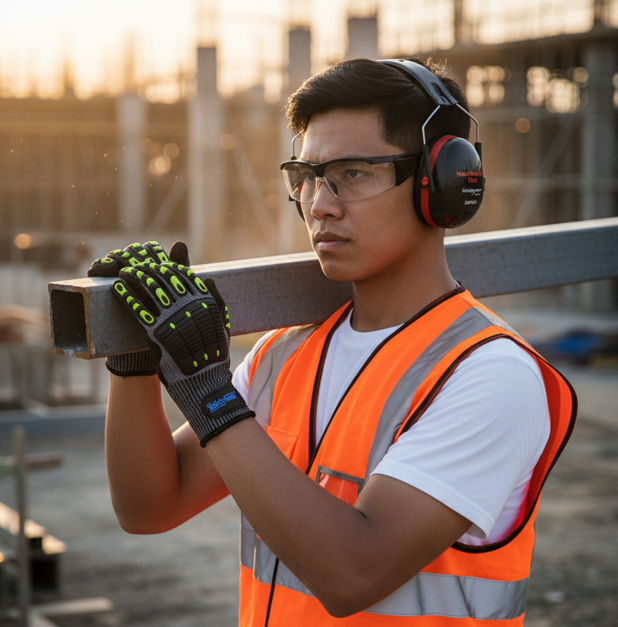
Construction work involves many manual tasks, each with different risks such as cuts, abrasions, chemical exposure, and electrical hazards. Therefore, workers must select gloves based on task-specific risk assessments and relevant standards such as EN 388, EN 374, and IEC 60903.
Glove Selection by Task
- General handling: Use general-purpose gloves with good abrasion resistance and moderate cut protection where needed (e.g. EN 388 levels B–C).
- Rebar and sheet metal: Use high cut-resistant gloves (EN 388 levels D or E) to protect against sharp edges.
- Electrical work: Use insulating rubber gloves rated under IEC 60903. In addition, workers must inspect and test them regularly.
- Chemical handling: Use nitrile or neoprene gloves compatible with the specific chemical (EN 374).
- Concrete work: Use waterproof or coated gloves. Fresh concrete is highly alkaline and can cause burns with prolonged contact.
Fit and Maintenance
Workers must balance protection with dexterity. Gloves that are too bulky reduce grip, while poor fit increases risk. Therefore, workers should replace damaged or contaminated gloves immediately.
👉Key certifications: EN 388 (mechanical protection) | EN 374 (chemical resistance) | IEC 60903 (electrical insulation)
👉 Explore our range of safety gloves for construction and industrial use.
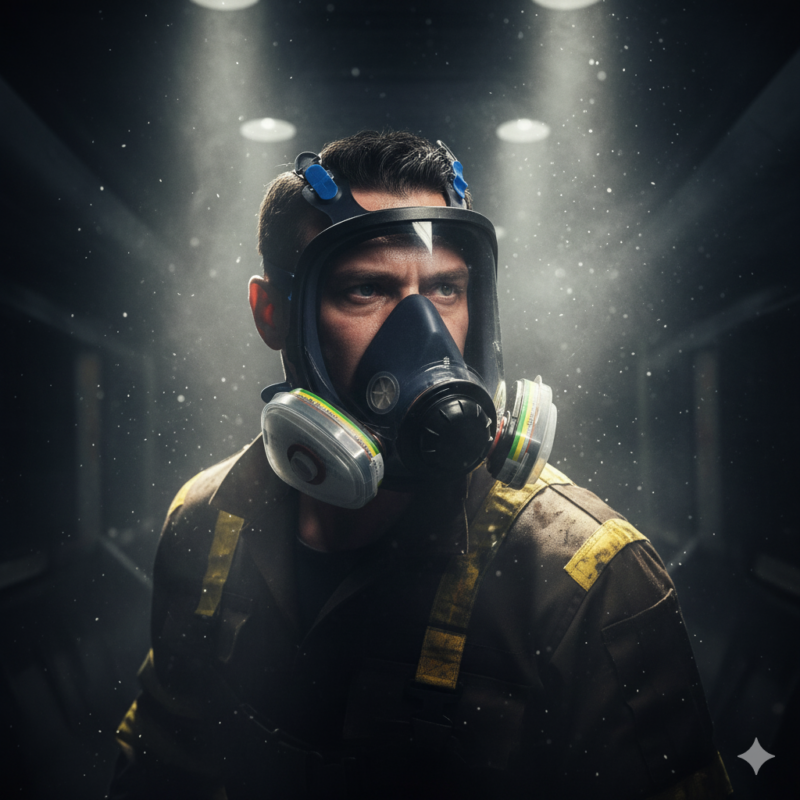
7. Respiratory Protection
Construction activities generate airborne hazards from multiple sources, including dust, fumes, vapours, and hazardous fibres. Effective respiratory protection depends on selecting equipment appropriate to the specific contaminant and exposure level.
- Concrete cutting, demolition, and grinding: At minimum, FFP2 respirators (≥94% filtration efficiency) should be used where airborne dust is present. FFP3 respirators (≥99%) are recommended where respirable crystalline silica is generated. Silica dust from concrete and masonry is classified as a Group 1 carcinogen by the International Agency for Research on Cancer and can cause silicosis, an irreversible and potentially fatal lung disease. This is not a nuisance hazard — it requires proper respiratory protection.
- Spray painting, adhesives, solvents: Half-face respirators fitted with appropriate organic vapour (OV) cartridges should be used. Cartridge selection and replacement schedules must be matched to the specific chemical exposure.
- Confined space entry: Supplied-air respirators or self-contained breathing apparatus (SCBA) may be required, depending on atmospheric conditions. These must be used as part of a comprehensive confined space entry control system, including air monitoring and permit procedures.
- Asbestos removal (legacy buildings): Full-face respirators with P3 filters are required. Asbestos work must be carried out by specialist contractors in accordance with DOSH regulations.
Tight-fitting respirators require proper fit testing to ensure an effective seal. Factors such as facial hair can significantly reduce protection and must be controlled.
👉Key certifications: EN 149 (FFP disposable masks) | EN 140 (half-face respirators) | MS 1479 (Malaysia)
👉 View certified respirators and respiratory protection equipment.
Construction PPE Compliance Checklist (DOSH / OSHA 1994)
Use this checklist for daily pre-work toolbox talks and DOSH audit preparation:
| PPE Item | Certification Required | When Required |
| Safety helmet | MS 1869 / EN 397 | Typically required across all active construction areas (site policy) |
| Safety boots | EN ISO 20345 (S3 commonly used) | Required for all site personnel exposed to physical hazards |
| High-visibility vest / jacket | EN ISO 20471 Class 2 or 3 | Required where there is vehicle or plant movement |
| Full-body harness | EN 361 | Required when working at height (commonly ≥2m) without adequate edge protection |
| Safety lanyard / SRL | EN 354 / EN 360 | Required as part of a complete fall arrest system |
| Safety glasses | EN 166 | Required for cutting, drilling, grinding, and overhead work |
| Chemical goggles | EN 166 (liquid splash protection, marking “3”) | Required during chemical handling |
| Face shield | EN 166 | Required for grinding, cutting, and high-impact tasks (with safety glasses) |
| FFP2 / FFP3 respirator | EN 149 | Required for dust-generating work (e.g. concrete cutting, demolition) |
| Half-face respirator (OV cartridge) | EN 140 + appropriate filter (e.g. EN 14387) | Required for solvent, paint, and vapour exposure |
| Cut-resistant gloves | EN 388 (Level C or higher where needed) | Required for handling sharp materials (rebar, sheet metal, glass) |
| Electrical insulating gloves | IEC 60903 | Required for electrical work depending on voltage level |
| Hearing protection (≥SNR 25) | EN 352 | Required where noise exposure exceeds 85 dB(A) |
| Knee pads | — | Recommended for prolonged kneeling tasks (e.g. tiling, flooring) |
| Welding helmet | EN 379 (filter) | Required for arc, MIG, and TIG welding |
PPE Requirements by Construction Trade in Malaysia
Structural and Civil Works
Workers in foundation, structural, and concrete works face impact, cut, and dust hazards. Therefore, they should wear S3 safety boots, helmets, high-visibility clothing, and cut-resistant gloves for rebar handling.
In addition, workers should use FFP2 respirators during concrete breaking or other dust-generating tasks. They should also wear safety glasses for overhead work. For concrete pouring, workers must use chemical-resistant gloves because wet concrete is highly alkaline.
Electrical Works (LV/HV)
Electrical work involves specialised risks, so workers must use task-specific PPE. For live work, they must wear insulating rubber gloves compliant with IEC 60903 and test them regularly.
Furthermore, workers may need electrical hazard-rated footwear, arc-rated clothing, and face shields with suitable arc ratings. These are especially important for switchgear operations and LV panel installation.
Scaffolding and Working at Height
Workers on scaffolds or near unprotected edges must use proper fall protection. Typically, they use full-body harnesses connected to secure anchorage points. In addition, they should wear helmets with chin straps to prevent displacement.
At the same time, teams must maintain good housekeeping. They should secure tools and materials and set up exclusion zones below active work areas.
Demolition Works
Demolition work creates high-risk conditions, including structural instability and airborne dust. Therefore, workers should use enhanced PPE such as FFP3 respirators, heavy-duty cut-resistant gloves, and S3 or S5 safety boots.
If asbestos is present, workers must use full-face respirators with P3 filters. In addition, only specialist contractors should carry out this work. Teams must also prepare a method statement and risk assessment before starting.
Road and Highway Construction
Workers near live traffic face high visibility and noise risks. Therefore, they should wear Class 3 high-visibility clothing compliant with EN ISO 20471.
In addition, they should use hearing protection, slip-resistant S3 boots, and eye protection. At the same time, teams must implement proper traffic management controls to improve overall safety.
How to Choose a DOSH-Compliant PPE Supplier in Malaysia
Selecting the right construction PPE supplier is critical — not only for compliance with Department of Occupational Safety and Health requirements, but also for ensuring worker safety and audit readiness.
The following checks help protect your organisation both legally and operationally:
1. Verify certifications — don’t rely on claims alone
Request valid test reports from accredited laboratories (e.g. ISO/IEC 17025). Certification marks such as CE or SIRIM should be clearly displayed on the product itself, not just on packaging.
2. Avoid unverified or grey-market sources
Counterfeit or substandard PPE remains a risk. Products without clear manufacturer details, traceability, or quality documentation may not meet safety standards.
3. Confirm product traceability
Reputable suppliers should provide batch numbers, manufacturing dates, and documentation to trace products back to origin — essential for investigations and DOSH audits.
4. Assess supplier credibility and support
Choose suppliers with established quality control systems, local presence, and technical expertise. PPE recommendations should be based on site-specific risks, not generic sales.
Established PPE providers in Malaysia often operate SIRIM-audited facilities and maintain strong quality systems — key indicators of compliance readiness.
Equipping a construction site? Request a site-specific PPE assessment and quotation to ensure your selection meets both regulatory requirements and actual site risks.
Frequently Asked Questions — Construction PPE Malaysia
IIs PPE mandatory on construction sites in Malaysia?
Yes. Employers must provide PPE when they cannot eliminate hazards through engineering or administrative controls. Under OSHA 1994, employers must base PPE on risk assessment. At the same time, workers must use PPE correctly to stay safe.
What is the minimum PPE required?
There is no fixed legal minimum. Instead, PPE depends on site-specific risk assessments.
However, most sites set a baseline: safety helmets, safety boots, and high-visibility clothing. In addition, workers use task-specific PPE such as harnesses, gloves, eye protection, and respirators where needed. Importantly, DOSH checks whether PPE matches actual site hazards.
Who is responsible for providing PPE?
Employers hold the main responsibility under OSHA 1994. This includes main contractors and sub-contractors.
Furthermore, employers must provide PPE at no cost. Meanwhile, principal contractors must coordinate site safety. Therefore, teams should clearly define PPE responsibilities and carry out regular audits.
What happens if PPE is not used?
DOSH officers may take action based on risk level. For example, they may:
- Issue improvement notices
- Stop work immediately
- Prosecute serious breaches
Penalties can reach RM 500,000 and/or imprisonment. In addition, CIDB may suspend or revoke contractor registration.
Do safety helmets expire?
Yes. Manufacturers typically set a lifespan of 3–5 years.
However, Malaysia’s heat, UV, and humidity can speed up wear. Therefore, workers should inspect helmets regularly and replace them after any impact.
What is EN ISO 20345?
EN ISO 20345 defines safety footwear standards, including toe protection, slip resistance, and penetration resistance.
For example, S3 boots are widely used because they offer strong protection. As a result, using compliant footwear improves safety and supports compliance.
Can CE-certified PPE be used in Malaysia?
Yes. CE-certified PPE is widely accepted when it meets recognised EN standards.
However, some projects—especially government jobs—may require SIRIM certification. Therefore, always confirm requirements and request proper documentation.
Supplying Certified PPE for Malaysian Construction Sites
With over 20 years of experience supporting Malaysia’s construction industry, Safetyware Group provides certified PPE solutions aligned with recognised safety standards and site requirements.
From RHINO SHOE safety boots and safety helmets to full-body harness systems and respiratory protection, Safetyware supplies complete PPE packages backed by proper certification documentation and product traceability — supporting both compliance and on-site safety.
Whether you are equipping a new project or upgrading existing site safety measures, working with a knowledgeable supplier ensures your PPE selection matches actual site risks and regulatory expectations.
👉 Browse certified construction PPE for Malaysia projects
👉 Request a site-specific PPE quotation and recommendation
📞 Need More Information?
Your safety matters. If you have questions about what PPE is right for your workplace, we’re here to help!
Visit our website: www.safetyware.com
wear wisely, work Safely – with Safetyware! ✨
If you need a quotation, feel free to contact us at:
📩 Email: [email protected]
📞 Tel: WhatsApp Us