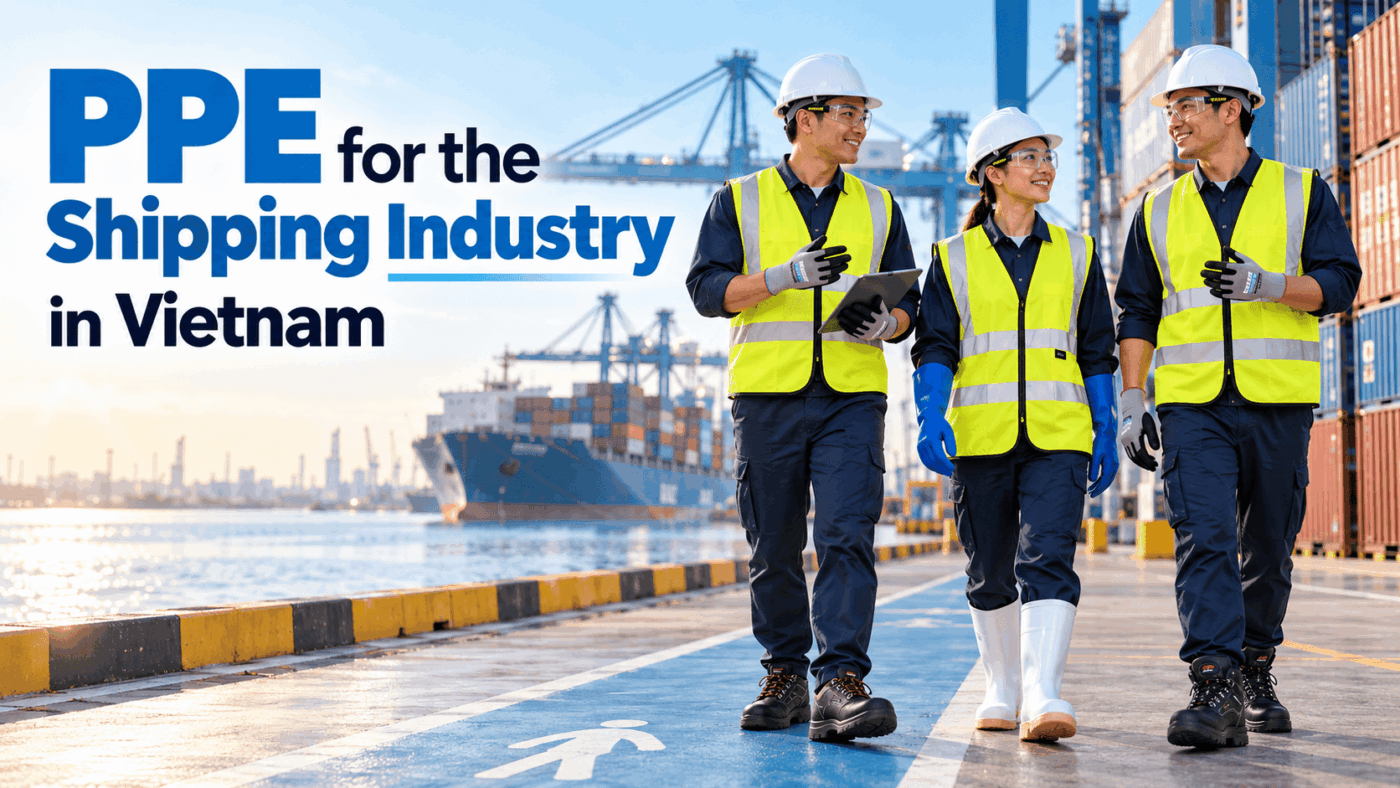
Shipping work combines moving cargo, heavy machinery, wet and slippery surfaces, noise, chemicals, work at height, confined spaces and exposure to water. A single “standard kit” therefore cannot protect every seafarer, stevedore, maintenance technician or port worker.
The right approach is task-based: assess the hazard, control it at source, then select certified and compatible personal protective equipment for the remaining risk. Employers and vessel operators must also distinguish ordinary work PPE from statutory life-saving appliances carried for emergencies.
This guide explains how to build a practical PPE programme for Vietnam’s shipping industry. It separates Vietnamese workplace duties, international maritime requirements and common industry practice so buyers can specify equipment without turning recommendations into invented legal rules.
Important: This is a procurement and programme guide, not legal or class advice. Confirm the latest Vietnamese requirements and the vessel’s flag-state, port-state, classification-society, cargo, charterer and safety-management-system requirements before purchase.
What counts as the shipping industry?
“Shipping industry” can cover several workplaces with different control systems:
- Seafarers working on deck, in accommodation areas and in engine rooms
- Port and terminal personnel handling containers, bulk cargo and vehicles
- Stevedores, tally clerks, drivers and cargo surveyors
- Shipyard, dry-dock and marine maintenance teams
- Jetty, pilot-transfer and other work-near-water personnel
- Contractors who enter vessels to clean, paint, repair or inspect them
The employer, shipowner, terminal operator and contractor may have overlapping responsibilities. A contractor should not assume the vessel’s PPE matrix automatically covers the contractor’s work, and a vessel should not assume a port’s minimum PPE rule covers specialised shipboard tasks.
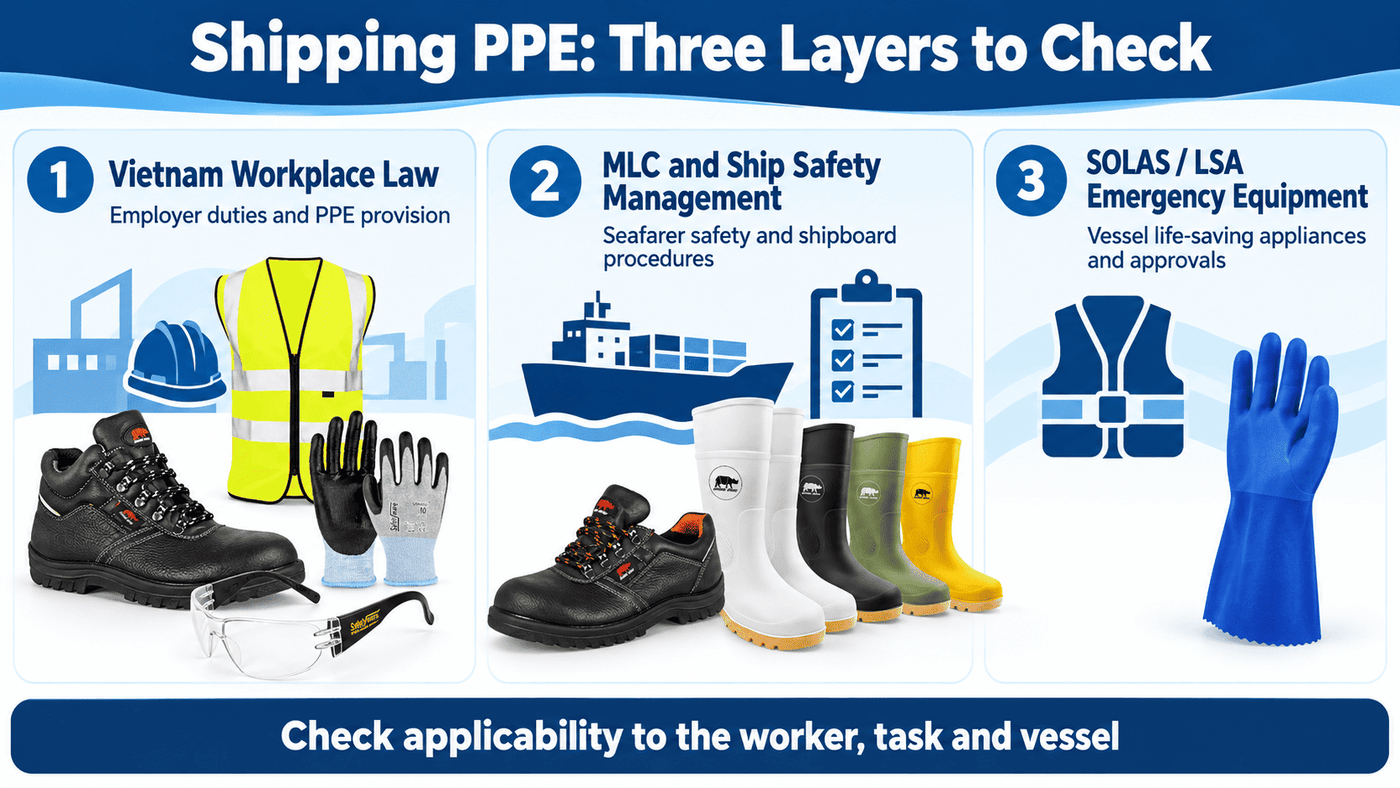
The three layers that govern PPE decisions
| Layer | What it does | Practical implication |
|---|---|---|
| Vietnamese occupational safety and health law | Establishes workplace duties for employees exposed to dangerous or hazardous factors and the provision of PPE at work | Employers should document hazards, issue suitable PPE, instruct users and maintain a traceable programme |
| International maritime instruments and vessel requirements | Set safety-management, seafarer-welfare and life-saving-appliance requirements for covered ships | Ship-specific carriage, approval, inspection, maintenance and drill requirements must be checked separately from routine PPE |
| Site and industry practice | Adds terminal, customer, cargo, class, insurer and company rules | A port may require a helmet, high-visibility garment and protective footwear, but this does not replace task-specific assessment |
Vietnamese workplace PPE duties
Vietnam’s Law on Occupational Safety and Health No. 84/2015/QH13 was adopted on 25 June 2015 and took effect on 1 July 2016. Article 23 establishes the general duty to provide appropriate PPE to employees exposed to dangerous or hazardous factors and requires employees to use it while working. vanban.chinhphu.vn
Circular No. 25/2022/TT-BLDTBXH, issued on 30 November 2022 and effective from 1 April 2023, regulates the provision of PPE at work. Its occupational listings should be treated as a starting point, not a substitute for assessing the actual task. vanban.chinhphu.vn
For shipping operations, the PPE issue register should connect each item to a real hazard—such as impact, chemical splash, excessive noise or fall exposure—not merely to a job title.
MLC, 2006: seafarer health and safety
Vietnam ratified the Maritime Labour Convention, 2006 on 8 May 2013, and its ratification remains in force. normlex.ilo.org
Under Regulation 4.3 and Standard A4.3, covered ships require occupational safety and health policies and programmes, risk evaluation, training and reasonable precautions to prevent accidents, injuries and disease. The current text addresses necessary, appropriately sized PPE. International Labour Organization
The MLC applies to seafarer working and living conditions on covered ships. It should not be presented as the sole legal basis for PPE used by every shore-based employee at a Vietnamese port.
SOLAS and the LSA Code: emergency equipment is a separate category
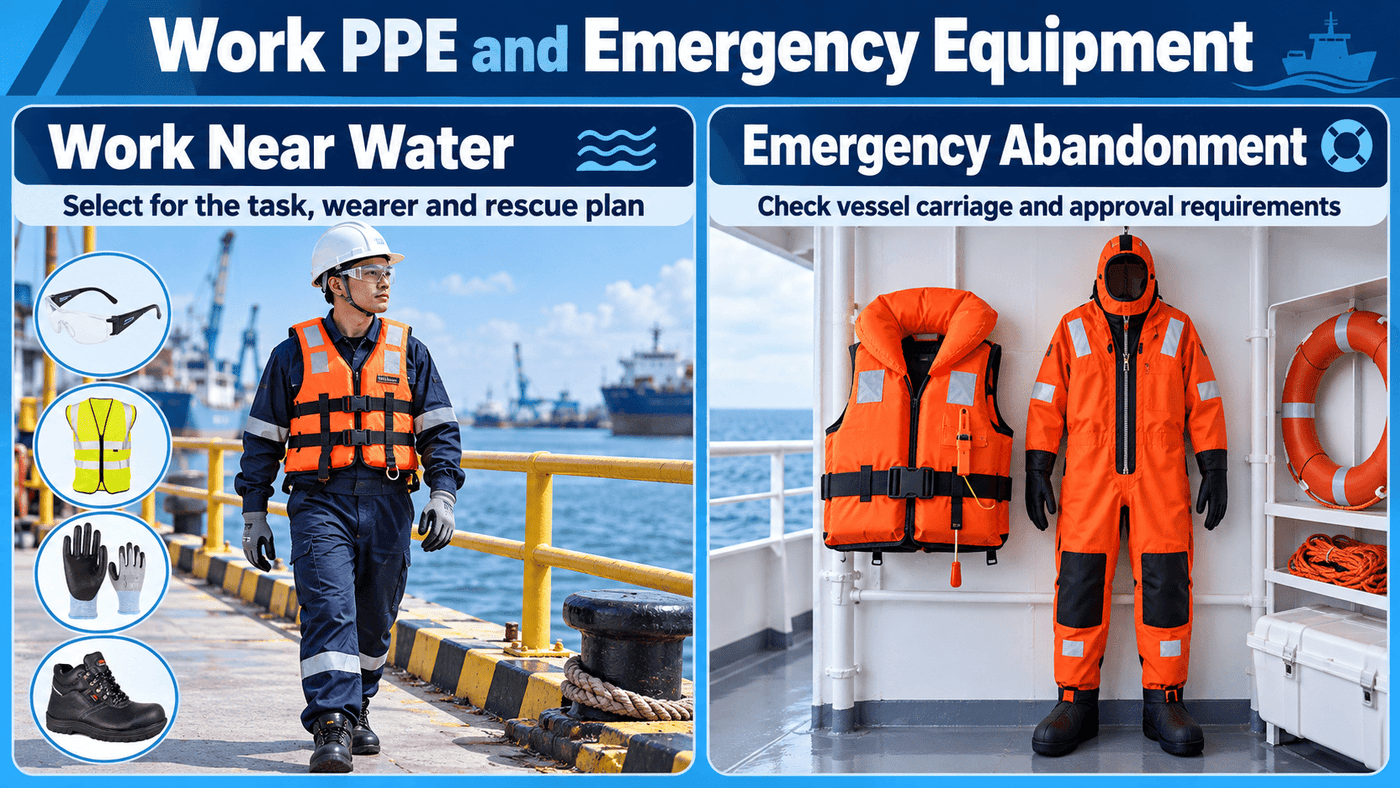
SOLAS Chapter III covers life-saving appliances and arrangements. The mandatory International Life-Saving Appliance Code contains detailed technical requirements. Personal life-saving appliances include lifebuoys, lifejackets, immersion suits, anti-exposure suits and thermal protective aids. IMO
These are not interchangeable with ordinary task PPE. The required type, quantity, approval, location and maintenance regime depend on matters such as ship type, voyage and applicable administration requirements. Procurement teams should verify certificates and markings for the exact model rather than relying on a supplier category name.
A useful distinction:
- A ship’s emergency lifejacket is part of the vessel’s life-saving arrangement and is selected against applicable carriage and approval requirements.
- A work vest or PFD may be worn during a specific over-water task, but it must be selected for that activity, wearer, buoyancy need, clothing, fall risk and rescue plan.
One device should not automatically be assumed to satisfy both purposes.
The ISM Code: make PPE part of the system
For ships to which it applies, the International Safety Management Code provides the framework for safe ship operation and pollution prevention. IMO
PPE selection should therefore connect to the vessel’s safety management system: risk assessments, permits to work, familiarisation, maintenance, defect reporting, emergency procedures and records.
Shipping hazards and suitable PPE considerations
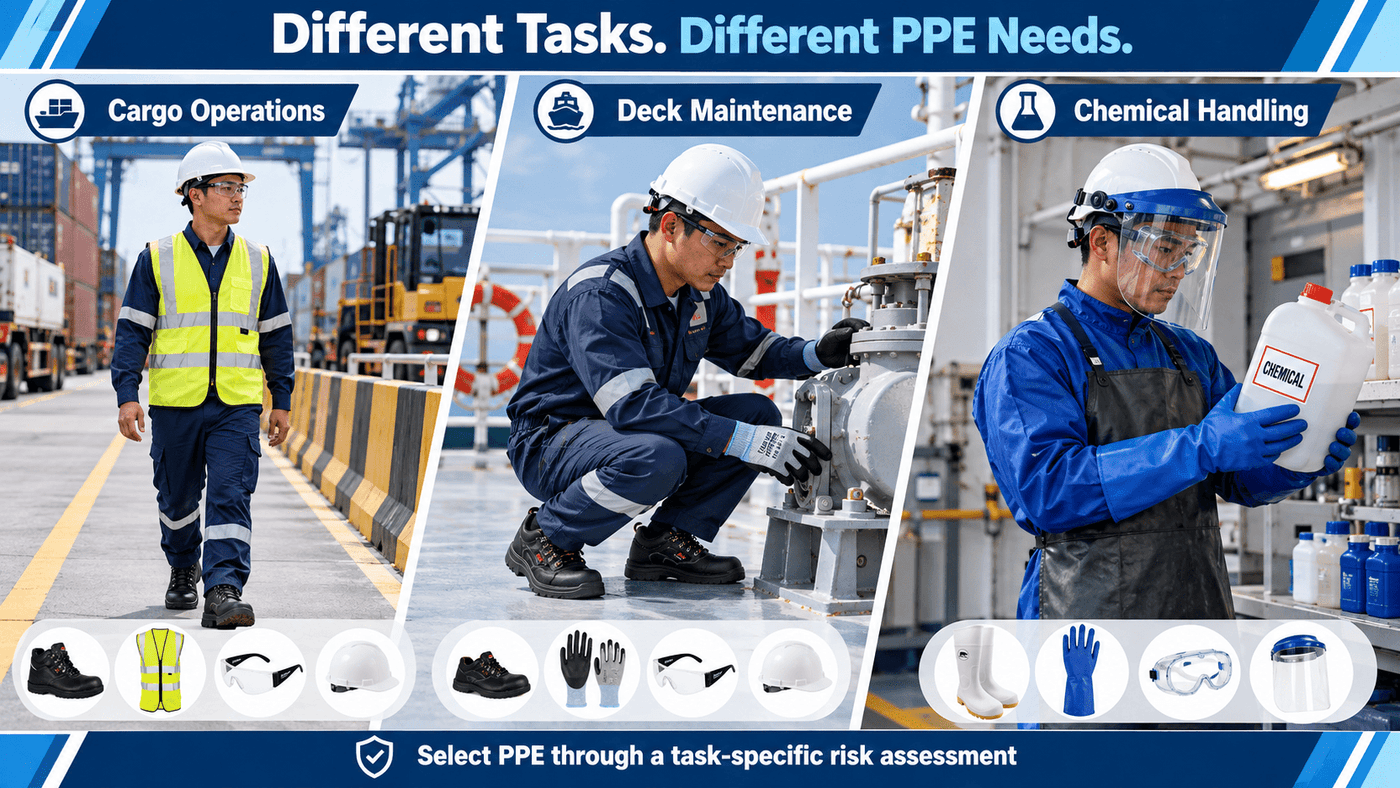
The following table is a selection aid. It does not make every listed item mandatory for every job.
| Task or area | Main hazards | Higher-order controls to confirm first | PPE considerations for residual risk |
|---|---|---|---|
| Container yard and cargo handling | Vehicle strike, dropped objects, pinch points, dust, noise | Traffic separation, exclusion zones, lifting plan, communication, mechanical aids | High-visibility garment, safety helmet, eye protection, protective footwear, task-specific gloves and hearing protection where assessment requires it |
| Mooring and line handling | Line recoil, crushing, entanglement, wet deck, falling overboard | Mooring plan, equipment condition, trained team, clear communication and exclusion from snap-back and bight zones | Helmet, eye protection, suitable gloves, protective footwear, weather protection and task-appropriate flotation equipment |
| General deck work | Impact, slips, weather, corrosion, hand injury | Housekeeping, guardrails, non-slip surfaces and tool control | Helmet, safety eyewear, grip-appropriate gloves, protective footwear, rainwear and visibility garments |
| Engine room | Noise, heat, hot surfaces, oils, rotating equipment | Guards, insulation, ventilation, isolation and lockout procedures | Hearing and eye protection, task-specific gloves, protective footwear and suitable workwear |
| Hot work and welding | Arc radiation, sparks, fumes, fire, burns | Permit, isolation, gas testing where relevant, ventilation and fire watch | Welding helmet or correct lens, eye and face protection, heat-resistant gloves, flame-resistant clothing and suitable respiratory protection |
| Painting or chemical handling | Splash, vapour, mist, skin exposure | Substitution, enclosure, ventilation and safety data sheet review | Chemical-compatible gloves and clothing, goggles or face shield, footwear and appropriately selected respiratory protection |
| Working at height | Falls and dropped tools | Avoidance, permanent access, guardrails or controlled platform | A complete fall-arrest or restraint system, suitable helmet and rescue provision |
| Enclosed-space entry | Oxygen deficiency, toxic or flammable atmosphere, engulfment | Entry permit, isolation, ventilation, atmosphere testing, communication, attendant and rescue plan | PPE defined by the entry assessment; respiratory and rescue equipment must match the atmosphere and plan |
| Work near or over water | Drowning, wet exposure, poor visibility | Barriers, safe access, lighting, buddy system and retrieval plan | Properly fitted flotation equipment, high-visibility clothing and weather protection |
| Emergency abandonment | Immersion, exposure, delayed rescue | Muster arrangements, drills, stowage and maintenance | Approved lifejackets, immersion or anti-exposure suits and other required life-saving appliances |
Mooring: PPE cannot control stored energy
A helmet and gloves may reduce secondary injuries, but neither can stop the energy released by a parted mooring line. Workers must stay clear of bights and designated danger areas, use agreed communication and follow the ship’s mooring procedure. PPE is the final layer, not the mooring plan.
Enclosed spaces: a respirator is not an entry system
IMO guidance describes enclosed spaces by features such as limited openings, inadequate ventilation and lack of design for continuous occupancy. Their atmosphere may be oxygen-deficient, oxygen-enriched, flammable or toxic. IMO
Entry requires a controlled process, not simply a mask and portable gas detector. The procedure should address isolation, ventilation, atmosphere testing, authorisation, communication, a standby person and rescue capability.
An air-purifying respirator does not supply oxygen and must not be selected for an oxygen-deficient or unknown atmosphere.
Working at height: specify a system, not a harness alone
Fall protection must be designed around the anchorage, connection method, free-fall distance, clearance, swing-fall risk, user weight, sharp edges and rescue method. Components should be compatible and used within the manufacturer’s instructions.
Core PPE categories for shipping operations
Head, eye and face protection
Choose a safety helmet for the identified impact, penetration, electrical and environmental risks. Check retention requirements where wind, climbing or vessel movement could dislodge it.
Match eye and face protection to impact, dust, chemical splash, welding radiation or molten-particle exposure. A face shield usually supplements—rather than replaces—suitable primary eye protection.
Hand protection
No glove is suitable for every marine task. Grip gloves used for dry cargo handling may be unsuitable for oils or chemicals.
Chemical gloves must be selected using the substance, concentration, temperature, breakthrough or permeation information and task duration. Welding, rope handling, knife work and electrical tasks require different performance.
Protective footwear
Assess toe impact, penetration, metatarsal exposure, wet surfaces, hydrocarbons, chemicals, heat and electrical risk. Confirm the exact standard and markings for the model.
Outsole material, tread condition, fit and housekeeping all affect slip risk. A slip-resistant claim does not make every contaminated surface safe.
Hearing protection
Engine rooms, workshops and cargo equipment can create damaging noise. Base selection on a noise exposure assessment and verified protector attenuation.
Avoid choosing maximum attenuation indiscriminately. Workers must still hear alarms and safety communication or receive suitable alternative warnings.
Respiratory protection
Identify the contaminant, physical form and concentration before choosing filters, cartridges or supplied air.
A respiratory protection programme should cover medical suitability where required, fit testing for tight-fitting facepieces, facial-hair rules, filter change schedules, cleaning, storage and training. Filtering respirators are unsuitable where oxygen is deficient or the atmosphere is unknown.
Protective clothing and high visibility
Select workwear for the actual exposure: weather, low visibility, flame, heat, chemical splash, static risk or contamination.
A high-visibility vest is not automatically flame-resistant or chemical protective. If several hazards apply, verify that the finished garment provides the required combined performance.
Flotation and survival equipment
Check wearer size, buoyancy or performance category, turning characteristics where relevant, compatibility with clothing and harnesses, lights or whistles, stowage and inspection.
For statutory vessel equipment, confirm applicable approval documentation rather than relying on appearance or colour.
A practical PPE selection process
Step 1: Break work into tasks
Do not begin with a catalogue. List routine, non-routine and emergency activities: berthing, cargo securing, reefer connection, bunkering, tank entry, welding, painting, pilot transfer, cleaning, rescue and abandonment.
Step 2: Identify hazards and exposure
Record the source, route of harm, expected severity, exposure level and duration. Use safety data sheets, noise or air monitoring, equipment manuals, incident history and worker feedback.
Step 3: Apply the hierarchy of controls
Eliminate or reduce the hazard using design, substitution, guarding, ventilation, traffic control, barriers, isolation and procedures. PPE addresses residual risk; it should not compensate for an avoidable unsafe system.
Step 4: Specify performance, fit and compatibility
Write a specification that identifies the hazard, relevant standard and version, required rating, size range, environmental conditions and interfaces with other PPE.
Check that helmets, eyewear, respirators, hearing protection, flotation equipment and fall-protection components can be worn together without defeating fit or function.
Step 5: Trial equipment with representative users
Include different face shapes, body sizes, prescription-eyewear needs and work activities. A controlled trial can reveal fogging, poor grip, restricted movement, pressure points and communication problems before a large order is placed.
Step 6: Control issue, inspection and replacement
Keep model-level records, user allocations, inspection criteria, service-life information and replacement triggers.
Salt, ultraviolet light, oils, chemicals, heat and repeated wetting can accelerate deterioration. Quarantine damaged, contaminated, expired or untraceable equipment.
Step 7: Train and verify competence
Training should include limitations, pre-use checks, fitting, compatibility, cleaning, storage, defect reporting and emergency actions.
For respirators, fall protection, gas detection and life-saving appliances, practical competency checks are more valuable than signature-only attendance records.
Procurement checklist for buyers and safety managers
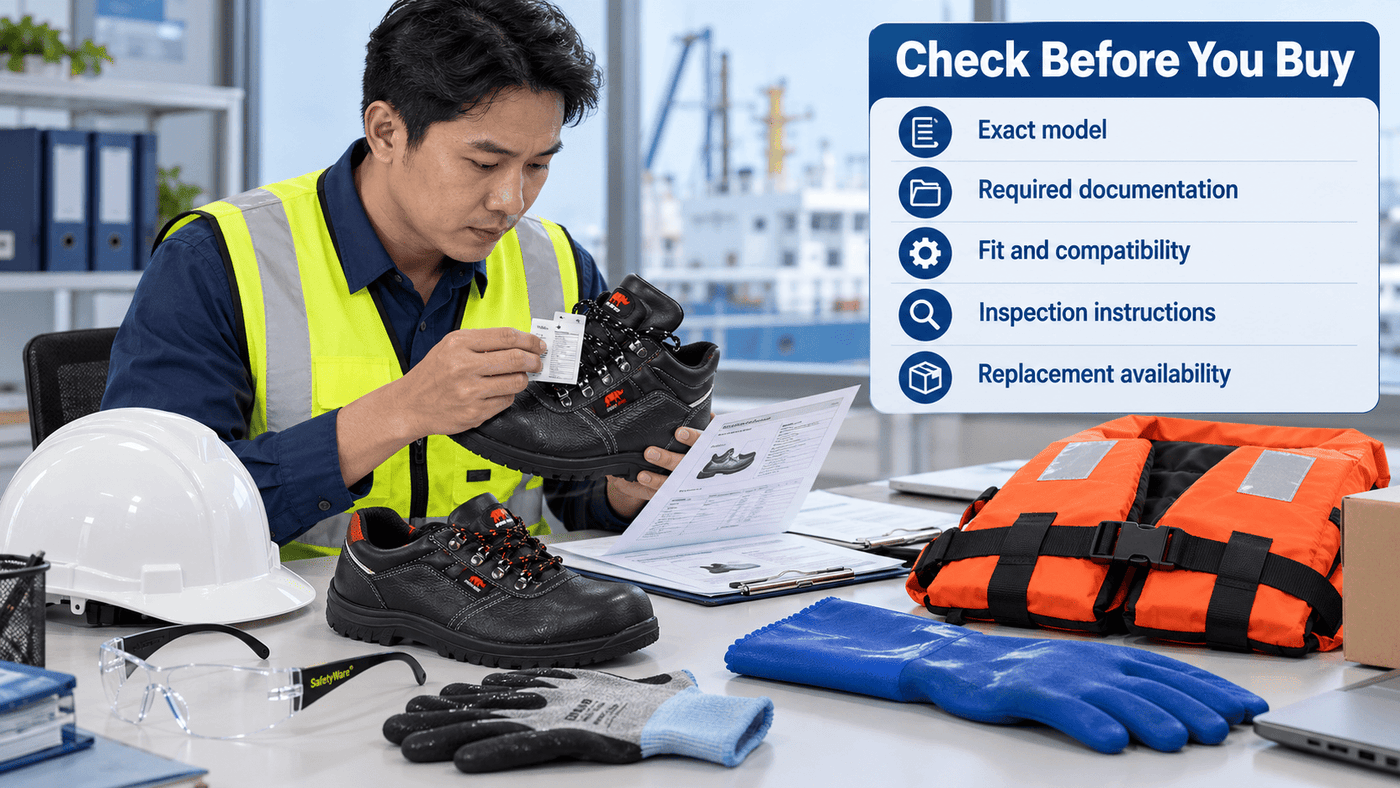
Before approving a model, confirm:
- The job, task and hazard are defined.
- Higher-order controls have been reviewed.
- Applicable Vietnamese, flag-state, port, class, charterer and company requirements are identified.
- The standard, edition, performance level and exact product marking are suitable.
- Certificates or declarations belong to the exact model.
- The equipment fits the intended user population.
- PPE worn together remains compatible.
- Materials suit salt, moisture, sunlight, oil, chemicals and expected temperatures.
- Cleaning, storage, inspection and replacement instructions are available.
- Spare parts, consumables and replacements can be obtained throughout the service period.
- User instructions are understood by the workforce.
- Issue, inspection, maintenance and defect records can be retained.
- Life-saving appliances have the approval and carriage documentation required for the vessel and voyage.
Frequent mistakes to avoid
- Buying by job title alone. Two deck tasks may require different gloves, eye protection or flotation.
- Treating colour as proof of compliance. Orange or fluorescent yellow does not prove a product standard or approval.
- Assuming one lifejacket suits all work near water. Activity, buoyancy, compatibility, fall exposure and rescue arrangements matter.
- Using disposable dust masks for vapours or oxygen-deficient spaces.
- Buying a harness without engineering the complete system.
- Ignoring compatibility between helmets, eyewear, earmuffs, respirators and flotation equipment.
- Keeping damaged or contaminated PPE in circulation.
- Confusing a general supplier claim with model-specific statutory approval.
SAFETYWARE Products and Solutions
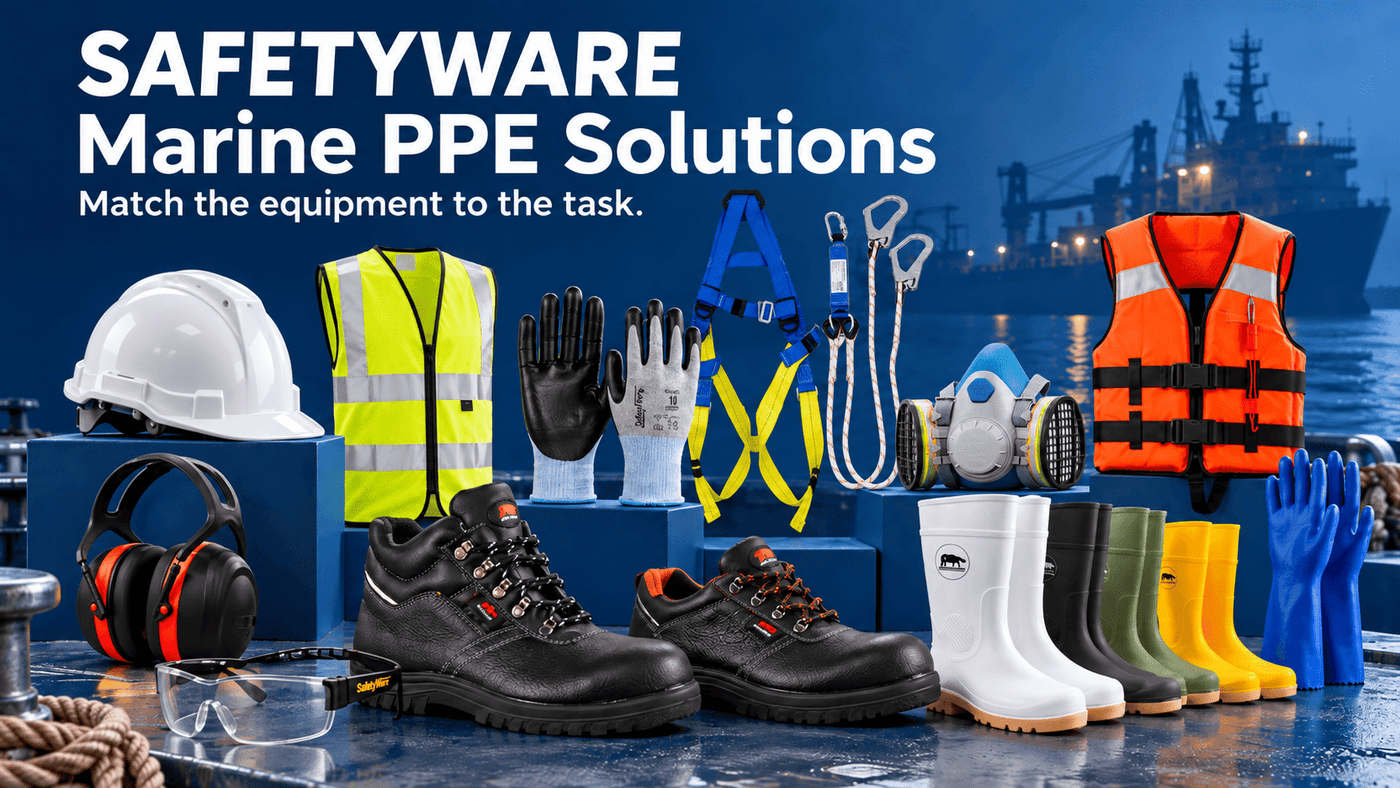
SAFETYWARE can support shipping companies, terminals, shipyards, distributors and contractors seeking to standardise PPE across mixed marine tasks. Begin with a hazard matrix and required product documentation rather than a generic shopping list.
Relevant official ranges include:
- Marine safety equipment for lifejackets, lifebuoys, lights, immersion suits and related equipment. Confirm exact vessel, voyage and approval requirements before ordering.
- Personal protective equipment for head-to-toe protection selected according to hazard, performance, fit and compatibility.
- Safety helmets and eye and face protection for cargo, deck and maintenance tasks.
- Fall protection covering harnesses, lanyards, anchorage and rescue-related components.
- Air-purifying respirators for suitable known contaminants where oxygen is sufficient.
- Rainwear and chemical-resistant clothing for task-specific weather and splash protection.
- IMO-format marine safety signs for identifying emergency equipment and locations, subject to the vessel’s signage plan.
SAFETYWARE’s current ranges include marine equipment, head-to-toe PPE, fall-protection systems and task-specific respiratory protection. Model selection must still be based on application, documentation and compatibility. Safetyware
Buyers should request the current technical data sheet, available sizes, model-specific certification or approval documents, maintenance instructions and lead time for every shortlisted item.
Conclusion
Effective PPE for Vietnam’s shipping industry starts with the task, not the catalogue. Employers should fulfil Vietnamese workplace duties, shipowners should integrate PPE into MLC and ISM safety arrangements, and vessel teams should manage SOLAS/LSA life-saving appliances under their separate carriage, approval and maintenance requirements.
The strongest programme combines hazard control, model-specific documentation, user fit, equipment compatibility, practical training and disciplined inspection. This helps prevent both under-protection and unnecessary over-specification—and gives procurement teams a defensible basis for every item they buy.
Regulatory and source review date: 26 October 2026.
Sources and references
- Government of Vietnam, Law No. 84/2015/QH13 on Occupational Safety and Health
- Government of Vietnam, Circular No. 25/2022/TT-BLDTBXH on PPE at work
- ILO NORMLEX, Ratifications for Viet Nam
- ILO NORMLEX, Maritime Labour Convention, 2006, as amended
- IMO, International Safety Management Code
- IMO, Life-saving appliances
- IMO, Summary of SOLAS Chapter III
- IMO, Enclosed-space ship safety rule
- SAFETYWARE, PPE and safety equipment
📞 Need More Information?
Looking for PPE for Marine Industry?
Explore SAFETYWARE’s safety shoes and workplace PPE range at
👉Safetyware Catalogs
Our safety specialists can help evaluate workplace hazards, recommend suitable safety helmets, and support compliance with Malaysia workplace safety requirements.
If you need a quotation, feel free to contact us at:
📩 Email: [email protected]
📞 Tel: WhatsApp Us