PPE selection for semiconductor work must protect people while meeting the process requirements for cleanliness and electrostatic discharge control. The right combination depends on the job, the chemicals used and the equipment being serviced.
Why semiconductor PPE needs more than a cleanroom checklist
A worker assembling electronic components, a technician maintaining a process chamber and an operator handling chemicals can work in the same facility while needing very different protection.
Semiconductor operations can involve solvents, corrosive chemicals, hazardous energy, noise and other process-specific hazards. These risks can change when equipment, materials or production methods change. A tidy, controlled environment does not remove the need to assess exposure. [1]
For PPE buyers and safety managers, the practical starting point is a task list. Identify what the worker will do, what could reach their skin, eyes or lungs, and what other hazards remain after engineering and work-practice controls.
Then add the cleanroom and ESD requirements. This helps prevent a common purchasing mistake: choosing a product that protects the manufacturing process but does not adequately protect the person.
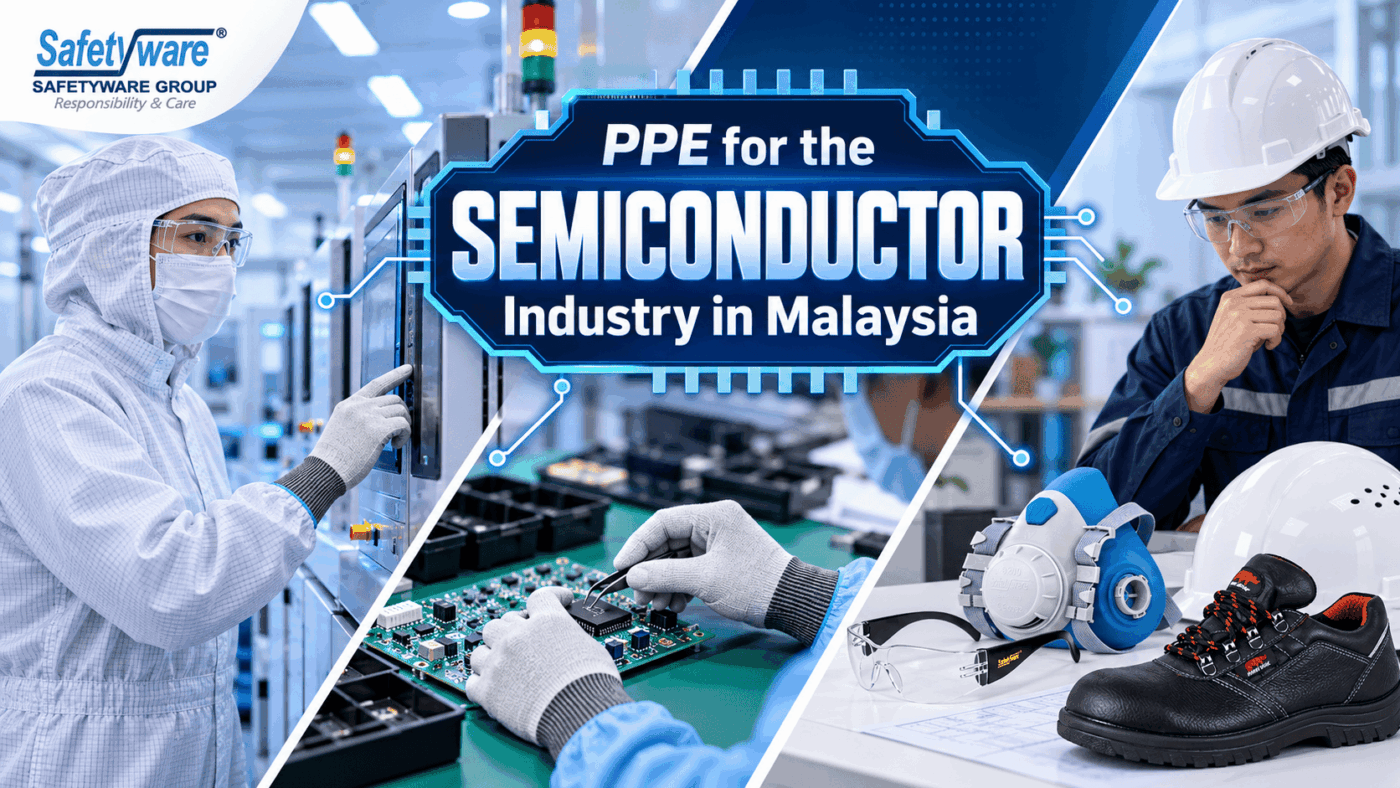
[Image placement 1 — Featured image] Place below this introduction.
Image title: PPE for the Semiconductor Industry in Malaysia
Scene: A modern semiconductor facility with separate views of a cleanroom operator, an ESD assembly workstation and a PPE selection discussion. Include the full article title in creative, readable typography.
Aspect ratio: 16:9. Alt text: PPE selection for semiconductor workers in Malaysia covering cleanroom, ESD and chemical protection.
Copy-ready prompt 1 is provided at the end.
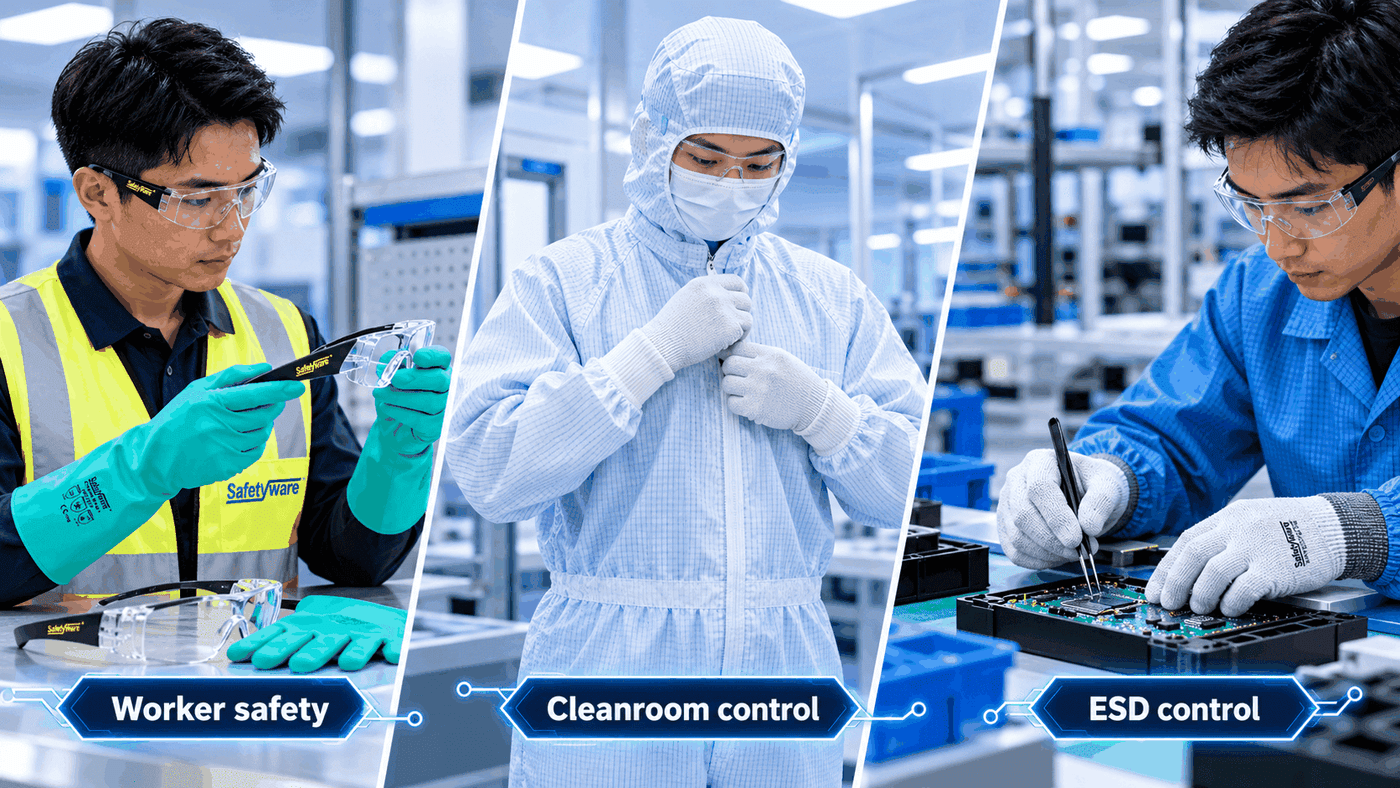
Understand the three different protection goals
These goals can overlap, but each needs its own evidence.
| Protection goal | What it addresses | What buyers should verify |
|---|---|---|
| Worker protection | Injury or illness from the assessed task | Hazard-specific performance, fit, compatibility and limitations |
| Cleanroom contamination control | Particles or contaminants introduced into the process | Site cleanliness specification, material, packaging and gowning requirements |
| ESD control | Electrostatic damage to sensitive electronic devices | Electrical performance and compatibility with the site ESD control programme |
A cleanroom coverall is not automatically a chemical protective suit. An ESD glove is not an electrical insulating glove. A product may fulfil more than one function, but those functions must be documented separately.
ISO 14644-1:2015 concerns the classification of air cleanliness by airborne particle concentration. It does not, by itself, certify a glove’s chemical resistance or specify one universal gowning set. [2]
IEC 61340-5-1:2024 provides requirements for an ESD control programme protecting electronic devices. Its scope does not cover flammable liquids, gases or powders. An electronics ESD claim therefore should not be treated as proof of suitability for an explosive atmosphere. [3]
Malaysian requirements and technical standards
Start with the legal duty to assess and control risk
Malaysia’s Occupational Safety and Health Act 1994, in the updated text as at 1 June 2024, includes section 18B. It requires employers, self-employed persons and principals to conduct risk assessments and implement the necessary controls. Section 15 also establishes employers’ general safety and health duties. [4]
This approach does not mean every semiconductor employee needs the same PPE. The assessment must identify the controls appropriate to the work.
Apply chemical and noise requirements where relevant
Under the USECHH Regulations 2000, work that may expose employees to chemicals hazardous to health requires a written assessment of the health risks. Regulations 15 and 16 address exposure controls and approved PPE. PPE is used where preferred controls are impracticable, during their implementation, or where they are insufficient. Employers must manage issuance, maintenance, inspection and training, and provide suitable, properly fitting equipment in adequate supply. [5]
The Noise Exposure Regulations 2019 address assessment, exposure control and hearing protection. They also require hearing protection zones and use of the provided hearing protection in those zones under the specified conditions. [6]
Reference or requirement Status Purchasing implication Act 514 and applicable Malaysian regulations Legal duties Base selection on the workplace assessment and relevant exposure requirements ISO 14644-1:2015 Technical cleanroom classification standard Use the facility’s actual cleanliness specification when qualifying garments and consumables IEC 61340-5-1:2024 Technical ESD programme standard Qualify products within the site’s complete ESD system Customer specifications and site gowning procedures Contractual or operational requirements Record the exact zone, task and acceptance criteria
International standards are not automatically Malaysian legal requirements simply because they appear on a datasheet. Ask which legal provision, approval condition, contract or site procedure makes a particular standard applicable.
For regulated PPE, obtain the relevant current approval evidence for the exact supplied model. A company certificate or a logo on a brochure does not establish the suitability of every product.
US OSHA and NIOSH resources cited here provide technical guidance; their US legal requirements are not presented as Malaysian law.
Match PPE to the work being performed
The following matrix is a starting point for assessment, not a ready-made authorisation to perform a hazardous task.
| Work activity | Risks or process needs to assess | PPE selection considerations |
|---|---|---|
| Routine cleanroom production | Contamination and the actual process exposure | Approved gowning set and gloves; add worker protection where the assessment requires it |
| Assembly, inspection and test | ESD-sensitive devices, dexterity and sharp edges | Qualified ESD gloves; documented cut protection where needed; compatible footwear system |
| Chemical transfer or wet-process support | Chemical splash, skin contact and inhalation | Chemical-specific gloves and clothing; splash eye and face protection; assessed respiratory protection |
| Tool or chamber maintenance | Residues, sharp parts, heat and stored energy | Task-specific hand, eye and body protection after isolation and hazard verification |
| Electrical maintenance | Shock and arc hazards | Specialist electrical PPE selected through the electrical safety procedure |
| Utility rooms and noisy equipment areas | Noise exposure and mechanical hazards | Hearing protection selected from noise assessment; other PPE matched to the job |
| Material handling and loading areas | Dropped loads, foot injuries and vehicle interaction | Suitable protective footwear and other PPE identified by the site assessment |
Maintain separate instructions for normal production, cleaning, maintenance and emergency response. Opening equipment can introduce exposures that are absent during enclosed operation. OSHA’s semiconductor guidance also identifies source controls, automation, enclosures and hazardous-energy controls as important measures. [1]

Choose gloves for both the hazard and the process
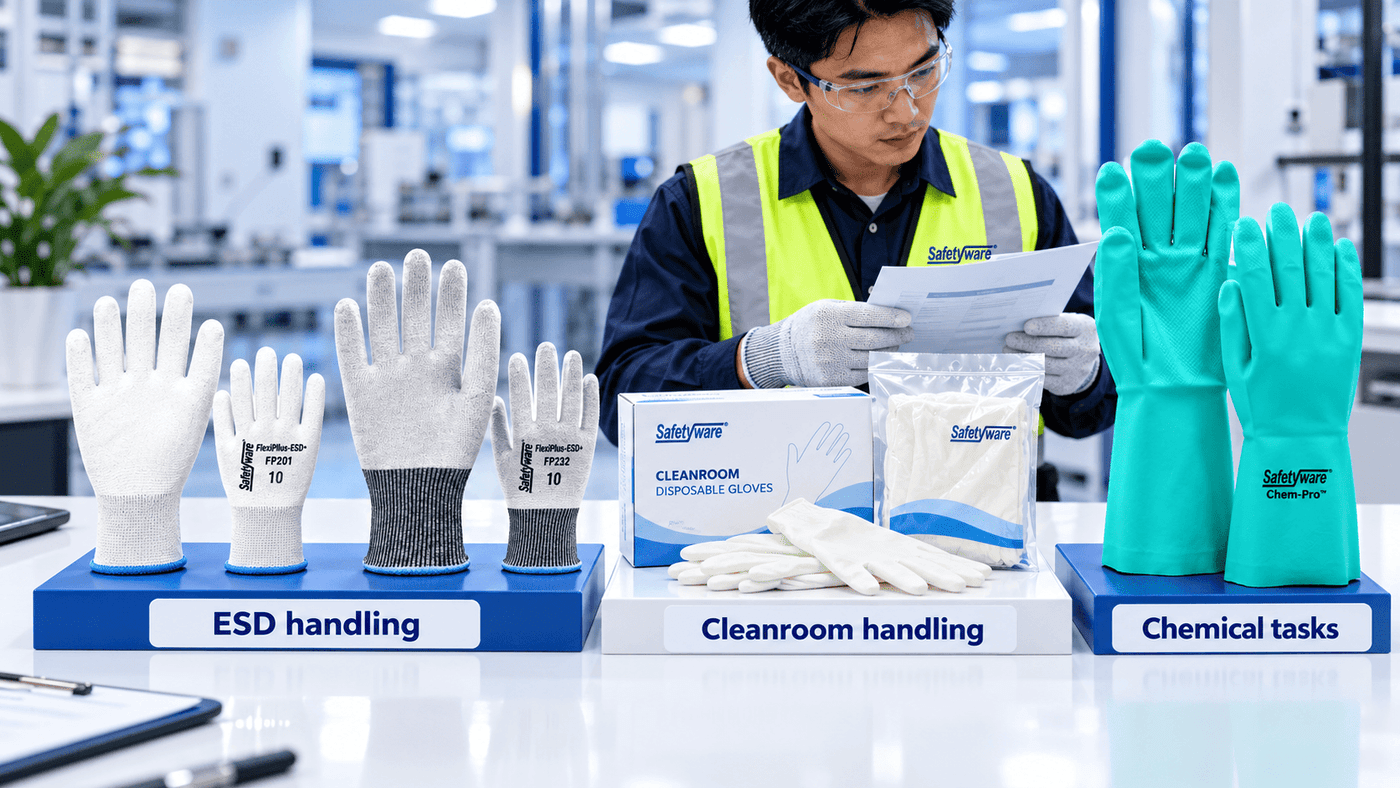
Cleanroom and ESD handling
For controlled handling, ask for evidence that matches the actual acceptance criteria. A useful enquiry should identify:
- The work area and whether the glove will touch exposed components or process surfaces.
- Cleanliness, packaging and contamination requirements.
- ESD test method, results and relevant conditions.
- Required grip, dexterity, sizing and cuff coverage.
- Any additional cut, chemical or thermal hazards.
Do not assume all gloves sold in an ESD or cleanroom category can enter every controlled zone. Qualify the exact model with the quality and ESD teams before bulk purchase.
Chemical handling
Glove material alone is not enough to make a safe selection. “Nitrile” describes a material family; thickness, construction and the chemical exposure still matter.
Ask the supplier to compare the proposed glove with the chemical identity, concentration, temperature, contact duration and task. Review permeation, breakthrough and degradation information where relevant. A laboratory breakthrough result should not be copied directly into a workplace wear-time rule without considering the actual conditions.
Hydrofluoric acid requires particular care. Cal/OSHA’s technical guidance highlights selection by concentration and contact time, with PPE-manufacturer and SDS information used to assess gloves, clothing and footwear. Do not approve a general cleanroom glove for HF simply because it is disposable or nitrile. [7]
Set a replacement rule for each approved application and train workers to remove contaminated equipment without transferring chemicals to their skin.
Select compatible eye, face and respiratory protection
For chemical splash tasks, assess suitable goggles and additional face protection. A face shield does not provide a sealed barrier around the eyes. Check that the selected combination works with hoods, prescription eyewear and any respirator. HF guidance specifically addresses splash protection and chemical-resistant equipment. [7]
For respiratory protection, begin with the contaminant and exposure assessment. A cleanroom face mask should not be assumed to protect against hazardous gases or vapours.
An air-purifying respirator must have the correct approved filter or cartridge combination for the assessed exposure. These respirators do not supply oxygen and cannot be used in oxygen-deficient or immediately dangerous to life or health atmospheres. An unknown gas release requires the site emergency response procedure, not an improvised cartridge choice. [8]
For tight-fitting respirators, arrange fit testing for the selected make, model and size. Check compatibility with other worn equipment and keep the sealing area free of interference. Fit testing and the wearer’s routine seal check serve different purposes. [9]
Define who may respond to a leak or spill. Workers should follow the alarm and evacuation procedure; emergency entry and rescue require specifically trained, equipped personnel.
Treat footwear, garments and hearing protection as a system
ESD footwear must work with the site flooring and verification arrangements. Overshoes, cleaning, wear and changes to the floor can affect performance, so assess the complete combination. Select toe protection, grip and other safety features separately according to the job.
Do not use an ESD designation as evidence of electrical insulation. Electrical work needs its own risk assessment and controls. Cleanroom apparel likewise needs separate evidence before being used for chemical splash, flame or arc protection.
For noisy areas, choose hearing protectors using the assessed exposure and required attenuation. Trial them with the actual hood, glasses and other equipment. A comfortable item is only useful if it continues to fit and function in the full ensemble.
A practical procurement and wearer-trial checklist
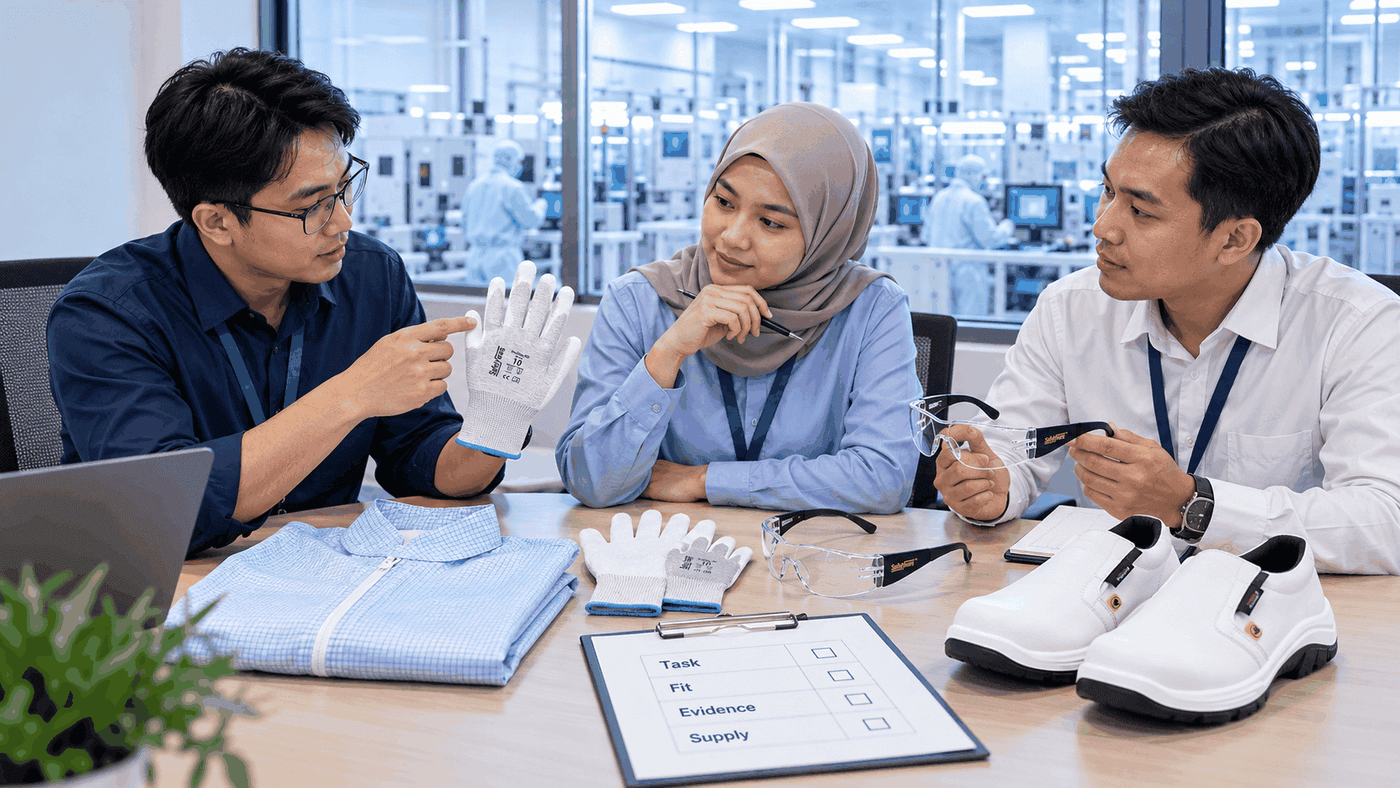
Bring EHS, production, quality, the ESD coordinator and purchasing into the same approval process.
| Check | Evidence or action |
|---|---|
| Define the application | Record task, work zone, routine or maintenance use, and exposure conditions |
| Confirm worker protection | Match the exact model to the identified hazards and relevant approval requirements |
| Confirm process compatibility | Obtain cleanliness, packaging and ESD evidence required by the site |
| Check the full ensemble | Assess cuffs, hoods, eyewear, respirators, footwear and hearing protectors together |
| Trial safely | Use representative tasks under approved controls; never deliberately expose a wearer to test PPE |
| Record acceptance | Document fit, dexterity, fogging, comfort, durability and process-test results |
| Plan supply | Confirm sizes, lead time, pack quantity, shelf life and an approved substitution process |
| Control changes | Reassess when the product, chemical, process, supplier specification or work conditions change |
Approve alternatives before shortages occur. A substitute with a similar appearance may have different protective, electrical or contamination performance.
At issue and before use, check damage, contamination, closures and the manufacturer’s limitations. Keep reusable equipment under the specified cleaning and storage regime, and replace it at the defined limits or when inspection identifies a defect.
SAFETYWARE Products and Solutions
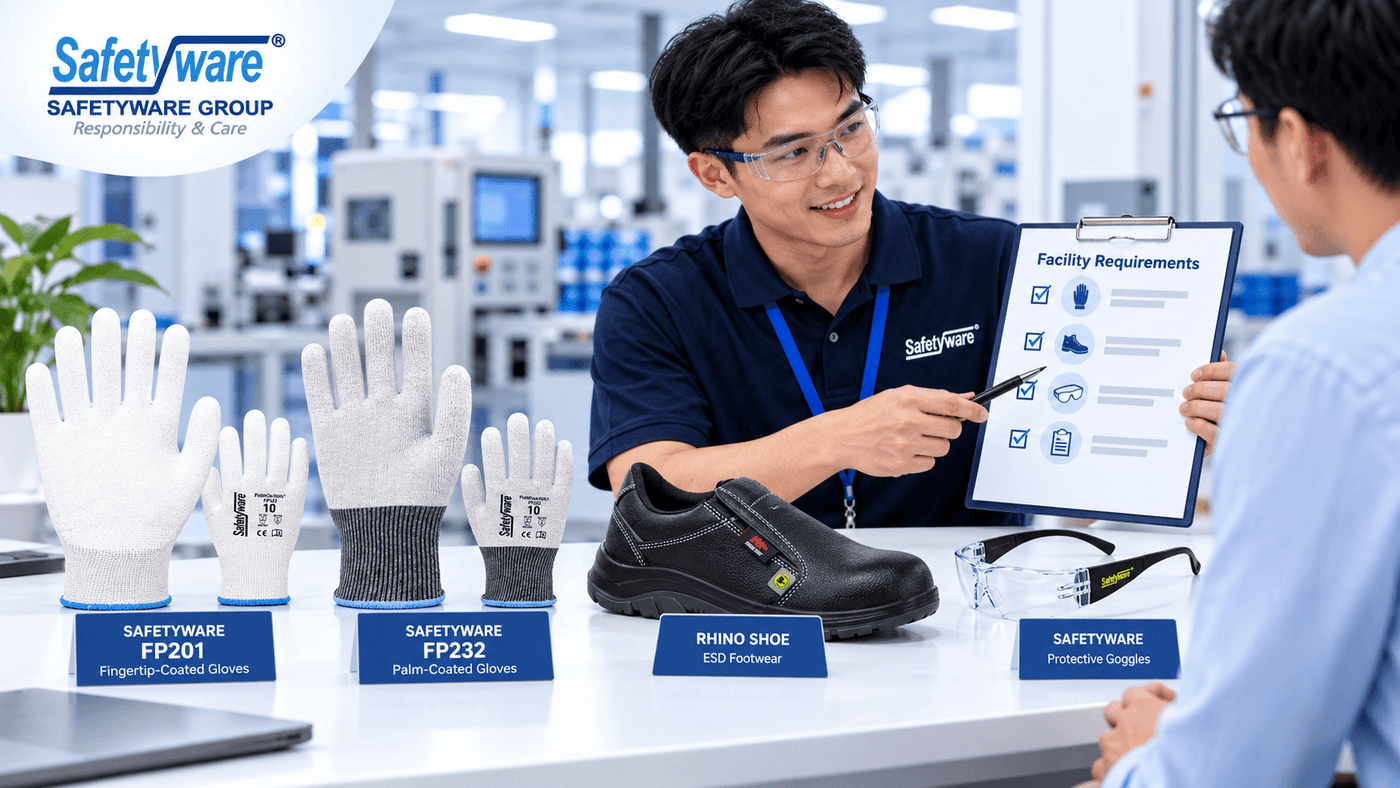
SAFETYWARE’s official product directory provides a starting point for comparing hand protection, apparel, footwear and other equipment.
The following verified pages are relevant to a semiconductor PPE enquiry. They are options for technical evaluation; final suitability depends on the exact work and site requirements.
| Product or range | Relevant discussion | What to confirm before approval |
|---|---|---|
| SAFETYWARE FlexiPlus-ESD FP201 ESD Finger-Tip Coated Gloves | The listing identifies a polyester/carbon liner and PU fingertip-coated construction for ESD handling | Current datasheet, electrical test evidence, cleanliness and packaging requirements |
| SAFETYWARE FLEXIPLUS-ESD+ FP232 Cut Resistant PU Palm Coated Gloves | The listing describes an HPPE/carbon liner and ESD PU palm coating | Exact cut-performance evidence, required dexterity and site ESD/contamination acceptance |
| Cleanroom and ESD Apparel | Garment options for controlled areas | Zone-specific gowning requirements, cleaning method and any separate protective functions |
| Chemical Resistant Gloves | Compare gloves for assessed chemical tasks | Chemical-specific compatibility, contact conditions and applicable approval documentation |
| Eye and Face Protection | Compare glasses, goggles and face protection | Hazard-specific performance and compatibility with the complete ensemble |
| RHINO SHOE ESD Safety Shoes | Footwear options for static-control workplaces | Exact model documentation, wearer-floor testing, safety features and cleanliness needs |
The FP201 page contains inconsistent wording about coating coverage in its description. Its title and specification table identify fingertip coating. Ask for the current supplied-model datasheet and sample before standardising it.
For a useful quotation, share the task list, chemical details where applicable, size breakdown, site specifications, expected consumption and required delivery date. Request samples and supporting documents so the facility team can evaluate protection, process compatibility and supply together.
Conclusion
Choosing PPE for the semiconductor industry in Malaysia starts with the work, the exposure and the controls already in place. Worker safety, contamination control and ESD performance must all be checked, even when one product is intended to support several needs.
Build a task-specific PPE matrix, verify the exact product evidence and trial the complete set before approving bulk supply. Keep replacement rules and approved alternatives clear so protection remains consistent through daily operations and maintenance.
Sources and references
Checked on 9 October 2026. Product links appear directly in the SAFETYWARE table above.
- US OSHA — Semiconductor hazards overview and Safety in Semiconductor Manufacturing. Technical context, not Malaysian legislation.
- ISO — ISO 14644-1:2015: Classification of air cleanliness by particle concentration.
- IEC — IEC 61340-5-1:2024: Protection of electronic devices from electrostatic phenomena.
- Attorney General’s Chambers Malaysia — Occupational Safety and Health Act 1994, updated text as at 1 June 2024.
- USECHH Regulations 2000, legal text hosted by Universiti Malaya, cross-checked with DOSH’s USECHH self-assessment resource.
- Attorney General’s Chambers Malaysia — Occupational Safety and Health (Noise Exposure) Regulations 2019.
- Cal/OSHA — Protecting Workers Exposed to Hydrogen Fluoride. Technical chemical-protection guidance.
- US NIOSH — A Guide to Air-Purifying Respirators.
- US NIOSH — Respirator fit testing.
- SAFETYWARE — Official product directory and the product/category pages linked in “SAFETYWARE Products and Solutions”.
📞 Need More Information?
Looking for Global Standard PPE?
Explore SAFETYWARE’s safety shoes and workplace PPE range at
👉Safetyware Catalogs
Our safety specialists can help evaluate workplace hazards, recommend suitable safety helmets, and support compliance with Malaysia workplace safety requirements.
If you need a quotation, feel free to contact us at:
📩 Email: [email protected]
📞 Tel: WhatsApp Us