
Lockout tagout protects people from unexpected start-up and the release of stored energy during service or maintenance. However, many workplaces still treat padlock colour as if it carried a universal meaning. That approach creates risk.
In fact, no worldwide rule says that every red lock belongs to an authorised employee or that every blue lock belongs to a contractor. A company may adopt those meanings, but it must define them in its own written procedure and train workers to follow the same system.
This guide explains the meaning of common LOTO colours and tags, the difference between legal duties and good practice, and the steps buyers should take when selecting a lockout system.
[Image placement marker — Featured image: after the introduction. Full prompt appears at the end.]
What Is Lockout Tagout?
Lockout tagout, often shortened to LOTO, is a planned method for controlling hazardous energy. Before work begins, authorised workers shut down equipment, isolate its energy sources, control stored energy and verify that the machine cannot operate.
A complete system may control:
- Electrical energy
- Hydraulic and pneumatic pressure
- Steam, gas, water and other fluids
- Gravity and suspended loads
- Springs, flywheels, capacitors and other stored energy
- Heat, cold or process chemicals
A lockout device physically holds an energy-isolating device in a safe position. By contrast, a tagout device gives a visible warning and identifies the person or reason behind the isolation. A tag does not provide the same physical restraint as a lock. Therefore, workers should not treat a tag as a substitute for a lock unless the applicable rule and site procedure allow it and equivalent protection exists.
Do LOTO Padlock Colours Have Universal Meanings?
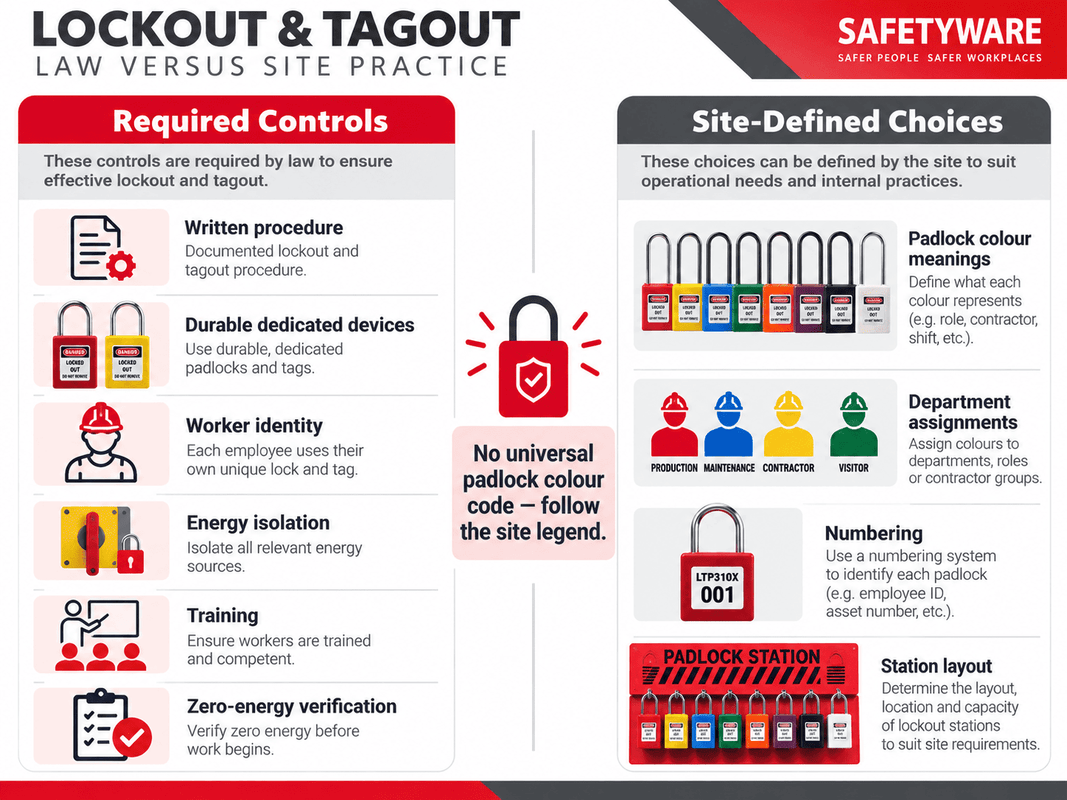
No. There is no universal LOTO padlock colour code that applies across all countries, industries and workplaces.
For example, a factory may reserve red padlocks for personal lockout. Another plant may use red for electrical isolation and blue for personal locks. Both systems can work if the employer documents the meanings, prevents conflicting use and trains everyone who enters the area.
Under US OSHA 29 CFR 1910.147, a facility must standardise lockout and tagout devices by at least one characteristic: colour, shape or size. In addition, tags must use a standard print and format. However, OSHA does not assign a fixed purpose to each padlock colour.
As a result, workers must read the site’s LOTO procedure and colour legend. They should never guess a lock’s owner or purpose from colour alone.
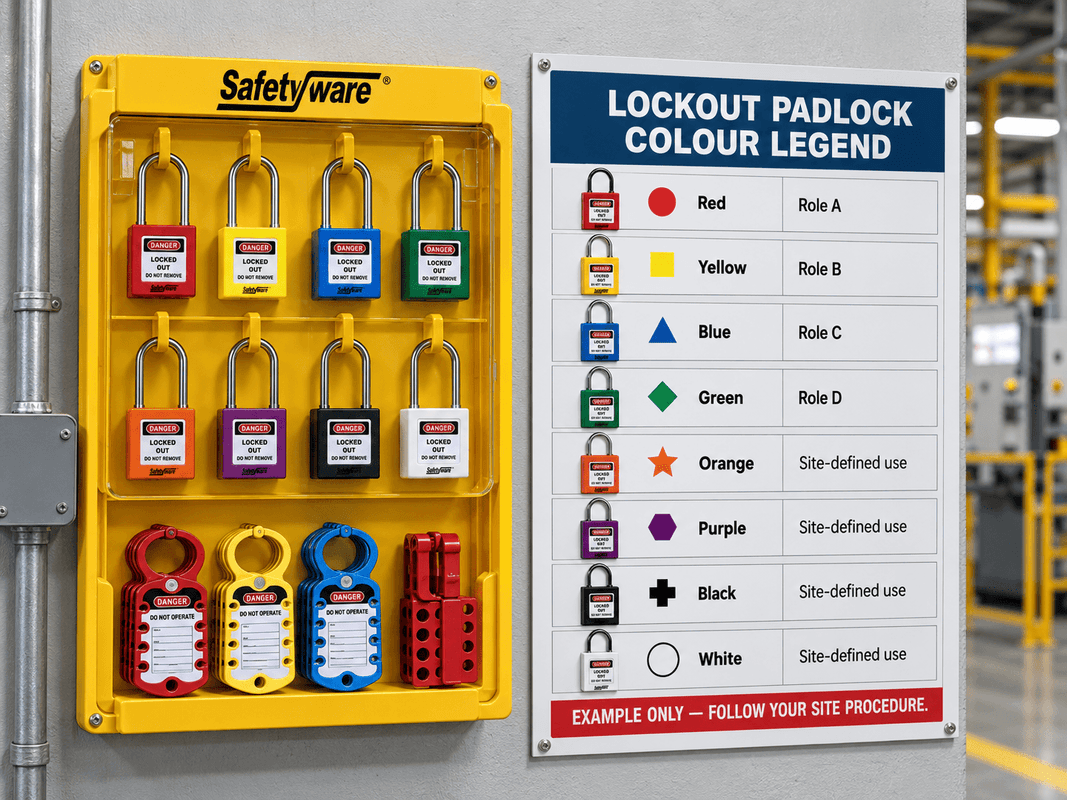
Common LOTO Padlock Colours and Site-Defined Uses
The table below lists examples that workplaces sometimes adopt. It does not create a legal or universal colour code.
| Padlock colour | Possible site-defined use | Important control point |
|---|---|---|
| Red | Personal danger lock for an authorised worker | The lock should identify its owner, and only the approved removal process should permit removal |
| Yellow | Department, affected-person or operational-control lock | Define who controls the key and when the lock may come off |
| Blue | Contractor, maintenance trade or equipment lock | Contractors must receive site-specific LOTO instructions before work starts |
| Green | Commissioning, mechanical work or an equipment-status lock | Do not use green to imply that equipment is safe unless the written legend says so |
| Orange | Shift-transfer, special-task or transition lock | A formal handover must keep protection continuous during shift changes |
| Purple | Special hazard, department or project lock | Post the colour legend where users issue and return locks |
| Black, white or grey | Supervisor, equipment, operations or another local role | Avoid meanings that overlap with personal locks or emergency controls |
Colour provides a quick visual cue. Nevertheless, it should support—not replace—personal identification, clear tags, controlled keys and a written procedure.
Build a colour system that workers can trust
First, choose colours only after mapping the people and tasks that need separate roles. Next, create one approved legend for the whole site. Then, apply that legend to procedures, training, permit forms, lock stations and contractor inductions.
For multi-site companies, use the same system where practical. If local rules differ, explain the variation before workers move between plants. Also consider workers with colour-vision deficiency. Text, numbers, shapes and lock labels can provide a second way to recognise each role.
What LOTO Tag Colours Mean
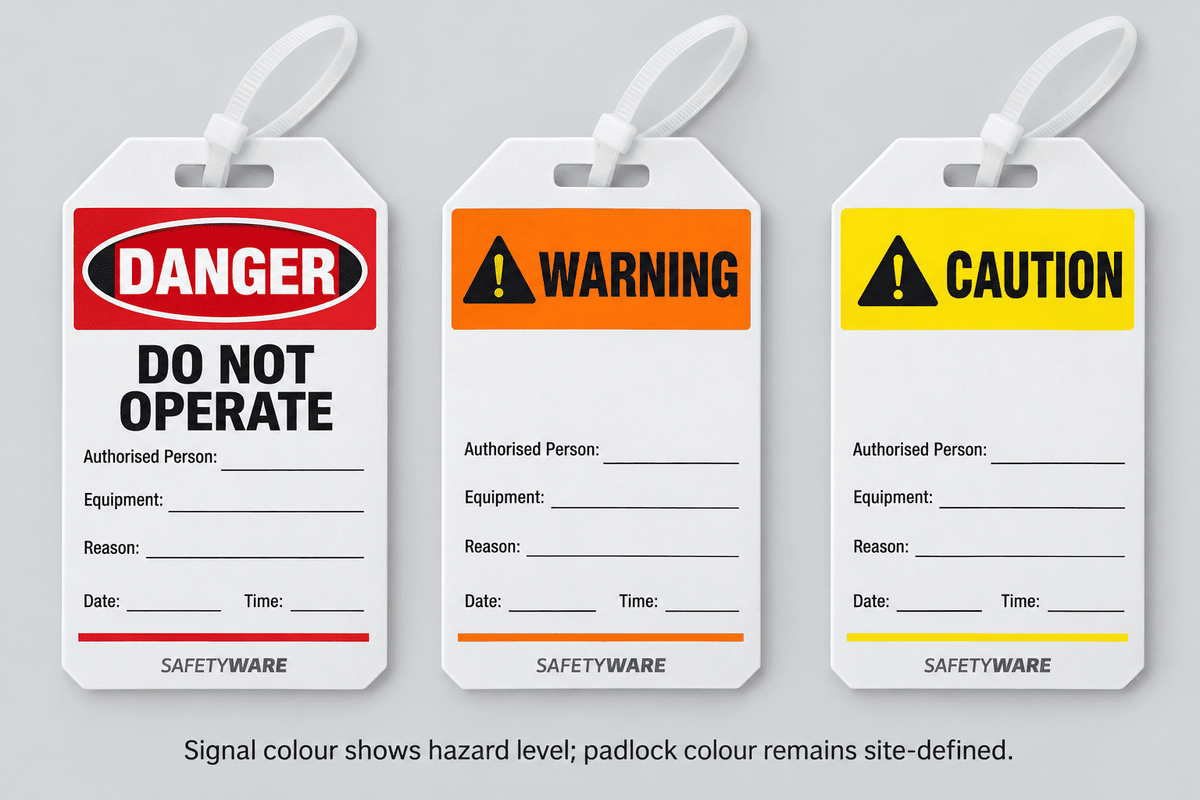
Padlock colours and tag signal colours serve different purposes. In the United States, OSHA’s accident-prevention tag rule does not mandate a specific colour for every tag. However, its non-mandatory colour recommendations link signal words with these colours:
| Signal word | Recommended colour | Intended message |
|---|---|---|
| DANGER | Red or mainly red | An immediate or major hazard that could cause death or serious injury |
| WARNING | Orange or mainly orange | A hazard level between Danger and Caution |
| CAUTION | Yellow or mainly yellow | A possible hazard or unsafe practice with a lower level of risk than Danger |
| BIOLOGICAL HAZARD | Fluorescent orange or orange-red | A biological hazard or potentially infectious material |
These signal colours help communicate hazard severity. Still, they do not assign ownership or job roles to LOTO padlocks. Furthermore, local sign standards may use different terms or layouts. Buyers should match tags to the site procedure and the law that applies at the workplace.
For energy control under OSHA 29 CFR 1910.147, tags must warn against hazardous conditions if someone energises the machine. Typical legends include “Do Not Start,” “Do Not Open,” “Do Not Close,” “Do Not Energise” or “Do Not Operate.”
What Information Should a Lockout Tag Show?
A useful tag communicates the restriction at a glance. At a minimum, it should match the site procedure and meet the applicable legal rules. Therefore, a practical tag normally includes:
- A clear signal word and instruction, such as DANGER — DO NOT OPERATE
- The name of the authorised person who applied it
- An employee number, department or contact detail where the procedure requires one
- The equipment or isolation-point reference
- The reason for the lockout
- The date and time
- A work-order or permit number, if used
- Space for a photograph, barcode or QR code only when the site system controls and maintains that information
Keep the critical warning large and easy to read. Although extra data can help, crowded text can hide the main message.
OSHA durability and attachment requirements
OSHA requires energy-control devices to withstand their expected workplace conditions. For example, a tag must remain legible when exposed to weather, wet conditions or a corrosive environment that the workplace can reasonably expect.
In addition, OSHA requires tag attachments to be non-reusable, hand-attachable, self-locking and non-releasable. Their minimum unlocking strength must equal at least 50 pounds, and their basic design must match an all-environment nylon cable tie. Employers should therefore buy the tag and attachment as part of one suitable system, rather than attaching a durable tag with weak string.
Lockout, Tagout and Other LOTO Devices
A reliable LOTO programme uses the right device for each isolation point.
Personal safety padlocks
An authorised worker attaches a personal lock to protect themselves. The lock should show the worker’s identity. Moreover, the key system should prevent one person from casually opening another person’s lock.
Keyed-different padlocks normally suit personal lockout because each lock has its own key. Keyed-alike sets may suit tightly controlled equipment or departmental applications. Meanwhile, master-key systems need strict written controls because misuse could defeat personal protection.
Lockout hasps
A hasp lets several workers place their personal padlocks on one isolation point. The equipment remains locked until each worker removes their own lock. Consequently, hasps support group work without asking people to share a lock or key.
Group lock boxes
For a complex job, an authorised person may place the keys from equipment-isolation locks inside a group lock box. Each exposed worker then applies a personal lock to the box. As a result, no one can reach the isolation keys until every personal lock has come off, subject to the approved group-lockout procedure.
Equipment-specific devices
Circuit breakers, electrical plugs, gate valves, ball valves and pneumatic fittings need devices that match their shape and size. Therefore, buyers should test fit before a full rollout. They should also confirm that each device holds the isolator securely in the required position.
Legal Requirements, Standards and Company Practice
LOTO programmes often refer to laws and standards in the same document. However, they do not carry the same legal weight.
| Source | What it does | Compliance status |
|---|---|---|
| Applicable workplace law or regulation | Creates enforceable employer and worker duties | Mandatory within its jurisdiction and scope |
| ANSI/ASSP Z244.1-2024 | Gives detailed guidance for controlling hazardous energy through lockout, tagout and risk-based alternative methods | Voluntary consensus standard unless a contract, authority or company rule adopts it |
| ISO 14118:2017 | Covers prevention of unexpected machinery start-up across energy types | Voluntary standard unless law, contract or company policy adopts it |
| Company LOTO procedure and colour legend | Turns legal and technical duties into site-specific steps, roles and visual controls | Mandatory within the organisation when properly issued; it does not replace the law |
United States
OSHA 29 CFR 1910.147 covers the control of hazardous energy during service and maintenance within its scope. In general, the employer must create an energy-control programme, use suitable procedures and devices, train workers, and carry out periodic inspections.
When an energy-isolating device can accept a lock, the procedure should use lockout unless the employer can show that tagout provides full employee protection under the rule. Moreover, OSHA requires employers to control stored energy and verify isolation before work starts.
For electrical work, 29 CFR 1910.333 adds requirements for de-energising, locking or tagging and verifying electrical circuits and equipment. Control switches or interlocks alone do not provide energy isolation.
Malaysia
Malaysia’s Occupational Safety and Health Act 1994, as amended and reprinted effective 1 June 2024, places broad duties on employers. These duties include providing safe plant and systems of work, safe arrangements for the use and operation of plant, and the information, instruction, training and supervision needed for safety.
The Act itself does not establish a universal padlock colour code. Therefore, Malaysian employers should base their written LOTO process on the plant risk assessment, machine instructions and applicable rules or approved guidance. DOSH Malaysia also publishes a nine-step LOTO infographic that reinforces the need to isolate and shut down machinery before maintenance or service.
Singapore
Singapore’s Workplace Safety and Health (General Provisions) Regulations require an occupier to establish and implement lockout procedures where unintended activation during inspection, cleaning, repair or maintenance could injure a person. The occupier must also ensure that relevant workers receive full instructions.
The procedure must isolate or disconnect energy sources, discharge stored energy and prevent accidental activation. However, the regulation does not create a universal padlock colour chart. Accordingly, each workplace must define and teach its colour system.
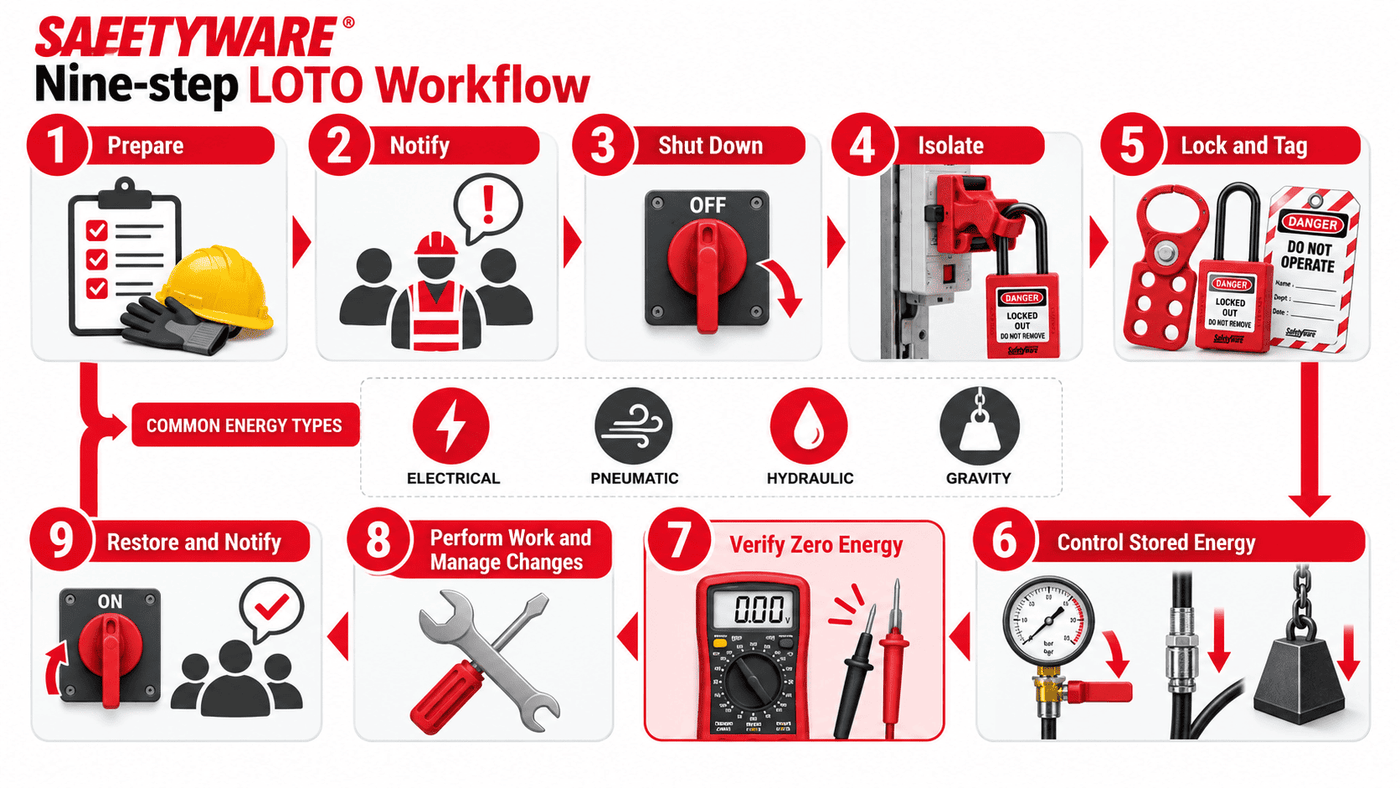
A Practical Nine-Step LOTO Process
The exact procedure must follow local law and the site’s written programme. Nevertheless, this sequence provides a useful planning framework:
- Prepare for shutdown. Identify the machine, tasks, energy sources, isolation points and affected people.
- Notify affected workers. Explain which equipment will stop, why it will stop and who controls the job.
- Shut down normally. Use the correct stopping sequence to avoid creating a new hazard.
- Isolate every energy source. Operate disconnects, valves, breakers or other true energy-isolating devices.
- Apply locks and tags. Each authorised worker applies the devices required by the procedure.
- Control stored energy. Bleed pressure, discharge capacitors, block raised parts, release springs and secure gravity hazards.
- Verify zero-energy state. Try the controls safely and use suitable test methods. Then return controls to neutral or off.
- Perform the work and control changes. Maintain protection through shift changes, group work and contractor handovers.
- Restore service safely. Inspect the area, confirm that people and tools are clear, remove devices under the authorised process, re-energise and notify affected workers.
Verification deserves special attention. A lock on the wrong breaker creates an appearance of safety without controlling the hazard. For this reason, the competent or authorised person must confirm the actual zero-energy state before anyone starts work.
Group LOTO, Shift Changes and Contractors
Complex work needs clear ownership. First, designate an authorised person to coordinate the isolation. Next, document every energy source and isolation point. Then, ensure that each exposed worker maintains personal protection under the group procedure.
During a shift change, the outgoing and incoming workers should follow a planned handover that keeps the equipment continuously protected. Similarly, host employers and contractors should exchange their energy-control procedures before work starts. They should resolve different colour codes, tag formats and removal rules during induction—not at the machine.
Common LOTO Mistakes
Even a well-stocked lockout station can fail when the process breaks down. Watch for these frequent errors:
- Using a push button, selector switch or software control as the only isolation point
- Locking one energy source while ignoring pressure, gravity, heat or stored electrical energy
- Treating a tag as a physical lock
- Sharing personal keys or using an uncontrolled master key
- Removing another worker’s lock without following the documented exception process
- Using ordinary padlocks for both lockers and energy control
- Relying on colour without a name, label or written legend
- Starting work before testing the zero-energy state
- Using a device that does not fit the breaker, valve or plug
- Allowing damaged, faded or unreadable tags to remain in service
- Failing to manage contractor or shift-change handovers
LOTO Purchasing and Programme Checklist
Before buying or expanding a system, safety and procurement teams should check the following points.
Procedure and risk controls
- Has the site listed every machine and hazardous energy source?
- Does each machine have a clear, current isolation procedure?
- Does the procedure define authorised, affected and other employees?
- Does the site explain every padlock colour in one approved legend?
- Does the programme cover group work, shift changes and contractors?
- Does it set a controlled process for exceptional lock removal?
Devices and identification
- Do electrical, valve, pneumatic and cable devices fit the actual isolation points?
- Are locks reserved only for energy control?
- Does each personal lock identify its owner?
- Can tags withstand the expected weather, moisture and chemicals?
- Do tag attachments meet applicable strength and one-time-use requirements?
- Do stations hold enough devices for planned shutdowns and peak maintenance work?
Training and assurance
- Have authorised employees received task-specific training?
- Have affected employees learned the purpose and limits of the LOTO system?
- Do contractors understand the host site’s procedure and colour code?
- Does the site inspect procedures and field practice at the required intervals?
- Do teams review incidents, near misses and equipment changes?
SAFETYWARE Products and Solutions
SAFETYWARE offers a broad Lockout & Tagout range for building or expanding a site system. Buyers should select products only after mapping the actual isolation points, user roles and key-control plan.
Padlocks, tags and group control
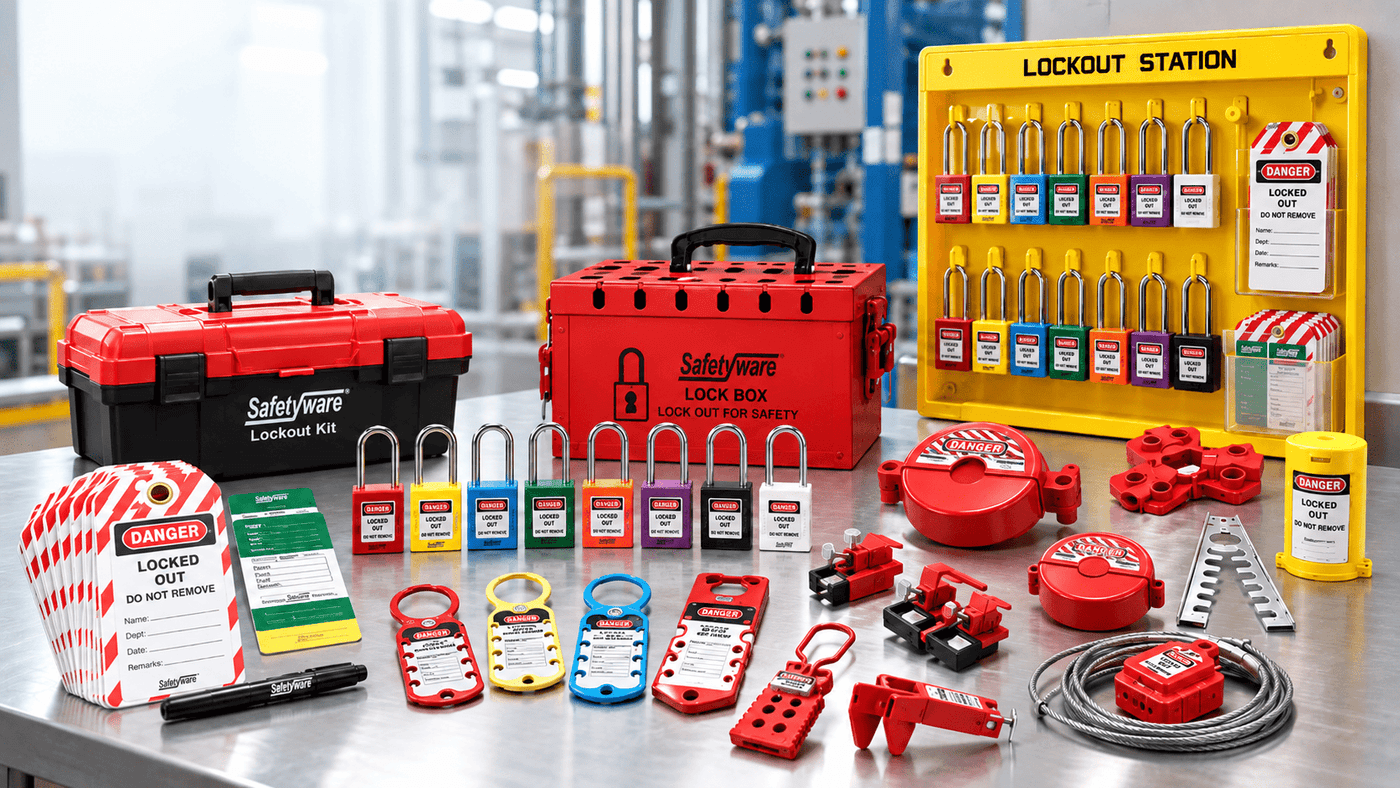
SAFETYWARE lockout padlocks and accessories include several shackle and colour options. Therefore, a site can build a visible role system while keeping identification and key control at the centre of the programme.
In addition, lockout tags and signage communicate the restriction, owner and reason for isolation. For multi-person tasks, lockout hasps let workers attach individual padlocks to a shared isolation point. Storage bags and boxes can also support organised group control and transport.
Devices for different energy sources
The electrical lockout range includes devices for breaker, plug, switch and control applications. Likewise, valve lockout devices support fluid-process isolation, while pneumatic lockout devices help control compressed-air connections.
However, the product must match the exact isolator. Buyers should confirm dimensions, material, environmental exposure, number of users and required padlock holes before ordering.
Kits and stations
Lockout kits and stations help teams store and issue commonly used devices. A fixed station can improve visibility in a workshop, while a portable kit can support field maintenance. Even so, the contents should reflect the site survey rather than a generic list.
SAFETYWARE can support product selection and quotations through its official enquiry form. For a sound result, share photos or dimensions of the isolation points, the required number of users and the site’s LOTO procedure during the review.
Conclusion
LOTO colours make a hazardous-energy programme easier to see, but colour alone cannot keep a worker safe. No universal padlock chart assigns one fixed meaning to every colour. Instead, each employer should create a clear site legend, standardise devices, identify lock owners and train every person who may encounter the system.
Most importantly, the team must isolate every energy source, control stored energy and verify the zero-energy state before work begins. When a written procedure, trained people and correctly fitted devices work together, LOTO becomes a dependable life-safety system rather than a collection of coloured locks.
Sources and References
Information checked on 16 September 2026.
- US OSHA — 29 CFR 1910.147, The control of hazardous energy
- US OSHA — 29 CFR 1910.145, Accident prevention signs and tags
- US OSHA — Appendix A to 1910.145, Recommended colour coding
- US OSHA — 29 CFR 1910.333, Selection and use of electrical work practices
- ASSP — ANSI/ASSP Z244.1-2024 overview
- ISO — ISO 14118:2017, Prevention of unexpected start-up
- Attorney General’s Chambers of Malaysia — Occupational Safety and Health Act 1994, reprint effective 1 June 2024
- DOSH Malaysia — Lockout Tagout infographic
- Singapore Statutes Online — Workplace Safety and Health (General Provisions) Regulations, regulation 16
- SAFETYWARE — Lockout & Tagout products
📞 Need More Information?
Looking for Full Range of LOTO supplies?
Explore SAFETYWARE’s safety shoes and workplace PPE range at
👉Safetyware Catalogs
Our safety specialists can help evaluate workplace hazards, recommend suitable safety helmets, and support compliance with Malaysia workplace safety requirements.
If you need a quotation, feel free to contact us at:
📩 Email: [email protected]
📞 Tel: WhatsApp Us