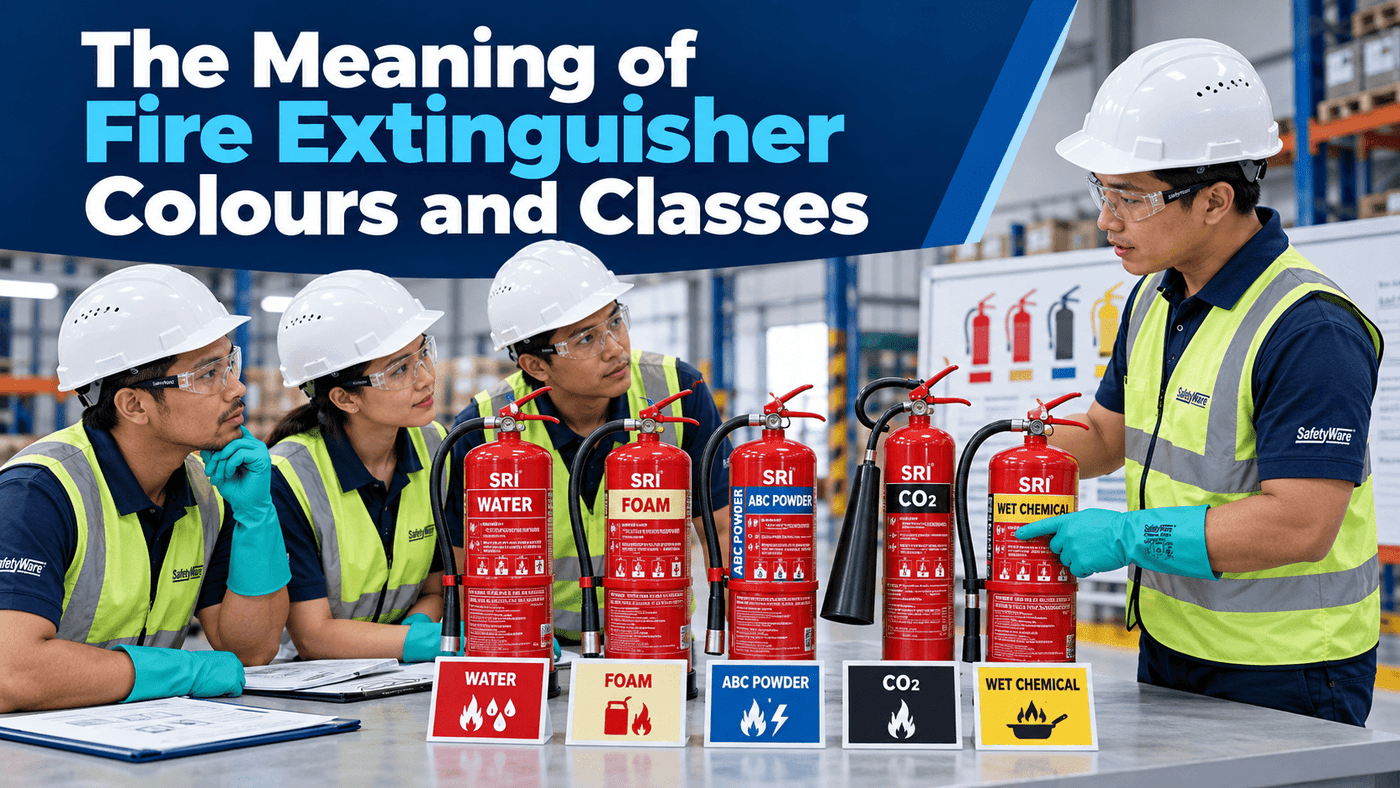
The colour panel on a fire extinguisher helps identify its extinguishing agent. The class marking tells you which fuel or hazard the unit has been tested or approved to tackle. These are connected, but they are not the same thing—and neither should be interpreted without reading the full label.
This distinction has become even more important. ISO 3941:2026, published on 21 January 2026, introduced a class for lithium-ion battery fires. Meanwhile, the North American system continues to use different meanings for some letters. An extinguisher marked “Class C” may refer to flammable gases in an ISO-style system but to energised electrical equipment in the United States.
For buyers, employers and safety managers, the practical rule is simple: identify the fuel and operating environment first, then select the approved extinguisher, rating, capacity, location and service plan. Do not choose by cylinder colour alone.
Safety note: Portable extinguishers are intended for an incipient or early-stage fire only, when the user has a clear escape route and has been trained under the site’s emergency plan. Raise the alarm, evacuate and call the emergency services when the fire is spreading, smoke or heat makes approach unsafe, the agent is uncertain, or the exit could be lost.
Fire extinguisher colour, class and rating: what is the difference?
| Marking | What it normally communicates | What the buyer should verify |
|---|---|---|
| Agent colour panel or band | The extinguishing medium, such as foam, powder, CO2 or wet chemical | Which national colour convention applies and whether the label is current and legible |
| Fire-class letter or pictogram | The fuel or hazard category for which the extinguisher is intended | Whether the class system is ISO/European, North American or another national system |
| Fire rating | The tested extinguishing capability for specified test fires | The exact approval standard, rating, model and certificate |
| Capacity | Quantity of agent, such as kg or litres | Whether the capacity and discharge characteristics suit the risk and placement |
| Approval and service label | Product conformity and maintenance status | Applicable national approval, current inspection, service contractor and next due date |
A blue panel may help you recognise a powder extinguisher in a UK-style colour system, but it does not prove that every powder formulation is appropriate for every Class A, B, C, D, electrical or battery hazard. The class marks, product rating, instructions and applicable approval remain decisive.
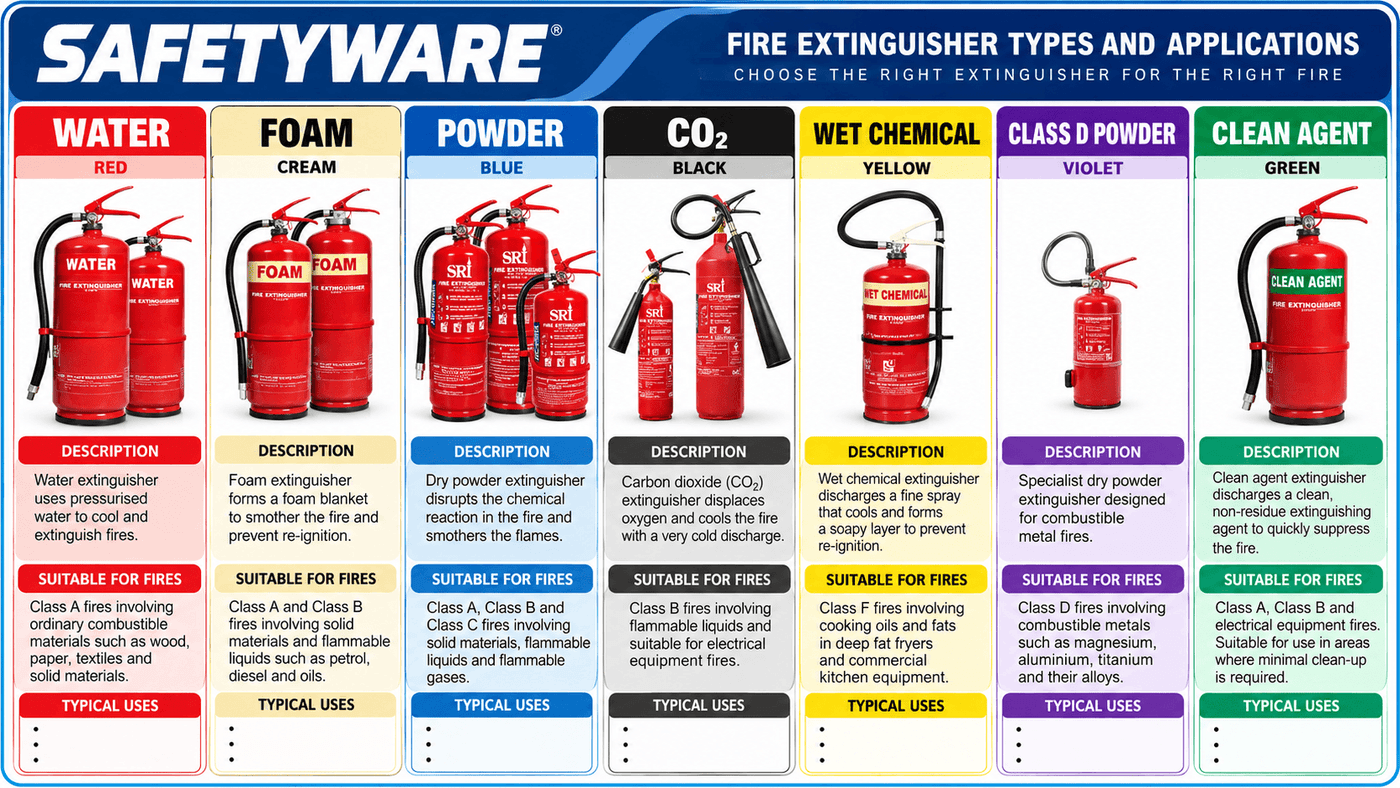
Common fire extinguisher colour codes
Modern UK-style extinguishers generally have a red body with a limited colour zone identifying the agent. London Fire Brigade guidance states that the UK colour zone may occupy up to 5% of the extinguisher body.
| Extinguishing agent | Common UK-style identification colour | Typical applications—subject to the unit’s rating |
|---|---|---|
| Water | Red | Class A ordinary combustibles |
| Foam | Pale cream | Class A and many Class B liquid risks |
| Dry powder | Blue | Multi-risk applications according to the powder formulation and rating |
| Carbon dioxide (CO2) | Black | Many Class B and energised electrical-equipment risks |
| Wet chemical | Canary yellow | Class F cooking-oil and fat fires; some units also carry a Class A rating |
| Class D powder | Signal violet | Specific combustible-metal risks, with agent matched to the metal |
| Clean agent | Green | Applications stated on the approved product label |
These colours are not globally universal. Some countries use different bands, labels, pictograms or legacy cylinder colours. Older extinguishers may also follow a previous full-body colour convention. Always read the complete label and check the governing national requirement rather than transferring a colour rule from another country.
Why extinguisher bodies are often red
Red makes fire equipment easy to locate and is widely associated with firefighting equipment. However, a red cylinder does not identify the agent. The colour panel, class pictograms, wording, approval label and nozzle or horn design provide the more specific information.
ISO fire classes: A, B, C, D, F and the new L
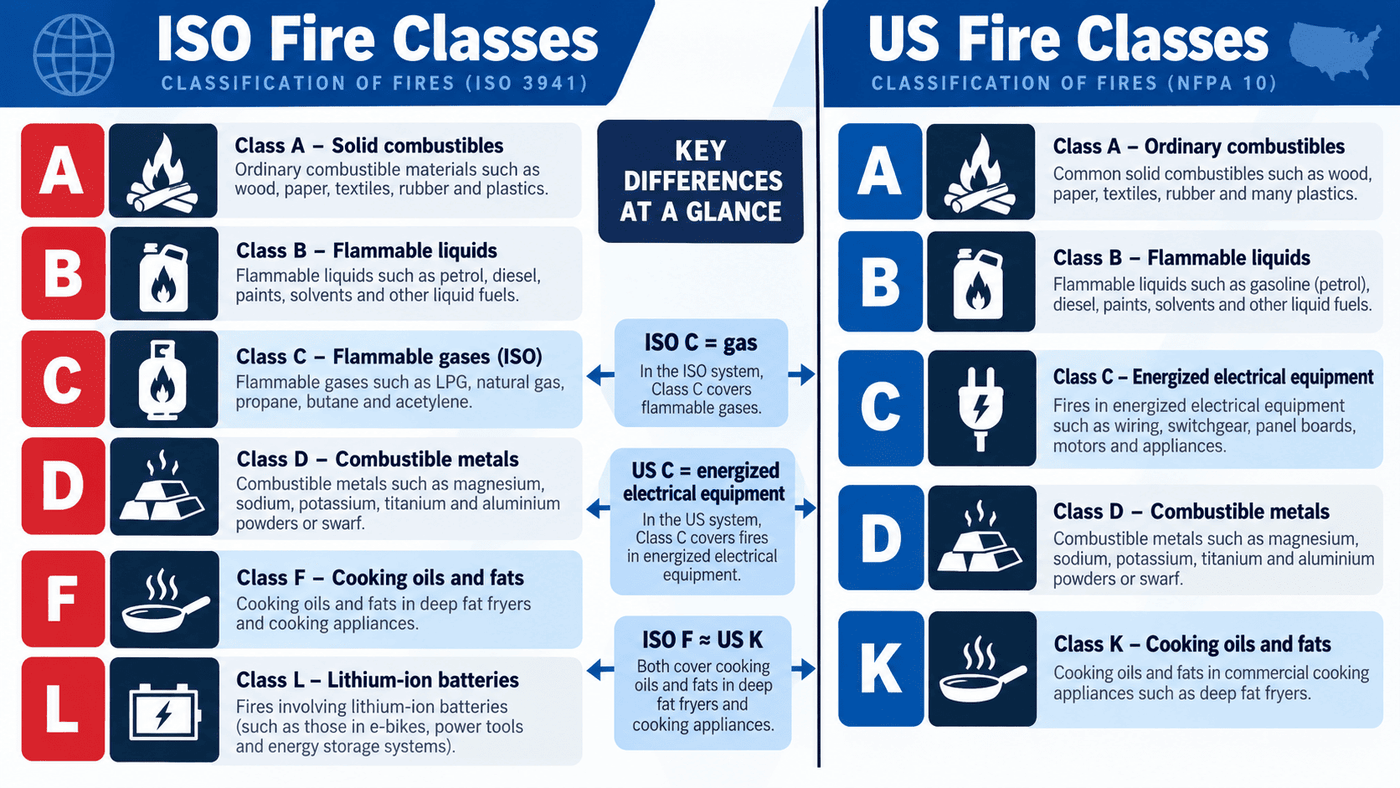
ISO 3941:2026 classifies fires by the nature of the fuel. It replaced ISO 3941:2007 and added a classification for lithium-ion battery fires. The public ISO preview lists Classes A, B, C, D, F and L.
| ISO-style class | Fuel or hazard category | Typical examples | Important selection point |
|---|---|---|---|
| A | Solid materials, usually organic, that may form glowing embers | Wood, paper, textiles and many plastics | Check the unit’s tested A rating, not merely the word “water” or “powder” |
| B | Liquids or liquefiable solids | Petrol, solvents, paint and some waxes | Avoid using an agent that spreads or reacts with the liquid |
| C | Gases | LPG, propane, butane and methane | Shut off the fuel supply when safe; uncontrolled gas release can re-ignite |
| D | Metals | Magnesium, sodium, potassium and other combustible metals | The specialist powder must match the particular metal and process |
| F | Cooking oils and fats | Deep-fat fryers and commercial cooking oils | Use an extinguisher specifically rated for Class F |
| L | Lithium-ion battery fires | Batteries and battery systems within the standard’s scope | Use a hazard-specific, approved solution; do not assume ABC or Class D suitability |
Electrical equipment is not a separate ISO fire class
ISO explains that its classification is based on the burning material, so it does not define a separate class for electrical risk. An energised panel can involve an underlying Class A or B fuel, but the agent must also be safe for use around the electrical voltage and equipment.
This differs from the US system, where Class C identifies a fire involving energised electrical equipment. That is one of the most important reasons not to read a class letter without knowing the system.
What is new about Class L?
ISO 3941:2026 added a classification for lithium-ion battery fires. This does not mean every extinguisher carrying a marketing reference to “lithium” is automatically suitable for every cell chemistry, battery size, state of charge or energy-storage installation.
Battery fire protection requires a scenario-specific assessment that considers thermal runaway, re-ignition, toxic and flammable gases, cooling, isolation, water runoff, location and emergency response. Buyers should require evidence that the exact product or system has been evaluated for the intended battery hazard under the applicable national rules and technical standard.
North American fire classes: why Class C and K are different
US OSHA defines the principal workplace classes differently:
| US class | Meaning in the North American system | Comparison with ISO-style terminology |
|---|---|---|
| A | Ordinary combustibles such as paper, wood, cloth and some plastics | Broadly similar to ISO Class A |
| B | Flammable or combustible liquids, gases, greases and similar materials | Combines hazards that may be split between ISO Classes B and C |
| C | Energised electrical equipment requiring a non-conductive medium | Not an ISO fire class; ISO classifies the underlying fuel |
| D | Combustible metals | Broadly similar in concept, but agent selection remains metal-specific |
| K | Cooking appliances involving vegetable or animal oils and fats | Comparable in purpose to ISO/European Class F |
An American ABC extinguisher and an extinguisher marked A/B/C in an ISO-style market may therefore communicate different class coverage. Procurement specifications should name the standard and market, not just the letters.
Which extinguisher agent is used for each hazard?
The following matrix is a starting point only. The exact model’s rating, instructions and national approval control the final choice.
| Agent | Commonly suitable when correctly rated | Key limitations to assess |
|---|---|---|
| Water | Class A solids | Generally unsuitable for flammable liquids, gases, metals, cooking oil and live electrical equipment |
| Foam | Class A and many Class B hazards | Electrical suitability must be explicitly tested and marked; compatibility with the liquid must be checked |
| ABC dry powder | Broad A/B/C coverage under the system stated on the label; some electrical-equipment applications | Residue can damage equipment and impair visibility; it is not a substitute for Class D, F/K or battery-specific protection |
| CO2 | Many Class B liquid and energised electrical-equipment risks | Limited cooling can permit re-ignition; discharge and oxygen displacement require consideration, especially in small spaces |
| Wet chemical | Class F or K cooking oils and fats; some products also have an A rating | Intended mainly for the specific cooking-oil hazard stated on the label |
| Class D powder | Specific combustible metals | One formulation may not suit every metal; never improvise with water or a general ABC unit |
| Battery-specific agent or system | The battery hazard stated in its verified test evidence | Suitability depends on chemistry, scale, installation and re-ignition control; “lithium” claims require technical evidence |
Never infer suitability from the nozzle or colour alone
A CO2 horn, powder hose or wet-chemical lance may support identification, but components can vary by model. Read the operating instructions, fire-class pictograms, rating, approval, service status and safety warnings before use.
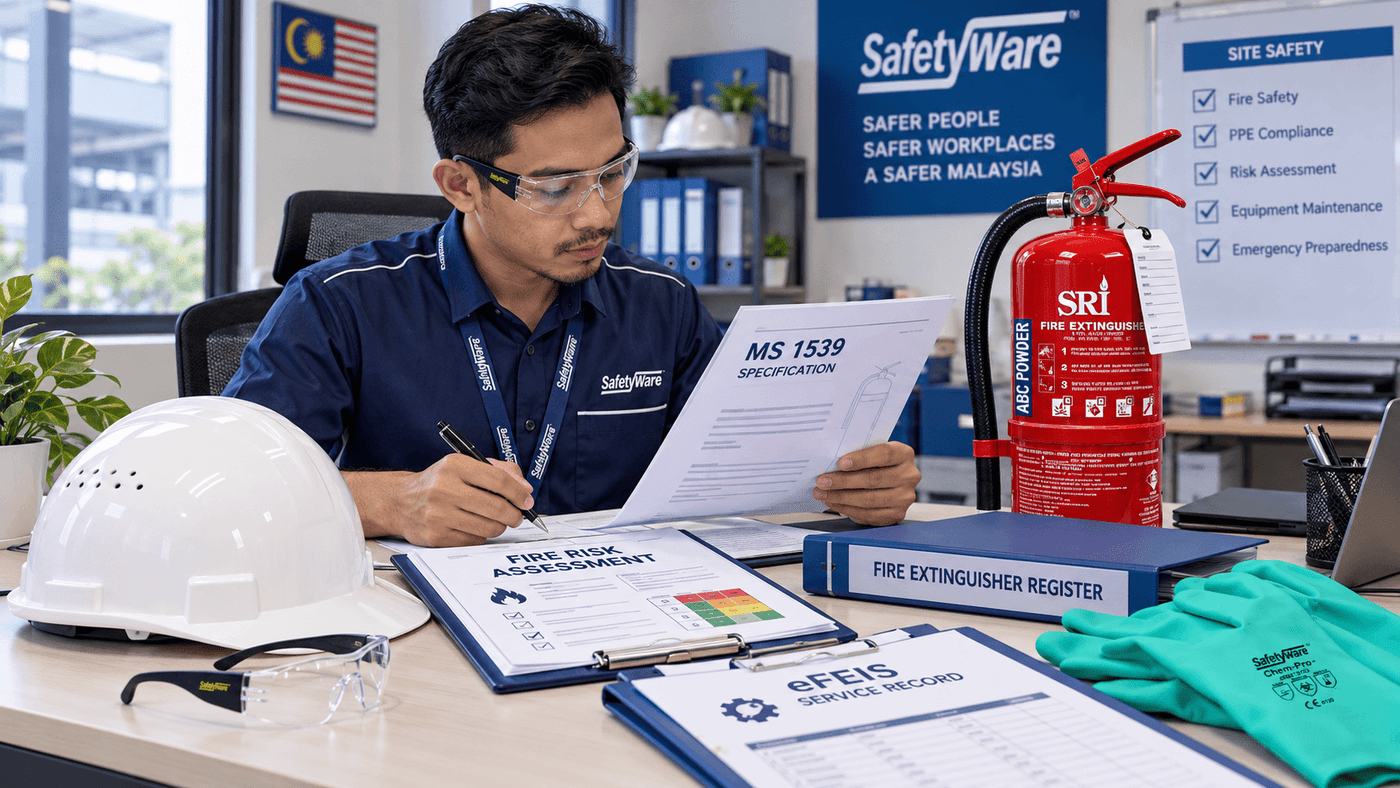
Malaysia: MS 1539 and BOMBA eFEIS
For Malaysia, extinguisher selection and servicing should be checked against the current requirements applied by the Fire and Rescue Department of Malaysia (JBPM/BOMBA), the building or fire-certificate context and the relevant Malaysian Standards.
The official JBPM eFEIS FAQ explains that eFEIS is the department’s electronic system for portable fire-extinguisher inspection. It lists dry powder, CO2, water, foam and wet-chemical units and refers to UBBL 1984, the applicable Fire Services fee regulations and MS 1539.
The MS 1539 series separates several functions:
- MS 1539-1:2018 covers construction and testing methodology.
- MS 1539 Part 3 addresses selection and installation.
- MS 1539 Part 4 addresses maintenance.
- MS 1539-5:2014 covers extinguishers for Class F fires.
Legal requirement versus standard: A Malaysian Standard defines technical requirements and good practice; it does not by itself replace legal duties, BOMBA conditions, approved plans or fire-certificate requirements. The competent fire-safety assessor, BOMBA requirements and the applicable approval route should determine what a specific premises needs.
Workplace selection checklist
Hazard and class
- List each credible fuel: solids, liquids, gases, metals, cooking oils and batteries.
- Identify energised electrical equipment and the operating voltage.
- Confirm the class system and national standard used on the label.
- Consider mixed hazards and the possibility of re-ignition.
- Obtain specialist advice for combustible metals and lithium-ion batteries.
Product and approval
- Verify the exact model, agent, capacity, fire rating and temperature range.
- Check the current certificate, approval mark and product-label evidence required locally.
- Confirm the agent is compatible with nearby chemicals, equipment and food or clean areas.
- Review residue, visibility, toxicity, pressure and confined-space implications.
- Ensure replacement units are equivalent to the approved fire-protection plan.
Siting and access
- Select locations from the fire-risk assessment and applicable installation standard.
- Keep units visible, identified, unobstructed and on the escape side of the hazard.
- Verify travel distances, mounting method, signage and protection against impact or weather.
- Do not place a user where the fire can block the only exit.
- Account for workplace layout changes, stored goods and vehicle movements.
Inspection, maintenance and training
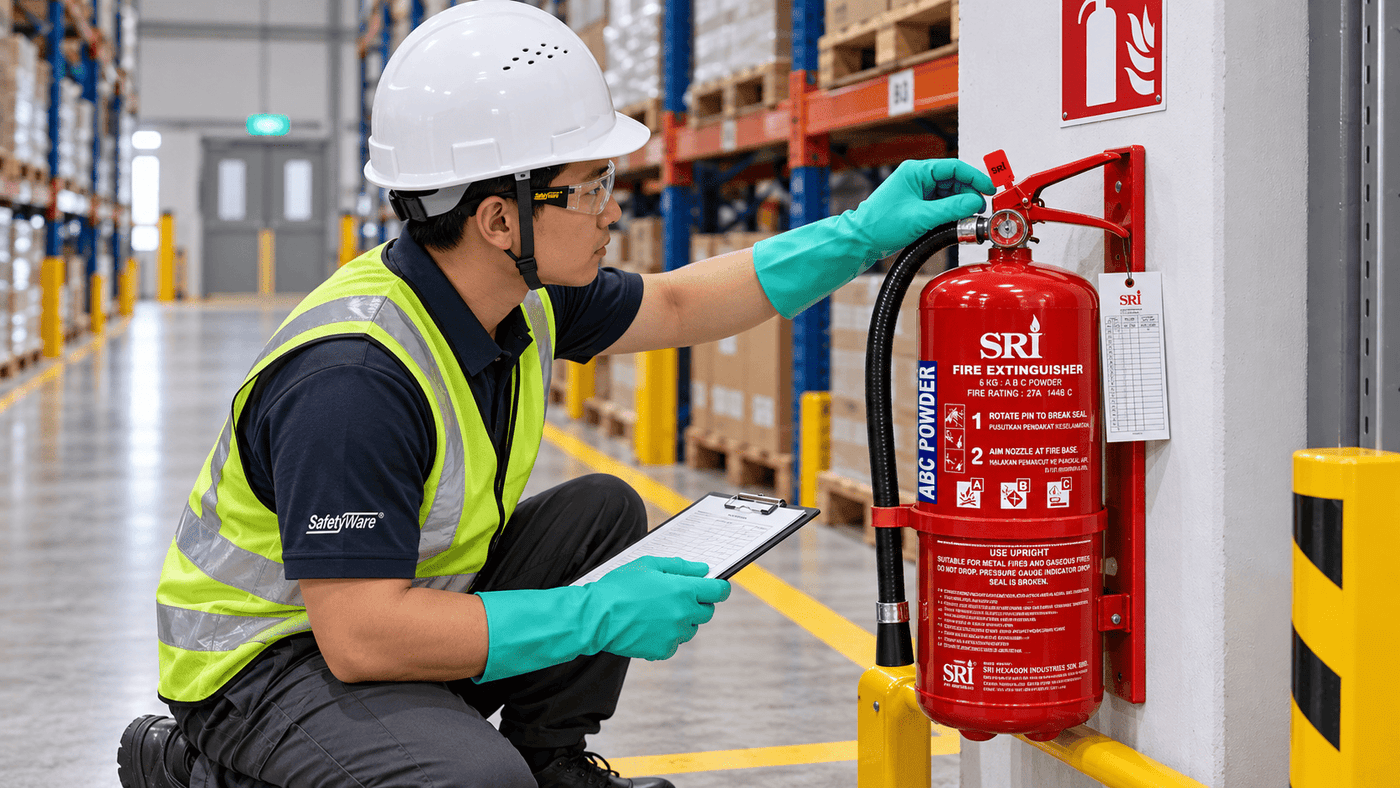
- Record serial number, location, model, rating, service status and next due date.
- Check pressure indicator where fitted, pin, seal, hose, horn, cylinder and label.
- Use the competent or registered service route required by the jurisdiction.
- Train employees on alarm, evacuation, extinguisher limits and the site emergency plan.
- Replace or service any discharged, damaged, corroded, obstructed or overdue unit.
Common mistakes to avoid
- Choosing by colour only. Colour codes vary and identify the agent, not complete suitability.
- Assuming class letters are universal. ISO Class C is gas; US Class C is energised electrical equipment.
- Calling electricity a universal Class E. Some markets use E informally or nationally, but ISO 3941 does not define an electrical fire class.
- Treating ABC powder as universal. It does not automatically cover metal, cooking-oil or battery fires.
- Using Class D powder on every lithium hazard. Combustible lithium metal and lithium-ion batteries are not the same scenario.
- Buying capacity without a rating. Kilograms or litres do not replace tested fire performance.
- Ignoring residue and re-ignition. An agent may suppress flame but create contamination or insufficient cooling.
- Blocking the equipment. A compliant unit is ineffective behind stock, furniture or a locked obstruction.
- Missing training and an escape plan. Employees need to know when not to fight the fire.
- Allowing obsolete labels or service records. A faded class mark or expired service status creates uncertainty during an emergency.
SAFETYWARE Products and Solutions
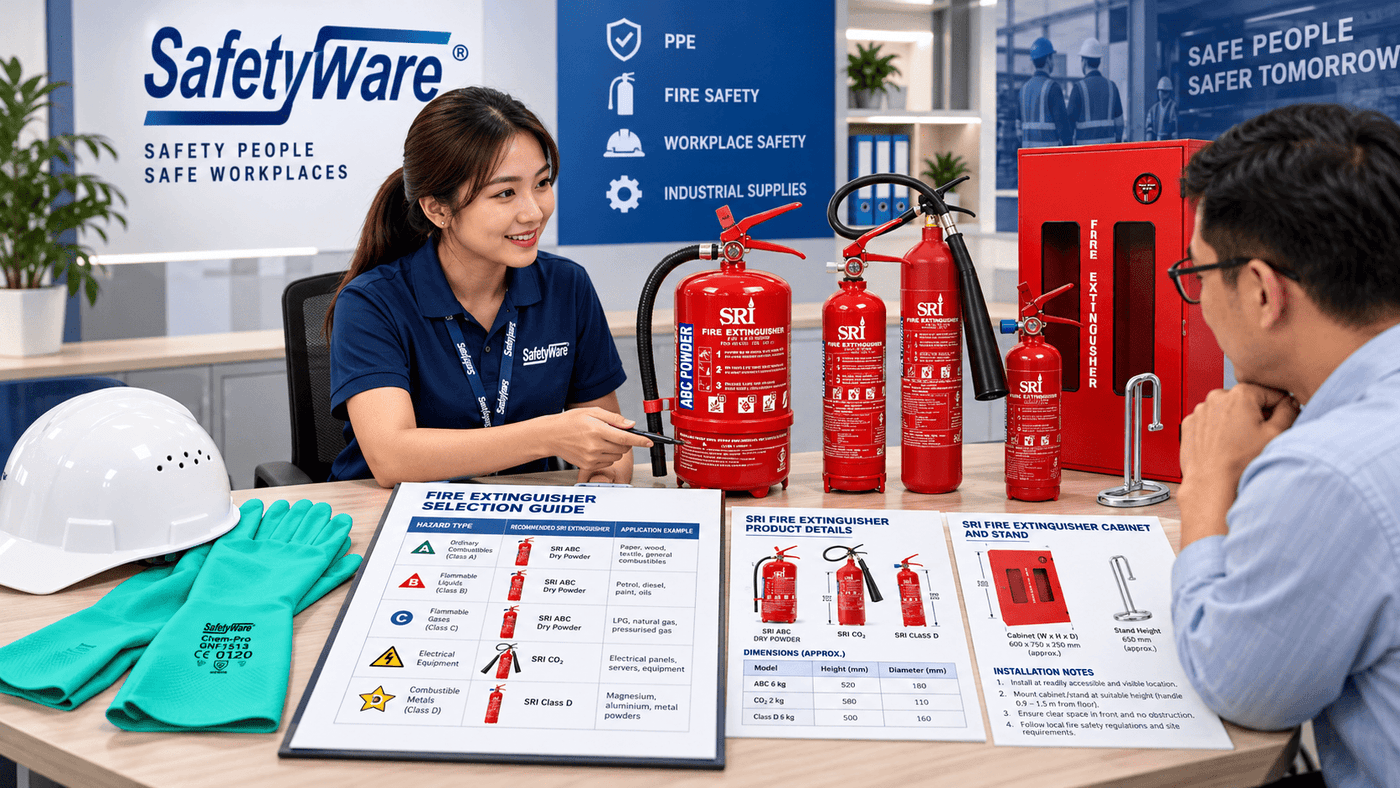
SAFETYWARE’s official Fire Extinguishers and Accessories category provides options for general workplace, electrical-equipment and specialist metal-fire planning. Selection should begin with the site hazard, class system and applicable approval—not with price or cylinder size alone.
Relevant official product pages include:
- SRI ABC Dry Powder Fire Extinguishers in 1 kg, 2 kg, 4 kg, 6 kg and 9 kg options. The page identifies ABC powder coverage for ordinary-combustible, flammable-liquid and flammable-gas classes in the referenced market system, plus electrical-fire use. Confirm the exact rating, approval and suitability for the installation.
- SRI Carbon Dioxide (CO2) Fire Extinguishers in listed 2 kg and 5 kg options. CO2 is relevant where flammable-liquid or electrical-equipment risks and residue sensitivity are important, subject to the product rating and site assessment.
- SRI Class D Fire Extinguisher for specified combustible-metal hazards. Buyers should disclose the exact metal, process, quantity and environment so the extinguishing powder can be technically reviewed.
- SAFETYWARE Fire Extinguisher Stand for single or double placement arrangements. Confirm extinguisher size, stability, visibility and whether a wall bracket or cabinet is more appropriate.
- SRI Fire Extinguisher Cabinet for equipment protection where access remains immediate and the cabinet suits the extinguisher dimensions and environment.
For a project enquiry, provide SAFETYWARE with the premises type, country, fuel hazards, electrical and battery risks, proposed locations, required standard, existing fire-protection plan, quantities and service expectations. This allows the product, rating, mounting and inspection needs to be reviewed together. Current availability and project suitability should be reconfirmed through the SAFETYWARE enquiry form.
Conclusion
Fire-extinguisher colours are identification aids, not a complete selection system. A cream panel commonly indicates foam, blue powder, black CO2 and yellow wet chemical in a UK-style scheme—but the model’s fire classes, rating, instructions, approval and service status determine what it can actually do.
The class letters must also be read in context. ISO 3941:2026 uses A, B, C, D, F and the new L class, and it does not create a separate electrical class. The United States uses C for energised electrical equipment and K for cooking oils and fats. Malaysia then adds its own MS 1539, BOMBA and eFEIS requirements.
Start with a fire-risk assessment, name the applicable standard and jurisdiction, require model-specific evidence, position the unit for safe access, and maintain and train for it. That approach is far more reliable than choosing an extinguisher by colour or an “ABC” label alone.
Sources and references
- International Organization for Standardization, ISO 3941:2026 — Classification of fires
- ISO Online Browsing Platform, ISO 3941:2026 preview
- London Fire Brigade, Guidance Note 8 — Fire extinguishers
- US Occupational Safety and Health Administration, 29 CFR 1910.155 — Fire-protection definitions
- US Occupational Safety and Health Administration, 29 CFR 1910.157 — Portable fire extinguishers
- Fire and Rescue Department of Malaysia, eFEIS FAQ
- Department of Standards Malaysia, MS 1539-1:2018
- SAFETYWARE, Fire Extinguishers and Accessories
- SAFETYWARE, SRI ABC Dry Powder Fire Extinguishers
- SAFETYWARE, SRI Carbon Dioxide Fire Extinguishers
- SAFETYWARE, SRI Class D Fire Extinguisher
Standards, regulatory guidance and official product pages were checked on 23 October 2026. Confirm the current national requirements, exact product approval and competent fire-safety advice before purchasing, installing or using an extinguisher.
📞 Need More Information?
Looking for Certified Fire Extinguisher?
Explore SAFETYWARE’s safety shoes and workplace PPE range at
👉Safetyware Catalogs
Our safety specialists can help evaluate workplace hazards, recommend suitable safety helmets, and support compliance with Malaysia workplace safety requirements.
If you need a quotation, feel free to contact us at:
📩 Email: [email protected]
📞 Tel: WhatsApp Us