

Workplace accidents in Malaysia cost far more than the immediate human toll. 📉
DOSH data consistently shows that manufacturing, construction, and oil & gas account for the majority of fatalities and permanent disabilities each year.
Behind most preventable incidents is one common issue:
👉 Workers and supervisors were either not trained or trained inadequately.

EHS (Environmental, Health and Safety) training in Malaysia is both a legal obligation and a strategic investment. Under the Occupational Safety and Health Act 1994 (OSHA 1994), employers are required to provide sufficient information, instruction, training, and supervision to ensure the safety and health of their employees. Failure to comply exposes employers to DOSH enforcement action, fines of up to RM 50,000, and — in the case of fatalities — criminal prosecution.
This guide explains what EHS training Malaysian employers are legally required to provide, which certifications carry DOSH recognition, how HRDC claimability works, and how to decide between public training programmes and customised in-house delivery — with an introduction to Safetyware Academy, one of Malaysia’s leading DOSH-approved and HRDC-accredited training providers.
Why EHS Training Is Not Optional in Malaysia
The Legal Foundation: OSHA 1994
Section 15(2)(c) of the Occupational Safety and Health Act 1994 places a clear duty on every employer to provide, for persons at work, “such information, instruction, training and supervision as is necessary to ensure, so far as is practicable, the safety and health at work of his employees.”
This is not a passive duty — DOSH officers actively inspect training records during site visits. If a worker is involved in an incident and can demonstrate they received no relevant safety training, the employer’s liability exposure increases significantly. Negligence in training is a compounding factor in prosecution.
Beyond OSHA 1994, specific regulations mandate training for particular roles and activities:
- OSH (Use and Standards of Exposure of Chemicals Hazardous to Health) Regulations 2000 (USECHH): Employers must train workers who work with hazardous chemicals on safe handling, storage, and emergency response
- OSH (Noise Exposure) Regulations 2019: Workers in hearing conservation programmes must receive audiometric testing and training on hearing protection
- Construction Industry Development Board (CIDB) regulations: All construction workers must hold a valid CIDB Green Card (basic safety training) before entering a construction site
- DOSH Working at Height guidelines: Competent persons must be appointed and trained for work at height operations
The Business Case Beyond Compliance
The legal argument is compelling enough, but the business case for systematic EHS training is equally strong. Research across industries consistently shows:
✅ Companies with structured safety training programmes report significantly fewer lost-time
injuries
💰 Insurance premiums for workman’s compensation are reduced where training
records demonstrate proactive risk management
🌍 International clients and multinationals — particularly in the electronics, automotive, and oil
and gas sectors — routinely audit their Malaysian suppliers’ EHS training programmes as
part of vendor qualification
🏭 ESG (Environmental, Social and Governance) reporting obligations for listed companies and
their supply chains now include workforce safety training as a measurable disclosure
metric

Who Needs EHS Training in Malaysia — and What Type?
The right training depends on the worker’s role, the hazards present in their work environment, and — for certain positions — specific DOSH certification requirements. Here is a practical overview:
- Roles with Mandatory DOSH Certification
- Safety and Health Officer (SHO): Companies with more than 100 employees (or in a scheduled industry with 40 or more employees under the OSH Act) must appoint a registered SHO. SHOs must hold a recognised degree or diploma in occupational safety and health, or complete the DOSH-accredited SHO course.
- Occupational Safety and Health Coordinator (OSH-C): Companies that do not meet the SHO threshold but still have safety responsibilities are required to appoint a trained OSH Coordinator. The OSH-C certification is a 3-day DOSH-accredited programme — one of the most widely attended safety certifications in Malaysia. Safetyware Academy is a DOSH-approved provider of the OSH-C programme. Know More
- Competent Persons (specific tasks): DOSH regulations require trained and assessed “competent persons” to supervise or conduct specific high-risk tasks including confined space entry, working at height, lifting and rigging operations, and scaffolding erection.
Roles Requiring Task-Specific Training
1. All workers — regardless of seniority — whose tasks expose them to specific hazards require training matched to those hazards. This includes:
- Workers handling hazardous chemicals (USECHH training)
- Workers in noise-exposed areas (hearing conservation programme)
- Workers operating machinery, cranes, or forklifts
- Workers in confined spaces (confined space attendant and entry team)
- Workers performing hot work (welding, cutting, grinding)
- Workers in first aid roles (designated first aiders under OSHA)
- Fire wardens and emergency response team members
2. Supervisors and Managers
Safety obligation does not sit only with frontline workers. Supervisors, production managers, and facility managers need training to fulfil their duty to enforce safe work practices, conduct safety observations, and respond to incidents. Management-level EHS training — including audit skills, incident investigation, and safety culture — is increasingly specified in ISO 45001 certification requirements and multinational client audits.
The EHS Training Course Landscape: What Safetyware Academy Offers
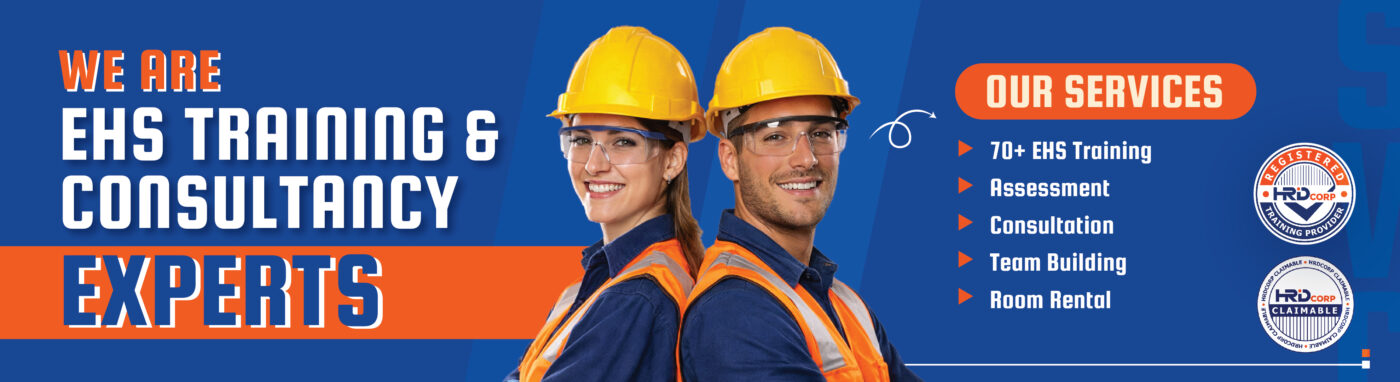
Safetyware Academy is the training and consultancy division of Safetyware Group, Malaysia’s leading PPE manufacturer and safety solutions provider. Established in 2011, Safetyware Academy is both a DOSH-approved training provider and an HRDC (Human Resource Development Corporation) accredited provider — meaning courses are eligible for HRD Corp levy claims.
Training is delivered through two channels: public training (scheduled, open-enrolment programmes at Safetyware facilities) and in-house training (delivered at the client’s premises, customised to the client’s industry, site conditions, and workforce profile).
OSH Certification Programmes
Occupational Safety and Health Coordinator (OSH-C) — 3 Days The cornerstone certification for companies required to appoint an OSH Coordinator. Covers OSHA 2022 requirements, hazard identification and risk assessment (HIRARC), developing safety policies, accident investigation, emergency preparedness, and workplace safety inspections. Certified by DOSH.
Target audience: OSH Coordinators (required by law for eligible workplaces), safety officers in training, supervisors with safety responsibilities.
Safety and Health Officer (SHO) Competency Enhancement Refresher and competency enhancement programmes for registered SHOs maintaining their DOSH registration.
Hazard-Specific Safety Training
🔍 Hazard Identification, Risk Assessment and Risk Control (HIRARC) Practical, hands-on training in conducting workplace HIRARC — the foundation of any OSH management system. Participants learn to identify hazards, assess risk likelihood and severity, and select appropriate controls in the hierarchy of controls framework. Essential for anyone involved in DOSH or ISO 45001 audits.
🧪 Chemical Handling and Storage (USECHH) Aligned with the USECHH Regulations 2000. Covers chemical hazard identification, safe handling and storage procedures, PPE selection for chemical environments, emergency spill response, and regulatory record-keeping. Directly applicable to manufacturing, laboratory, petrochemical, and agricultural environments.
🚧 Confined Space Awareness and Entry Covers the legal definition of confined spaces under OSHA, the permit-to-enter system, atmospheric testing requirements, rescue procedures, and the roles of the competent person, attendant, and entry team. Applicable to construction, manufacturing, oil and gas, and utilities sectors.
🪜 Working at Height Safety Addresses DOSH guidelines on working at height, the selection and use of fall protection equipment (harnesses, lanyards, anchor systems), scaffold inspection, mobile elevated work platform (MEWP) safety, and rescue from height. Essential for construction, facilities management, and telecommunications tower teams.
🔊 Noise at Work and Hearing Conservation Aligned with the OSH (Noise Exposure) Regulations 2019. Covers noise measurement, TWA calculation, engineering and administrative controls, selection and fitting of hearing protection, and audiometric testing requirements. Required for companies implementing a hearing conservation programme.
💪 Ergonomics and Manual Handling Addresses musculoskeletal disorder (MSD) risk factors, ergonomic assessment methods (REBA, RULA), workstation design, manual handling techniques, and administrative controls for reducing repetitive strain and back injuries. Relevant across manufacturing, logistics, healthcare, and office environments.
Emergency Response and First Aid
❤️ Basic Occupational First Aid (BOFA) / First Aid and CPR Covers primary and secondary patient assessment, CPR (with AED), choking, bleeding control, burns, fractures, and emergency transport. Meets the OSHA 1994 requirement for designated first aiders (1 first aider per 100 employees minimum). HRD Corp claimable.
🔥 Fire Warden and Fire Fighting Training Covers fire triangle theory, fire classification, fire extinguisher selection and use (practical component with live fire extinguisher training), evacuation procedures, and the role of the fire warden. Required for all workplaces under BOMBA (Fire and Rescue Department) guidelines and OSHA 1994 emergency preparedness requirements.
🚨 Emergency Response Team (ERT) Training Advanced emergency response training for designated ERT members, covering search and rescue, first aid in emergency scenarios, fire suppression, and coordination with BOMBA and DOSH during emergency incidents.
Environmental and Sustainability (ESG) Training
As ESG reporting becomes a listing requirement on Bursa Malaysia and a procurement condition for multinational clients, Safetyware Academy’s environmental and ESG training programmes have grown rapidly in demand:
🌍 Environmental Awareness and ISO 14001 Introduction Overview of environmental legislation in Malaysia (Environmental Quality Act 1974), ISO 14001 Environmental Management System requirements, significant aspect identification, waste management, and environmental emergency response.
📊 ESG Fundamentals for Malaysian Businesses Covers the ESG framework as applied to Bursa Malaysia Main and ACE Market listing requirements, Sustainability Reporting standards (GRI, MSCI), carbon footprint basics, and ESG data collection and disclosure for annual reports.
🌿 Carbon Literacy and Greenhouse Gas (GHG) Accounting Introduction to carbon accounting frameworks (GHG Protocol Scope 1/2/3), carbon reduction target setting, and Malaysian carbon market developments (Bursa Carbon Exchange).
Management Systems Auditing
📑 ISO 45001 Internal Auditor Training Prepares participants to plan, conduct, and report on internal audits of Occupational Health and Safety Management Systems. Covers ISO 45001 clause requirements, audit evidence gathering, non-conformance writing, and CAPA follow-up. Required for companies seeking ISO 45001 certification.
📑 ISO 14001 Internal Auditor Training Equivalent programme for Environmental Management Systems.

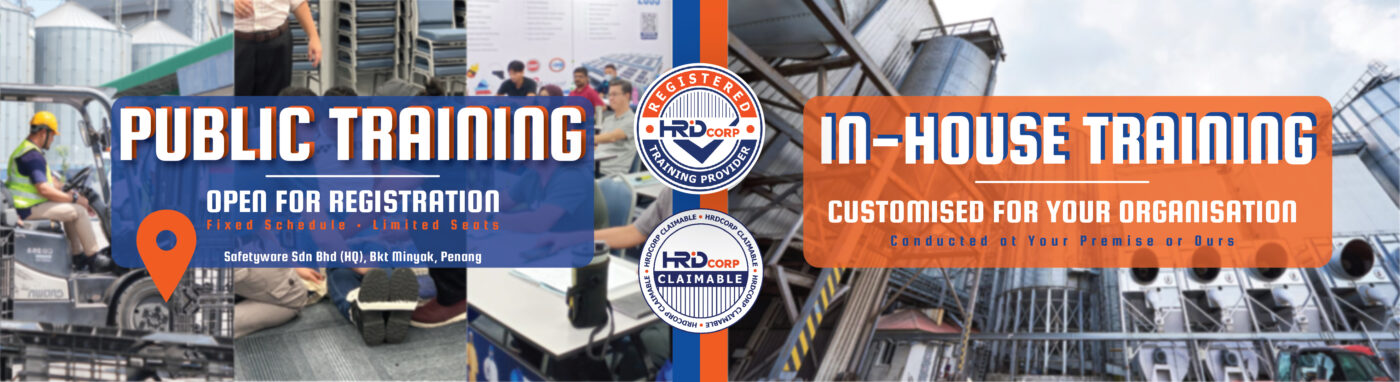
Public Training vs In-House Training: Which Is Right for You?
| Factor | Public Training | In-House Training |
| Cost per participant | Lower (shared cost) | Higher per head, but lower total for large groups |
| Scheduling | Fixed calendar | Flexible — scheduled around your operations |
| Content customisation | Standardised curriculum | Fully customised to your industry, site, hazards |
| Minimum group size | Individual enrolment | Typically minimum 15–20 participants |
| Networking | Cross-industry peer learning | Team cohesion, shared organisational context |
| Best for | 1–5 employees needing certification | Whole departments, new site onboarding, mass training |
Safetyware Academy’s recommendation: For statutory certifications (OSH-C, BOFA) where individuals need a DOSH-recognised certificate, public training is the most efficient route. For hazard-specific operational training — chemical handling, confined space, fire warden — in-house delivery customised to your actual site conditions and chemicals used produces better knowledge retention and practical application.

HRDC (HRD Corp) Claimability — Reducing Your Training Cost to Zero
All Safetyware Academy programmes are registered with HRD Corp (Human Resource Development Corporation) and eligible for HRD Corp levy claims. This means that Malaysian employers who contribute to the HRD levy can claim back 100% of approved training costs — effectively making EHS training free for levy-contributing companies.
The levy contribution rate for employers with 10 or more employees is 1% of monthly wages. Many companies contribute year after year without fully claiming their entitlement. Safetyware Academy’s training coordinators can assist with the full HRD Corp claim process, from SBL-Khas application to post-training claim submission.

EHS Consultancy Services: Beyond the Classroom
Training closes the knowledge gap — but many organisations also need expert support to build and maintain the systems and documentation frameworks that sustain compliance. Safetyware Academy’s consultancy arm offers:
📊 HIRARC Development and Review
Expert facilitators conduct systematic hazard identification walks and document a fully compliant HIRARC register aligned with OSHA 1994 and ISO 45001 requirements.
📘OSH Management System (OSHMS) Development
Building from scratch or upgrading an existing system to meet ISO 45001 or DOSH OSHMS guidelines — covering policy, objectives, legal register, hazard register, SOP development, and audit schedules.
⚠️ Incident Investigation and Reporting
DOSH-compliant incident investigation using root cause analysis methodologies (5-Why, Fault Tree Analysis). Preparation of the Form 6 / JKKP 6 accident report required for DOSH notification within 7 days of an incident.
🔍 DOSH Audit Preparation and Gap Assessment
Pre-audit gap analysis against OSHA 1994 and relevant regulations, with a prioritised corrective action plan and documentation review. Many clients engage this service ahead of DOSH scheduled audits or following an improvement notice.
📈 Workplace Safety Climate Survey and Behavioural Safety Programme
Assessment of safety culture maturity, leading indicator measurement, and behavioural observation programmes to shift organisations from reactive to proactive safety management.
Ready to build a legally compliant, DOSH-ready workforce?
Feel free to contact us for more details
Whatsapp : 012-4987882
Email : [email protected]