
Cut Resistant & Impact Resistant Gloves:
The Complete Selection Guide
From EN 388:2016 cut level A to F and ANSI/ISEA 105 A1–A9, understand what the standards mean, which material protects best, and how to select the right glove for every cut and impact hazard.
Why Cut-Resistant Gloves Matter
Hand injuries are the most frequently reported workplace injuries across Malaysia’s manufacturing, construction, oil and gas, metal fabrication, glass handling, food processing, and logistics sectors. Lacerations and cuts account for the majority of these incidents — and the overwhelming majority are preventable with the correct hand protection.
The challenge for safety professionals is not simply selecting “a cut-resistant glove.” The performance of cut-resistant gloves varies enormously across different hazard types, blade geometries, materials, and coatings. A glove rated for cut protection against a smooth blade may fail against a serrated or glass edge — and vice versa. Selecting the wrong glove provides false assurance and leaves workers exposed.
This guide covers everything you need to know: the EN 388:2016 and ANSI/ISEA 105 standards, the range of cut-resistant materials available, impact protection for crush and struck-by hazards, and how to match glove performance to your specific workplace risks.
🛡 Key Principle: Match the Glove to the Hazard
Higher cut level does not always mean better. A very high cut-level glove may compromise dexterity for fine assembly work — creating a different risk. The correct approach is to use HIRARC (Hazard Identification, Risk Assessment, and Risk Control) to identify the precise cut hazard, then select the minimum-adequate glove that allows the task to be performed safely and efficiently.
Understanding EN 388:2016 — The European Cut Protection Standard
EN 388 is the European standard for protective gloves against mechanical risks. The 2016 revision (EN 388:2016+A1:2018) significantly changed how cut resistance is measured and communicated. Understanding the difference between the old and new standard is essential for accurate glove selection.
The EN 388:2016 Pictogram — Six Parameters Explained
The EN 388 pictogram displays up to six performance levels. Each position in the code corresponds to a specific test:
EN 388:2016 — The Six-Parameter Pictogram
Old Coup Test vs. New TDM Test
The original EN 388 cut test (the Coup test) had a significant flaw: very high-cut-resistance materials such as HPPE and steel fibers would dull the rotating blade, inflating scores artificially. The 2016 revision introduced the ISO 13997 TDM (tomodynamometer) test — a straight-blade cut test that measures the force in Newtons required to cut through the glove material at a fixed cut length. When the Coup test is not reliable (the blade dulls), the glove receives an “X” in the Coup position, and the ISO TDM result (A–F) applies instead.
When comparing gloves, always check both the EN 388 pictogram position and whether an ISO cut level (A–F) is stated. A glove marked “4X4XF” has excellent abrasion, tear, and puncture resistance, an unreliable Coup score (X), and the highest ISO cut resistance (F).
⚠ Common Mistake: Comparing Old vs New Scores
A Coup test score of “5” (the maximum under the old system) does not equal EN 388 ISO level E or F. The Coup test at level 5 corresponds roughly to only 15–20 N — which is ISO level D at best. Always use the ISO 13997 (TDM) letter rating (A–F) for accurate cut level comparison.
Understanding ANSI/ISEA 105 — The American Cut Level Standard
The American National Standard ANSI/ISEA 105 uses a different scale: cut levels A1 through A9. The ANSI standard uses the TDM test (the same blade-draw method as EN 388:2016 ISO cut) and reports results in grams rather than Newtons. This makes it easier to compare across the two systems — though not directly interchangeable.
ANSI/ISEA 105 Cut Levels A1–A9 vs. EN 388 ISO Cut Level Equivalents
Cut-Resistant Materials: What’s Inside the Glove?
The cut resistance of a glove is determined primarily by its liner material. Different fibers offer different trade-offs between cut resistance, comfort, dexterity, weight, and cost. Understanding these materials helps safety professionals make informed decisions beyond simply reading the label.
Cut-Resistant Liner Material Hierarchy
Blended Liners
Most modern cut-resistant gloves use blended yarns — combining two or more fibers to optimize performance. A common blend is HPPE + glass fiber + elastane, which provides cut resistance (HPPE), enhanced cut rating (glass), and stretch for dexterity (elastane). Steel + HPPE blends combine the puncture resistance of steel with the comfort of HPPE.
Glove Coating Comparison: Nitrile, PU, Sandy Nitrile & More
The palm coating on a cut-resistant glove serves three critical functions: grip, abrasion resistance, and barrier protection. The right coating depends on the work environment and the nature of the handling task.
Polyurethane (PU)
Ultra-thin coating offering maximum tactile sensitivity and precision grip on dry surfaces. Best for fine assembly, electronics, and clean environments.
Best dexterityNitrile Foam
Open-cell foam structure provides excellent wet and dry grip by channelling liquid away from the contact surface. The most versatile coating for general industrial use.
Best all-round gripSandy Nitrile
Nitrile coating embedded with abrasive particles for extreme grip in oily, wet, or greasy conditions. Ideal for metal fabrication, oil and gas, and automotive.
Best oily gripFull Nitrile / Latex
Complete palm and finger coverage providing maximum abrasion resistance and liquid barrier. Heavier feel but best for heavy-duty wet handling and food processing.
Best abrasionImpact Resistant Gloves: Protection from Crushing and Struck-By Hazards
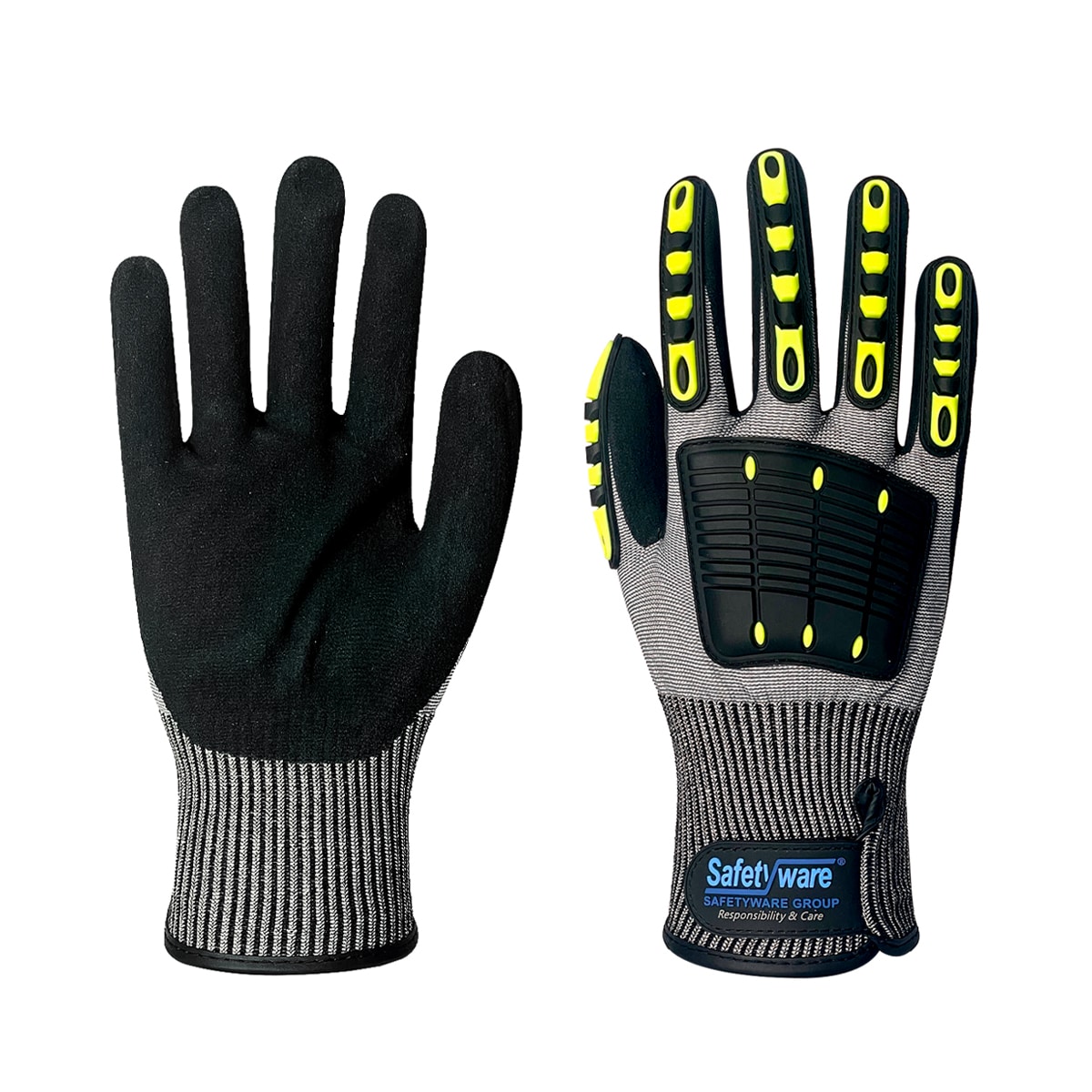
In industries such as oil and gas, mining, construction, and heavy engineering, the hazard is not only sharp edges — blunt force trauma from heavy objects, struck-by incidents, and crushing between machinery components also cause severe hand injuries. Impact-resistant gloves address this hazard by incorporating thermoplastic rubber (TPR) back-of-hand impact guards over a cut-resistant liner.
Anatomy of an Impact-Resistant Cut-Resistant Glove
When to Specify Impact-Resistant Gloves
- Oil and gas — drilling, maintenance, pinch point and dropped object risks
- Mining and quarrying — rock handling, equipment maintenance
- Heavy construction — formwork, rebar, scaffolding, concrete work
- Subsea and offshore — pipe handling, deck operations
- Heavy engineering — where crush and impact coexist with cut hazards
Selecting the Right Cut Level for Your Industry
| Industry / Task | Typical Hazard | Recommended ANSI Level | EN 388 ISO Approx. |
|---|---|---|---|
| Electronics / PCB assembly | Light sharp component edges | A2–A3 | B |
| Food processing (non-blade) | Metal edges, packaging | A3–A4 | C |
| Automotive assembly | Sheet metal burrs, stampings | A4–A5 | C–D |
| Glass handling | Glass sheet edges | A5–A6 | D–E |
| Metal fabrication / grinding | Sharp metal, grinding sparks | A4–A6 | C–E |
| Meat processing / abattoir | Blade-intensive, repetitive cuts | A7–A9 | F |
| Oil & gas / offshore | Cut + impact (pipe, equipment) | A5–A6 + Impact | D–E + EN 13594 |
| Demolition / recycling | Scrap metal, jagged edges | A6–A8 | E–F |
| Waste management | Mixed debris, needles | A6+ puncture-rated | E–F + P4 |
Safetyware’s Cut Resistant Glove Range
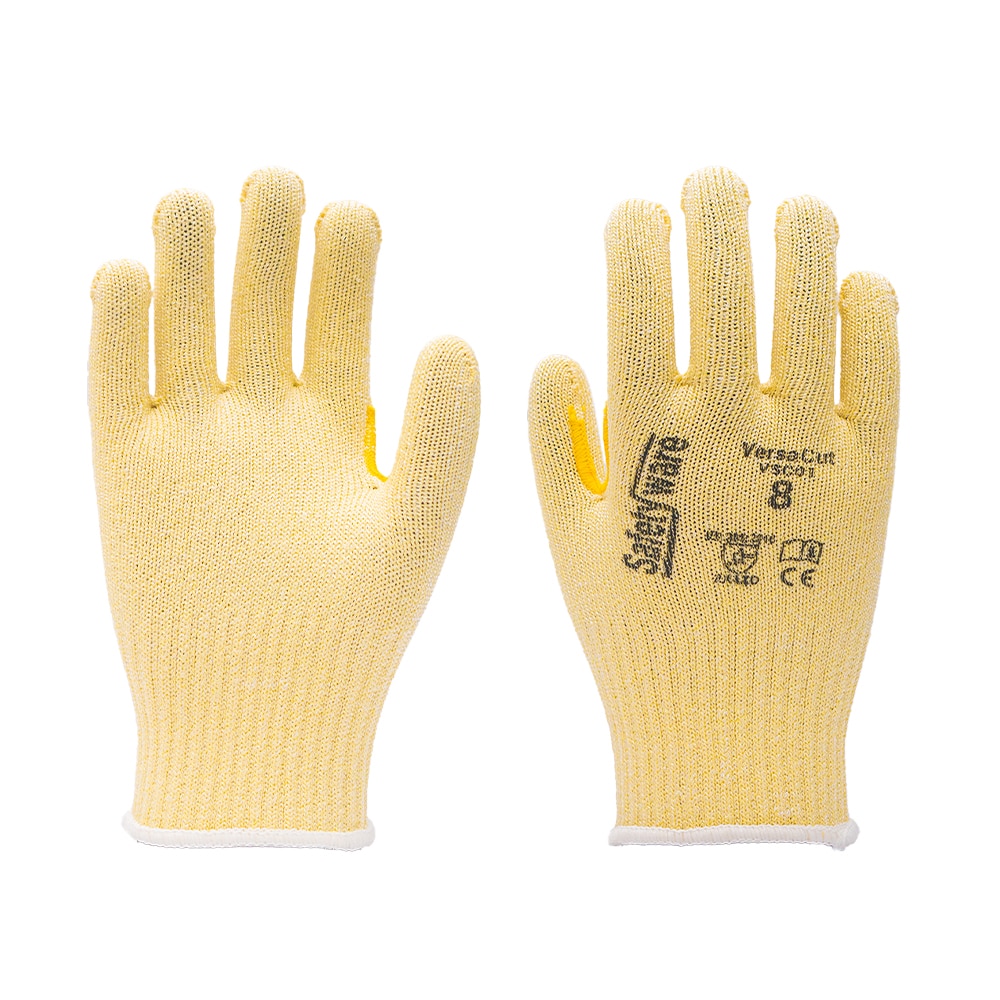
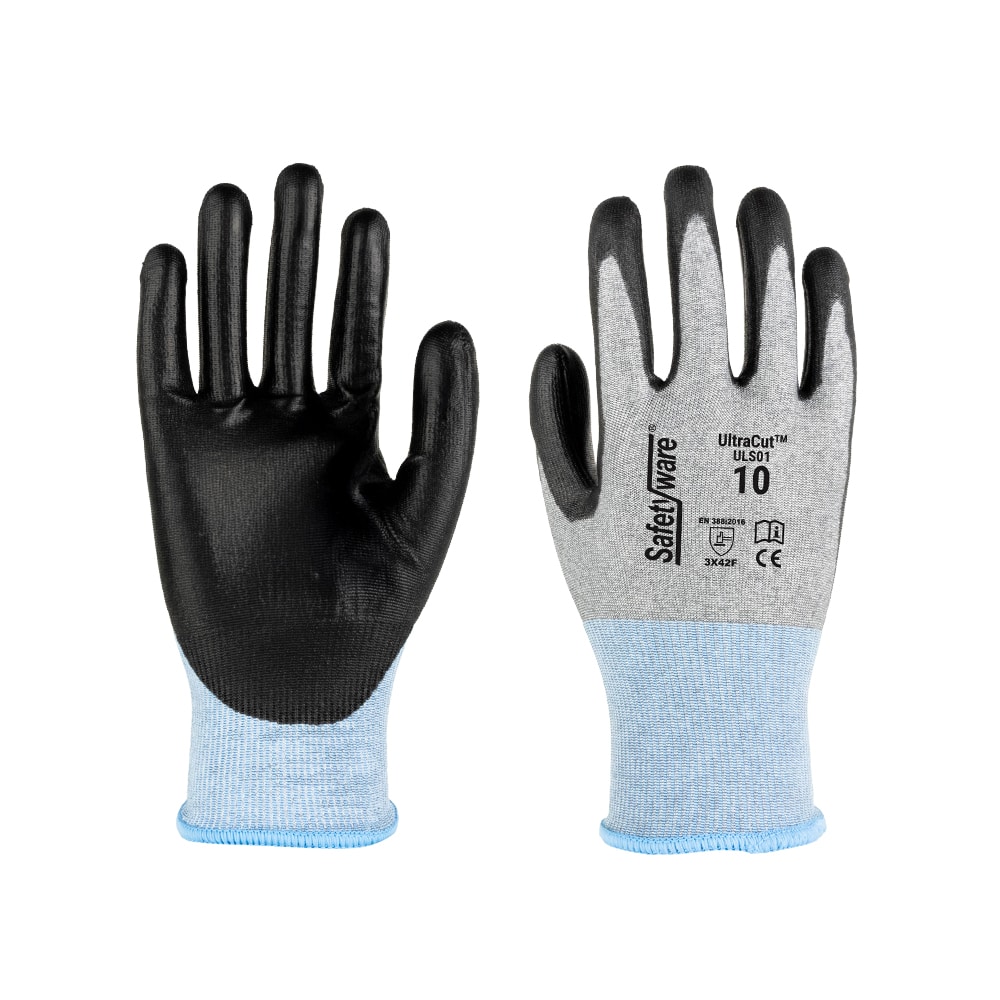
Safetyware Group offers one of the most comprehensive ranges of cut resistant and impact resistant gloves available in Malaysia, Singapore, Thailand, Australia, and across the APAC region. Our range spans every cut level from A2 to A9, in a variety of liner blends, coatings, and with or without impact TPR back-of-hand protection.



⚠ Important: Dexterity vs. Protection Trade-Off
Higher cut level gloves (A7–A9 / EN F) typically use heavier liner constructions that reduce tactile sensitivity and dexterity. For precision assembly or tasks requiring fine finger movement, a mid-range cut level glove (A4–A5) with a thin, well-coated liner often represents the optimal balance. Safetyware’s team can help you identify the right specification for each task in your facility.
Glove Care, Inspection, and Replacement
Cut-resistant gloves lose protection over time through abrasion of the liner fibers, washing, and physical damage. Key inspection and care principles include:
- Visual inspection before each use — check for cuts, punctures, abrasion thinning, and coating delamination
- Washing guidance — most coated gloves can be machine washed at 40°C in a mesh laundry bag; check manufacturer guidance as some coatings are wash-sensitive
- Replacement triggers — any visible cut through the liner, significant coating wear exposing liner, or gloves that have sustained a cut incident should be replaced immediately
- Buddy checks — in high-risk environments, implement a system where supervisors inspect gloves at the start of each shift
- Record keeping — document glove issue, inspection, and replacement as part of PPE management records required under OSHA 1994
Safetyware’s 40-Year Glove Heritage
Safetyware Group’s deep expertise in hand protection is rooted in over four decades of glove manufacturing and supply history — making us one of the most experienced glove specialists in Southeast Asia.
Leader Rubber Products Sdn. Bhd. founded in Penang — the first locally-owned rubber gloves factory in Malaysia, establishing our manufacturing heritage in hand protection.
Multifocal Corporation Sdn. Bhd. established, expanding the glove portfolio and building distribution capability across Malaysia and the region.
Safetyware Group Berhad listed on Bursa Malaysia — a public company with regional operations across Malaysia, Singapore, Thailand, Australia, and APAC.
One of the most comprehensive glove ranges in the APAC region — cut, chemical, thermal, disposable, general-purpose, leather, and ESD gloves for every industry and hazard.
Frequently Asked Questions: Cut Resistant Gloves
The 2016 revision added the ISO 13997 TDM (blade-draw) cut test alongside the original Coup (rotating blade) test. The Coup test gave inflated results for high-cut-resistance materials, as the blade dulled against HPPE and steel fibers. The TDM test uses a straight blade drawn at constant speed and measures the force in Newtons required to cut through the material — a more reliable and consistent measurement. Gloves now show both results: a numeric Coup score (or “X” if unreliable) and an ISO TDM letter (A–F). Always use the ISO letter for accurate comparison of cut-resistant gloves.
Sheet metal work typically involves a combination of sharp edges, burrs, and stamping processes. For light sheet metal handling (thin gauge, minimal burrs), ANSI A3–A4 (EN 388 ISO level C) is typically appropriate. For heavier gauge metal, cut edge handling, or coil steel work, A5–A6 (EN D–E) is recommended. For operations involving steel coil or demolition-type scrap metal, A7 or above may be warranted. A site-specific HIRARC assessment should confirm the appropriate level.
Most coated cut-resistant gloves can be machine washed at 40°C in a mesh laundry bag. However, some coatings (particularly full-latex coats) may degrade with repeated washing. Always check the manufacturer’s care instructions. After washing, gloves should be air-dried rather than tumble-dried to preserve the liner structure. Importantly, even after careful washing, gloves that have been cut through — no matter how small — must be replaced, as the liner is compromised.
TPR stands for Thermoplastic Rubber — a moulded rubber compound applied to the back-of-hand and finger dorsal surfaces of impact-resistant gloves. TPR acts as a shock-absorbing layer that distributes and absorbs the energy from blunt impacts, crushing forces, and struck-by incidents. When tested to EN 13594, Level 1 gloves transmit no more than 7 kN of force, while Level 2 gloves transmit no more than 4 kN. TPR is combined with cut-resistant liners (HPPE, Dyneema) in dual-hazard gloves for oil and gas, mining, and heavy construction applications.
Under OSHA 1994 (Act 514) and the Factories and Machinery Act, employers are required to conduct HIRARC and provide appropriate PPE where hazards cannot be controlled by engineering or administrative controls. Where hand cutting hazards are identified, appropriate cut-resistant gloves are part of the required PPE provision. DOSH enforcement has increased significantly following the OSHA Amendment Act 2022, with greater scrutiny of PPE specification and documentation requirements.
Safetyware Group maintains one of the most comprehensive glove inventories in Malaysia and Singapore, with stock across cut levels A2 through A9, in multiple liner materials, coatings, and sizes. Our team can assist with glove selection based on your HIRARC, arrange samples for worker trials, and provide DOSH-compliant documentation. Contact Safetyware Group to arrange a glove assessment with our hand protection specialists.
No. No glove is cut-proof under all conditions. The correct term is “cut-resistant” — meaning the glove provides a measured level of resistance to cutting force as defined by the EN 388 or ANSI/ISEA 105 standards. Even the highest-rated gloves (ANSI A9 / EN F) can be penetrated by sufficient force, a sufficiently sharp edge, or by sustained contact with a cutting surface. This is why HIRARC is essential: the glove must be matched to the specific hazard, and administrative controls (safe work procedures, training) must supplement PPE.